Why Dual Form Nails Point Upwards (and Why the Free Edge Gets So Thick)
Why do dual form nails point upwards, and why can the free edge become so thick? I made exactly this mistake when I was still learning to work with dual forms, and I kept the photographs of the set.
In this article I explain what went wrong, using the same set I show in my video on the official YouTube channel, Radina Ignatova | Nail Academy. The set used an arched dual form on relatively flat natural nail beds, at a very short length. The aim is that you do not repeat the same mistake.
Quick Answer: Why Do Dual Form Nails Point Upwards?
Because the dual form has too much internal space for the short length you are creating. On relatively flat nail beds, an arched dual form filed down to a very short nail leaves negative space underneath, which becomes a stress area and a negative apex. The nail then ends higher up instead of finishing where it should, and the free edge becomes very thick. For short lengths, choose a form with a minimum product reserve, and always consider what the form was designed to create and the length you want, not only whether it fits or has a nice shape.
From Artistic Touch – Nail Training Academy
Want to learn this properly? The Ultimate Dual Forms
The Ultimate Dual Forms teaches how to assess natural nails, understand form architecture and control your application.
Watch the Video: Why Dual Form Nails Point Upwards
The video combines photographs of the original set with a visual demonstration. These are the parts I would watch first:
- How thick the free edge is (0:29)
- Negative space, the stress area and negative apex (1:50)
- Why the shorter the length, the faster the form needs to drop (2:52)
- Choosing a form with a minimum product reserve (3:17)
- When arched dual forms do work (4:46)
- What the form is designed to create (6:26)
The Set That Went Wrong
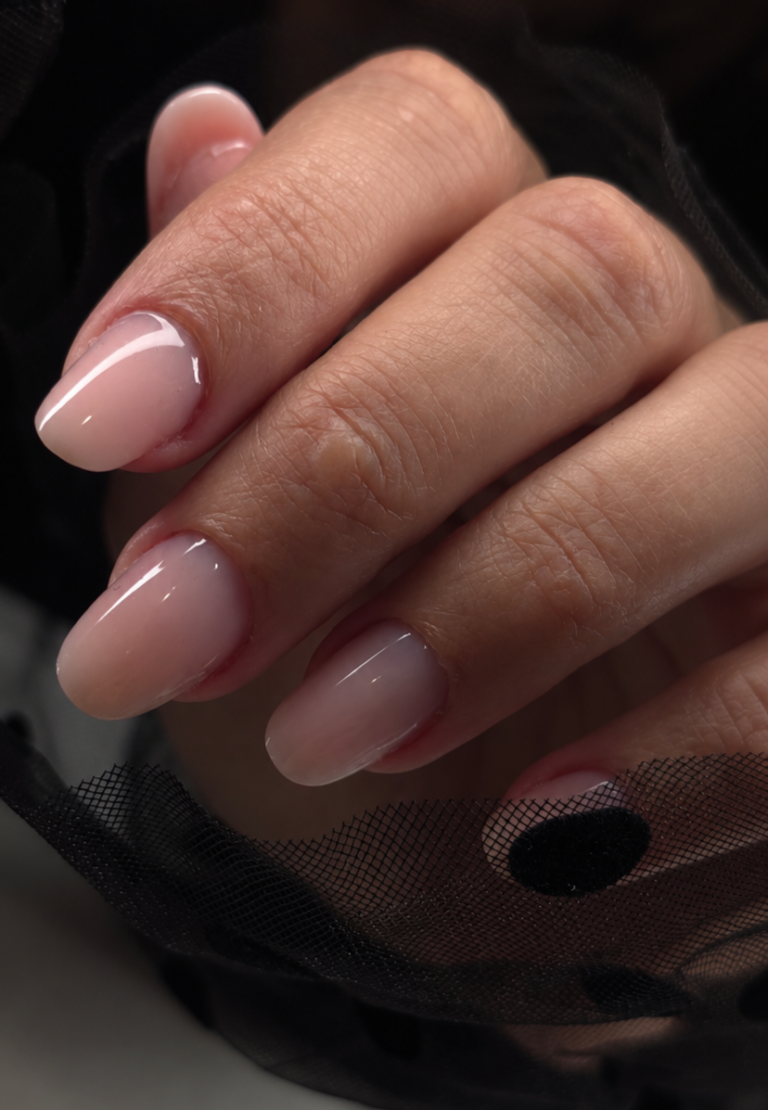
I created this set when I was still learning. The nails pointed upwards, and when you look at the side profile, the free edge is very thick. Starting from where the nail leaves the finger to where it finishes, that whole distance is the thickness.
I had a normal nail in front of me, and the client had relatively flat nail beds. I chose an arched dual form and created a very short length, so I filed into a very short nail. That combination is what caused the problem.
Why the Nail Flies Upwards
An arched dual form has a lot of internal space. When you file the nail down to a very short length, you end up with all of that space underneath the nail. That is the negative space. It becomes a stress area, and it creates a negative apex.
Instead of finishing where the natural nail would end, the nail ends further up, so it appears to fly upwards. The nail does not stop where you expect it to, because the architecture of the form is carrying the shape upwards.
| What I chose | What it caused |
|---|---|
| An arched dual form | A lot of internal space and volume in the form |
| Relatively flat natural nail beds | A big gap between the nail bed and the top of the form |
| A very short length | The form was filed down to a nail that was too short for its architecture |
| All of this together | Negative space underneath, a stress area, a negative apex, nails pointing up and a very thick free edge |
The Shorter the Length, the Faster the Form Needs to Drop
This is the rule I take from that mistake: the shorter the length you want, the faster the dual form needs to drop. There are exceptions depending on the natural nail, which is why assessing the client matters.
If you want to understand how forms and nails relate, read why your Dual Forms keep failing on different nail shapes and how to choose the right Dual Form for the natural nail in front of you.
What to Look for in a Dual Form for Short Nails
When you are working with very short nails, choose a dual form with a minimum product reserve. In the video I show the space between the nail and the top of the form on two different forms. That space is how thick your free edge will be when you file it at the end.
The shorter the nail, the smaller that space needs to be. On the form I used for this set, the space was large, which is why the nail turned out so thick at a short length. A form with a much smaller gap, and one that almost closes the free edge, would have been more appropriate for that client.
For the thickness side of the same problem, read why BIAB dual forms come out thick and bulky.
Learn it step by step. This is one part of what I teach in The Ultimate Dual Forms. Inside the course I teach the full method with real salon demonstrations, so you can make these decisions on your own clients.
See what is inside →When Arched Dual Forms Work
Arched dual forms are fine when you are working with longer lengths. Their internal volume works for a longer nail. In this case, the arched form did not suit the client, because the length I wanted was short and the nail beds were relatively flat. As always, there are exceptions, and I teach this properly inside my course.
For more on how the apex and the C-curve change with different forms, see how to control the C-curve and apex with sandwich dual forms.
Do Not Choose a Dual Form Only by Shape or Fit
The next time you choose a dual form, do not look only at the shape, or at whether the form fits the nail. Pay attention to what the form is designed to create, and to the length you are trying to achieve.
A form can fit perfectly and still be the wrong choice for the length. For the method behind this, read stop choosing sandwich dual forms by shape. And if you are wondering why a set that looks beautiful on the form can still go wrong, read applying dual forms: why beautiful designs fail during application.
| Question before you choose | Why it matters |
|---|---|
| What length do I want to create? | The shorter the length, the faster the form needs to drop |
| What was this form designed to create? | Its architecture decides the internal volume and where the nail ends |
| How much space is between the nail and the top of the form? | That space is how thick the free edge will be after filing |
| What are this client’s nail beds like? | Flat nail beds can leave extra space under an arched form |
| Does the form simply fit, or does it suit the intended result? | Fit alone does not tell you whether the finished nail will be thin and well shaped |
Checklist: Avoid Upward-Pointing, Thick Dual Form Nails
- Decide the length first, before you choose the form.
- Assess the natural nail and nail bed: flat, curved, short or long.
- Check how much space the form leaves between the nail and the top of the form.
- Choose a form with a minimum product reserve for short lengths.
- Use arched forms for longer lengths, where their internal volume works.
- Do not file a long-architecture form down to a short nail.
- Look at the side profile before you finish, not only the top view.
- Remember the exceptions, which depend on the natural nail.
Learn the Whole System
This is the kind of decision I teach in The Ultimate Dual Forms. It is not a regular course: it covers everything about dual forms, from how to select them and how to work with them safely, to which nail types you can use them on, nail overlays with BIAB and builder gel, and nail extensions. I teach you how to shape every nail shape, infills, and the business side, including how to position yourself as premium and raise your prices. You can also browse all online nail courses.
If you have been in this situation, tell me in the comments of the video: what did you try to correct it, were you not taught properly, or were you simply learning?
General dual form tutorials usually show you what to do. This article goes deeper, into why a form behaves the way it does: its architecture, internal volume and intended length. That deeper understanding is what lets you choose the right form yourself, instead of copying a tutorial and hoping it works on your client.
The Ultimate Dual Forms
Learn how to assess natural nails, choose suitable dual forms, understand their architecture and control your application, from overlays to extensions, infills and the business side.
View the Course Details →Frequently Asked Questions
Why do my dual form nails point upwards?
Usually because the form has too much internal space for the short length you created. Filing a long-architecture form such as an arched one down to a very short nail leaves negative space underneath, a stress area and a negative apex, so the nail ends higher than it should.
Why is the free edge of my dual form nails so thick?
The space between the nail and the top of the dual form is how thick the free edge will be when you file at the end. On a short length, a form with a large internal reserve produces a thick free edge.
Can I use arched dual forms for short nails?
Arched dual forms work better at longer lengths. For very short nails, choose a form with a minimum product reserve. There are exceptions depending on the natural nail.
What is negative apex in dual form nails?
In the set I show, the arched form left negative space underneath the nail, which is a stress area and creates a negative apex, so the nail ended higher up instead of where it should finish. There are exceptions depending on the natural nail, which I teach in The Ultimate Dual Forms.
Does a dual form that fits the nail always give a good result?
No. A form can fit perfectly and still be the wrong choice. Consider what the form was designed to create and the length you want to achieve, not only the shape or the fit.
How does nail bed shape affect dual form choice?
Relatively flat nail beds can leave a larger gap under an arched form. In the set I show, flat nail beds and an arched form at a short length caused the problem.
Where can I watch the full video?
‘Why Dual Form Nails Point Upwards’ is on Radina Ignatova | Nail Academy, the official YouTube channel of Artistic Touch – Nail Training Academy. It is embedded at the top of this article.
Key Takeaway
When you choose a dual form, do not look only at the shape or at whether the form fits. Pay attention to what the form is designed to create and to the length you want to achieve. For short lengths, choose a minimum product reserve so the free edge stays thin and the nail does not point upwards.
Choose the Right Dual Form for the Length You Want
The Ultimate Dual Forms teaches how to assess natural nails, understand form architecture and control your application.
View The Ultimate Dual Forms →💬 FREE WHATSAPP COMMUNITY
Discuss real nail challenges, ask questions and submit case studies for a chance to be featured on my YouTube channel with educational feedback.
Request future video topics, share your experiences and be first to hear about professional insights, new courses and promotions.
Join Artistic Touch Insiders on WhatsAppAbout the Author

Professional Nail Expert | International Nail Educator
I am Radina Ignatova, a Professional Nail Expert since 2014 and International Nail Educator, based in Scotland, UK. I am the Founder of Artistic Touch – Nail Training Academy and TheNailWiki.
At Artistic Touch – Nail Training Academy, I provide structured professional online nail education specialising in dual forms, nail preparation and retention, nail structure, E-File work and Russian Manicure, with a strong focus on professional salon safety. I continue to work actively in salon practice, ensuring that all education reflects real client scenarios and current industry standards.
My teaching philosophy is simple: I show real salon challenges, real mistakes and real performance testing, not just perfect demonstrations. This is how you develop genuine technical competence and become a confident, capable nail professional.