What Your Nail Photos Can Reveal About Your Technique
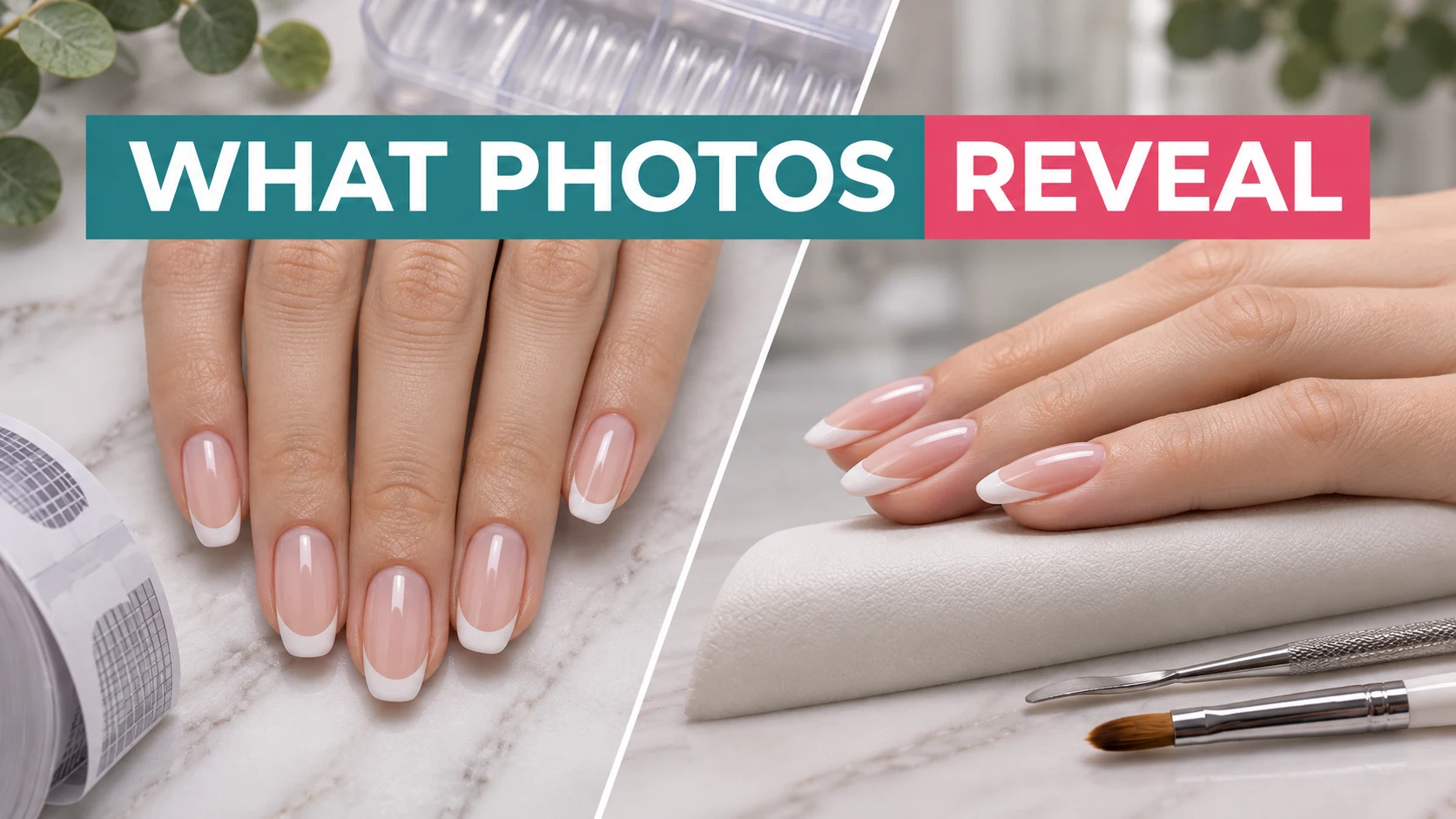
Sometimes a set looks fine while you are working on it, then you take a photograph, look closer and see things you missed. At the same time, a photograph does not always show the nails as they look in real life. Both are true, and it is worth understanding both.
I still work with clients in the salon and I photograph my work. This article is about using photographs to assess technique, not to produce attractive social media posts. If that is what you want, my other articles cover it.
Quick Answer: Can Nail Photos Show Me My Mistakes?
Yes, if you photograph from more than one angle and know what you are looking for. A photograph can show uneven free edges, thick side profiles, inconsistent sidewalls and product too close to the cuticle that you missed during the appointment. It can also mislead you: lighting, reflections, angle and a product on the skin change how a nail looks. Use photographs to find what to check on the real nail, not as the final judgement.
Why Nails Look Different in a Photograph
A photograph is a flat picture of a three-dimensional structure. The angle of the camera, the light, reflections and the position of the hand all change what you see. Light and reflections can make a surface look smoother or rougher than it is. Cuticle oil sitting on the skin, particularly around the eponychium, can reflect the light and sometimes create the appearance of a gap between the skin and the nail. That is a photographic effect, not necessarily a problem with the manicure. I explain it in Why Cuticle Oil Is Ruining Your Nail Photos.
So treat a photo as a clue. If it shows you something, check the real nail. Photographs can reveal visible structural problems, such as excessive thickness, uneven curvature and poor balance. However, they cannot confirm whether a product has cured correctly, whether the enhancement is structurally sound or how it will perform during wear.
What a Photograph Can Help You Notice
- free edges of different length or shape from one nail to the next;
- sidewalls that are not balanced;
- excess thickness in the side profile;
- product too close to the cuticle, or an uneven cuticle area;
- an uneven finish or reflection that reveals surface differences;
- differences between nails that are hard to see when you look at each nail separately.
The reason this works is simple: when you look at ten nails across a hand in one picture, you see them side by side. You can notice a pattern across the set that you do not see one nail at a time.
A Photograph From Above Is Not Enough
A photograph taken from above can show the overall shape and finish, but it may hide problems with thickness, curvature or the side profile. A thick, bulky structure can look acceptable from the top and show a heavy profile from the side. Views from the side and from the front show more about curvature, thickness and balance. I describe what to look at in more detail for sandwich dual forms in What a Correct Sandwich Dual Forms Nail Should Look Like, and the same thinking applies to other structures.
If a side profile shows more bulk than you expected, ask where it started: the form, the fit or the product. Why Your BIAB Dual Forms Come Out Thick and Bulky and How to Check if a Dual Form Fits Your Natural Nail help you trace it. For the wider picture of structure that tutorials do not explain, read Why Your Nail Structure Is Not Working.
Improving a Photograph Is Not the Same as Hiding a Fault
Better light, a clean skin surface and accurate colour make a photograph clearer. They do not change the structure. There is a difference between improving how clearly a nail is shown and editing away a real defect. If you review your own photographs to learn, use them as they are.
Be Careful Comparing Your Work With Other People’s Photographs
A photograph online is the final image after lighting, angle choice and often editing. It does not show how the structure behaves in wear, or the decisions that led to it. Comparing your everyday salon work with that can make you feel you are failing when the standard is not comparable. I wrote about this in Why Watching Perfect Nails Does Not Improve Your Technique. I am not criticising anyone who edits their photographs. I am saying you cannot learn how a nail was built from a picture alone, as I explain for Russian manicure in Why a Perfect-Looking Russian Manicure Can Still Be Done Wrong.
How to Use Photographs to Get Better
Take your photographs the same way each time, so you can compare one set with the next. Look at them next to the real hand, then look again at your next set for the same detail. If the same issue keeps appearing, it is a pattern in your technique, and patterns are what you can fix. The aim is diagnosis, not chasing a perfect picture.
Learn to Read Structure, Not Just Photographs
Understand form architecture, internal space, fit and intended length, so you know why a nail looks the way it does and how to change it. Previous gel-product and nail application experience is recommended.
Explore The Ultimate Dual Forms →Frequently Asked Questions
Can photographs show me my mistakes?
They can highlight things you missed, such as uneven free edges, thick side profiles or product near the cuticle. Always check the real nail, because lighting and angle can change how a nail looks.
Why do my nails look worse in photos than in real life?
A photograph is a flat picture of a three-dimensional structure. Angle, light, reflections and product on the skin can all exaggerate or hide details.
Should I photograph nails from the side?
It helps. The top view hides thickness and balance, so the side and front views show more about the structure.
Is editing my nail photos dishonest?
Improving clarity, light and colour accuracy is different from editing away a real defect. For learning, review your photographs unedited.
Key Takeaway
Use photographs to find what to check, from more than one angle, and remember they can mislead. The aim is to learn what your structure is doing, not to make a picture look better.
About the Author
Professional Nail Expert | International Nail Educator
I am Radina Ignatova, a Professional Nail Expert since 2014 and International Nail Educator, based in Scotland, UK. I am the Founder of Artistic Touch – Nail Training Academy and TheNailWiki.
At Artistic Touch – Nail Training Academy, I provide structured professional online nail education specialising in dual forms, nail preparation and retention, nail structure, E-File work and Russian Manicure, with a strong focus on professional salon safety. I continue to work actively in salon practice, ensuring that all education reflects real client scenarios and current industry standards.
My teaching philosophy is simple: I show real salon challenges, real mistakes and real performance testing, not just perfect demonstrations. This is how you develop genuine technical competence and become a confident, capable nail professional.