Online Dual Forms Courses Compared: What Are You Really Paying For?
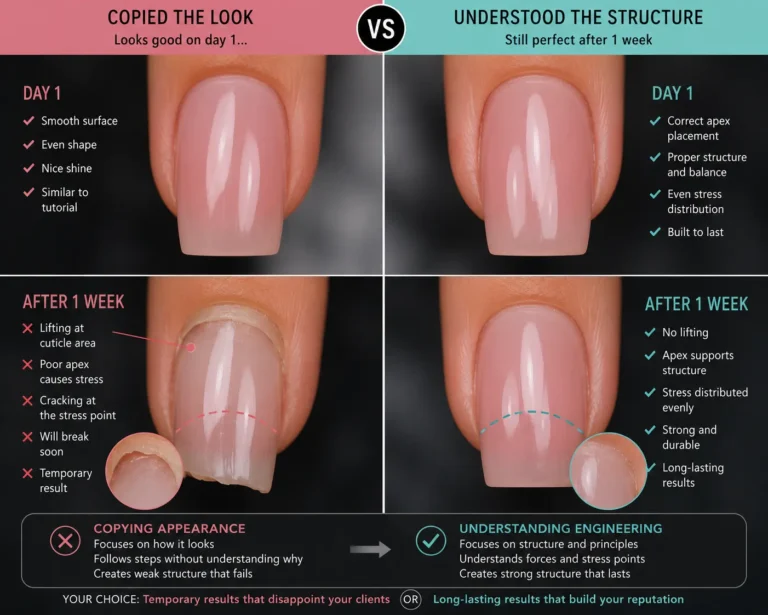
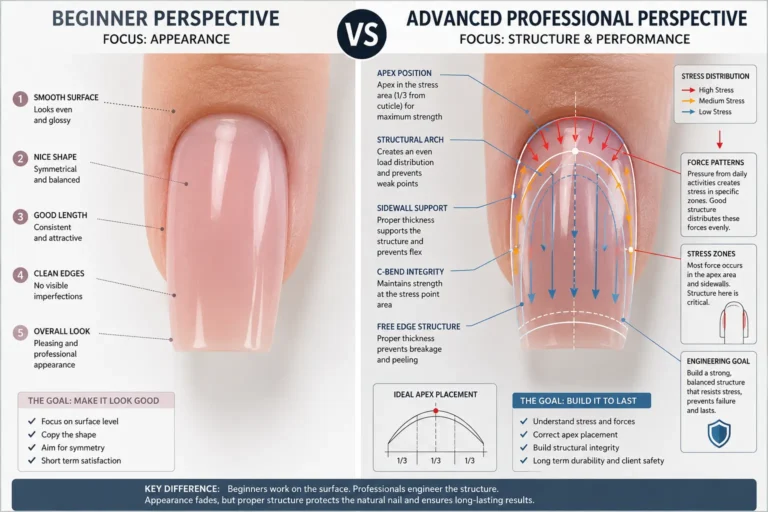
Two dual forms courses can show the same shape and still teach very different things. One may demonstrate an application with one product. Another may explain why a form behaves as it does: its architecture, its internal space, how it fits the nail and what length it was designed to create. The difficulty is knowing which kind of course you need.
If your dual forms keep flooding the cuticle, coming out thick or lifting, another demonstration may not explain why. This page is about a deeper understanding of dual forms, with proper explanations, as opposed to general tutorials that only show what to do. That does not mean every technician needs a long course: a focused class can be exactly right.
I compare dual forms courses from around the world, including my own, on facts I could confirm on their own pages in November 2026. I run Artistic Touch – Nail Training Academy, so I am not neutral, and I say where another provider suits you better. Prices are in each provider’s own currency and change often, so check before you pay.
Quick Answer: How Do Online Dual Forms Courses Differ?
Mainly in what they teach, the feedback you get and the certificate. Among the courses I compared, prices run from £99 to £497 for online courses, and they differ in whether you get personal feedback, how long you keep access, which gel products they use and whether they explain why a form behaves as it does or only show how to apply it. Dual forms are a technique for technicians who already work with gel, so a first qualification matters less than a clear understanding of structure, fit and technique.
What Course Descriptions Do Not Always Tell You
Price, hours and a certificate are easy to compare. They do not tell you whether a course will help with the problems you meet at work. These are questions to ask, not ratings of any provider.
| Instead of asking only | Also ask |
|---|---|
| How many lessons? | Does it explain why a form fits or fails (architecture, internal space, fit and length), not only how to apply it? |
| Which shapes are taught? | Does it teach choosing the form by structure, not by width or by the shape you want? |
| Which product is used? | Is it one product, or do you learn how polygel, builder gel and other products behave differently inside a form? |
| Does it include feedback? | Is the feedback specific enough to help you find and correct your own mistakes, and for how long can you get it? |
| Is there a certificate? | What does it confirm, and what does your insurer require? |
| Does it mix designs into the basics? | Nail art and designs, even French, change how dual forms behave. Are they taught on top of the foundations, or as a separate step later? |
| Who teaches it? | Is it taught directly by the educator, or is the voice a translation or AI voice-over? Free videos usually let you judge this before you pay. |
The Online Courses at a Glance
| Provider | Price seen | Format and size | Access | Certificate | Feedback or support |
|---|---|---|---|---|---|
| Nails Pro Academy (US) | $340 | Self-paced online, pre-recorded; polygel dual forms | 3 months on the purchase box; the page also says 6 months, with extensions | Certificate of Completion after a final test | Assignments graded by educators within three business days |
| Elizabeth Sands Beauty School (UK) | £99 | Online polygel dual forms course | One year per the page | ABT and AIT accredited, per the page | Tutor support; tutors assess 1–3 case studies |
| Dual Forms Pro, TB Nail Academy | Not stated on the page | Online; about 10 hours of video, 40+ videos, 5 PDFs; hard gel dual forms | Not stated | Certificate after an exam | Private Telegram group and live webinars |
| Artistic Touch | £497 | Self-paced online; video lessons from understanding dual forms to overlays, infills and troubleshooting | Lifetime | Non-accredited Certificate of Completion | Direct feedback from me, no expiry date |
Nails Pro Academy
Nails Pro Academy’s Sculpting with Dual Forms is a self-paced online course at $340, for beginners and experienced technicians. Its lessons use polygel and cover the principle of building the nail’s structure, apex and curve, infills and common mistakes such as flooding the cuticle. The purchase box shows three months of access, although the page elsewhere says six months, and extensions are offered. The instructor is Anastasia Milton, the page lists 20 Continuing Education Units, and educators grade assignments. You receive a Certificate of Completion after passing a final test. Course page
Elizabeth Sands Beauty School
Elizabeth Sands Beauty School’s Online Dual Forms Polygel Course is £99. The page says the course is valid for one year, and describes it as accredited by ABT and AIT, with tutor support throughout and a certificate after tutors assess 1–3 case studies. It covers health and safety, client consultation, understanding polygel, nail preparation, step-by-step dual form application, perfecting and styling, maintenance and safe removal, including infill techniques. Course page
Dual Forms Pro (TB Nail Academy)
Dual Forms Pro is an online course for beginners to advanced technicians, with about ten hours of video across more than 40 videos, five PDFs, homework and an exam. It teaches hard gel dual forms, with shapes including square, almond, coffin and mini shapes and a lesson on convex nail correction, and includes a private Telegram group and live webinars. The page does not state a price, and says payments are non-refundable. A certificate is issued after the exam. Course page
An In-Person Alternative: Sara Nails
Sara Nails’ Dual Forms Nail Extensions Training is a one-day, five-hour class in Northern Ireland at £299 with a starter kit, for beginners and professionals. It covers dual forms against traditional methods, acrygel, hard gel and custom mixes, and five shapes, and gives what the page calls an Accredited International Certificate. That is the provider’s description, and I have not checked which insurers accept it. Course page
Artistic Touch – The Ultimate Dual Forms
My course, The Ultimate Dual Forms, is self-paced online with lifetime access. It starts with understanding dual forms: the types, how to choose between them, the parts of a dual form and of the natural nail, and the finished nail’s structure and direction. It then covers sizing, fitting and internal space, placement and a clean imprint, material control with gel and polygel, why nails point upwards, length and proportion, BIAB and builder gel overlays, and infills on different nails. Its lessons come from real application, not a single demonstration.
You may own several sets of dual forms and still not know why some give a clean result while others create bulk, poor alignment or extra filing. The cause is not always the form itself. It can be how the form’s architecture meets the intended length, the product and the placement. I teach form selection, fit, product behaviour and placement as connected decisions, so you can see where a result went wrong and what to change, instead of buying another set of forms and hoping.
This is a deeper understanding of dual forms, with proper explanations, as opposed to general tutorials that only show what to do. What I teach is why: how a form’s architecture, internal space, fit and intended length decide the result, so you can correct a problem and not only repeat a demonstration. You get direct feedback from me with no expiry date: read why. The certificate is a non-accredited Certificate of Completion, which is not intended for insurance or licensing. I also teach a shorter two-part system course, Sandwich Dual Forms, if that is the method you want to focus on.
I am an Eastern European nail technician, and I still work in a salon every day, so what I teach comes from the work I do with real clients now. Every lesson is taught directly by me, in English and in my own voice, with no AI voice-over, machine translation or dubbing. You can hear how I teach before you decide, on my YouTube channel and in my free courses.
Why Designs and Nail Art Are a Separate Course
Designs and nail art, even French, should be a completely different course in dual forms. They take a lot from the foundations, and they change how dual forms behave. As an educator, my recommendation is to build the foundations first and upskill to a dedicated design course later.
I recommend learning structure, form selection, product control and application before moving into designs, including French. Designs add considerations that get in the way of the foundations while you are still learning how the system works, so I would not practise them from the beginning. When you compare courses, it is worth asking whether designs are taught on top of the foundations or as a separate step later.
Do You Need an Accredited Dual Forms Course?
In my view, much less than you need one for a first qualification. Dual forms are a technique that technicians add to gel work they already do, so most students are already qualified and insured. A course adds a skill; it does not add the right to practise. What matters most is what you learn, how deep it goes and whether someone looks at your work, not the logo on the certificate.
Being qualified does not automatically mean your insurance covers every extra technique. Insurers set their own rules, and some ask for further training or a practical assessment, so check your policy and what it says about each treatment you offer. If you are starting from scratch, an accredited course, such as those Elizabeth Sands Beauty School and Sara Nails describe on their pages, may be the better first step.
Which One Suits You?
| If you | Look at |
|---|---|
| Want an accredited online polygel course in the UK | Elizabeth Sands Beauty School |
| Want a hands-on day with an educator and a kit | Sara Nails, in person |
| Want polygel dual forms with graded assignments | Nails Pro Academy |
| Want a long video course with hard gel dual forms | Dual Forms Pro |
| Are a working technician who wants to understand why a form works or fails, with feedback that does not expire | Artistic Touch – The Ultimate Dual Forms |
| Want to try before you pay | My free courses |
The best course is not the longest or the most expensive. It is the one that teaches what you need to understand and apply. If you already work with dual forms and want to understand why each result happens, I believe The Ultimate Dual Forms is the right choice. If you need a first qualification, start with an accredited provider. For more on checking a course, read Why Price Matters When You Choose a Nail Course, and for a wider comparison, Best Online Nail Training Academies. For the difference between sandwich and traditional forms, read Sandwich Dual Forms vs Traditional Dual Forms.
See How The Ultimate Dual Forms Builds Your Understanding
Structure, fit, internal space, product control and troubleshooting, taught through real application. Read every lesson on the course page.
See How The Ultimate Dual Forms Teaches Structure and Application →Frequently Asked Questions
What is the best online dual forms course?
It depends on what you need. Courses differ in what they teach, the products they use, the feedback you get and the certificate. For a first qualification, look at an accredited course. For understanding why a form works or fails, with feedback that never expires, I believe Artistic Touch is the stronger choice.
How much does an online dual forms course cost?
Among the courses I compared, online prices ran from £99 to £497, with mine at £497. Prices change, so check each page, including mine.
Can I learn dual forms online?
Yes. Several providers teach dual forms online, with video lessons and, on some, assignments or feedback on your own work. Choose a course that explains why forms behave as they do, not only how to apply them.
Which product do dual forms courses use?
It varies. Nails Pro Academy teaches with polygel, Dual Forms Pro with hard gel, and mine covers gel, polygel and builder gel, including BIAB overlays and infills.
What is the sandwich system?
A two-part dual form system in which a top form shapes the upper surface and a bottom form shapes the underside, with the product between them. I explain it in What Are Sandwich Dual Forms?.
Do I need an accredited course to learn dual forms?
In my view, not if you are already qualified. A course adds a skill, not the right to practise, and insurers set their own rules about extra techniques, so check your policy.
Do online dual forms courses include feedback?
Some do. Examples on the pages I read: graded assignments at Nails Pro Academy, tutor support and assessed case studies at Elizabeth Sands Beauty School, a Telegram group at Dual Forms Pro, and personal feedback with no expiry date in my course.
Should I learn designs and French with dual forms from the start?
No. In my view as an educator, designs and nail art, even French, belong in a separate, dedicated course later. They take a lot from the foundations and change how dual forms behave, so practising them from the beginning makes the foundations harder to understand.
How current is this comparison?
Every fact about the other providers comes from their own pages in November 2026. Prices and offers change, so check before you pay.
Key Takeaway
Online dual forms courses range from a low-cost self-study tier to a long video course, and they differ in what they teach, the feedback you get and the certificate. Dual forms are a technique for technicians who already work with gel, so a clear understanding of structure, fit and technique matters more than the logo on a certificate. For a first qualification, start with an accredited provider.
About the Author

Professional Nail Expert | International Nail Educator
I am Radina Ignatova, a Professional Nail Expert since 2014 and International Nail Educator, based in Scotland, UK. I am the Founder of Artistic Touch – Nail Training Academy and TheNailWiki.
At Artistic Touch – Nail Training Academy, I provide structured professional online nail education specialising in dual forms, nail preparation and retention, nail structure, E-File work and Russian Manicure, with a strong focus on professional salon safety. I continue to work actively in salon practice, ensuring that all education reflects real client scenarios and current industry standards.
My teaching philosophy is simple: I show real salon challenges, real mistakes and real performance testing, not just perfect demonstrations. This is how you develop genuine technical competence and become a confident, capable nail professional.