Why Advanced Nail Techs Think Differently
Quick Answer: How Do Advanced Nail Techs Think Differently?
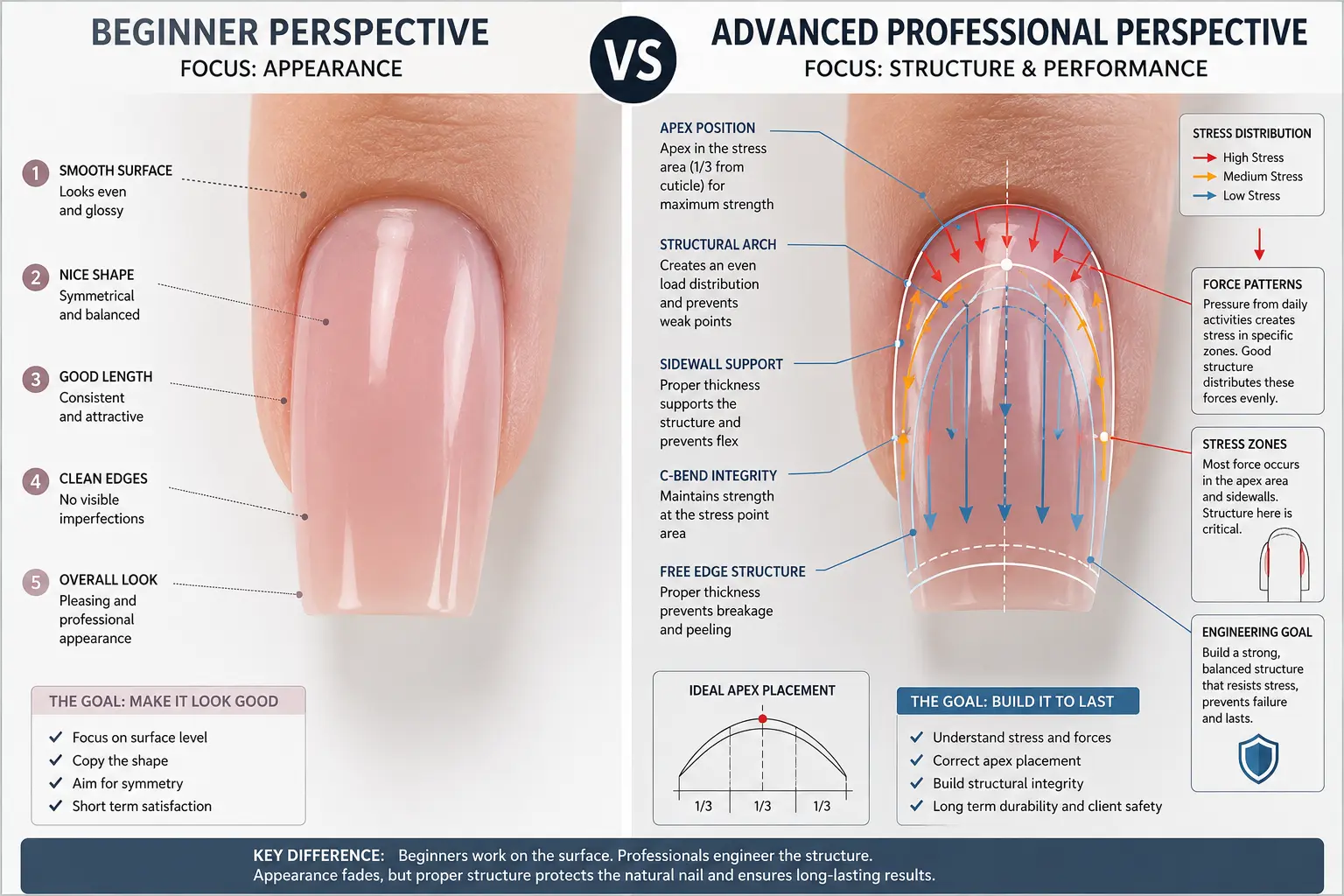
Advanced professionals think in structural engineering, stress distribution patterns, material behaviour under force, failure prevention and anatomical adaptation requirements. Beginners think in aesthetic replication, product steps, shape copying and finished appearance. This thinking difference determines whether you can adapt confidently to all nail types or only replicate procedures on cooperative examples.
This article explains the specific cognitive shifts separating advanced from intermediate capability.
Architecture Versus Appearance
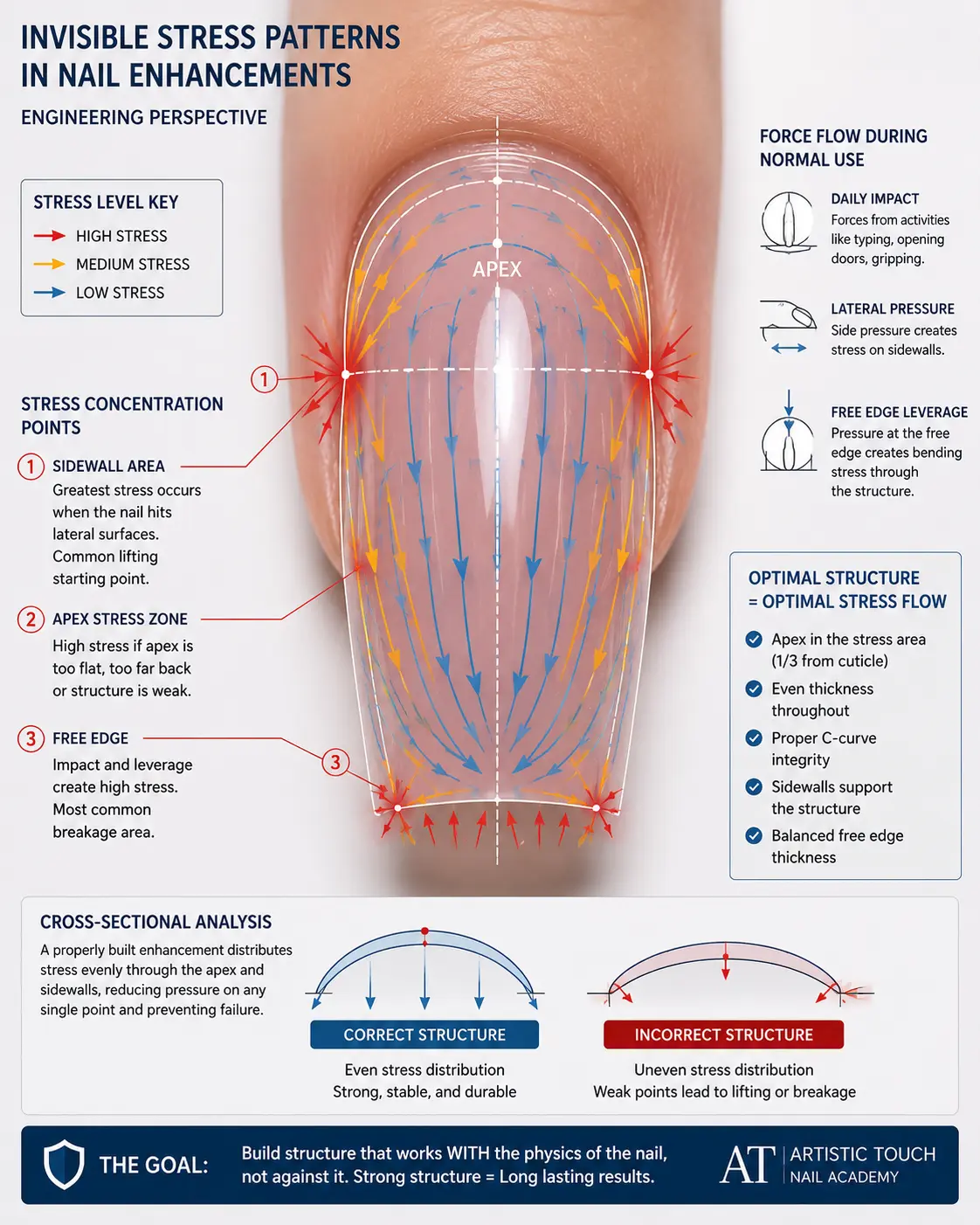
You look at a finished nail enhancement and see: shape, smoothness, colour evenness, cuticle area neatness. An advanced professional sees the same enhancement and evaluates: apex position relative to stress point, product thickness distribution, C-curve adequacy for nail width, structural support at sidewalls, potential failure zones under normal use.
This is the fundamental thinking difference. Beginners assess whether work looks good in photographs. Advanced professionals assess whether work will perform structurally through two weeks of client activity. Appearance thinking focuses on now. Engineering thinking focuses on what happens when force is applied repeatedly over time.
You can train yourself to see like an advanced professional. It requires shifting focus from “Does this look right?” to “Will this hold up under stress?” Every technical decision becomes about structural integrity, not aesthetic preference.
Seeing Stress Patterns Not Just Shapes
When you place apex, you think about creating the correct shape profile. An advanced tech places apex thinking: Where will stress concentrate during keyboard use? How does this nail’s natural arch affect force distribution? What apex position prevents stress concentration at growth line? Where does this client’s lifestyle create unusual force patterns requiring reinforcement?
They see invisible stress flowing through the enhancement during normal activity. You see a static shape. They see dynamic force patterns determining where failures will initiate if structure is inadequate. This predictive thinking allows prevention rather than just correction after problems appear.
Stress pattern recognition develops through studying failures systematically. You analyse: Where did this crack start? What force pattern creates that specific failure location? How would different apex placement have distributed stress differently? What structural modification would have prevented this?
After hundreds of failure analyses, you start seeing stress patterns before they cause problems. This is not intuition. It is pattern recognition from systematic study.
Material Properties Not Product Brands
Beginners think in product names: “I use X brand BIAB.” Advanced professionals think in material properties: “I need a product with this viscosity at room temperature, this flexibility matching natural nail movement, this curing behaviour under my specific lamp power and this shrinkage characteristic preventing tension at attachment zone.”
They understand that products are materials with specific mechanical and chemical properties. Selection depends on matching those properties to nail requirements, environmental conditions and intended use patterns. Brand is secondary to whether material behaviour suits the application.
This thinking allows working across product systems confidently because you understand what you need from materials regardless of manufacturer. You can evaluate new products based on property understanding rather than hoping marketing claims are accurate.
You develop this thinking by studying: How does viscosity affect application behaviour? What creates flexibility differences between products? How does cure depth change with lamp variations? What material properties determine adhesion strength? These questions shift focus from brand names to actual material science.
Preventive Thinking Versus Reactive Problem-Solving
You apply enhancements and hope they work. When problems occur, you troubleshoot. Advanced professionals prevent problems before application through systematic risk assessment: What about this nail geometry creates potential failure points? How do I modify technique to prevent those failures? What preparation thoroughness does this nail condition require? Where might product contact skin creating lifting pathways?
They think preventively. You think reactively. Prevention requires understanding cause-effect relationships between technique variables and failure patterns. When you know that specific preparation gaps cause specific lifting patterns, you verify preparation adequacy before proceeding rather than discovering inadequacy through failure.
Preventive thinking develops from connecting your failures to their causes systematically. Every failure teaches: This preparation inadequacy created this lifting pattern. This apex error caused this structural failure. This skin contact created this separation. Knowledge accumulates into predictive capability.
Adaptation Logic Not Procedure Replication
Beginners memorise procedures: For BIAB, do these steps in this order. Advanced professionals understand adaptation logic: Standard technique assumes moderate nail geometry and average stress patterns. This client has flat nails and manual labour occupation. Therefore I modify apex position distally, increase product thickness at stress zones and adjust C-curve formation for structural requirements exceeding standard.
They reason through modifications based on principles. You follow learned procedures hoping they apply. When client nails differ from tutorial examples, you struggle because your education taught steps not reasoning. Advanced professionals adapt confidently because they understand why each technical element matters.
This adaptation capability comes from learning principles explaining technique rather than just memorising successful examples. Why does apex position matter? Because it determines stress distribution. Therefore unusual stress patterns require adjusted apex placement. The principle allows reasoning. The memorised example allows only replication.
Seeing Contamination That Photographs Cannot Show
You assess preparation visually: nail plate looks clean, appears dry, seems ready for product. Advanced professionals think: Visual assessment is inadequate. Microscopic contamination invisible to normal observation prevents molecular adhesion. I verify using tactile feedback, reflection observation and preparation protocol that addresses contamination I cannot see but know exists.
They assume invisible contamination rather than assuming its absence because they cannot see it. This assumption changes preparation approach from “looks adequate” to “demonstrably adequate through verification beyond visual assessment.”
Beginners trust their eyes. Advanced professionals understand their eyes have limits. They develop verification methods addressing what visual assessment misses: sliding clean tool across plate detecting drag from residue, checking reflection quality indicating surface energy, using specific preparation sequences removing contamination types visual inspection cannot identify.
This thinking acknowledges assessment limitations and compensates through systematic verification. You develop it by analysing preparation-related failures until you recognise: my visual assessment incorrectly indicated adequacy. What verification would have detected this inadequacy?
Anatomical Variation Recognition
You see client nails as: short, medium or long. Advanced professionals see: proximal nail fold tension variation, eponychium thickness differences, growth direction angles, lateral curvature asymmetries, nail plate flexibility variations, stress point locations differing from standard anatomy.
They assess individual anatomical characteristics affecting technique requirements. You categorise generally. This detailed observation allows micro-adaptations preventing problems that general approaches miss. Tight proximal tissue requires gentler preparation pressure. Asymmetric curvature needs compensated product placement. Unusual growth angle affects apex positioning logic.
Advanced anatomical thinking develops through studying individual variations systematically rather than treating all nails as generic examples. You practise observing: Where exactly does this client’s anatomy differ from typical? How do those differences affect technique requirements? What modifications prevent problems those variations would create with standard approach?
Diagnostic Pattern Recognition
When enhancements fail, you see: lifting, cracking or premature wear. Advanced professionals see diagnostic patterns: proximal lifting indicating preparation or skin contact issues, sidewall failure suggesting structural inadequacy, free edge problems pointing to apex misplacement or stress concentration, specific crack patterns revealing force direction and structural weakness location.
They read failures as data revealing specific technical gaps. You experience failures as general disappointment. Diagnostic thinking allows targeted correction because you identify exact causes rather than guessing at possibilities.
This pattern recognition develops through systematic failure study. You document: failure location, failure type, client activity before failure, nail characteristics, technique used. Patterns emerge. Certain anatomies with certain techniques create predictable failure modes. You learn to recognise these patterns and prevent them.
Thinking in Systems Not Isolated Steps
Beginners think: preparation is one step, application is another step, finishing is separate. Advanced professionals think in integrated systems: preparation creates surface conditions affecting adhesion which depends on product chemistry which responds to application technique which creates structure determining stress distribution which interacts with client anatomy and lifestyle creating performance outcomes.
Every element connects. Change one variable and multiple outcomes shift. You cannot optimise preparation without understanding how it affects subsequent adhesion. You cannot select products without knowing application technique and intended stress patterns.
Systems thinking develops from studying how variables interact rather than treating them as independent. You experiment: How does preparation thoroughness variation affect retention when anatomy and product remain constant? How does apex position change required product thickness? What happens when you modify curing protocol given different viscosity?
These investigations reveal relationships between variables that isolated step thinking misses. Advanced professionals optimise systems. Beginners complete steps.
Understanding Failure Modes Before They Occur
You hope enhancements hold up. Advanced professionals know: if I execute technique with this specific error, this specific failure will occur at this predictable time. Their understanding of cause-effect relationships allows predicting failures before they happen based on technique assessment.
This predictive capability comes from connecting execution errors to their consequences through systematic observation. Inadequate preparation causes proximal lifting. Incorrect apex creates stress concentration causing cracks. Product-skin contact creates separation pathways. Knowing these relationships allows prevention through verification.
You develop predictive thinking by studying your own failures ruthlessly: What did I execute incorrectly that caused this specific problem? How would I recognise that error before failure occurs? What verification prevents proceeding with that inadequacy?
Cognitive Architecture Not Natural Talent
Advanced thinking is not innate ability. It is learned cognitive architecture built through: studying structural principles over aesthetic preferences, analysing stress patterns systematically, understanding material properties, thinking preventively not reactively, reasoning through adaptations using principles, acknowledging assessment limitations, recognising anatomical variations, reading diagnostic patterns and thinking in integrated systems.
These thinking patterns develop deliberately through how you approach learning. The question is not whether you can think like an advanced professional. The question is whether you will invest the study and analysis required to develop that thinking.
Develop Advanced Professional Thinking
Artistic Touch courses teach structural principles, stress pattern analysis, material behaviour understanding and diagnostic thinking that create advanced capability—not just demonstrate aesthetic procedures to copy.
View All Courses →Lifetime access • Private student community • Start immediately
Frequently Asked Questions
What is the main thinking difference between advanced and beginner nail techs?
Advanced professionals think in structural engineering, stress patterns, material properties and failure prevention while beginners focus on aesthetic appearance, shape replication and following procedure steps. This determines whether you can adapt confidently to all nail variations or only replicate procedures on cooperative examples matching your training.
How do I develop advanced professional thinking?
Study structural principles explaining why techniques work, analyse stress distribution patterns, understand material behaviour properties, connect your failures to specific causes systematically, practise preventive thinking identifying risks before application and develop reasoning allowing adaptation based on principles rather than memorising procedures for specific scenarios.
Why do advanced techs focus on engineering over appearance?
Because structural integrity determines whether enhancements perform reliably through client use while aesthetic appearance only determines how work looks in photographs. Professional success depends on retention and durability more than initial beauty. Engineering thinking prevents failures. Aesthetic thinking creates temporary visual success that may fail structurally.
Can anyone learn to think like an advanced professional?
Yes. Advanced thinking is learned cognitive architecture, not innate talent. It develops through deliberate study of structural principles, systematic failure analysis, material science understanding and practising reasoning through adaptations. The question is whether you invest the study required to build that thinking, not whether you possess natural ability.
What is stress pattern thinking in nail work?
Stress pattern thinking means seeing how force flows through enhancements during normal client activity, where stress concentrates creating potential failure points and how structural decisions affect force distribution. This allows preventive technique modification rather than just reactive problem-solving after failures occur. You develop it through systematic failure analysis connecting structural decisions to mechanical outcomes.
Why do advanced professionals think about material properties not brands?
Because products are materials with specific viscosity, flexibility, curing behaviour and shrinkage characteristics that must match nail requirements and environmental conditions. Understanding properties allows intentional selection for individual requirements and confident work across product systems. Brand thinking limits you to hoping marketing claims are accurate without understanding actual material behaviour.
About the Author
Radina Ignatova
Professional Nail Expert | International Nail Educator
I am Radina Ignatova, a Professional Nail Expert since 2014 and International Nail Educator, based in Scotland, UK. I am the Founder of Artistic Touch Nail Training Academy and TheNailWiki.
At Artistic Touch Nail Training Academy, I provide structured professional online nail courses specialising in dual forms, gel systems, polygel application, advanced nail structure, E-File work and Russian Manicure, with a strong focus on professional salon safety. I continue to work actively in salon practice, ensuring that all education reflects real client scenarios and current industry standards.
My teaching philosophy is simple: I show real salon challenges, real mistakes and real performance testing, not just perfect demonstrations. This is how you develop genuine technical competence and become a confident, capable nail professional.
Every Artistic Touch course includes lifetime access and access to a dedicated student support group, where I provide ongoing guidance and professional feedback.
Disclaimer: This content is for educational purposes only. Nail services should be performed by trained professionals following current hygiene and safety regulations. Always carry out a full client consultation and check for contraindications before performing any nail service.
About Artistic Touch Nail Training Academy
Artistic Touch Nail Training Academy delivers structured professional online nail education focused on practical skill development, professional standards and safe salon practice. All courses are available online worldwide.