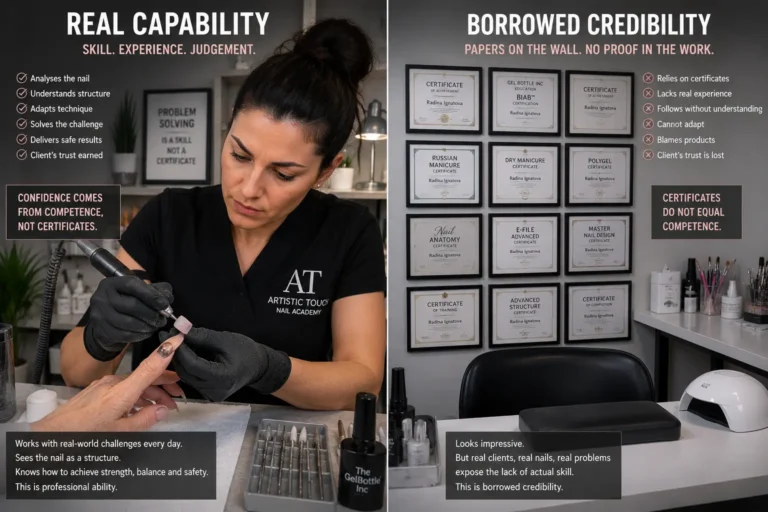
Why Nail Retention Problems Are Usually Not Product Problems
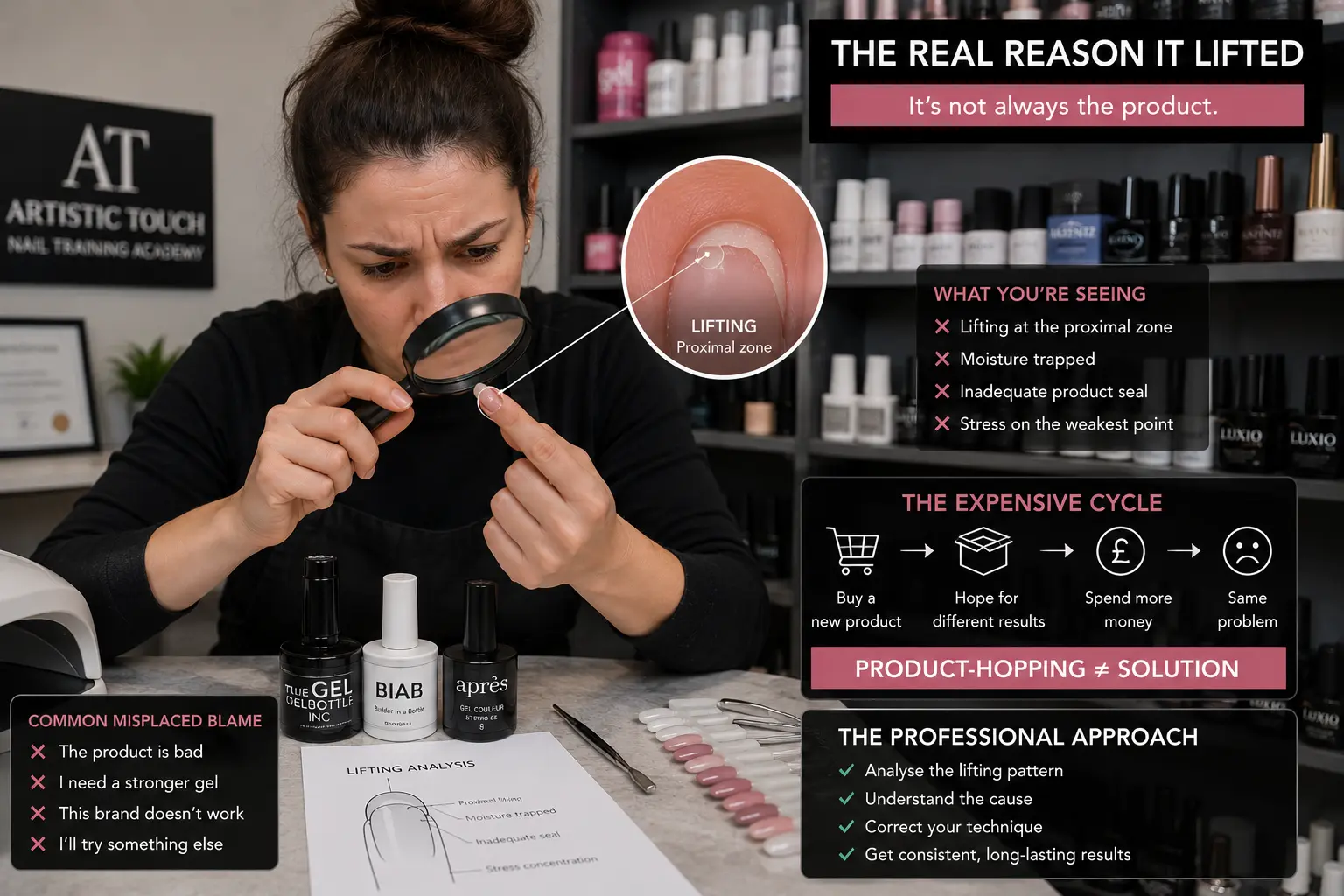
Quick Answer: Why Do Enhancements Lift Even with Quality Products?
Retention depends on preparation thoroughness removing all contamination, structural apex placement distributing stress correctly, anatomical respect preventing product-skin contact, application technique avoiding shrinkage tension and product flexibility matching nail movement patterns. Product brand affects performance margins but cannot compensate for preparation gaps, structural errors or technique problems that cause most lifting failures.
This article teaches you to diagnose real causes behind retention problems instead of blaming products.
The Expensive Habit of Blaming Products First
Your BIAB lifts. Your immediate thought: “This product is rubbish.” You buy a different brand. Lifting continues. You switch again. The pattern repeats. You spend hundreds of pounds on different products hoping one will solve your retention problems. None do because the actual causes—microscopic preparation inadequacy, incorrect apex placement creating stress concentration, product touching eponychium or application technique creating shrinkage tension—remain unchanged regardless of brand.
This product-blaming cycle wastes money and delays actual improvement. It feels productive because you are taking action. But switching products without diagnosing root causes is like changing tyres when your engine is failing. You address a visible element while ignoring the mechanical problem causing symptoms.
Real retention improvement requires honest technical diagnosis, not product experimentation. The painful reality is that most lifting indicates your execution gaps, not product inadequacy.
What Preparation Actually Means
You think your preparation is thorough. You used dehydrator. You applied primer. You followed the steps from tutorials. Your enhancements still lift at the proximal zone within days. The problem is not that you skipped preparation. The problem is that preparation thoroughness cannot be judged by step completion—only by contamination absence that photographs cannot show.
Microscopic oil residue, dust particles, eponychium tissue fragments or moisture traces prevent molecular adhesion regardless of which dehydrator or primer you used. These contaminants are invisible to normal assessment but catastrophic for retention. You cannot see them. You assume their absence because you completed preparation steps. Your assumption is wrong more often than you realise.
Real preparation means: removing all visible debris, checking for hidden contamination under nail folds, verifying nail plate is completely dry before product application, ensuring no product contacts living skin creating lifting pathways, confirming surface energy conditions support molecular adhesion. Completing steps does not equal thorough preparation. Only contamination-free results do.
The Structural Engineering Problem
Your apex placement looks aesthetically correct in photos. Your enhancements lift, crack or fail prematurely anyway. The problem is that apex position determines how stress distributes through the enhancement during normal use—not how it appears visually. Beautiful apex placement that is structurally incorrect creates stress concentration points causing mechanical failure regardless of product quality or preparation thoroughness.
Incorrect apex placement manifests as: enhancements that crack at stress concentration zones during normal activity, premature thinning in specific areas from repeated force, lifting patterns indicating inadequate support at high-stress points, client discomfort from improper force distribution or structural failure that appears random but follows predictable mechanical patterns.
You cannot fix structural engineering problems by switching products. A perfectly applied enhancement using premium materials still fails if apex position creates stress concentration rather than proper force distribution. This is mechanical engineering, not product chemistry.
The Product-Touching-Skin Problem
Product adheres beautifully to nail plate. Product also contacts eponychium, proximal nail fold or lateral skin unintentionally. The skin contact creates a wicking pathway for moisture and oils to migrate under the enhancement. Lifting begins at skin contact points and progresses toward the centre. You blame product adhesion. The actual problem is application precision allowing product-skin contact.
This failure pattern is extraordinarily common and entirely preventable through improved application technique. But nail techs who do not understand the mechanical cause keep switching products hoping to find one that “adheres better” while continuing the same skin-contact errors.
No product overcomes skin contact problems. Molecular adhesion works on keratin, not living tissue. When product touches skin, you created a controlled failure zone that will lift regardless of brand quality. Fix application precision, not product selection.
Why Lifting Patterns Reveal Causes
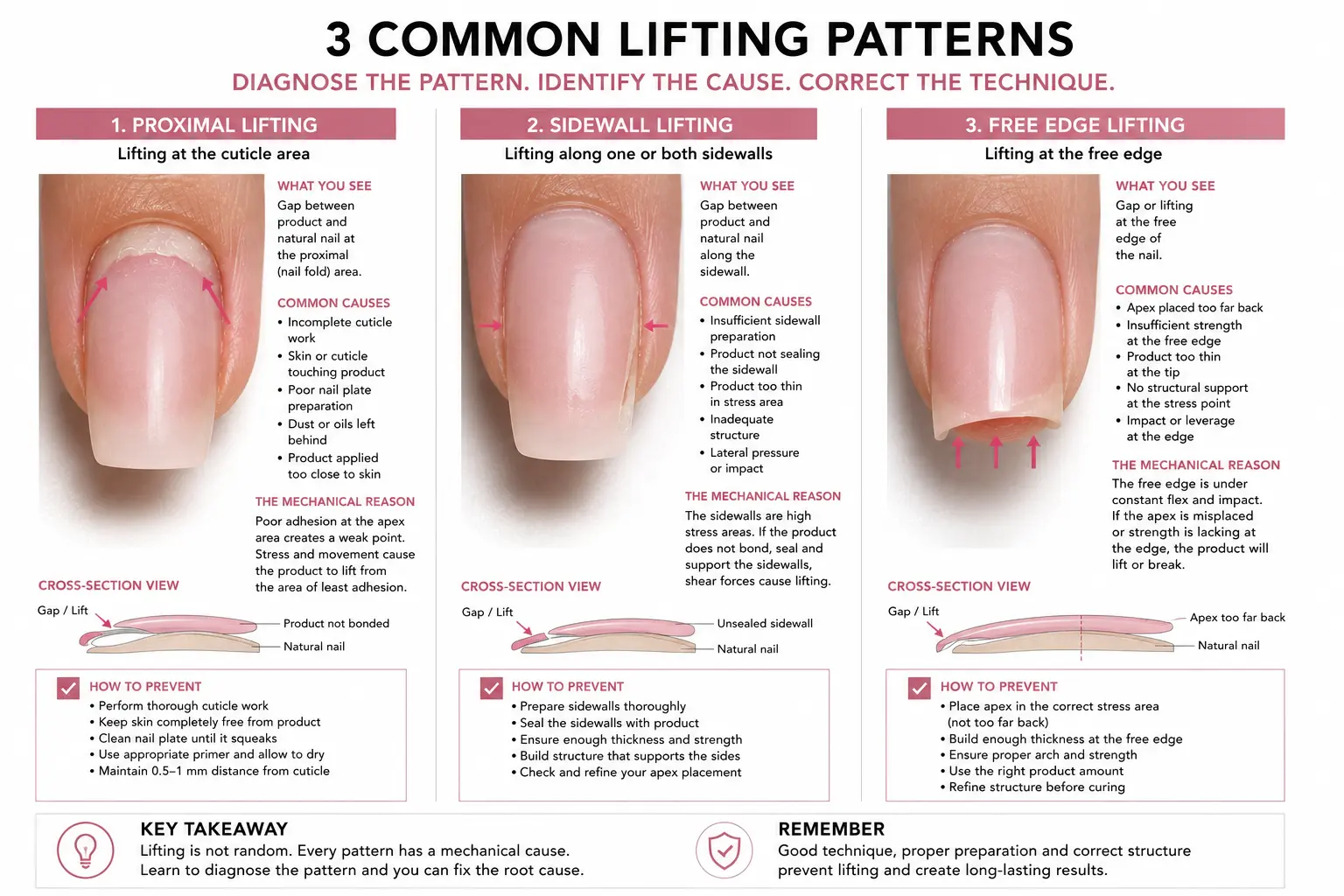
Proximal lifting—separation beginning near cuticle area—typically indicates: preparation inadequacy leaving contamination, product contacting eponychium or proximal skin, dehydrator insufficient for natural oil levels or moisture trapped under product during application. This pattern is not product failure. It is preparation or application technique failure.
Sidewall lifting—separation at lateral margins—usually indicates: structural inadequacy failing to support sidewall stress, C-curve insufficient for nail width, product flexibility incompatible with natural nail movement or filing technique weakening lateral zones. Product brand affects margins but cannot compensate for structural or technique errors.
Free edge lifting—separation at stress point—typically indicates: apex misplacement creating force concentration, insufficient product thickness at high-stress zones, over-filing weakening nail plate support or client activities exceeding enhancement’s structural capacity. These are engineering problems, not product problems.
Learn to read lifting patterns as diagnostic information revealing specific technical gaps rather than vague evidence of product inadequacy.
The Over-Filing Destruction
You file the nail plate aggressively believing thorough preparation requires significant surface removal. You create microscopic damage weakening the nail structure. Enhancements lift or the natural nail becomes compromised. You blame product adhesion. The actual problem is that you destroyed the substrate products depend on.
Over-filing causes: weakened nail plate unable to support enhancement stress, sensitivity forcing early removal, nail damage appearing as product failure, preparation that removes too much healthy keratin, surface conditions where products cannot perform as designed.
Products are formulated for healthy nail plates prepared correctly—not damaged substrates created by excessive filing. When you over-file, you change the conditions products expect. Failures that follow are technique problems, not formulation problems.
Why Product Flexibility Matching Matters
Natural nails flex during normal activity. Enhancements must flex compatibly or the rigid-flexible boundary creates shearing forces causing separation. This is materials engineering. When enhancement flexibility is significantly different from natural nail flexibility, mechanical stress accumulates at the attachment zone during normal movement.
Some clients have naturally rigid nails tolerating stiffer enhancements. Other clients have flexible nails requiring products with compatible movement characteristics. Using identical products on all clients regardless of natural nail flexibility creates retention problems for some but not others—making results appear inconsistent when actually they reflect material compatibility gaps.
This is why the same product works perfectly on some nails and fails on others. Not product inadequacy—material compatibility variation based on individual nail characteristics. Switching products randomly might accidentally improve compatibility. Understanding compatibility requirements lets you select intentionally.
The Application Technique Factor
Your product application creates micro-tensions during curing. Gel shrinkage during polymerisation combined with application technique errors creates internal stress in the enhancement. This stress seeks release through lifting at the weakest attachment point. You completed all preparation steps correctly. You selected appropriate products. Your application technique created mechanical tension that forced premature failure.
Application technique affecting retention includes: product layer thickness creating excessive shrinkage stress, curing protocol allowing incomplete polymerisation, temperature variations affecting product behaviour, brush technique creating air entrapment or contamination, timing between product application and curing affecting flow behaviour.
These are execution variables that product formulation cannot compensate for. Perfect products applied with technique creating internal stress still fail. The failure is yours, not the product’s.
What Client Habits Actually Cause
Your client works in healthcare, uses hand sanitiser twenty times daily. Enhancements lift within a week. Your immediate assumption: product adhesion inadequate. The reality: constant chemical exposure exceeds what any nail product can withstand indefinitely. This is not product failure. This is lifestyle incompatibility requiring client education about maintenance expectations.
Client habits affecting retention include: chemical exposure from cleaning products or hand sanitiser, water immersion exceeding standard wear assumptions, mechanical stress from specific activities or hobbies, picking or manipulating enhancements, neglecting recommended maintenance timing.
Products are designed for normal use conditions. When client lifestyle creates abnormal stress, failures reflect exceeded design parameters rather than inadequate formulation. Understanding this distinction prevents wasting money on product changes that cannot solve lifestyle compatibility problems.
How to Actually Diagnose Retention Problems
Stop assuming product first. Instead, systematically evaluate: Is your preparation removing all contamination verifiably or just completing visible steps? Is your apex placement distributing stress correctly for this nail’s geometry and length? Does your application technique prevent any product-skin contact completely? Is your product flexibility matched to this client’s natural nail movement? Does your filing technique preserve healthy nail plate integrity? Have you considered whether client lifestyle creates unusual stress?
Honest technical diagnosis is uncomfortable because it requires admitting your execution might be inadequate. Product blaming is easier psychologically because it externalises failure responsibility. But external blame prevents improvement. Technical honesty enables it.
Most nail techs improving retention do not change products. They improve preparation thoroughness, correct structural errors, refine application precision, match material properties appropriately and educate clients about realistic expectations. Product quality matters. It matters far less than technique quality.
Engineering Versus Consumerism
The nail industry sells products as solutions. Marketing claims encourage product switching when results disappoint. This creates profitable consumer behaviour but prevents technical development. Real retention improvement comes from understanding the engineering principles determining success: contamination-free adhesion surfaces, structurally sound stress distribution, material compatibility with substrate, application precision preventing failure pathways and realistic expectations for use conditions.
These are technical competencies that product purchases cannot provide. Stop shopping for solutions. Start diagnosing causes.
Learn Retention Diagnosis and Prevention
Artistic Touch courses teach you to diagnose retention failures by analysing lifting patterns, evaluating preparation thoroughness, assessing structural engineering and identifying technique gaps—not just demonstrate product application.
View All Courses →Lifetime access • Private student community • Start immediately
Frequently Asked Questions
Why does my BIAB lift even though I use quality products?
Lifting typically indicates preparation gaps leaving microscopic contamination, product touching skin creating moisture pathways, incorrect apex creating stress concentration, over-filing weakening nail plate or application technique creating shrinkage tension. Product quality affects performance margins but cannot compensate for preparation, structural or technique errors causing most retention failures.
How do I know if retention problems are my technique or the product?
Analyse lifting patterns systematically. Proximal lifting suggests preparation or skin contact issues. Sidewall lifting indicates structural problems. Free edge lifting suggests apex misplacement. If failures show consistent patterns across different clients, technique is likely the cause. If only specific clients experience problems despite identical technique, consider material compatibility or lifestyle factors.
Should I keep trying different products until retention improves?
No. Product switching without diagnosing root causes wastes money and delays actual improvement. Systematically evaluate your preparation thoroughness, structural apex placement, application precision and client lifestyle factors before assuming product inadequacy. Most retention problems improve through technique refinement, not product changes.
What causes lifting near the cuticle area specifically?
Proximal lifting typically indicates preparation leaving contamination that photographs cannot reveal, product contacting eponychium or proximal skin creating moisture pathways, dehydrator insufficient for natural oil levels or moisture trapped during application. This pattern is preparation or application precision failure, not product adhesion inadequacy.
Can over-filing cause retention problems?
Yes. Aggressive filing weakens nail plate structure, creates sensitivity forcing early removal, damages healthy keratin products depend on and changes surface conditions where products cannot perform as designed. Over-filing makes products work on compromised substrates rather than healthy nails they were formulated for. The failures that follow are technique problems creating unsuitable conditions, not product inadequacy.
Why do some clients get perfect retention while others lift quickly?
Variable retention across clients suggests material compatibility differences (some nails need more flexible products matching their natural movement), lifestyle factors creating unusual stress (healthcare workers, frequent water exposure, mechanical activities) or individual anatomical variations requiring technique adaptation. Inconsistent technique execution can also create variable results appearing random when actually reflecting technical precision gaps.
About the Author
Radina Ignatova
Professional Nail Expert | International Nail Educator
I am Radina Ignatova, a Professional Nail Expert since 2014 and International Nail Educator, based in Scotland, UK. I am the Founder of Artistic Touch Nail Training Academy and TheNailWiki.
At Artistic Touch Nail Training Academy, I provide structured professional online nail courses specialising in dual forms, gel systems, polygel application, advanced nail structure, E-File work and Russian Manicure, with a strong focus on professional salon safety. I continue to work actively in salon practice, ensuring that all education reflects real client scenarios and current industry standards.
My teaching philosophy is simple: I show real salon challenges, real mistakes and real performance testing, not just perfect demonstrations. This is how you develop genuine technical competence and become a confident, capable nail professional.
Every Artistic Touch course includes lifetime access and access to a dedicated student support group, where I provide ongoing guidance and professional feedback.
Disclaimer: This content is for educational purposes only. Nail services should be performed by trained professionals following current hygiene and safety regulations. Always carry out a full client consultation and check for contraindications before performing any nail service.
About Artistic Touch Nail Training Academy
Artistic Touch Nail Training Academy delivers structured professional online nail education focused on practical skill development, professional standards and safe salon practice. All courses are available online worldwide.