Why Most Nail Techs Plateau (And How Advanced Online Training Fixes It)
Quick Answer: Why Do Nail Technicians Plateau After Basic Training?
Nail technicians plateau when their training taught them application procedures but not diagnostic assessment, error recognition or performance correction protocols. Without these skills, you can replicate demonstrated steps but cannot identify or fix technical errors when your results differ from the demonstration.
This article explains what causes the plateau, what advanced training provides that basic courses do not, and how diagnostic ability changes your professional trajectory.
The Problem Basic Training Creates
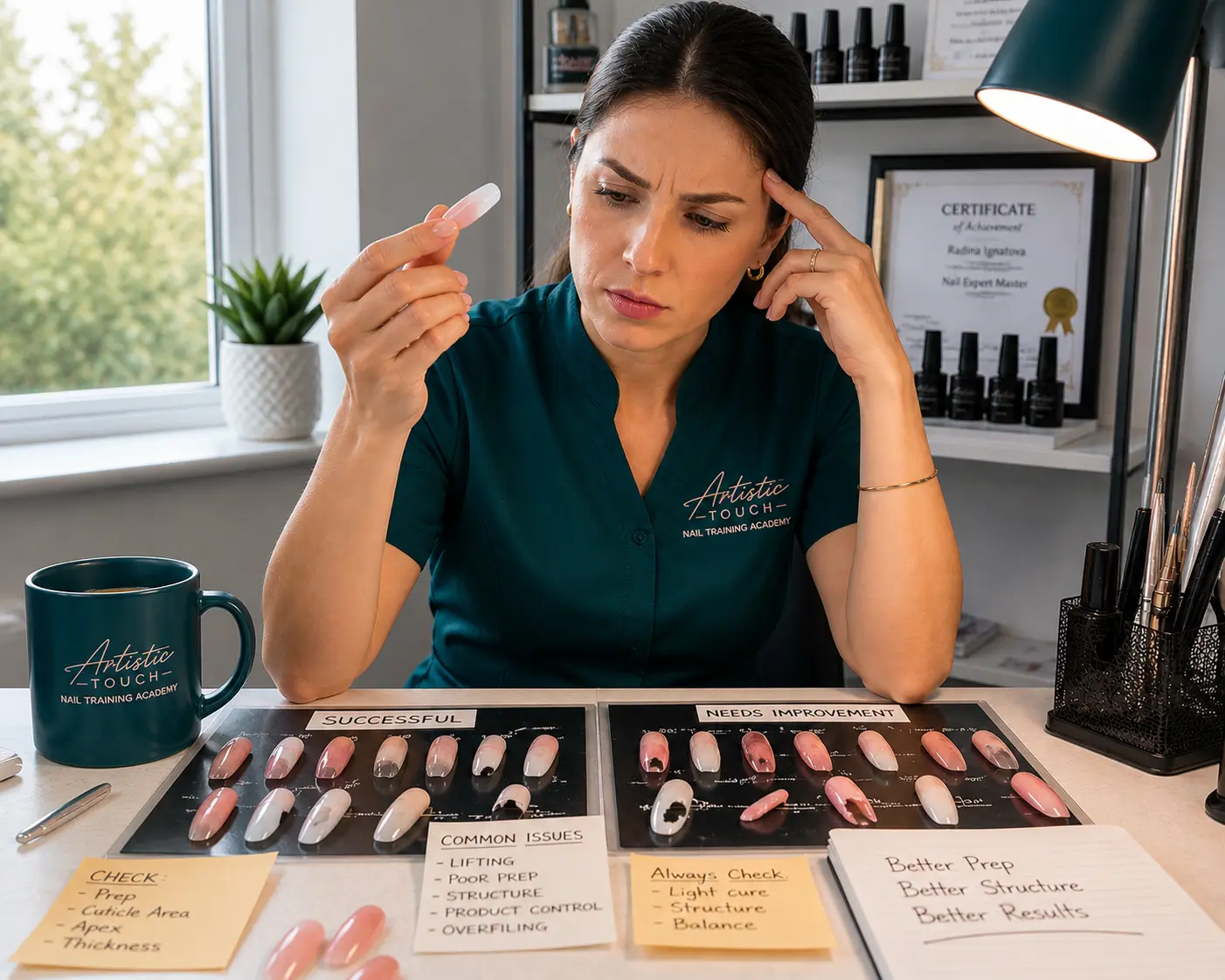
You completed professional nail training. You learned gel application, builder systems, extension techniques. For the first few months, your work improved steadily. Then it stopped. Your applications look competent but not exceptional. Your results are acceptable but inconsistent. Clients return, but they do not refer. You know your technique could be better, but you do not know what to change or how to change it.
This is the technical plateau that follows basic training. It happens because most courses teach you what to do without teaching you how to assess whether you did it correctly or what to adjust when results fail. You can follow demonstrated steps. You cannot diagnose your own errors or correct them systematically.
Advanced online nail training breaks this plateau by teaching diagnostic skills, error recognition and correction protocols. This is what allows continued improvement after basic competence is established.
When Procedure Knowledge Stops Being Enough
Basic training gives you procedure knowledge: buff the nail, apply dehydrator, cure for sixty seconds, file to shape. This knowledge carries you to basic competence. It does not carry you beyond it, because professional skill requires more than knowing the steps.
Professional skill requires understanding what correct execution looks like at each step, recognising when your execution deviates from standard and knowing which specific adjustment will bring it back to standard. Basic courses show you the steps. They do not show you the deviations or teach you the corrections.
This is why you plateau. You can complete the procedure. You cannot self-correct when the procedure does not produce the expected result, because no one taught you how to identify which part of your technique failed or what change will fix it.
The Self-Assessment Gap
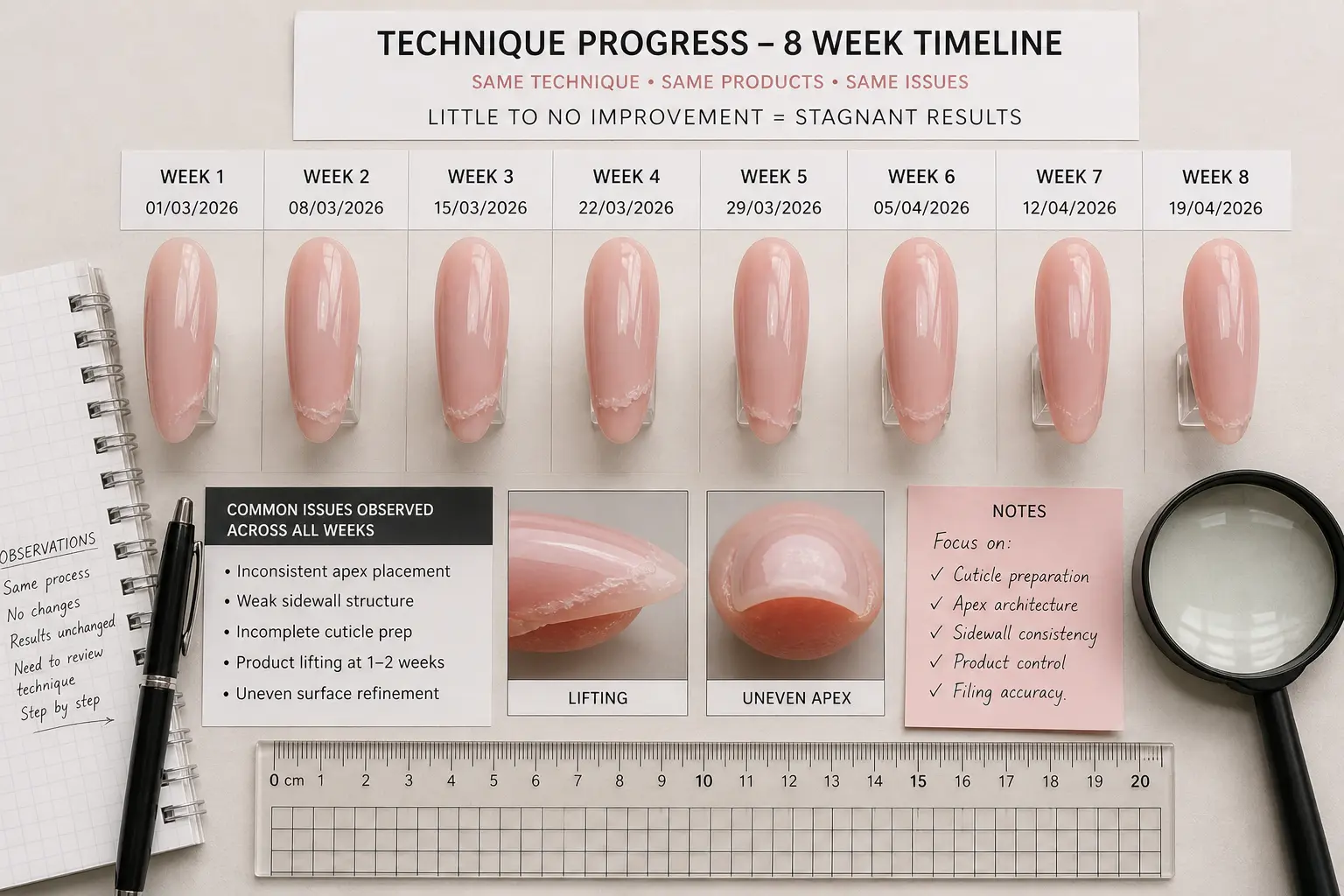
After basic training, you are expected to assess your own work and identify areas for improvement. But accurate self-assessment requires a reference standard you can compare against. Most nail technicians do not have this.
You think your preparation is thorough because you buffed the nail. You do not know that professional preparation requires complete oil removal, moisture elimination and surface texture verification that your buffing did not achieve. You think your apex is correctly placed because it looks centred. You do not know that correct apex placement relates to the nail’s stress curve, not just visual centre, and yours is positioned too far forward.
Without accurate self-assessment ability, practice does not improve technique. It reinforces whatever execution pattern you currently use, correct or incorrect. This is how nail technicians spend years working without meaningful improvement.
What Happens When No One Corrects Your Errors
Basic training typically includes no performance testing, work submission or technical feedback. You watch demonstrations, you practice, you assume your technique is correct if clients do not complain. This assumption is often wrong.
Your gel applications lift occasionally but not always, so you blame client lifestyle rather than identifying the preparation gap. Your apex structure looks acceptable from above but lacks proper stress distribution, so you do not recognise the structural weakness until enhancements break. Your filing pressure is too heavy, but the damage accumulates slowly enough that you do not connect it to your technique.
Professional errors that go uncorrected become professional habits. Years later, you are still making the same technical mistakes you made in your first month, because no one ever identified them or showed you the correction.
How Advanced Training Differs from Basic Training
Advanced online nail courses do not just teach new techniques. They teach you to diagnose existing technique, identify specific errors and apply targeted corrections. This changes how you approach every application.
Where basic training shows you one correct method, advanced training shows you multiple execution variations and explains when each is appropriate. Where basic training demonstrates perfect results, advanced training demonstrates common failures and walks through the diagnostic process that identifies their cause. Where basic training assumes you will self-correct, advanced training provides structured feedback on your submitted work.
This is not about learning more techniques. It is about developing the assessment and correction ability that allows you to execute existing techniques to professional standard.
The Role of Performance Feedback
You cannot accurately assess what you do not yet understand. This is why professional development requires external feedback from someone who can identify errors you do not recognise and explain corrections you have not considered.
Advanced online nail courses include work submission and technical review. You complete an application following course instruction. You photograph your result. An educator assesses your preparation quality, product placement, structural accuracy and finish standard, then identifies the specific technical gaps present and provides the exact corrections required to meet professional benchmarks.
This feedback reveals gaps you could not self-diagnose: that your “thin layer” is thicker than professional standard, that your lateral seal coverage misses the stress point, that your apex curvature creates structural weakness. You make the specific adjustment. Your technique improves. This is how you break the plateau.
Why Random Practice Does Not Fix Systematic Errors
Many nail technicians respond to the plateau by practising more. They complete more applications, hoping repetition will improve results. It does not, because practice without correction reinforces existing errors.
If your preparation protocol has a systematic gap, completing fifty more applications with that same protocol will not eliminate the gap. If your apex placement follows an incorrect reference point, practising the placement five hundred times will not move it to the correct position. Random practice improves speed. It does not improve accuracy unless you know what accurate execution looks like and can identify when you deviate from it.
Advanced training provides the diagnostic framework that makes practice effective. You learn what correct looks like. You learn to recognise deviation. You learn the specific correction that eliminates it. Then practice reinforces correct execution rather than incorrect habits.
What Breaking the Plateau Requires
The plateau is not a talent limit. It is a training gap. Basic courses give you enough knowledge to achieve basic results. Advanced courses give you the diagnostic and correction skills required to achieve professional results consistently.
If your technique has not improved significantly in the past year despite regular practice, the limitation is not your ability. It is the absence of structured diagnostic training and performance feedback. This is what advanced online nail courses provide.
Break the Plateau with Diagnostic Training
Artistic Touch advanced online nail courses teach error recognition, diagnostic assessment and performance correction. Learn what professional standard execution looks like and how to achieve it consistently.
View Advanced Courses →Lifetime access • Private student community • Start immediately
Frequently Asked Questions
How do I know if I have plateaued in my nail technique?
You have plateaued if your work quality has not improved significantly despite regular practice, if you encounter the same technical problems repeatedly without resolving them, or if you cannot identify specific areas for improvement beyond “get better.” Plateau indicates that you lack the diagnostic skills needed to self-correct rather than a skill limit.
Will more practice improve my nail technique?
Practice improves technique only when you know what correct execution looks like and can identify deviations from it. Random practice without diagnostic ability reinforces existing errors rather than correcting them. Effective practice requires knowing what to change and how to change it, which requires structured instruction and feedback.
What is the difference between basic and advanced nail training?
Basic training teaches application procedures and demonstrates correct results. Advanced training teaches diagnostic assessment, error recognition and correction protocols. Basic training shows you what to do. Advanced training teaches you how to identify when your execution deviates from standard and what specific adjustment will correct it.
How long does it take to break through a technical plateau?
Breaking a plateau depends on identifying the specific gaps in your technique and applying targeted corrections. With structured diagnostic training and performance feedback, most nail technicians see measurable improvement within 4-8 weeks of focused practice. Without diagnostic guidance, plateaus can persist indefinitely despite regular work.
Can online courses provide effective advanced training?
Online courses that include work submission, technical assessment and specific performance feedback can provide highly effective advanced training. The critical elements are diagnostic instruction, demonstration of common errors and their corrections, and individualised feedback on your actual technique execution rather than generic instruction.
Do I need advanced training if I already have clients?
Having clients confirms basic competence but does not indicate professional standard execution. If you experience recurring technical issues, inconsistent results or client retention challenges, advanced training that addresses diagnostic skills and error correction will improve both your work quality and business outcomes.
About the Author
Radina Ignatova
Professional Nail Expert | International Nail Educator
I am Radina Ignatova, a Professional Nail Expert since 2014 and International Nail Educator, based in Scotland, UK. I am the Founder of Artistic Touch Nail Training Academy and TheNailWiki.
At Artistic Touch Nail Training Academy, I provide structured professional online nail courses specialising in dual forms, gel systems, polygel application, advanced nail structure, E-File work and Russian Manicure, with a strong focus on professional salon safety. I continue to work actively in salon practice, ensuring that all education reflects real client scenarios and current industry standards.
My teaching philosophy is simple: I show real salon challenges, real mistakes and real performance testing, not just perfect demonstrations. This is how you develop genuine technical competence and become a confident, capable nail professional.
Every Artistic Touch course includes lifetime access and access to a dedicated student support group, where I provide ongoing guidance and professional feedback.
Disclaimer: This content is for educational purposes only. Nail services should be performed by trained professionals following current hygiene and safety regulations. Always carry out a full client consultation and check for contraindications before performing any nail service.
About Artistic Touch Nail Training Academy
Artistic Touch Nail Training Academy delivers structured professional online nail education focused on practical skill development, professional standards and safe salon practice. All courses are available online worldwide.