How to Improve Your Nail Technique After Basic Training
Quick Answer: How Do You Improve Nail Technique After Basic Training?
Improving nail technique after basic training requires diagnostic assessment of your current execution, identification of specific technical gaps, targeted correction practice and external performance feedback. Random practice without diagnostic ability reinforces existing errors rather than correcting them.
This article explains the specific steps required to move from basic competence to professional standard execution.
Why Practice Alone Does Not Improve Technique
After completing basic nail training, most nail technicians assume that continued practice will naturally improve their technique. They complete applications regularly, expecting gradual refinement through repetition. Months later, their work quality remains essentially unchanged.
This happens because practice without diagnostic ability does not produce improvement. It produces repetition. If your preparation protocol has a systematic gap, practising that protocol five hundred times will not eliminate the gap. If your apex placement follows an incorrect reference point, additional repetitions will not move it to the correct position.
Technique improvement requires knowing what correct execution looks like, recognising when your execution deviates from it and understanding which specific adjustment will bring it to standard. These are diagnostic skills, not practice hours.
Establish Measurable Performance Standards
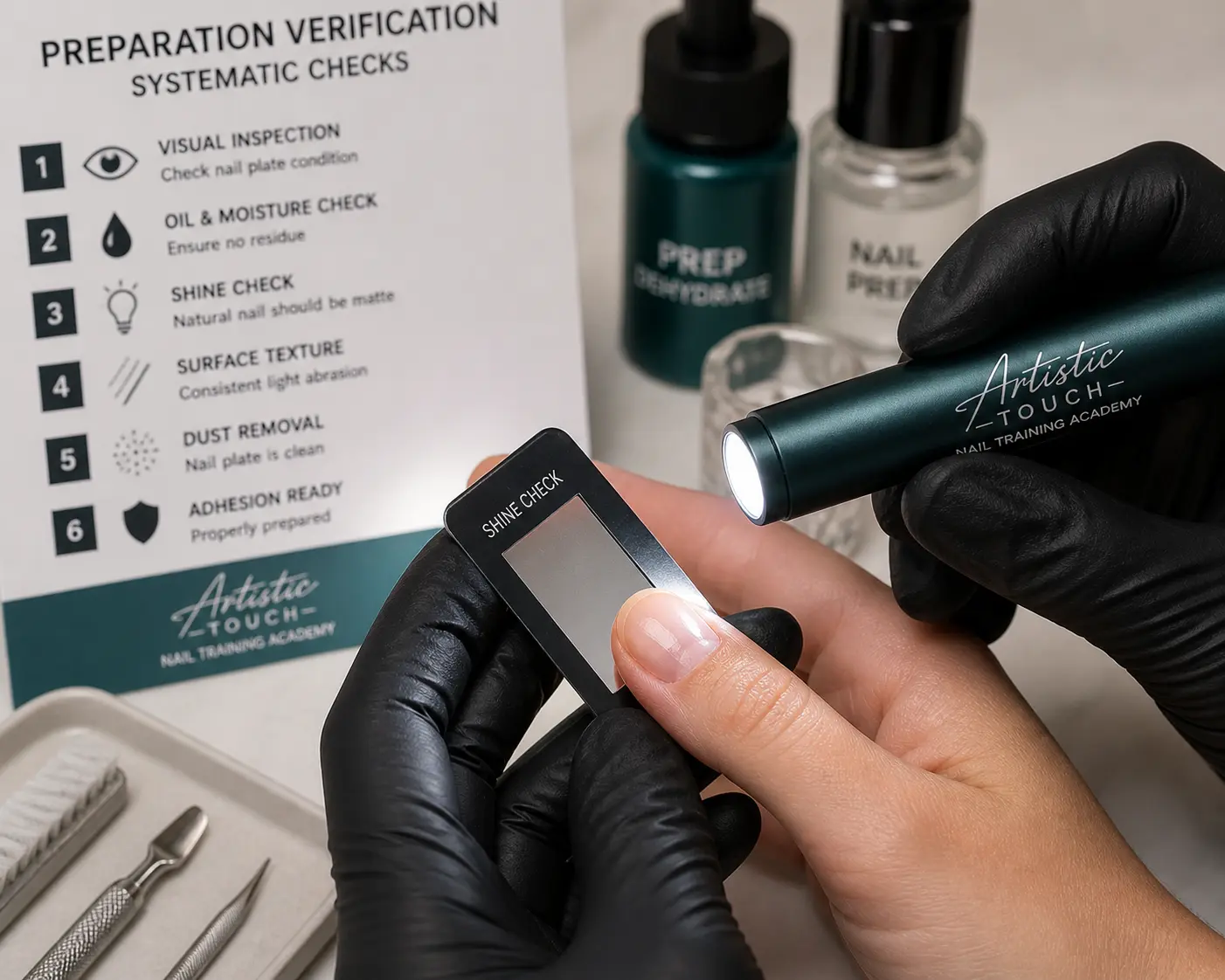
You cannot improve what you cannot measure. Professional technique development requires concrete performance benchmarks you can assess your work against, not subjective impressions of whether something “looks good.”
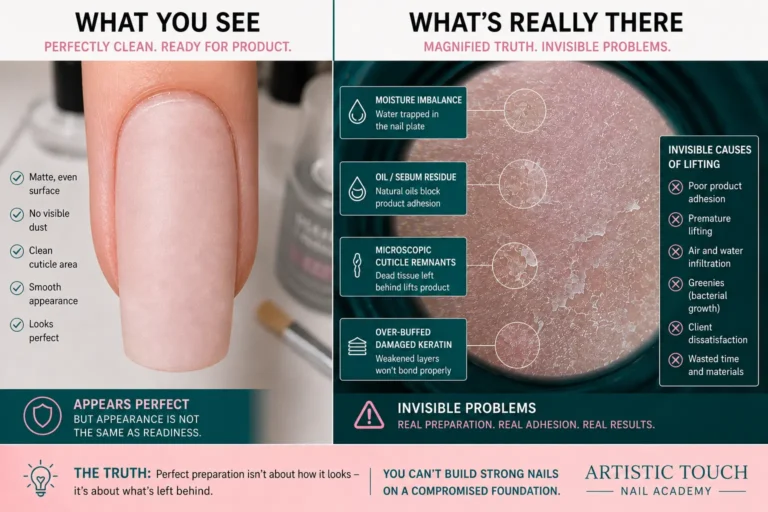
Professional standards for nail preparation include complete oil removal verified by absence of surface shine, appropriate surface texture for mechanical bond, elimination of previous product residue and moisture removal from lateral folds. Your preparation meets standard or it does not. There is no subjective middle ground.
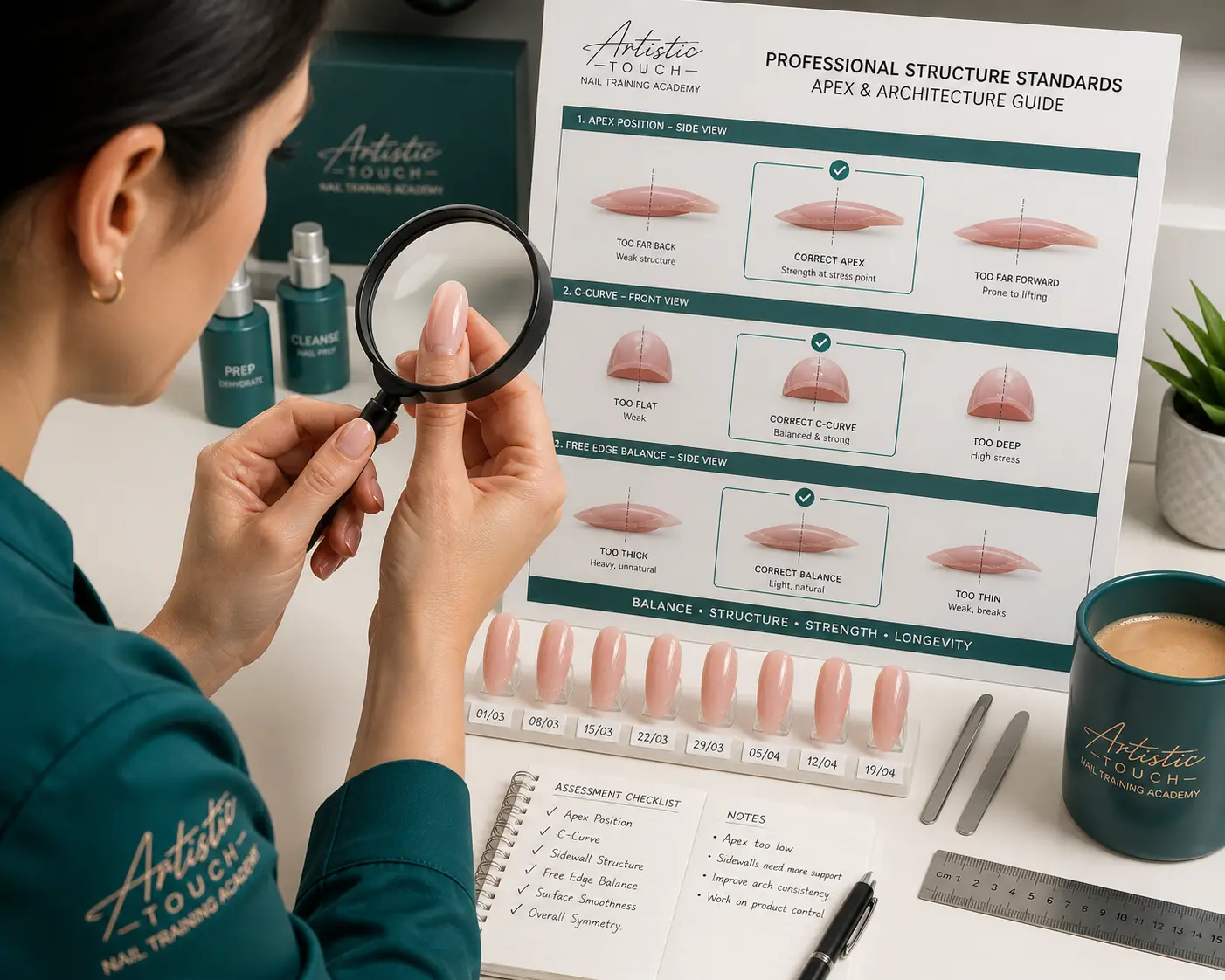
Professional standards for apex placement relate apex position to the nail’s natural stress curve, not visual centre. Professional standards for product curing require complete polymerisation verified by absence of tacky residue and proper hardness. These are measurable criteria. Assess your work against them. Identify gaps. Correct them systematically.
Learn to Recognise Technical Errors Before They Become Failures
Most nail technicians discover technical errors only after enhancements fail: lifting occurs, structure breaks, finish dulls. By this point, the client has already experienced the failure. Professional technique requires identifying errors before they progress to visible failure.
This means learning what inadequate preparation looks like before product application, what incorrect product viscosity behaves like during placement, what improper apex structure appears like before stress testing. You develop the ability to assess each stage of execution and catch deviations immediately rather than discovering them when the enhancement fails days later.
Courses that demonstrate only perfect applications do not teach error recognition. You need training that shows you common mistakes as they occur, explains their mechanical cause and demonstrates the correction sequence that prevents them.
Diagnostic Questions to Ask During Each Application
Professional nail technicians assess their work continuously during application, not just at completion. After preparation: Is the surface completely matte with no shine remaining? After dehydrator application: Did product reach the lateral folds and under the free edge? After product placement: Did the gel self-level correctly or are there visible ridges? After curing: Is the surface properly hardened with no flex under pressure?
These diagnostic checks identify problems while correction is still possible. When you complete an application and only then discover that preparation was inadequate or product placement was incorrect, the opportunity for correction has passed.
Seek External Performance Feedback
Self-assessment has inherent limitations. You cannot accurately evaluate execution quality for skills you are still developing, because you do not yet have the reference standard required to recognise deviations.
External feedback from an experienced educator identifies technical gaps you cannot self-diagnose. They see that your “thin layer” exceeds professional thickness standard, that your filing pressure damages the nail plate, that your lateral seal misses the stress concentration point. These are errors you would not recognise without external assessment because they appear acceptable to you.
Professional online nail courses that include work submission and technical review provide this feedback loop. You complete an application. You photograph your result. An educator assesses your work against professional benchmarks and provides specific corrections. You apply the correction. Your technique improves measurably.
Practice Corrections, Not Just Applications
Completing full applications builds speed and workflow efficiency. It does not necessarily improve technical accuracy. To improve accuracy, you must practise the specific corrections required to bring your technique to professional standard.
If your apex placement is systematically incorrect, dedicate practice sessions specifically to apex placement using proper reference points. If your lateral seal coverage is incomplete, practise lateral seal technique in isolation until coverage meets standard. If your filing pressure is too heavy, practise controlled pressure application before attempting full refinement sequences.
Targeted correction practice is more effective than random application repetition because it focuses effort on the specific technical gap that limits your performance rather than reinforcing existing execution patterns.
Understand Product Behaviour and Material Science
Professional nail technique requires understanding why products behave as they do, not just how to apply them. When you understand the material science, you can diagnose problems and adapt technique to different conditions.
You need to understand how UV wavelength and lamp output affect curing completeness, how humidity influences product viscosity, how temperature changes affect self-levelling behaviour, how product chemistry determines compatible primers and base coats. This knowledge allows you to identify why an application failed and what environmental or technical adjustment will prevent recurrence.
Courses that teach only application steps without explaining underlying product behaviour leave you unable to troubleshoot when conditions differ from the demonstration environment.
Document Your Progress with Objective Measurements
Subjective assessment—”this looks better than last week”—does not produce reliable improvement tracking. Use objective measurements: photograph each application under consistent lighting, measure enhancement longevity before lifting occurs, count technical errors per application session, track client retention rates.
These metrics reveal whether your technique is actually improving or whether perceived progress is confirmation bias. When measurements show consistent improvement, your practice approach is effective. When they do not, your approach requires adjustment regardless of subjective impressions.
What Professional Skill Development Requires
Moving from basic competence to professional standard execution is not automatic. It requires diagnostic training, measurable performance standards, error recognition ability, external feedback and targeted correction practice.
Most nail technicians complete basic training and then attempt self-directed improvement without these elements. Years later, their technique remains essentially unchanged because they lack the diagnostic framework required to identify and correct systematic errors. Professional online nail courses provide this framework.
Structured Training for Measurable Improvement
Artistic Touch online nail courses teach diagnostic assessment, demonstrate error recognition and provide professional feedback on your submitted work. Learn what professional technique looks like and how to achieve it consistently.
View All Courses →Lifetime access • Private student community • Start immediately
Frequently Asked Questions
How long does it take to improve nail technique after basic training?
Improvement timeline depends on the quality of diagnostic training and feedback you receive. With structured instruction that includes performance assessment and specific corrections, most nail technicians see measurable improvement within 4-8 weeks of focused practice. Without diagnostic guidance, improvement can take months or years if it occurs at all.
What is the fastest way to improve nail technique?
The fastest improvement comes from identifying your specific technical gaps through professional assessment, then practising targeted corrections rather than random full applications. One focused correction session addressing a diagnosed error produces more improvement than ten general practice sessions without diagnostic direction.
Can I improve my nail technique without taking another course?
Self-directed improvement is possible if you can accurately diagnose your technical errors and know the specific corrections required. However, most nail technicians lack this diagnostic ability after basic training, which is why their technique does not improve despite regular practice. Structured courses with performance feedback accelerate improvement by identifying gaps you cannot self-diagnose.
What should I focus on first when improving nail technique?
Focus first on preparation standards and product application fundamentals. These are the foundation skills that affect every enhancement you create. If preparation is inadequate or product placement is incorrect, advanced refinement techniques will not compensate. Master foundational execution before progressing to advanced methods.
How do I know if my nail technique is professional standard?
Professional standard execution produces consistent results that last 2-3 weeks minimum without lifting or structural failure, demonstrates proper apex placement relative to nail stress curves, shows complete stress point coverage and maintains client nail health throughout service cycles. If you experience frequent failures, inconsistent longevity or client nail damage, your technique has not yet reached professional standard.
Do I need professional feedback to improve my nail technique?
Professional feedback significantly accelerates improvement because it identifies technical errors you cannot self-diagnose. While some improvement is possible through self-directed practice, most nail technicians overestimate their execution accuracy and miss systematic errors that an experienced educator would identify immediately.
About the Author
Radina Ignatova
Professional Nail Expert | International Nail Educator
I am Radina Ignatova, a Professional Nail Expert since 2014 and International Nail Educator, based in Scotland, UK. I am the Founder of Artistic Touch Nail Training Academy and TheNailWiki.
At Artistic Touch Nail Training Academy, I provide structured professional online nail courses specialising in dual forms, gel systems, polygel application, advanced nail structure, E-File work and Russian Manicure, with a strong focus on professional salon safety. I continue to work actively in salon practice, ensuring that all education reflects real client scenarios and current industry standards.
My teaching philosophy is simple: I show real salon challenges, real mistakes and real performance testing, not just perfect demonstrations. This is how you develop genuine technical competence and become a confident, capable nail professional.
Every Artistic Touch course includes lifetime access and access to a dedicated student support group, where I provide ongoing guidance and professional feedback.
Disclaimer: This content is for educational purposes only. Nail services should be performed by trained professionals following current hygiene and safety regulations. Always carry out a full client consultation and check for contraindications before performing any nail service.
About Artistic Touch Nail Training Academy
Artistic Touch Nail Training Academy delivers structured professional online nail education focused on practical skill development, professional standards and safe salon practice. All courses are available online worldwide.