Testing Sandwich Dual Forms for the First Time – Honest Mistakes
What Happens When You Test Sandwich Dual Forms Wrong?
This video shows every mistake I made testing sandwich dual forms for the first time: thick decorations blocking product flow, flash curing sections instead of pressing everything at once, forcing bottom forms onto hooked nails, and poor product placement causing gaps at sidewalls.
These mistakes are common because sandwich dual forms work completely differently than regular dual forms — treating them the same way creates structural problems that show up immediately.
Watch: Testing Sandwich Dual Forms for the First Time
This video documents my first attempt with sandwich dual forms using a frosty snowflake design. You will see exactly what went wrong, why these mistakes happened, and what the finished nails looked like despite the structural problems.
Five Critical Mistakes Shown in This Video
After analysing this first attempt, I identified five major mistakes that caused structural problems, gaps, and poor retention:
1. Placing Thick Decorations Inside the Form
Putting gems and rhinestones inside the dual form prevented the polygel from reaching the sidewalls and stress points, creating massive gaps and weak structure.
2. Flash Curing Like Regular Dual Forms
Flash curing the cuticle area first (like you would with regular dual forms) created uneven pressure distribution and prevented proper seal formation. Sandwich forms require pressing everything at once and curing fully.
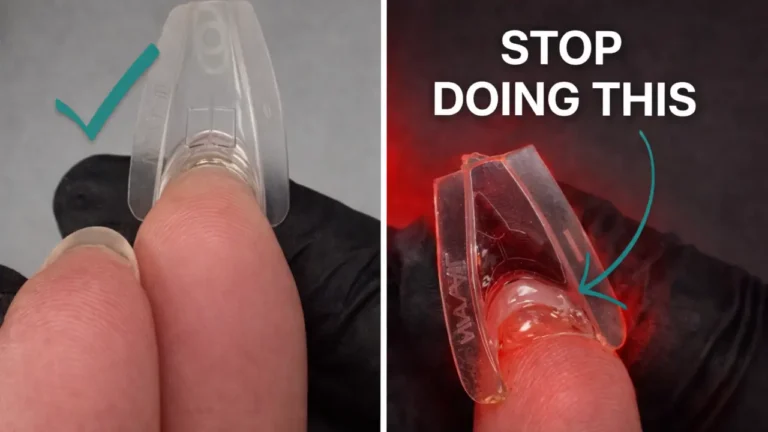
3. Forcing the Bottom Form on Hooked Nails
On nails that curve downward (hooked nails), forcing a flat dual form bottom created gaps underneath and made the nail sit too high. The solution is to skip the bottom form entirely and file the underneath to match the natural curve.
4. Poor Product Placement
Not spreading the product to the edges of the form before application caused flooding at the cuticle and insufficient coverage at the sidewalls where structural support is needed most.
5. Not Checking the Seal Before Curing
Pressing the form onto the nail and curing immediately without checking from different angles meant I missed visible gaps that guaranteed lifting after curing.
What You Will See in This Video
- Complete nail prep process with dehydrator and flexible base coat application
- Mixing chrome powders, gel polish, and pigments into polygel for the frosty ombre effect
- Creating 3D snowflakes using builder gel and silicone moulds
- Placing decorations inside the dual form with top coat
- Applying the sandwich dual form bottom with base coat (my preferred method to avoid skin contact)
- Pressing technique and flash curing process
- Visible gaps, holes, and structural problems as they happened
- Attempting to fix mistakes with additional product
- Filing and refining the finished nails with carbide cone drill bit
- Honest commentary on what went wrong and why
⚠️ Critical Safety Warning About Mixing Products
Do not put too much gel polish, pigment, or chrome powder into polygel. Changing the chemistry too much can prevent proper curing, weaken the structure, and potentially cause allergic reactions. Always use small amounts only and cure a test piece first to ensure it sets properly.
Watch the Corrected Technique
This video shows what went wrong. However, seeing mistakes once is not the same as understanding how to prevent them consistently across different nail types and client situations.
After filming this first attempt, I analysed every mistake and created a corrected version showing all five problems fixed. The difference was dramatic — professional structure, no gaps, proper strength, and beautiful results.
Master the Full Sandwich Dual Forms System
Learning proper technique from the start prevents these costly mistakes and builds the confidence that comes from genuinely understanding how sandwich dual forms work — and that is exactly what I teach inside my Sandwich Dual Forms Online Course.
Related Tutorials
This is Part 1 of the Sandwich Dual Forms tutorial series. Watch the other parts to see the complete process:
- Part 2: Corrected Technique — See all five mistakes fixed with professional results
- Complete Sandwich Dual Forms Guide — Full technical guide on TheNailWiki covering all aspects of the sandwich dual form system
About the Author

Radina Ignatova
Professional Nail Expert | International Nail Educator
I am Radina Ignatova, a Professional Nail Expert since 2014 and International Nail Educator, based in Scotland, UK. I am the Founder of Artistic Touch Nail Training Academy and TheNailWiki.
At Artistic Touch Nail Training Academy, I provide structured professional online nail courses specialising in dual forms, gel systems, polygel application, advanced nail structure, E-File work and Russian Manicure, with a strong focus on professional salon safety. I continue to work actively in salon practice, ensuring that all education reflects real client scenarios and current industry standards.
My teaching philosophy is simple: I show real salon challenges, real mistakes and real performance testing, not just perfect demonstrations. This is how you develop genuine technical competence and become a confident, capable nail professional.
Every Artistic Touch course includes lifetime access and access to a dedicated student support group, where I provide ongoing guidance and professional feedback.
Disclaimer: This content is for educational purposes only. Nail services should be performed by trained professionals following current hygiene and safety regulations. Always carry out a full client consultation and check for contraindications before performing any nail service.
About Artistic Touch Nail Training Academy
Artistic Touch Nail Training Academy delivers structured professional online nail education focused on practical skill development, professional standards and safe salon practice. All courses are available online worldwide.