The Real Reason Nail Prep Fails: You Were Trained To Follow Routine, Not Understand Structure
The Core Problem
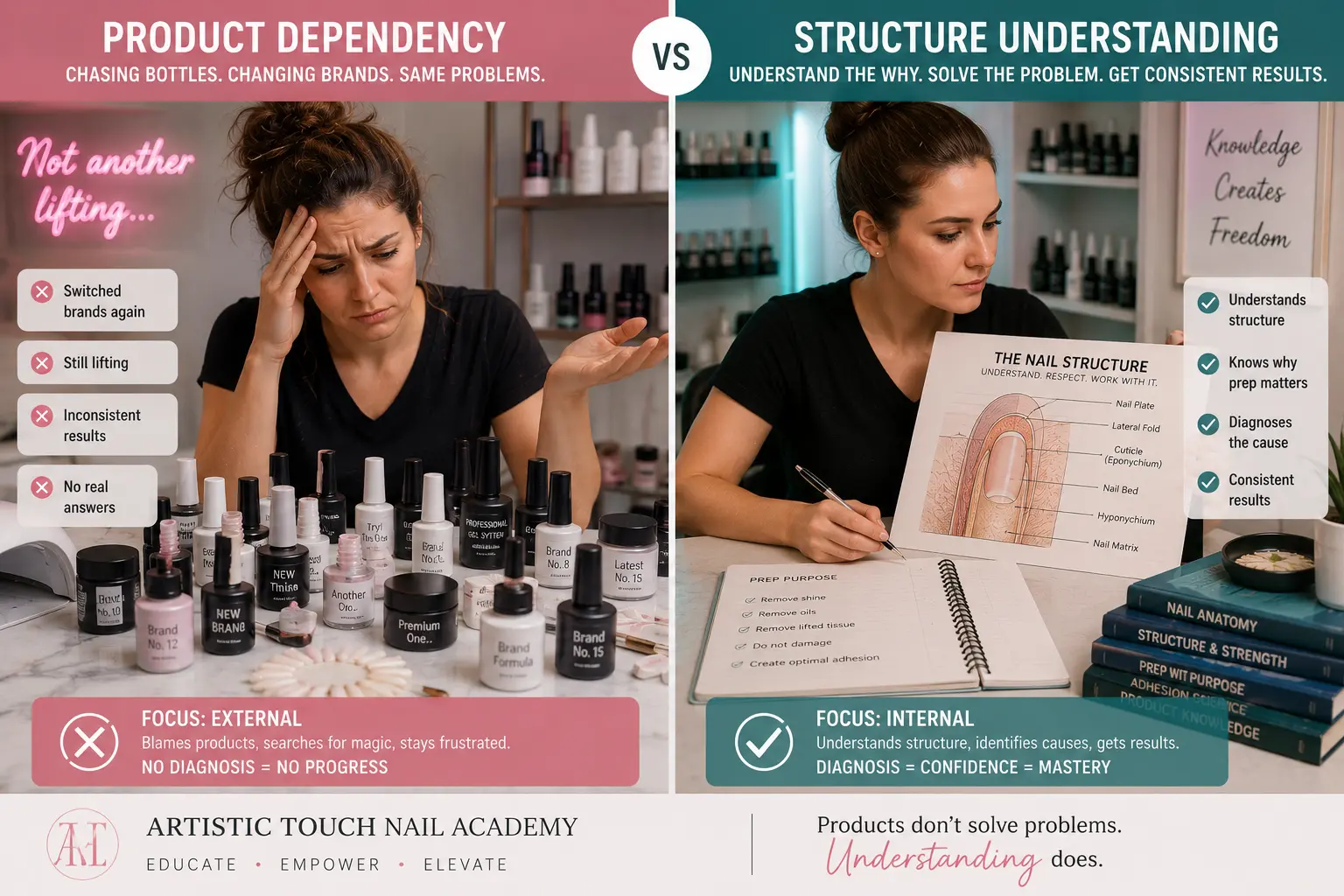
You can execute preparation perfectly and still fail because you were taught what to do but not why it works. This creates a devastating gap: when preparation fails, you cannot diagnose the cause because you do not understand the mechanisms you were executing. You repeat the same routine hoping it works differently. You blame products. You switch brands constantly. You never develop the diagnostic thinking that would reveal what actually failed and how to fix it.
This article explains why that gap exists and why it keeps you stuck in cycles of inconsistent results.
The Emotional Experience of Knowing What To Do But Not Why
You know your routine perfectly. Dehydrate for thirty seconds. Buff in one direction. Apply primer and wait. Cleanse with alcohol. Apply base coat. You have executed this sequence hundreds of times. You know exactly what to do. But when lifting occurs, you cannot explain why. You have no framework for understanding what went wrong. You only know that the routine failed. So you repeat the routine, hoping for different results. The lifting continues. You experience the growing frustration of being mechanically competent but diagnostically helpless.
This is the emotional core of inconsistent nail work: you are executing correctly but failing mysteriously. You did everything you were taught to do. Everything felt right. The routine was perfect. So when failure occurs, confusion is the natural response. What could you have possibly done wrong when you followed the exact procedure? The answer is that the procedure was never designed to work universally. It was designed to work on average nails under average conditions. The unique conditions of this specific nail broke the average routine. But you do not understand the routine’s limitations because you do not understand why it works. So you cannot recognise when conditions fall outside the procedure’s design parameters.
Procedures Versus Understanding: The Invisible Boundary
You learned procedures. A procedure is a fixed sequence. Do A, then B, then C. The sequence produces reliable results when conditions match the assumptions the procedure was designed for. But the assumptions are usually hidden. You are never told what conditions the procedure assumes. You are just told: follow these steps.
Understanding is different. Understanding the biological and chemical mechanisms means you know why each step matters. You know what conditions the step addresses. You know how to adapt the step when conditions differ from the standard. This is the gap: you can execute procedures without understanding. But you cannot adapt procedures or troubleshoot failures without understanding.
Professional nail techs operate from understanding. They know why dehydration matters—removing moisture that interferes with adhesion chemistry. But they also know that different nails start with different baseline moisture levels. So they adapt dehydration to what they observe. They know why buffing removes shine—creating surface texture that product can grip. But they also know that different nails have different keratin density. So they adapt buffing pressure accordingly. This adaptation is only possible through understanding.
Procedures teach you what to do. Understanding teaches you why you are doing it and how to adjust when conditions change.
Why The Confidence From Product Switching Is False
When preparation fails consistently, product switching feels like decisive action and progress. You research new BIAB brands. You order samples. You test a new system. Sometimes the new product performs better. You feel like you solved the problem. You recommend the new brand to other technicians. The cycle perpetuates: everyone is constantly switching products believing each new brand might be the one that finally creates reliable retention.
This product-switching cycle is psychologically comforting because it gives you something to do. You cannot see the invisible preparation failures. But you can buy a different product. So you buy. When the new product works (sometimes temporarily, sometimes coincidentally with a nail that had better conditions), the false solution feels confirmed. When it fails, you assume you need a different product still. You never question whether the preparation failure is independent of product choice.
Professional understanding recognises that products perform according to their chemistry. When chemistry fails, the cause is at the bonding surface—moisture imbalance, contamination, structural damage. None of these are product problems. All of them are preparation problems. Switching products does not address preparation failures. It only creates the illusion of progress through trial and error that occasionally happens to work.
The Invisible Structural Realities You Cannot See
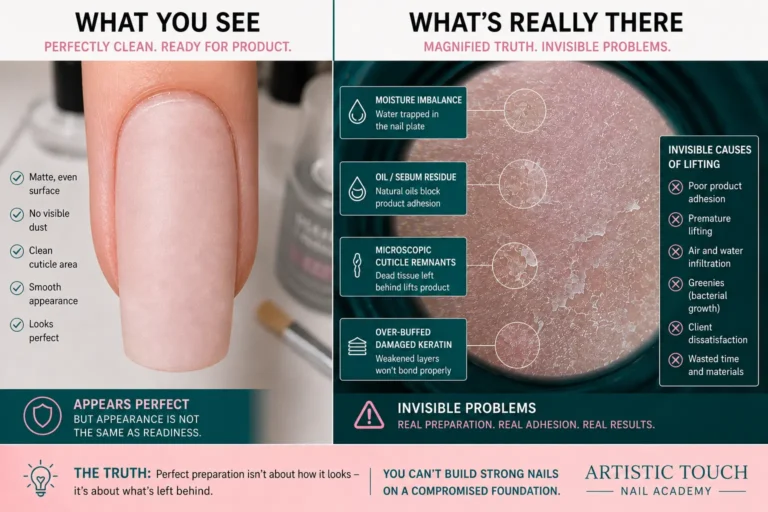
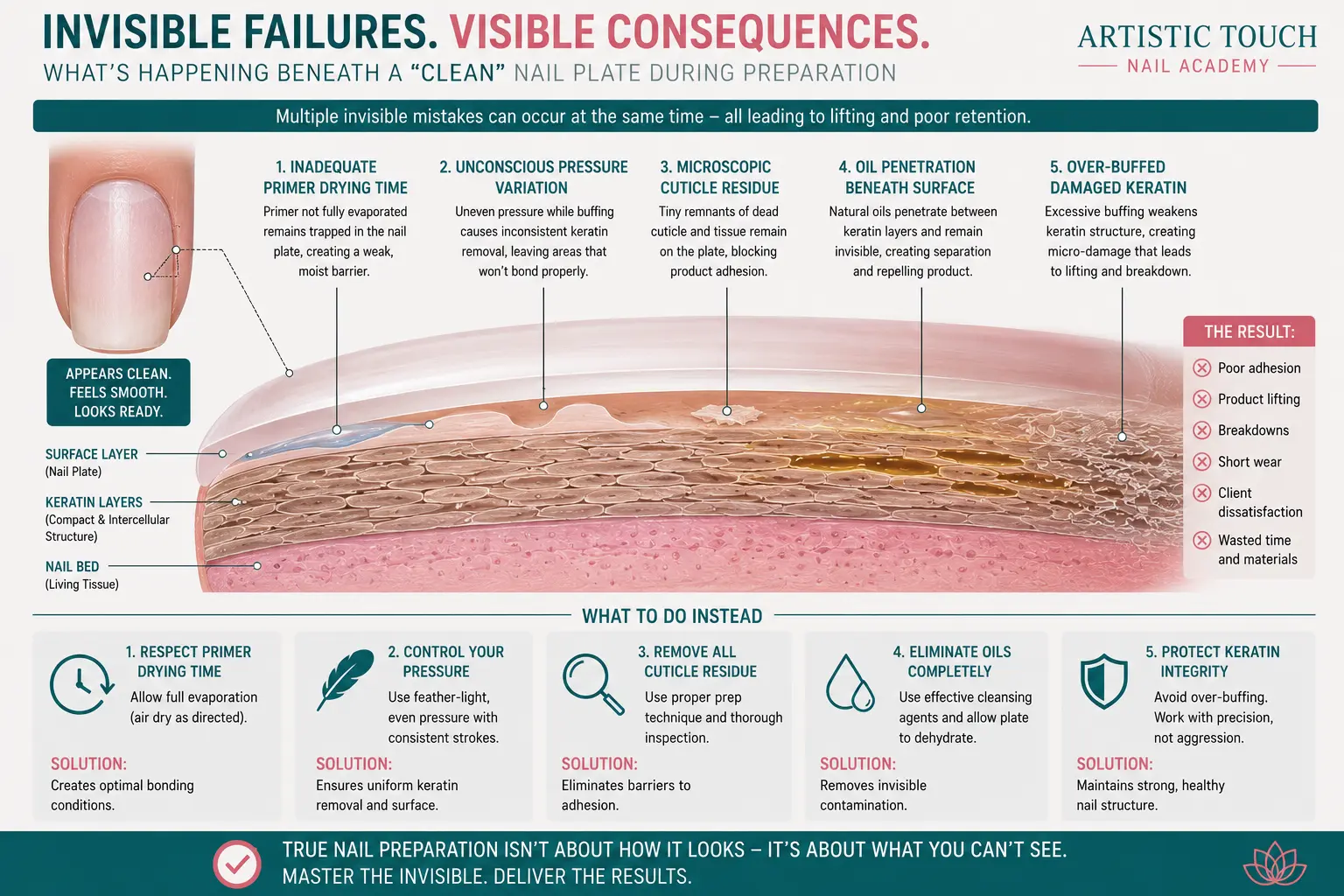
Your buffing created microscopic stress fractures in the keratin from excessive pressure. You cannot see these fractures. They will fail under the mechanical stress of wear. Or your dehydration removed not just surface moisture but the biological moisture the nail needs for flexibility. The nail becomes brittle. You cannot see the brittleness. It will fracture under the stress of normal movement. Or your over-filed edges created weak structural points. You cannot see the weakness. The enhancement will fail there first.
These invisible structural failures are predetermined by specific preparation actions. They are not random. They are not luck. They are direct consequences of specific technique choices. But those consequences are invisible until product performance reveals them days later. So they feel random and inexplicable. You assume bad luck or product inadequacy. Actually, invisible preparation damage was developing predictably based on your specific technique choices.
Understanding these invisible mechanisms is where diagnostic thinking begins. You stop asking “what product should I use?” and start asking “what preparation gaps would cause this specific failure pattern?” Proximal lifting reveals cuticle contamination or oil penetration. Sidewall lifting reveals inadequate adhesion or mechanical stress. Free edge lifting reveals structural weakness. These patterns point directly to specific preparation causes. But you can only make these connections if you understand the mechanisms that create the patterns.
The Frustration Of Incompetence Despite Feeling Competent
You execute your routine confidently. You feel competent performing the steps. The nails look properly prepared. You feel like you are doing everything right. Then lifting occurs and you experience cognitive dissonance. You felt competent but produced failure. This is more psychologically painful than knowing you made a clear mistake. A clear mistake you can correct. But feeling competent while failing suggests something is fundamentally wrong with your understanding, not just your execution.
This is where many nail techs experience self-doubt. They question their basic competence. They wonder if they are genuinely bad at nail work. The answer is more subtle: you are competent at executing procedures. You are incompetent at diagnosing when procedures are inappropriate. This is not a personal failure. This is a training gap. You were taught procedures. You were not taught diagnostic thinking. So you feel like you are doing everything right while mysterious failures persist.
Breaking this pattern requires a painful shift: accepting that procedural competence is only half of professional capability. The other half—diagnostic understanding—requires learning why procedures work, not just what they accomplish.
Why Rushing Creates The Illusion Of Problem-Solving
You experience consistent lifting. You assume the problem is inadequate time spent on preparation. So you spend more time on each step. You buff longer. You dehydrate longer. You apply more primer. You work harder. Sometimes this coincidentally works—the nails you spend extra time on sometimes hold better. You interpret this as confirmation that you needed to work harder. So you continue spending more time, hoping more work compensates for the unknown preparation gap.
But more work is not necessarily better work. Over-buffing damages adhesion. Over-dehydration makes keratin brittle. Over-applying primer creates thickness that traps solvents. More work creates different problems that look identical to inadequate work when product fails. You cannot distinguish between “I did not do enough” and “I did too much” without understanding what each step actually accomplishes. So you run in circles, working harder at steps that might be fundamentally inappropriate.
The False Certainty Of Visual Confirmation
Your preparation looks correct. The nail is matte. The surface is clean. The dehydrator has been applied. The primer is on. Everything looks like preparation should look. You feel certain you executed preparation properly. You proceed confidently. Lifting occurs. Now you experience the painful realisation: visual correctness does not indicate structural correctness. The nail looked properly prepared. Structurally it was not. You have no way of knowing the difference visually. So you cannot prevent the failure.
Professional understanding includes accepting this limitation: you cannot visually assess whether preparation will produce reliable adhesion. You can create conditions that support reliable adhesion. But you cannot confirm whether you created those conditions by looking. You can only confirm whether conditions are correct through product performance—which means by the time you discover a problem, the product is already applied and the failure pathway is established.
The Cycle: Procedure → Failure → Product Switching → Procedure
You execute procedure. Procedure fails on some nails. You blame the product. You switch brands. Sometimes the new product works better temporarily. You feel like you solved the problem. You return to using the original procedure. Failures resume on non-average nails. You blame the product again. You switch brands again. The cycle perpetuates because you never address the root cause: your procedure is only designed for average conditions. Non-average nails require procedure adaptation. But you do not understand the procedure well enough to adapt it. So you stay stuck in endless product switching.
Breaking this cycle requires developing understanding of what your procedures actually accomplish and why they fail on non-average nails. This understanding is what separates professional thinking from procedure-only execution.
Understanding Over Memorisation
Procedures can fail even when executed perfectly because procedures assume standard conditions. Real nails vary from standards. When you understand why each procedure step matters, you can recognise when the standard procedure is inappropriate and adapt accordingly. When you only memorise procedures without understanding, you repeat the same routine regardless of what the nail actually requires. The routine fails. You experience confusion because you cannot diagnose why. You switch products hoping chemistry will compensate for your preparation gaps. Professional thinking replaces this cycle with diagnostic understanding: what is this nail’s condition? What does it require? How should preparation adapt? This requires understanding, not just procedure execution.
Understand Why Preparation Works
The E-File Manicure and Gel Polish Online Course teaches understanding of biological and structural mechanisms—not just procedure memorisation that breaks down on non-average nails.
Enrol Now →Lifetime access • Start immediately • Learn at your own pace
Frequently Asked Questions
Why does my prep routine fail on some nails but work perfectly on others?
Procedures are designed for average conditions. Real nails vary from average: oily, dry, thin, thick, damaged, healthy. Your routine works on average nails because it matches their assumptions. It fails on non-average nails because those nails require procedure adaptation. Without understanding why each step matters, you cannot recognise when adaptation is needed. You repeat the same routine regardless of what the nail actually requires.
Why is switching products often not the solution?
Product switching creates illusion of progress through trial and error. Products perform according to chemistry. When chemistry fails, the cause is at the bonding surface—moisture imbalance, contamination, structural damage. These are preparation problems, not product problems. Switching products does not address preparation failures. Professional understanding recognises that reliable retention depends on preparation conditions far more than product choice.
How do invisible preparation failures develop if I execute my routine correctly?
Invisible failures like microscopic stress fractures, brittleness from over-dehydration and over-preparation damage develop directly from your specific technique choices. These consequences are invisible until product performance reveals them days later. They feel random but are predictable consequences of preparation technique. Understanding these mechanisms allows you to diagnose which specific preparation actions created the failure pattern you observe.
Why does working harder at preparation sometimes not fix lifting problems?
More work is not necessarily better work. Over-buffing damages adhesion. Over-dehydration creates brittleness. Over-applying primer traps solvents. More work creates different problems that look identical to inadequate work when product fails. Without understanding what each step actually accomplishes, you cannot distinguish between “not enough” and “too much.” You run in circles working harder at fundamentally inappropriate approaches.
How does understanding help when lifting still occurs despite correct preparation?
Understanding allows diagnosis. Different lifting patterns indicate different preparation causes. Proximal lifting reveals cuticle contamination or oil. Sidewall lifting reveals inadequate adhesion or mechanical stress. Free edge lifting reveals structural weakness. These patterns point to specific preparation gaps. Professional understanding transforms mysterious failures into diagnostic information you can learn from and prevent next time.
What is the difference between procedural competence and professional capability?
Procedural competence is executing steps correctly. Professional capability is understanding why steps work and how to adapt when conditions change. You can be procedurally competent—executing perfectly—while being professionally incompetent at diagnosing when procedures are inappropriate. Breaking this gap requires developing understanding that transforms procedure-following into diagnostic thinking.
About the Author
Radina Ignatova
Professional Nail Expert | International Nail Educator
I am Radina Ignatova, a Professional Nail Expert since 2014 and International Nail Educator, based in Scotland, UK. I am the Founder of Artistic Touch Nail Training Academy and TheNailWiki.
At Artistic Touch Nail Training Academy, I provide structured professional online nail courses specialising in dual forms, gel systems, polygel application, advanced nail structure, E-File work and Russian Manicure, with a strong focus on professional salon safety. I continue to work actively in salon practice, ensuring that all education reflects real client scenarios and current industry standards.
My teaching philosophy is simple: I show real salon challenges, real mistakes and real performance testing, not just perfect demonstrations. This is how you develop genuine technical competence and become a confident, capable nail professional.
Every Artistic Touch course includes lifetime access and access to a dedicated student support group, where I provide ongoing guidance and professional feedback.
Disclaimer: This content is for educational purposes only. Nail services should be performed by trained professionals following current hygiene and safety regulations. Always carry out a full client consultation and check for contraindications before performing any nail service.
About Artistic Touch Nail Training Academy
Artistic Touch Nail Training Academy delivers structured professional online nail education focused on practical skill development, professional standards and safe salon practice. All courses are available online worldwide.