Why Nail Prep Must Change For Different Nail Types: The Routine That Works Everywhere Actually Works Nowhere
The Uncomfortable Truth
You were taught one preparation routine for all nails. This routine works on some nails. It fails catastrophically on others. You interpret these failures as your inadequacy or the client’s problem nails. The real problem is that you are trying to apply a universal solution to non-universal biological variation. Professional preparation means accepting that no single routine works for all nails and developing the diagnostic skill to recognise which nail type you are encountering and how preparation must adapt.
When The Same Routine Produces Opposite Results
You prepare a thin flexible nail using your standard routine. You buff with normal pressure. The nail becomes dangerously fragile. Product lifts because the nail structure cannot support the enhancement. You prepare a thick rigid nail using identical routine. You buff with the same pressure. The surface is inadequately textured. Product lifts because adhesion surface is insufficient. The same routine produced opposite failures on opposite nail types. You experience confusion because you executed the procedure perfectly. The procedure itself was inappropriate for both nails.
This is the core problem nobody addresses in nail education: procedures are designed for average conditions. But nails are not average. They exist on spectrums: flexible to rigid, oily to dry, thin to thick, healthy to damaged. Your routine was designed for the middle of these spectrums. It fails at the extremes. When you encounter extreme nails, the routine fails not because you executed poorly but because the routine assumes conditions that do not exist.
Thin Flexible Nails: When Standard Prep Becomes Destruction
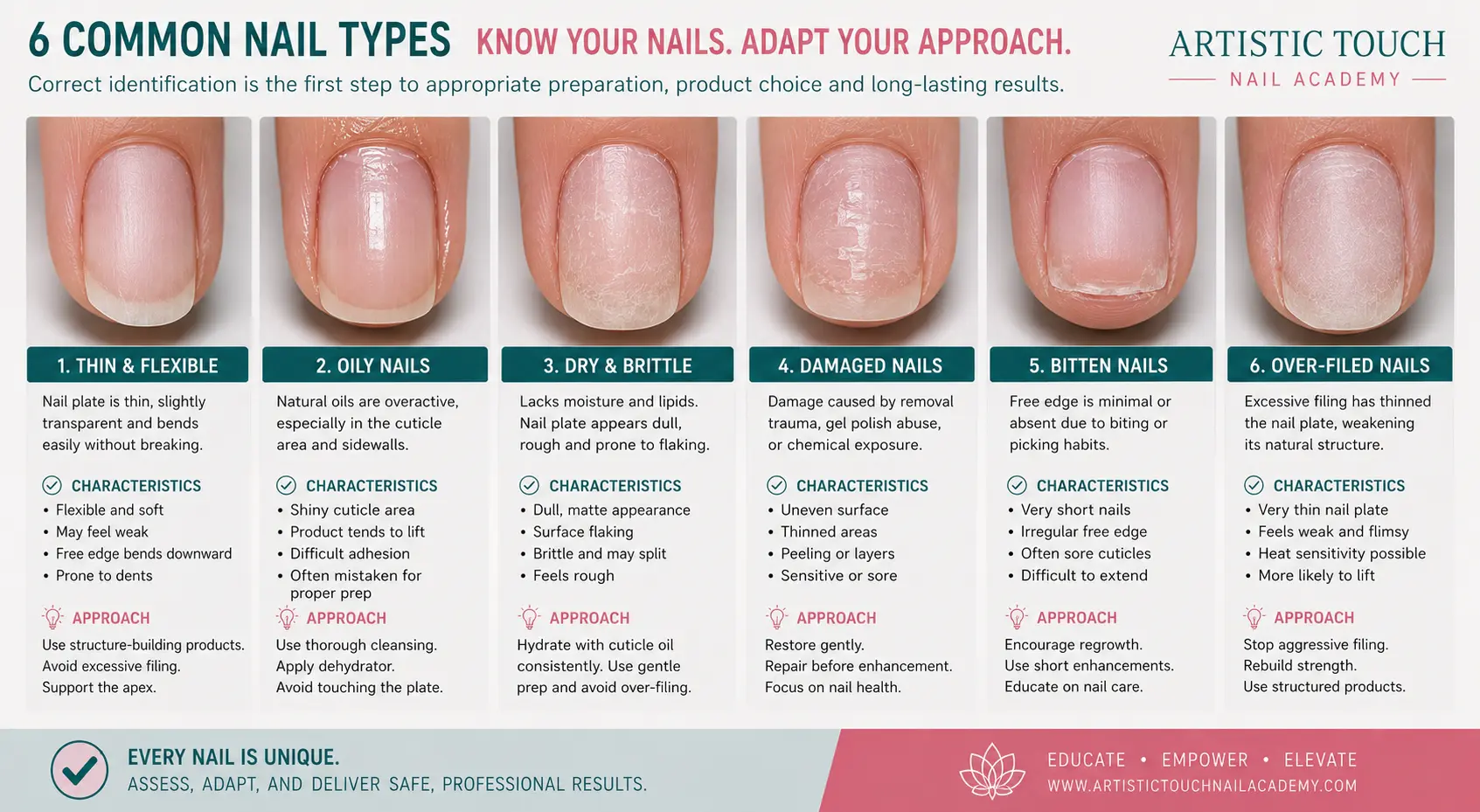
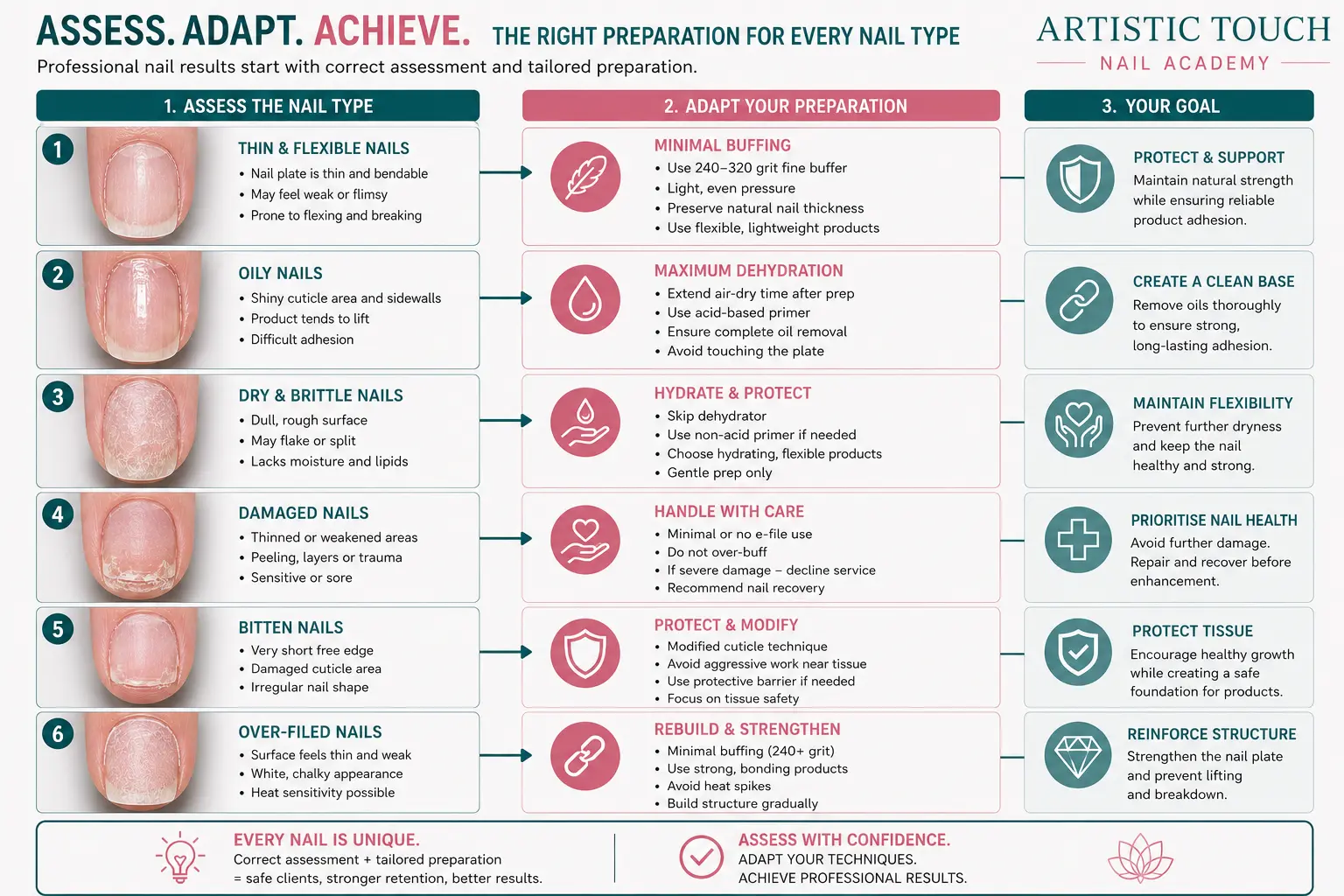
Thin flexible nails bend visibly when you press gently. They appear slightly transparent. They have limited keratin to work with. Your standard buffing removes material from already-inadequate structure. The nail becomes weaker, not stronger. Product adhesion fails not because preparation was insufficient but because preparation damaged the already-weak structure.
Additionally, thin nails flex during normal hand use. Product applied to flexing substrate experiences constant stress. If your standard preparation weakened the nail structure, the enhancement cannot withstand normal movement stress. Lifting occurs within days because you destabilised the platform the enhancement stands on. You interpret the failure as inadequate prep. Actually, you over-prepared a nail that needed minimal preparation.
Oily Nails: Continuous Oil Production Defeating Standard Dehydration
Standard dehydrator removes surface moisture. The nail appears properly prepared. The client’s nail bed continues producing oil. By the time you finish all ten nails, fresh oil has migrated to the surface of the first nails you prepared. Your dehydration was technically correct. Biologically, you lost the battle because you applied a one-time product to a continuous biological process.
Professional preparation on oily nails requires adapted strategy: extended dehydration, acid-based primers, working one nail at a time preventing re-contamination, possibly additional cleansing. These adaptations exist specifically because standard procedure is inadequate. If you do not know these adaptations exist, you repeat standard routine experiencing consistent failure and assuming the client’s “oily nail problem” cannot be solved. Actually, the client’s biology can be managed through adapted technique. You simply do not know the technique because education focused on teaching standard procedure.
Dry Brittle Nails: When Aggressive Prep Exacerbates Existing Problems
Dry nails appear dull and may show surface flaking. They lack flexibility. Standard dehydration removes additional moisture making them more brittle. Standard buffing pressure creates stress in already-stressed structure. The enhancement fails not from inadequate adhesion but from structural brittleness preventing support. You interpret the failure as poor product choice. Actually, your preparation exacerbated the client’s existing structural problem.
Damaged Nails: Assessment Before Proceeding
Some nails are too compromised for reliable enhancement regardless of preparation technique. Over-filing from previous services. Thinning from medical conditions. Separation between keratin layers. These nails require assessment determining whether service is even appropriate. Professional judgment often means declining service to protect both nail health and your reputation.
Why Professional Judgment Includes Declining Service
Some clients’ nails should not receive enhancement. This is the most important professional decision nobody teaches: recognising when to say no. Severely damaged nails. Extremely thin plates. Active medical conditions affecting nail growth. Professional judgment protects both the client’s nail health and your reputation by declining service that will certainly fail.
Develop Adaptive Preparation Thinking
The E-File Manicure and Gel Polish Online Course teaches you to recognise nail type and adapt preparation accordingly—not apply universal routine to non-universal nails.
Enrol Now →Lifetime access • Start immediately • Learn at your own pace
Frequently Asked Questions
Why does the same prep routine fail on different nails?
Procedures are designed for average conditions. Real nails vary on spectrums: flexible to rigid, oily to dry, thin to thick. Standard routine works on average nails and fails on extremes. Thin nails need minimal buffing. Oily nails need extended dehydration. Dry nails need less dehydration. Thick nails tolerate standard buffing. Professional preparation adapts to specific nail type rather than applying universal routine.
Should I decline service on certain nail types?
Yes. Some nails should not receive enhancement: severely damaged plates, extremely thin flexible nails barely adequate for support, active medical conditions affecting nail growth, permanent structural weakness. Professional judgment means declining service to protect client nail health and your reputation. Service that will certainly fail serves neither party.
How do I adapt preparation for oily nails?
Oily nails require extended or multiple dehydration applications, acid-based primers compensating for oil-resistant surfaces, working one nail at a time preventing re-contamination during multi-nail prep and potentially additional cleansing steps. Standard dehydration is inadequate because client biology produces continuous oil faster than one-time dehydration addresses it.
About the Author
Radina Ignatova — Professional Nail Expert | International Nail Educator. Founder of Artistic Touch Nail Training Academy and TheNailWiki. Teaching professional nail education since 2014 with focus on honest education showing real salon challenges and real performance testing.
Disclaimer: This content is for educational purposes only. Always perform nail services following professional hygiene and safety regulations.