The Hidden Gaps in Most Nail Courses (That Hold Nail Techs Back)
Quick Answer: What Critical Skills Do Most Nail Courses Omit?
Most nail courses teach application procedures but omit diagnostic assessment, error recognition during execution, performance verification standards and systematic correction protocols. These omissions are why nail technicians can complete courses yet struggle with persistent technical problems they cannot identify or fix.
This article identifies the specific training gaps that prevent professional competence development and explains what comprehensive courses actually teach.
What Courses Teach vs What Professional Work Requires
You completed a nail course. You learned gel application, builder techniques, enhancement systems. You can replicate the demonstrated steps. Your client results are unpredictable: some applications succeed, others lift or break, and you cannot identify why because the course taught you what to do but not how to diagnose what went wrong.
This gap between course content and professional competence is not accidental. Most nail courses focus on demonstrating procedures rather than teaching diagnostic ability because demonstration is easier to deliver and completion certificates are easier to sell than performance accountability.
Professional nail training teaches you not just how to execute techniques but how to assess execution quality, recognise errors during application and implement corrections based on diagnostic findings. These are the skills that separate consistent professional results from unpredictable outcomes.
Gap One: No Diagnostic Assessment Training
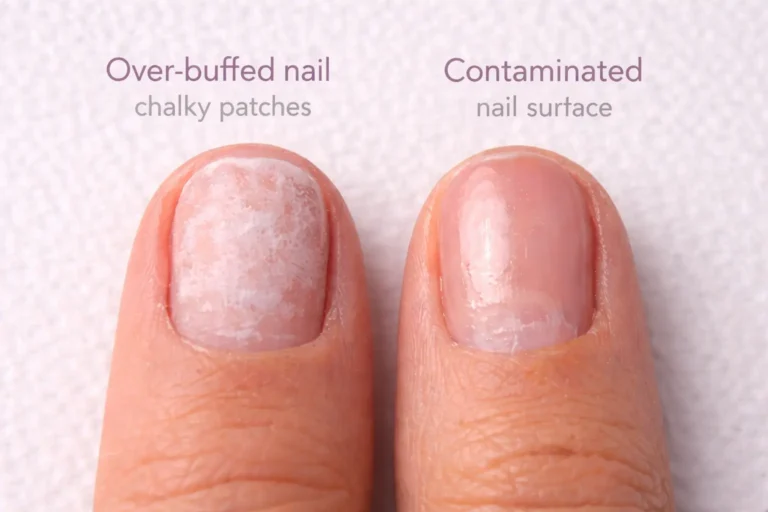
Most courses show you perfect applications and tell you to “ensure complete preparation” or “apply thin layers.” They do not teach you what complete preparation actually looks like when verified objectively, what inadequate preparation looks like when it appears acceptable to casual inspection or how to assess whether your preparation meets the standard required for reliable adhesion.
Without diagnostic assessment training, you cannot identify preparation gaps, application errors or curing inadequacies before they cause failures. You discover problems only when enhancements lift or break on clients, and you still do not know which specific technical step failed or what correction will prevent recurrence.
Professional courses teach you diagnostic protocols: what to check, how to check it, what adequate looks like, what inadequate looks like and how to verify standards are met before proceeding to the next step. This is what allows you to catch and correct errors during execution rather than discovering them through client failures.
Gap Two: Perfect Demonstrations Without Error Recognition
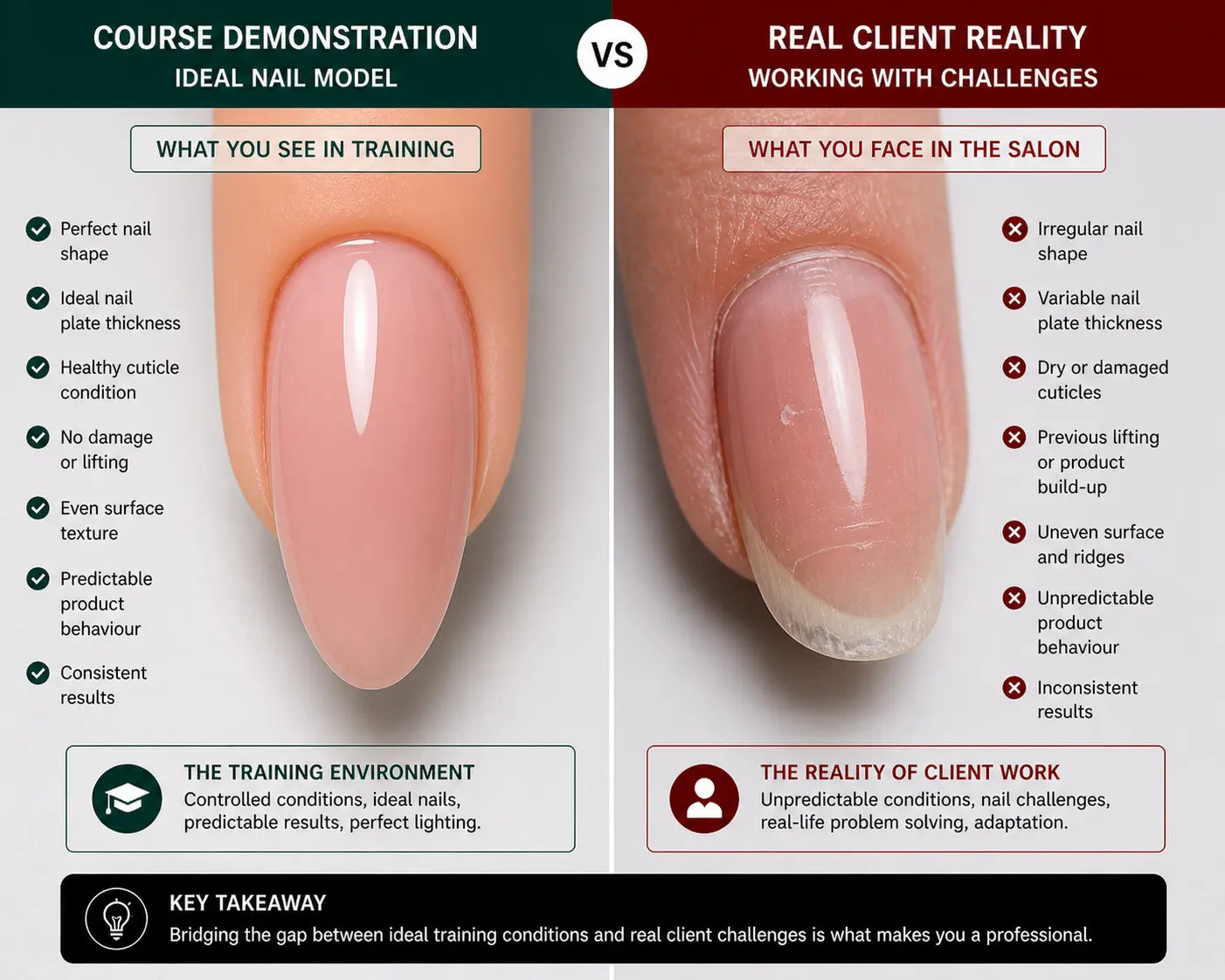
Courses demonstrate perfect results executed by experienced educators under ideal conditions. They do not demonstrate common errors, show you what those errors look like during execution, explain their mechanical causes or walk through correction sequences that eliminate them.
You watch flawless gel application with ideal self-levelling, perfect apex formation and complete curing. When your application does not self-level correctly, when your apex forms incorrectly or when curing is inadequate, you have no reference for what went wrong because the course never showed you error patterns or taught you to recognise them.
Professional training demonstrates multiple execution variations: correct execution, common errors and their visual indicators during application, and the specific corrections required for each error type. This teaches you error recognition—the ability to identify problems while correction is still possible rather than after failures occur.
Gap Three: No Performance Verification Standards
Most courses teach you procedure steps without teaching you how to verify that those steps actually achieved the required performance standard. You buff the nail, but the course does not teach you how to verify complete oil removal. You apply dehydrator, but the course does not teach you how to confirm moisture elimination. You cure the product, but the course does not teach you how to test for complete polymerisation.
Without verification standards, you assume steps are complete when you finish the action. Sometimes your execution was adequate. Sometimes it had gaps you did not recognise. Results are inconsistent because you cannot distinguish between adequate and inadequate execution.
Professional courses establish measurable verification criteria: complete oil removal shows zero shine under angled light inspection, adequate moisture elimination shows no visible dampness in lateral folds, proper curing produces specific hardness under pressure testing. You verify each criterion before progression rather than assuming adequacy.
Gap Four: Content Delivery Without Accountability
Most courses provide content delivery—videos to watch, demonstrations to observe, instructions to read—but no performance accountability. You watch all modules, complete a knowledge quiz and receive a certificate confirming content consumption. Nothing in this process verifies that you can actually execute the technique to professional standards.
You might execute every step incorrectly and still receive the completion certificate because no one assessed your actual work. The course confirmed you watched the content, not that you can perform the skills.
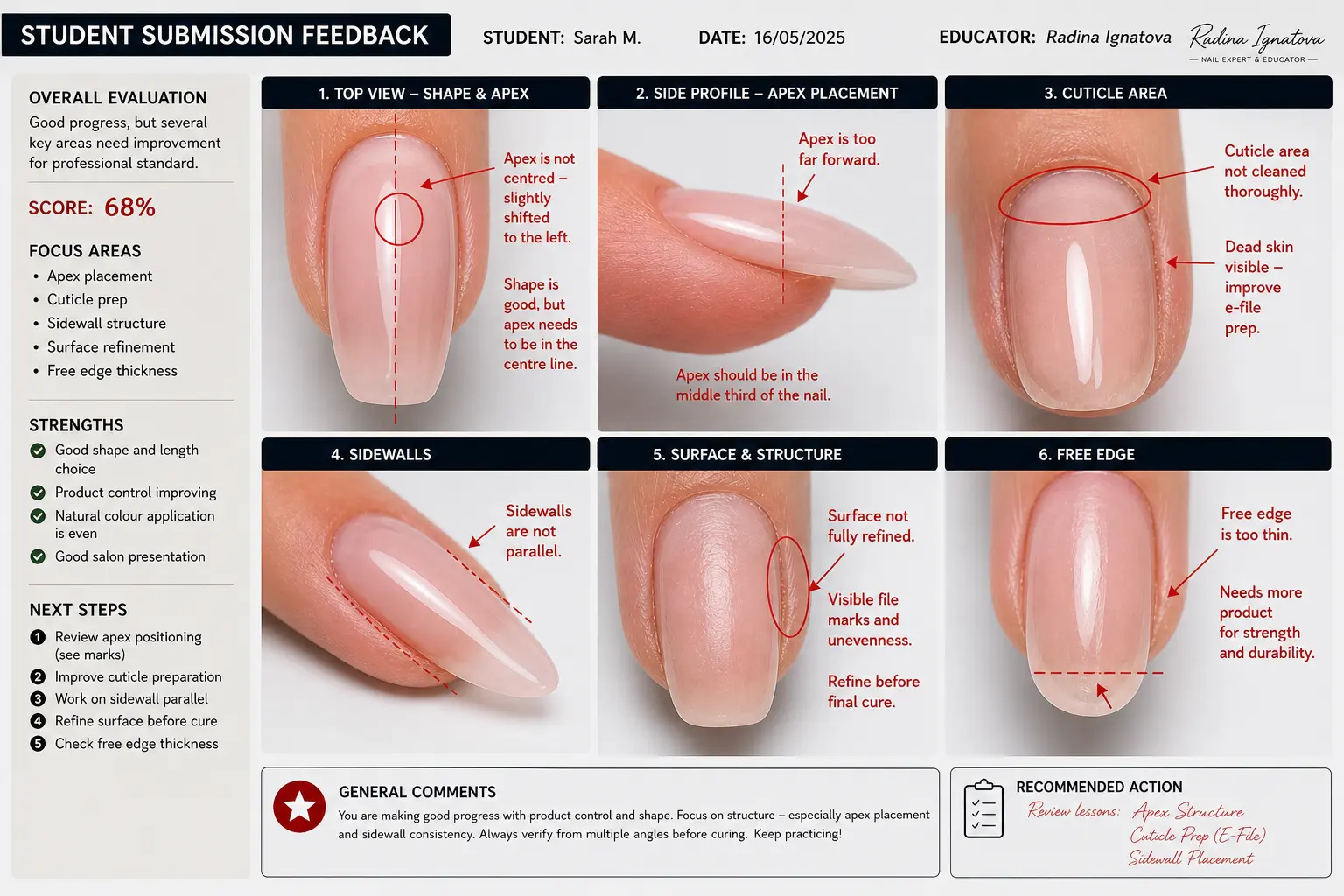
Professional courses include work submission and technical assessment. You complete applications, photograph results according to specified documentation standards and submit for review. An educator assesses your preparation quality, product placement, structural integrity and finish standard, then provides specific corrections for identified errors. You cannot progress while executing incorrectly because performance is verified, not just content consumption.
Gap Five: Generic Instruction Without Individual Adaptation
Courses teach generic application protocols: buff the nail, apply product, cure for specified time. They do not teach you how to adapt protocol to individual nail geometry variations, client lifestyle factors or environmental conditions that affect product behaviour.
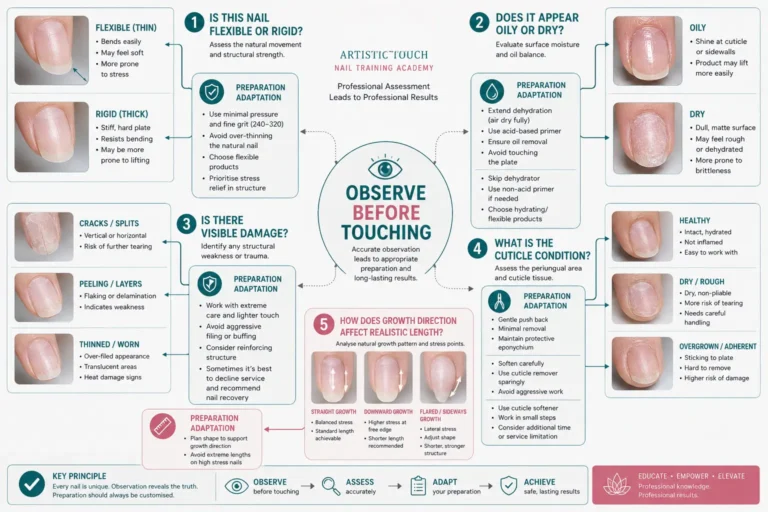
Your clients do not all have the same nail plate thickness, natural oil production, curvature patterns or daily hand use. Generic protocols work adequately for average conditions but fail when conditions deviate from average. The course did not teach you diagnostic thinking required to identify when adaptation is needed or what specific adjustments are appropriate.
Professional training teaches you assessment of individual variables: nail plate characteristics that require preparation modification, natural geometry that requires structural adaptation, lifestyle factors that require product selection changes. You learn when to vary from standard protocol and what modifications address specific conditions rather than applying one approach to all situations.
Gap Six: Procedure Knowledge Without Material Science Understanding
Most courses teach you application procedures without explaining the material science principles that govern product behaviour. You learn to cure for sixty seconds but not why cure time matters or what incomplete polymerisation produces. You learn to apply thin layers but not how viscosity, temperature and humidity affect self-levelling.
Without material science understanding, you cannot diagnose why products behave differently under varying conditions or what adjustments compensate for environmental changes. When gel does not self-level correctly, when builder does not cure adequately or when adhesion fails, you have no framework for identifying the cause or implementing appropriate corrections.
Professional courses teach underlying principles: how UV wavelength and output affect curing completeness, how product chemistry determines compatible primer systems, how temperature influences viscosity and self-levelling, how humidity affects product performance. This knowledge allows you to troubleshoot when conditions differ from demonstration environments.
Gap Seven: Completion Certificates Instead of Competence Verification
Course completion certificates confirm that you finished the training content. They do not confirm that you can execute techniques competently or that your work meets professional standards. Many nail technicians collect multiple completion certificates while their technical ability remains at basic level because courses tested content knowledge, not performance competence.
Professional certification should verify that you can perform techniques to measurable standards under assessment, not just that you watched instructional content. Without performance verification, completion means nothing about your actual capability.
Professional courses establish performance benchmarks and verify achievement through assessed work submission. You must demonstrate competent execution before receiving credentials. This ensures credentials actually indicate capability rather than just course attendance.
Why These Gaps Matter for Your Professional Development
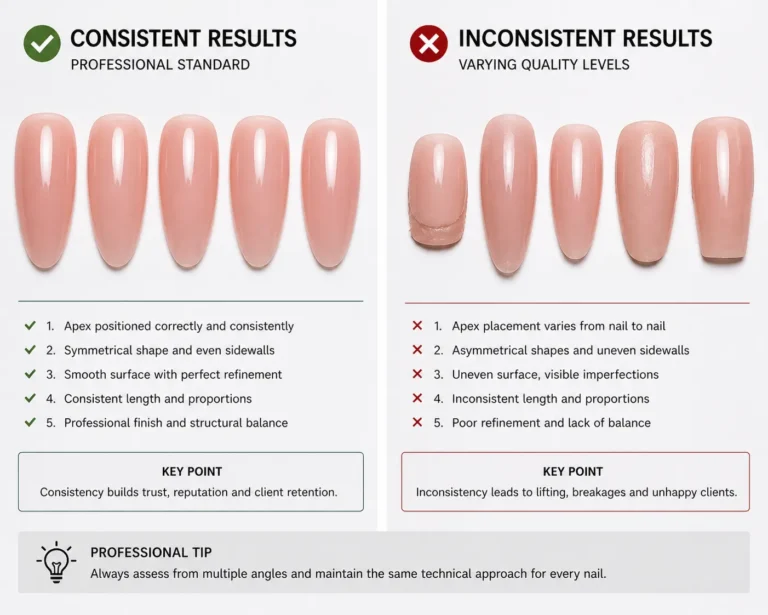
The gaps in most nail courses are not minor omissions. They are fundamental missing elements that prevent professional competence development. Courses teach you enough to attempt techniques but not enough to execute them reliably, diagnose failures or implement systematic corrections.
When you choose nail training, you are choosing whether to learn procedures or develop professional capability. Only comprehensive courses that include diagnostic training, error recognition, performance verification and accountability actually produce consistent professional results.
Complete Professional Training Without the Gaps
Artistic Touch online nail courses include diagnostic assessment training, error recognition demonstrations, performance verification standards and professional feedback on submitted work. Learn the complete skill set professional results require.
View All Courses →Lifetime access • Private student community • Start immediately
Frequently Asked Questions
Why do I still struggle after completing a nail course?
Most courses teach application procedures but omit diagnostic assessment, error recognition and performance verification. You learned what to do but not how to identify when your execution deviates from standards or what specific corrections are required. Without these diagnostic skills, technical problems persist despite course completion.
What should I look for in a quality nail course?
Quality courses include diagnostic assessment training, demonstrate common errors and corrections rather than only perfect results, establish measurable performance standards with verification protocols and require work submission with professional feedback. Courses that provide only demonstration videos and completion certificates omit critical skill development elements.
Do I need another course if I already completed basic training?
If your basic training omitted diagnostic assessment, error recognition or performance verification, additional training that includes these elements will significantly improve your results. The issue is not whether you completed a course but whether that course taught the complete skill set professional competence requires.
How can I tell if a course has these gaps before enrolling?
Check whether the course includes work submission and professional feedback, demonstrates technical errors and corrections, establishes measurable performance criteria and requires competence verification before completion. If the course offers immediate access to all content with completion based on watching videos and passing knowledge quizzes, it likely omits performance accountability.
Are completion certificates valuable for nail technicians?
Completion certificates confirm course attendance but do not verify technical competence or work quality. They have limited professional value unless accompanied by performance assessment results. Clients and employers care about your ability to produce professional results consistently, which certificates alone do not demonstrate.
Can I learn diagnostic skills without formal training?
Self-teaching diagnostic skills is difficult because it requires external assessment to establish accurate reference standards for what adequate execution looks like. Without professional feedback identifying your specific errors, you develop reference standards based on your own perception, which is often inaccurate. Structured training with performance assessment accelerates diagnostic ability development significantly.
About the Author
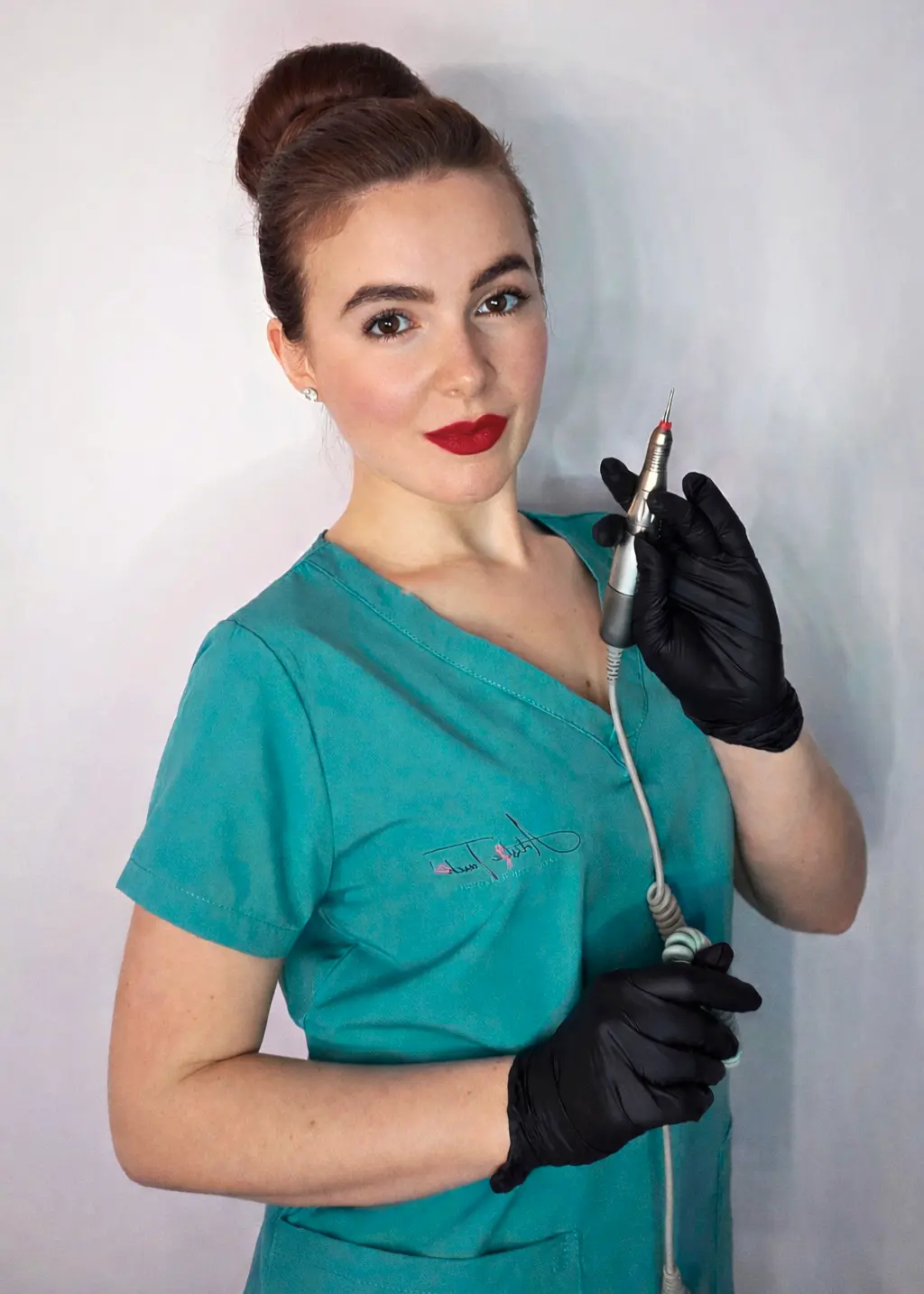
Radina Ignatova
Professional Nail Expert | International Nail Educator
I am Radina Ignatova, a Professional Nail Expert since 2014 and International Nail Educator, based in Scotland, UK. I am the Founder of Artistic Touch Nail Training Academy and TheNailWiki.
At Artistic Touch Nail Training Academy, I provide structured professional online nail courses specialising in dual forms, gel systems, polygel application, advanced nail structure, E-File work and Russian Manicure, with a strong focus on professional salon safety. I continue to work actively in salon practice, ensuring that all education reflects real client scenarios and current industry standards.
My teaching philosophy is simple: I show real salon challenges, real mistakes and real performance testing, not just perfect demonstrations. This is how you develop genuine technical competence and become a confident, capable nail professional.
Every Artistic Touch course includes lifetime access and access to a dedicated student support group, where I provide ongoing guidance and professional feedback.
Disclaimer: This content is for educational purposes only. Nail services should be performed by trained professionals following current hygiene and safety regulations. Always carry out a full client consultation and check for contraindications before performing any nail service.
About Artistic Touch Nail Training Academy
Artistic Touch Nail Training Academy delivers structured professional online nail education focused on practical skill development, professional standards and safe salon practice. All courses are available online worldwide.