Why Nail Prep Is More Than Removing Shine: What You Are Missing When You Stop After Buffing
The Problem With Visible Success
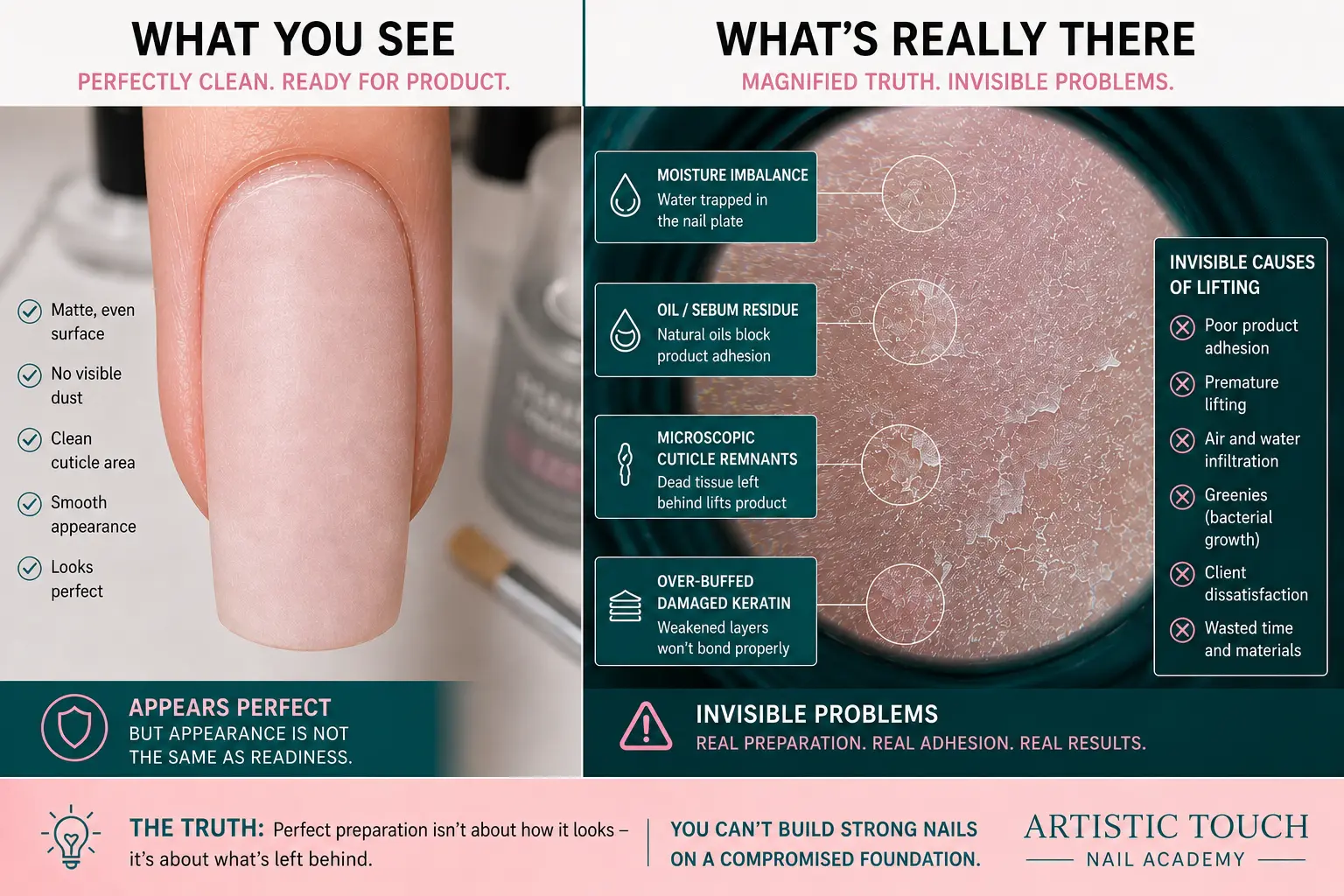
Removing shine is visible and satisfying. You can see the matte finish appearing. You can measure your progress. This visible success creates false confidence that preparation is complete. But real preparation addresses invisible conditions: moisture balance, oil management, cuticle contamination, structural stress points. These invisible conditions determine adhesion far more than surface texture. Most nail techs stop when the visible task—removing shine—is complete. Professional preparation continues until invisible conditions support reliable bonding.
This article explains why you feel like you are done when you have barely begun addressing the conditions that matter most.
The Satisfaction of Visible Tasks
You reach for your e-file. You buff the nail plate. Within seconds, the shine begins disappearing. You keep buffing. The surface becomes increasingly matte. After a minute, shine is gone completely. The nail has obvious texture. You feel like you accomplished something. The task is visible, measurable and complete. So you stop. You move to the next nail. This satisfied stopping point is where preparation actually should be intensifying.
This is the fundamental mismatch in nail education. You were taught tasks that are visible and measurable: remove shine, apply dehydrator, use primer, cleanse. These tasks are easy to teach because progress is obvious. The nail changes appearance with each step. You and your instructor can both see the task completing. But preparation is not complete when these visible tasks finish. Preparation is complete when invisible conditions support reliable adhesion. These invisible conditions cannot be seen. So they are rarely taught. So they are rarely addressed.
You perform visible preparation thoroughly. You feel confident preparation is complete. You apply product. Days later, lifting occurs. You blame the product or your technique. Actually, you addressed only the visible layer of preparation while the invisible structural conditions that determine adhesion remained unaddressed. This is not your fault. This is how nail education is structured—teaching the visible while assuming the invisible will somehow happen automatically.
The Psychological Trap of Procedural Confidence
You learned preparation as a procedure: dehydrate for X seconds, buff until matte, apply primer for Y seconds, cleanse with Z product, apply base coat. Following this procedure creates procedural confidence. You know what to do. You execute the steps. The steps complete. You feel prepared.
But procedures are designed for average conditions. They assume average nail moisture. Average oil production. Average cuticle thickness. Average growth rate. Real nails vary dramatically from these averages. Your procedure fails on oily nails because average dehydration does not address above-average oil production. It fails on thin nails because average buffing pressure removes too much material from already-thin plates. It fails on thick rigid nails because average dehydration inadequately addresses their high natural dryness. The procedure is not wrong. It is simply inappropriate for non-average conditions.
Professional preparation requires abandoning procedural confidence and developing diagnostic thinking. Before executing any procedure, you assess: what is this nail’s specific condition? What is its moisture level? Its oil production? Its structural characteristics? Its growth pattern? Only after answering these diagnostic questions do you execute preparation adapted to what you discovered. This requires thinking, not just executing steps. Most nail techs never develop this thinking layer because procedures feel complete without it. They provide immediate satisfaction and visible progress.
Why Buffing Until Matte Is Psychologically Satisfying But Structurally Inadequate
Shine disappearing is concrete feedback. You can see progress in real-time. The nail surface transforms from glossy to matte. This visible transformation is psychologically satisfying. It feels like progress. It feels like completion. So you stop when shine is gone.
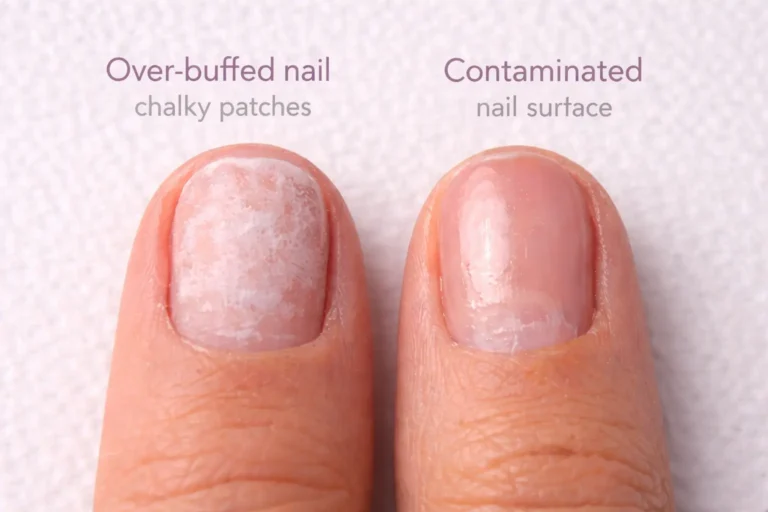
But matte finish does not indicate preparation completion. It indicates that you removed enough surface shine to create visible texture. That is all. The nail’s moisture balance might be incorrect. Oil might remain in deeper layers. The surface you created might be structurally compromised from over-buffing. Cuticle might remain microscopic on the plate. None of these problems are addressed by the visible task of removing shine. Yet all of them prevent reliable adhesion.
Professional preparation continues beyond matte finish. The visible task of buffing is just the beginning. Real preparation addresses moisture chemistry, contamination management, structural assessment and biological variation. These invisible tasks are what actually support adhesion. But because they are invisible, they feel like doing nothing after the satisfying work of visible buffing. So you skip them. The lifting that follows reveals that you were right—the visible buffing was just the beginning. The invisible work you skipped was where the actual preparation happened.
The Decision Point Nobody Teaches You To Recognise
After buffing, there is a critical decision point: does this nail need standard preparation, or does this nail’s specific conditions require adaptation? This decision requires assessing the nail’s biological condition, moisture balance, oil production and structural characteristics. But this assessment requires diagnostic thinking that procedures do not teach. So you skip the decision and proceed with standard preparation. The results are inconsistent because standard preparation works on some nails while failing on others.
Professional nail techs make this decision deliberately. Oily nails need extended or additional dehydration. Dry nails need minimal dehydration. Thin nails need gentle pressure and adapted buffing approach. Thick nails tolerate standard or aggressive buffing. Damaged nails might contraindicate service entirely. These decisions change how the rest of preparation executes. But they require recognising nail variation and adapting accordingly. Standard procedures do not teach this recognition. So most nail techs proceed identically regardless of what they encounter.
When Moisture Balance Determines Adhesion More Than Surface Texture
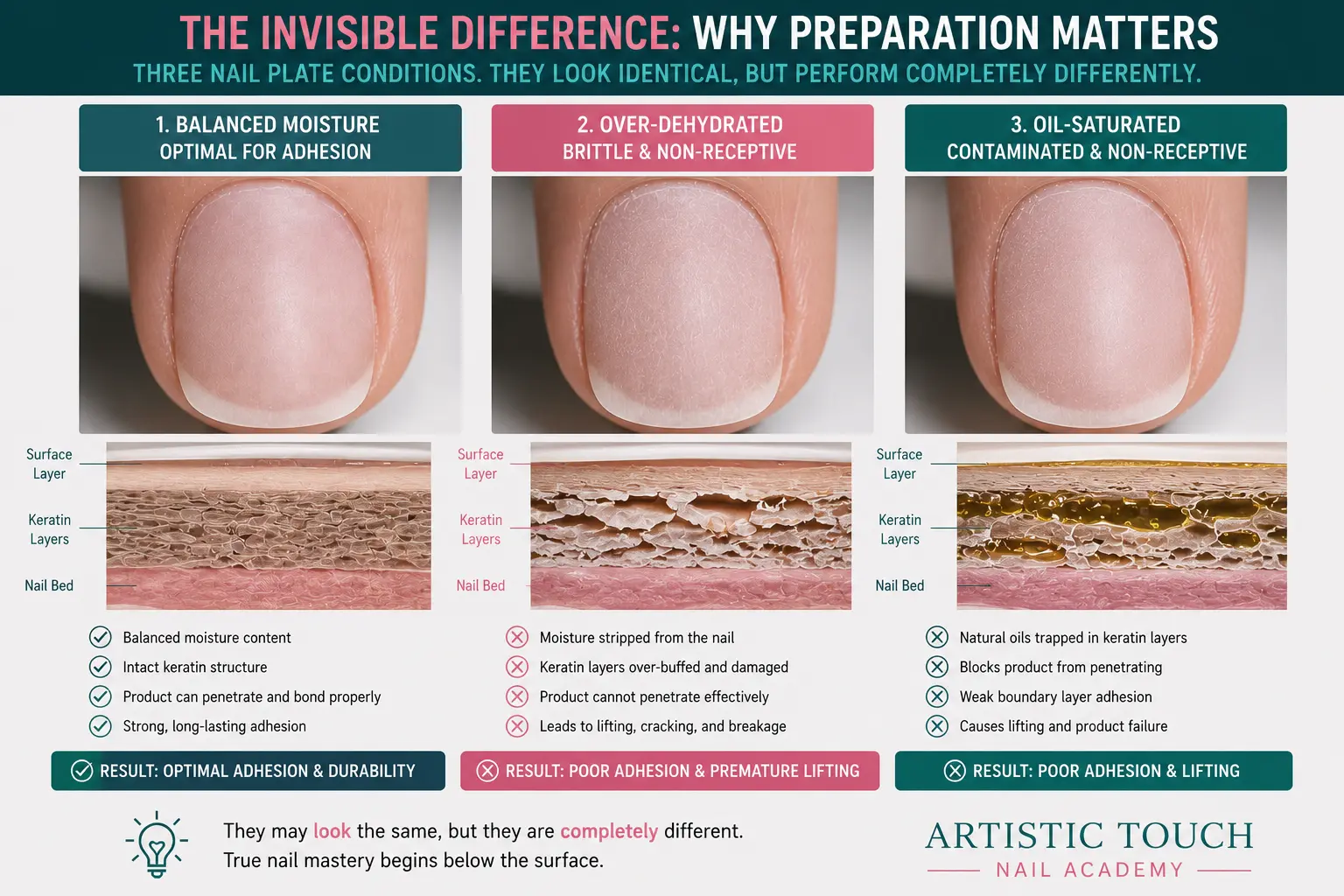
Nail plates need specific moisture content for optimal adhesion. Too much moisture and product cannot bond. Too little and keratin becomes brittle and non-receptive. The correct balance is individual—varies based on the client’s natural nail moisture production and the specific gel chemistry you are using. You cannot determine this balance by looking at the nail. You cannot determine it by buffing. You determine it through careful dehydration informed by assessment of this nail’s baseline moisture condition.
Standard dehydrator application works adequately on average nails. It severely over-dries naturally dry nails. It inadequately addresses continuously oily nails. The nail surface looks identically matte and prepared after standard dehydration. Moisture chemistry is completely different. Adhesion behaviour will be completely different. But you will not discover these moisture problems until product performance reveals them days later. By then the failure pathway is established.
Professional preparation requires adapting dehydration strategy to this nail’s specific moisture characteristics. This requires observation and diagnostic thinking, not just procedure execution. You assess: does this nail appear oily, dry or normal? Your answer determines dehydration strategy. Procedure-based preparation skips this assessment. Diagnostic preparation includes it as essential decision-making.
The Oil Management Nobody Discusses Adequately
Natural oils on nails are not just surface contamination. They represent biological production from the nail bed. Some clients produce continuous oil. Others have naturally dry nails. Your preparation routine is designed assuming average oil production. It fails when you encounter extremes.
Additionally, you were taught to cleanse with isopropyl alcohol before applying product. This removes visible contamination. It does not address oil that has penetrated into keratin layers or oil that will continue producing during the time between preparation and product application. On oily nails, fresh oil migrates to the surface while you are preparing other nails. Your earlier preparation becomes progressively contaminated through biological processes you cannot stop.
Professional preparation on oily nails uses adapted strategies: extended dehydration, acid-based primers compensating for oil-resistant surfaces, working one nail at a time rather than batch preparation, additional cleansing steps. These adaptations exist because standard procedure is inadequate. But you do not know these adaptations exist because education focused on teaching procedure, not on teaching why different nails require different approaches.
Why Cuticle Work Continues Long After It Appears Complete
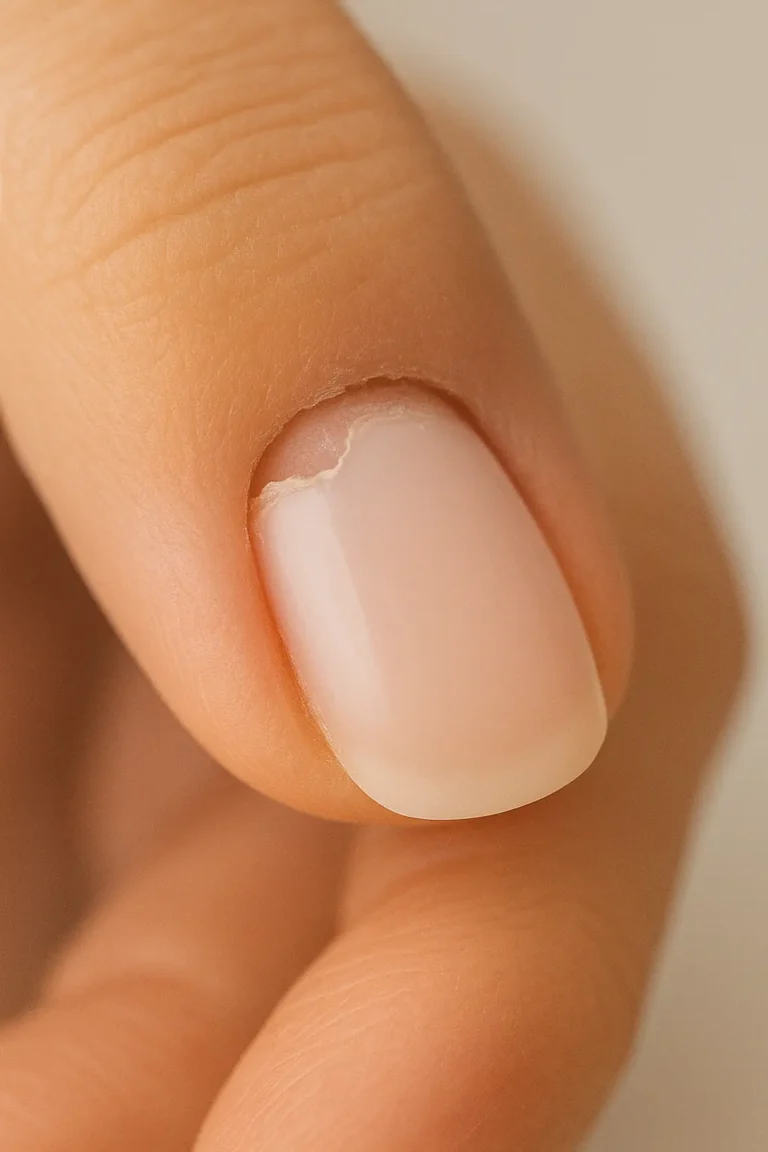
The visible cuticle is removed. The proximal nail fold is clean. You assess the cuticle work as complete. Microscopic cuticle remains on the plate where your eye cannot detect it. This microscopic residue creates separation pathways invisible during application but perfectly functional as moisture penetration routes causing proximal lifting within days.
This is the frustration experienced by beginning nail techs learning from experienced techs: why do they keep working on something that looks finished? The answer is that experienced techs are addressing preparation depth beyond what your assessment methods can measure. They continue until they believe microscopic contamination has been adequately addressed. The difference between “visually clean” and “actually clean at the bonding surface level” is invisible but critical for reliable adhesion.
You cannot develop this skill through watching. You develop it through working until you feel confident that preparation depth is adequate. This requires diagnostic thinking and professional judgment. It requires accepting that you cannot visually confirm whether your work is complete. It requires faith that continued work is addressing problems you cannot see. Most nail techs abandon this work because it feels unproductive. The lifting that follows reveals that those “unproductive” final steps were where the actual preparation was happening.
Beyond Visible Tasks
Preparation taught as a procedure teaches visible tasks: remove shine, apply products, create texture. Real preparation addresses invisible conditions: moisture balance, oil management, microscopic contamination, structural assessment, biological variation. The visible tasks feel complete and satisfying. The invisible conditions determine adhesion. Professional preparation requires continuing work long after visible tasks finish, addressing conditions you cannot measure with your eyes but can address through diagnostic thinking and adapted technique.
This is the gap between learning procedures and developing professional capability.
Go Beyond Removing Shine
The E-File Manicure and Gel Polish Online Course teaches preparation as diagnostic thinking addressing invisible structural conditions—not just visible procedure execution.
Enrol Now →Lifetime access • Start immediately • Learn at your own pace
Frequently Asked Questions
Is removing shine the only goal of nail buffing?
No. Removing shine is visible progress but represents only the beginning of preparation. Real preparation addresses invisible conditions: moisture balance appropriate for this nail’s biology, oil management preventing contamination, microscopic cuticle removal ensuring flush contact, structural assessment determining service appropriateness, pressure control protecting nail integrity. These invisible conditions determine adhesion far more than surface texture.
Why do different nails need different preparation approaches?
Procedures are designed for average conditions. Real nails vary dramatically: oily nails need extended dehydration while dry nails need minimal dehydration. Thin nails need gentle pressure while thick nails tolerate standard pressure. Damaged nails might contraindicate service while healthy nails proceed normally. Standard procedure fails on non-average nails. Professional preparation requires diagnostic assessment determining what this specific nail needs.
Why does cuticle work continue after it appears complete?
Visible cuticle is removed but microscopic residue remains on the plate where your eye cannot detect it. This microscopic cuticle creates separation pathways causing proximal lifting. Professional cuticle work continues until preparation depth is adequate—addressing microscopic contamination beyond what visual assessment can confirm. This is unproductive-feeling work that actually determines adhesion reliability.
How do I know if dehydration is adequate for this nail?
You cannot know definitively by visual assessment. Professional preparation requires assessing this nail’s baseline moisture condition. Does it appear oily, dry or normal? Your answer determines dehydration strategy. Oily nails need extended or multiple applications. Dry nails need minimal application. Normal nails use standard timing. Adapting dehydration to this nail’s biology rather than applying standard duration prevents both under-dehydration and over-dehydration.
Why do oily nails require different preparation than dry nails?
Oily nails produce continuous oil from the nail bed. Standard dehydration removes surface moisture but cannot stop biological oil production. Fresh oil migrates to the surface during preparation on the other nails. Professional preparation on oily nails uses extended dehydration, acid-based primers, working one nail at a time preventing re-contamination and additional cleansing addressing continuous oil production.
Is preparation complete when the nail looks matte?
No. Matte finish indicates you removed enough shine to create visible texture. It does not indicate that moisture balance is correct, oil contamination is addressed, microscopic cuticle is removed or structural conditions support adhesion. Professional preparation continues beyond matte appearance addressing invisible conditions that actually determine adhesion reliability.
About the Author
Radina Ignatova
Professional Nail Expert | International Nail Educator
I am Radina Ignatova, a Professional Nail Expert since 2014 and International Nail Educator, based in Scotland, UK. I am the Founder of Artistic Touch Nail Training Academy and TheNailWiki.
At Artistic Touch Nail Training Academy, I provide structured professional online nail courses specialising in dual forms, gel systems, polygel application, advanced nail structure, E-File work and Russian Manicure, with a strong focus on professional salon safety. I continue to work actively in salon practice, ensuring that all education reflects real client scenarios and current industry standards.
My teaching philosophy is simple: I show real salon challenges, real mistakes and real performance testing, not just perfect demonstrations. This is how you develop genuine technical competence and become a confident, capable nail professional.
Every Artistic Touch course includes lifetime access and access to a dedicated student support group, where I provide ongoing guidance and professional feedback.
Disclaimer: This content is for educational purposes only. Nail services should be performed by trained professionals following current hygiene and safety regulations. Always carry out a full client consultation and check for contraindications before performing any nail service.
About Artistic Touch Nail Training Academy
Artistic Touch Nail Training Academy delivers structured professional online nail education focused on practical skill development, professional standards and safe salon practice. All courses are available online worldwide.