The Nail Prep Step Most Nail Techs Rush: Assessment Before Application
The Invisible Work
The most critical preparation step appears to be no work at all. You sit with a client and look at their nails. You press gently. You observe. You assess. This takes ten seconds. It is the invisible work that determines how everything that follows will execute. Professional nail techs make this assessment deliberately. Beginning nail techs skip it entirely and proceed immediately with buffing. This skipped thinking explains why beginning and experienced techs using identical procedures get completely different retention results.
Why Invisible Thinking Feels Like Unproductive Waiting
You want to appear productive. Looking at nails without touching them does not feel like work. So you immediately reach for your e-file. You begin buffing. You feel like you are working. Actually, you are guessing about what this nail needs because you did not assess its specific characteristics. The actual productive work—thinking and assessment—was the invisible part you skipped.
This is the psychological barrier to professional development. Thinking does not feel like work. Visible physical effort feels productive. So nail techs rush past the essential thinking to get to the satisfying physical work of buffing. The results are inconsistent because the thinking that should inform preparation never happened.
The Assessment That Determines Everything
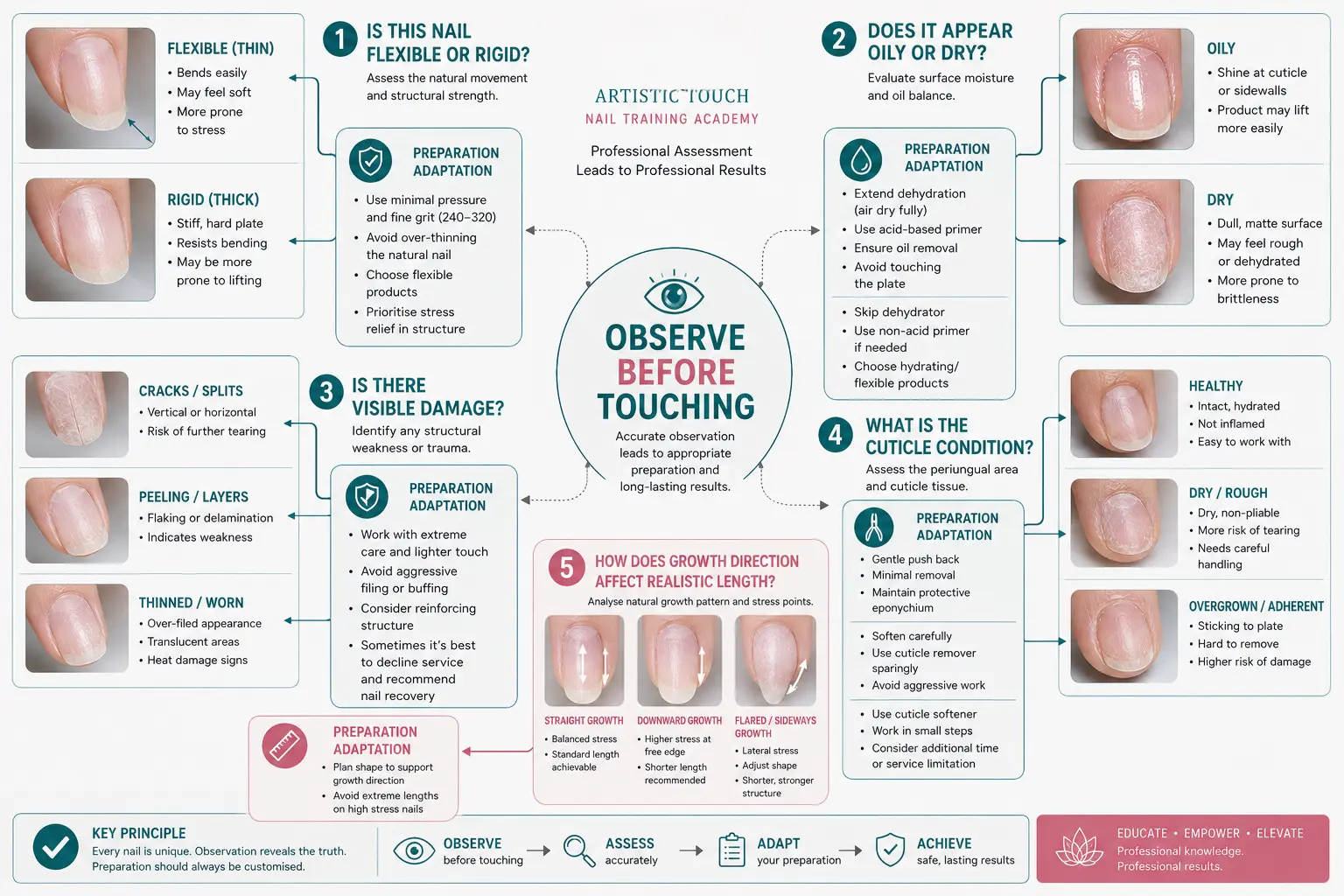
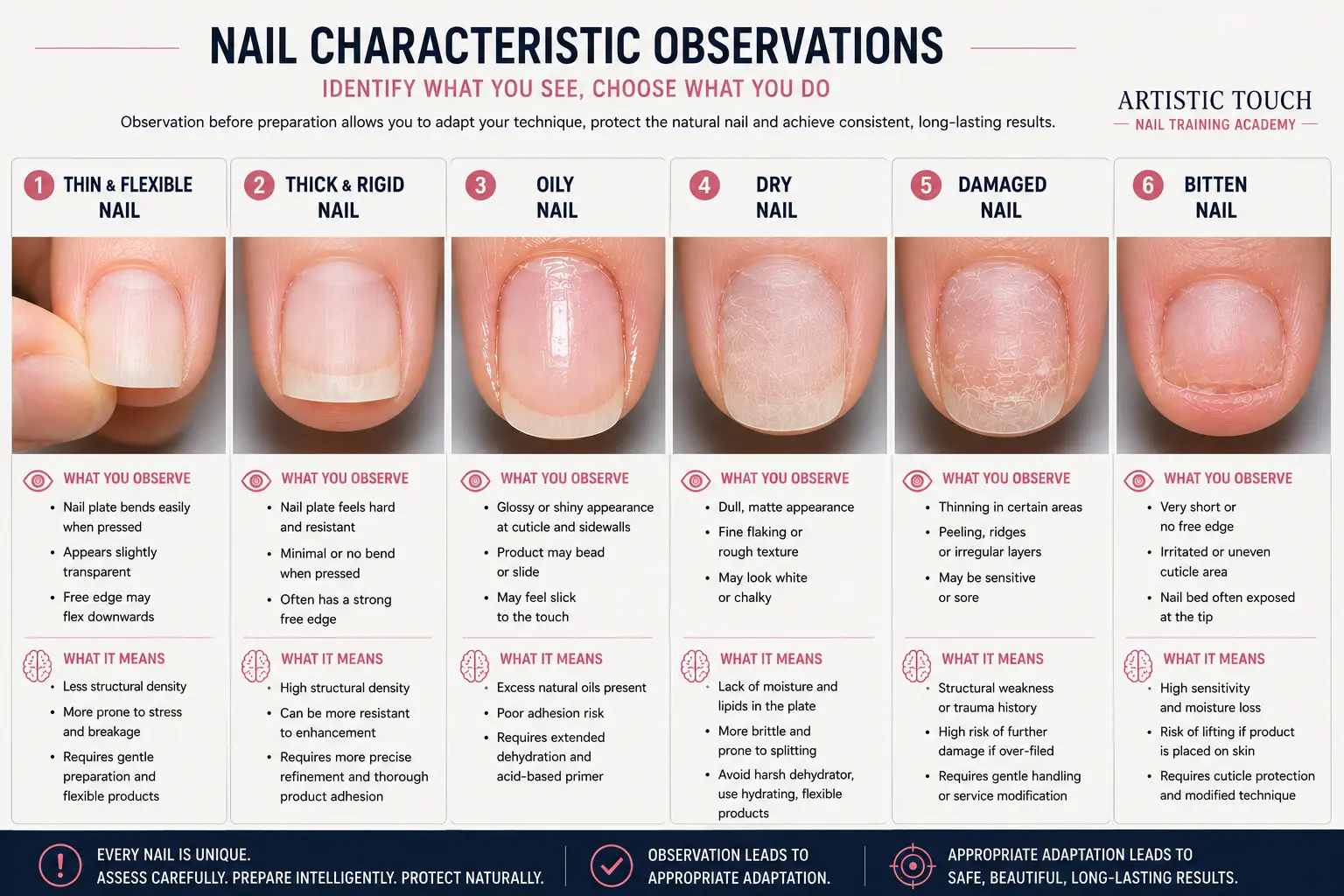
You press gently on the nail. Does it flex noticeably? Thin flexible nail. Does it feel rigid? Thick strong nail. You look at the cuticle zone. Is it glossy despite being clean? Oil. Is it dull and slightly flaky? Dry. You observe the nail plate. Are there thin spots or irregular areas? Damage. Do the sidewalls appear strong or weak? You check growth direction. Are nails growing straight or curved? All these observations take seconds. Each one changes how preparation should execute.
Thin nails need gentle pressure. Oily nails need extended dehydration. Dry nails need minimal dehydration. Damaged nails might contraindicate service. Curved growth patterns affect realistic enhancement geometry. These decisions are only possible after assessment. If you skip assessment, you proceed with standard routine regardless of what the nail actually requires. The inconsistent results follow predictably.
Why Tutorials Do Not Teach Assessment
Tutorials show the visible physical work: buffing, applying products, creating finishes. They do not show someone quietly observing a nail. Assessment does not photograph well. Assessment does not produce visible dramatic content. So tutorials skip it entirely. You learn the mechanical steps without learning the diagnostic thinking that should precede those steps.
This is not an oversight. This is a fundamental gap in how nail education is delivered. Visual content emphasises visible actions. Invisible thinking cannot be easily shown. So the thinking layer—which actually determines how visible actions should execute—is almost entirely absent from most nail education.
Assessment As Service Suitability Screening
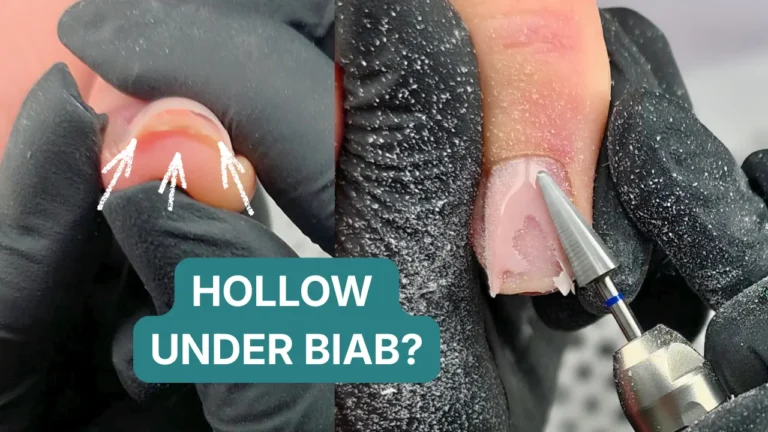
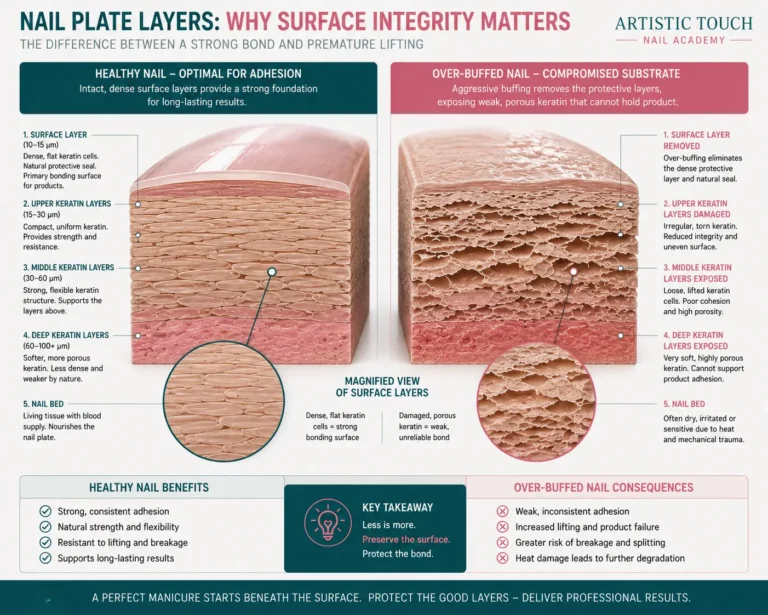
Some nails are too compromised for reliable enhancement. This assessment determines whether proceeding with service is even professional. Severely damaged plates from aggressive filing. Extremely thin nails barely adequate for support. Active medical conditions affecting nail growth. Separation between keratin layers. These observations answer one critical question: should I even offer this service?
Professional judgment often means declining service revenue to protect client nail health and your reputation. Service that will certainly fail serves neither party. But declining requires confidence that your assessment is correct and willingness to lose revenue based on that assessment. Most nail techs never develop this confidence because assessment thinking was never taught formally. So they proceed with unsuitable nails, fail predictably and blame themselves or the client instead of recognising that the assessment decision should have been “no service.”
How Assessment Determines Pressure Control
You assessed this nail as thin and flexible. You know gentle pressure is required. You use light pressure throughout. You assessed this nail as thick and rigid. You know it tolerates appropriate pressure. You use standard pressure. Without assessment, you use uniform pressure on all nails. Thin nails are under-prepared from aggressive pressure. Thick nails are under-prepared from insufficient pressure. Inconsistent results follow from inconsistent appropriateness of technique for what the nail actually is.
Develop Assessment Into Your Routine
The E-File Manicure and Gel Polish Online Course teaches diagnostic observation and assessment-informed adaptation—not just procedure execution without thinking.
Enrol Now →Lifetime access • Start immediately • Learn at your own pace
FAQ
What assessment questions matter most?
Is this nail flexible or rigid? Does cuticle appear oily or dry? Is there visible damage? What is cuticle thickness? How does growth direction affect realistic length? Does this nail appear suitable for enhancement? These questions take seconds. Each changes how preparation executes. Professional preparation requires answering them before touching the nail.
How does assessment improve retention?
Assessment determines how preparation adapts. Thin nails receive gentle pressure. Oily nails receive extended dehydration. Dry nails receive minimal dehydration. Service unsuitable for this nail’s condition is declined. These adaptations exist specifically because assessment revealed what this nail needs. Without assessment, uniform procedure fails on non-uniform nails.
Why do some professionals decline service?
Assessment reveals nails too compromised for reliable enhancement. Professional judgment means declining service to protect client nail health and reputation. Service that will certainly fail serves neither party. Declining requires confidence in assessment and willingness to lose revenue for professional integrity.
About Radina
Radina Ignatova — Professional Nail Expert | International Nail Educator. Founder of Artistic Touch Nail Training Academy and TheNailWiki. Teaching honest professional nail education since 2014 showing real salon challenges and real performance testing.
Disclaimer: This content is for educational purposes only. Always perform nail services following professional regulations.