Why Nails Lift Even When Your Prep Looks Clean: The Complete Guide to Nail Adhesion and Retention
You remove the shine. You clean the nail plate. You use quality products. You follow the steps exactly as you were taught. Yet, some clients still experience lifting, peeling, and retention problems.
So you change the gel. You change the primer. You change the base coat. And sometimes you even start questioning your own abilities.
The truth is that retention problems are rarely caused by one simple thing. Most lifting issues begin long before the product is applied. Hidden contamination, incorrect timing, poor workflow organisation, nail plate differences, product flexibility, support product misuse—these are the small details that most nail technicians never learn to recognise.
This article explains why nails lift, why changing products rarely solves the problem, and how the Nail Prep Course – Adhesion & Retention teaches you to diagnose and prevent lifting before it happens.
Why Your Prep Looks Clean But Your Nails Still Lift
Lifting is not about surface cleanliness. It is about invisible contamination, product connection, nail plate behaviour, support product misuse, workflow timing, and structural understanding. Most nail technicians are trained to follow steps without understanding why those steps matter. This creates retention problems that change products cannot fix.
The Nail Prep Course teaches you the complete retention system: how to identify hidden causes, diagnose nail plate differences, control contamination, time your workflow correctly, and understand why lifting actually happens.
Why Nails Lift: Understanding the Hidden Causes
When a nail lifts, most technicians blame themselves. They assume their technique is wrong, their products are poor, or they are not skilled enough.
But lifting is rarely about any one of those things. Lifting is usually caused by a combination of invisible factors that happen before, during, and after application.
Invisible contamination is one of the largest culprits. You cannot see it, but it is there: oil residue from your fingers, dust from filing, moisture from humidity or client perspiration, product residue from previous applications. These invisible particles sit between the nail plate and the product, breaking the connection that holds enhancement in place.
Incorrect timing is another invisible cause. If your prep steps are too far apart, the nail plate rehydrates. If your application follows prep too slowly, contamination reaccumulates. If your product is not applied within the optimal window, adhesion suffers. Most nail technicians follow a routine without timing it, never realising that speed and sequence matter more than they understand.
Nail plate differences cause lifting that cannot be solved by changing technique. Some clients have naturally oily nail plates. Some have very flexible nail beds. Some have thin, delicate plates that cannot support certain product weights. These biological factors are not something you fix with better prep. They require structural adaptation.
Product flexibility and support product misuse also cause lifting that looks like a prep problem. If your base coat is too rigid, it cannot flex with the nail plate and splits apart. If your top coat is too thick or too thin, it does not protect the enhancement underneath. If your support products are not compatible with your main product system, adhesion fails.
The Real Cause of Most Lifting
Lifting is a system failure, not a single mistake. It usually means something in your workflow, your product choice, your timing, your contamination control, or your nail plate assessment is wrong. Finding which one requires diagnostic thinking, not product switching.
Why Changing Products Rarely Solves Retention Problems
When retention fails, the instinct is to change products. Different primer. Different base coat. Different builder gel. Different top coat. You hope the next product will be the magic solution.
But here is the problem: if the real cause is hidden contamination, changing products will not help. If the real cause is poor workflow timing, changing products will not help. If the real cause is structural mismatch between your product and the client’s nail biology, changing products will not help.
You will change products ten times and still experience lifting, because you have not identified the actual problem. Meanwhile, you have wasted money, confused your own technique, and trained your body to use unfamiliar products under stress.
The nail technicians with the best retention do not have access to better products. They have access to better understanding. They know what is actually causing their lifting, so they fix the real problem instead of guessing with product switches.
Common Retention Myths That Keep You Stuck
Myth 1: “Better products equal better retention.”
Product quality matters, but product choice without understanding creates more problems. A premium gel applied with poor contamination control will lift faster than a mid-range gel applied with complete understanding.
Myth 2: “Aggressive prep prevents lifting.”
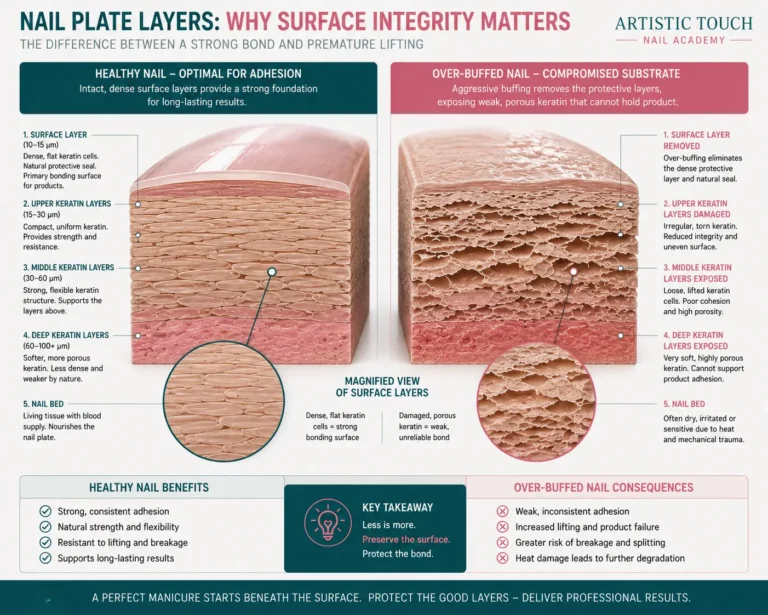
Over-prepping (over-filing, excessive dehydration, harsh cuticle removal) damages the nail plate and reduces retention. Lifting from over-prep looks identical to lifting from under-prep, but the solution is the opposite. Aggressive prep often creates the problem it attempts to prevent.
Myth 3: “If your hands are clean, your prep is clean.”
Clean hands do not equal clean nails. You transfer oils the moment your hands touch the nail. Contamination happens throughout the prep process: from file dust, from humidity, from product residue on your file or tools. Proper contamination control requires system thinking, not just hand washing.
Myth 4: “One routine works for all clients.”
Different nails require different approaches. Thin, flexible nails need lighter product systems and different timing. Oily nails need different primer selection. Bitten nails need different structural support. One routine creates problems on the nails that do not fit that routine.
Myth 5: “Lifting means you did something wrong.”
Lifting sometimes means the client’s nail biology does not match your product choice. Or the client’s lifestyle is incompatible with enhancement longevity. Or a single missed detail in your workflow created a tiny break in adhesion. Not all lifting is a technique failure.
The Nail Is Usually Telling You Something
When a nail lifts, it is communicating information. The location of the lift, the timing of the lift, the pattern of the lift—all tell you what actually went wrong.
Sidewall lifting tells you something different from free edge lifting. Centre lifting tells you something different from peeling patterns. Lifting that starts immediately after application tells you something different from lifting that appears three weeks in.
But you can only read this information if you understand what to look for. Most nail technicians see lifting and think: “Something went wrong.” An expert sees lifting and thinks: “Something specific went wrong. And here is what it is.”
This diagnostic thinking is what the Nail Prep Course teaches. Not just technique steps, but the thinking framework that lets you read what the nail is actually telling you.
⚠️ The Diagnostic Shift
Moving from “Something went wrong” to “This specific thing went wrong” is the shift that ends the cycle of product switching and constant frustration. This is what professional understanding creates.
Why Surface-Level Prep Training Often Fails
Most nail prep training teaches steps. File this way. Use this product. Clean with this brush. Follow this sequence. These steps are correct, but they are incomplete.
Step-based training does not teach you why each step matters. It does not teach you what happens when conditions are different. It does not teach you to diagnose problems or adapt your approach. It only teaches you to copy a routine.
When your situation matches the training exactly—same nail type, same lifestyle, same product system, same humidity—the routine works. But the moment something is different, your training fails because you have no framework for thinking beyond the steps.
Professional prep training must teach understanding. Why does contamination control matter? What is actually happening when you file? How does moisture affect adhesion? What structural principles determine nail plate behaviour? What is the difference between true cuticle removal and damage?
Without these answers, you are trained to follow a routine without understanding. With these answers, you are trained to think professionally.
Professional E-File Nail Preparation and Contamination Control
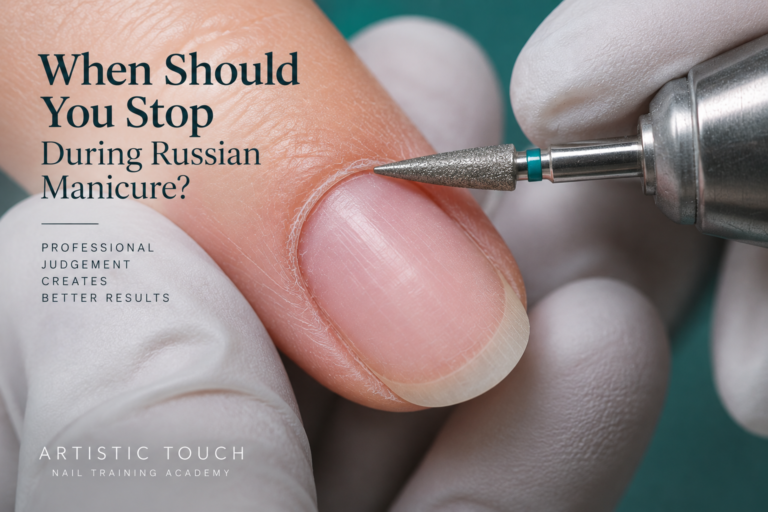
E-file nail preparation is not simply filing faster. Proper e-file technique requires understanding pressure, speed, nail plate response, dust creation, and contamination management.
Many technicians use e-files incorrectly, creating microdamage to the nail plate that looks fine but reduces adhesion. The file speed, the angle of approach, the pressure applied, the direction of filing—all affect how the nail plate responds.
Contamination control with e-files is also different from hand-filing. E-files create fine dust that travels. This dust must be managed throughout the prep process, not just at the end. If you allow dust to settle and accumulate, your seemingly clean nail plate is actually contaminated beneath the surface.
The Nail Prep Course teaches proper e-file technique that minimises damage, maximises adhesion, and maintains contamination control throughout the preparation process.
True Cuticle Removal and Nail Plate Preparation
True cuticle removal is one of the most misunderstood aspects of nail preparation. Many technicians either do not remove cuticle at all (leaving contamination) or remove skin along with cuticle (creating damage).
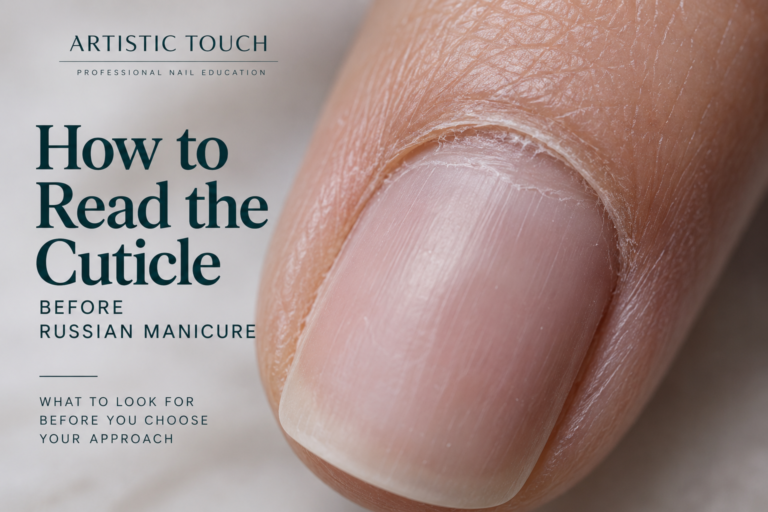
The cuticle is a seal. It sits on the nail plate protecting the growth area and the nail matrix. True cuticle removal means removing this seal without damaging the living tissue beneath. It requires understanding nail anatomy, knowing the difference between cuticle and skin, and using proper technique that respects the client’s nail health.
When true cuticle is not removed, a barrier sits between your product and the nail plate. This barrier breaks the connection and causes lifting. When cuticle is removed along with living skin, you damage the nail matrix and create long-term growth problems. Professional cuticle removal is the balance between these two extremes.
Understanding Product Connection and Support Product Selection
Product connection is not just about adhesion. It is about how different products in your system work together to create a lasting enhancement.
Your primer must prepare the nail plate for your base coat. Your base coat must create a foundation that allows your builder gel to adhere and flex. Your builder gel must support the weight and stress of daily wear. Your top coat must protect everything underneath.
If any one of these products does not perform its function, the entire system fails. A beautiful base coat sitting on poor prep will lift. A rigid builder gel on a flexible nail bed will crack. A thin top coat will not protect the enhancement beneath.
Many retention problems are actually support product misuse. You are using the right products but combining them incorrectly, using them in the wrong sequence, or choosing products that do not work together as a system.
Workflow Timing and the Preparation Window
Nail plate preparation is only effective within a specific window. If prep steps are too far apart, the nail plate rehydrates and contamination reaccumulates. If application follows prep too slowly, you lose the benefit of your preparation.
Most nail technicians follow a routine without timing it. They do not understand how long they have between prep and application. They do not realise that their slow workflow is sabotaging their preparation.
Professional nail preparation requires understanding the preparation window: how long your nail plate remains in an optimal state after each prep step, how quickly contamination can reaccumulate, how fast you need to work to maintain the benefit of your prep.
Understanding Nail Plate Behaviour and Biological Differences
Different nail plates behave differently. Some are naturally oily. Some are very dry. Some are extremely flexible. Some are thick and brittle. Some are thin and delicate.
These differences are biological. You cannot change them. But you can adapt your approach to work with them instead of against them.
An oily nail plate needs different primer selection and possibly different base coat application. A very flexible nail plate needs lighter product systems and different structural support. A thin nail plate needs gentler preparation and different product choices.
When you do not understand these differences, you apply the same technique to every client. Some clients have perfect retention. Others constantly lift. You assume it is a technique problem, but it is actually a nail plate biology problem that requires adaptation.
What You Will Learn Inside the Nail Prep Course – Adhesion & Retention
The Nail Prep Course teaches the complete retention system through real demonstrations, salon workflows, and practical troubleshooting methods.
Professional E-File Nail Preparation Techniques
Proper e-file pressure, speed, angle, and dust management. How to use e-files without creating microdamage. How to maintain contamination control throughout the filing process.
True Cuticle Removal
Understanding nail anatomy. The difference between cuticle and skin. Proper technique for cuticle removal that respects nail health and removes the barrier that causes lifting.
Contamination Control
Invisible contamination sources. How to identify and prevent contamination. System thinking for maintaining cleanliness throughout your workflow. Why hand washing alone is insufficient.
Product Connection and Support Products
How different products work together as a system. Understanding primer function, base coat role, builder gel support, and top coat protection. How support product misuse causes lifting.
Workflow Timing and the Preparation Window
Understanding the optimal preparation window. How to maintain nail plate state between prep steps. Why timing matters more than most technicians realise. How to work efficiently without sacrificing adhesion.
Nail Plate Behaviour and Biological Differences
Recognising different nail plate types. Understanding biological factors that affect retention. How to adapt your approach to different nail plates instead of forcing one routine on every client.
Identifying Hidden Causes of Lifting
How to read what the nail is telling you. Recognising early warning signs before failure. Diagnosing the actual cause instead of guessing with product changes. System thinking for retention problems.
Real Salon Troubleshooting
How to solve retention problems in real salon situations, not just perfect conditions. How to adapt your approach when clients have different nail biology. How to maintain your system when conditions are not ideal.
About the Author
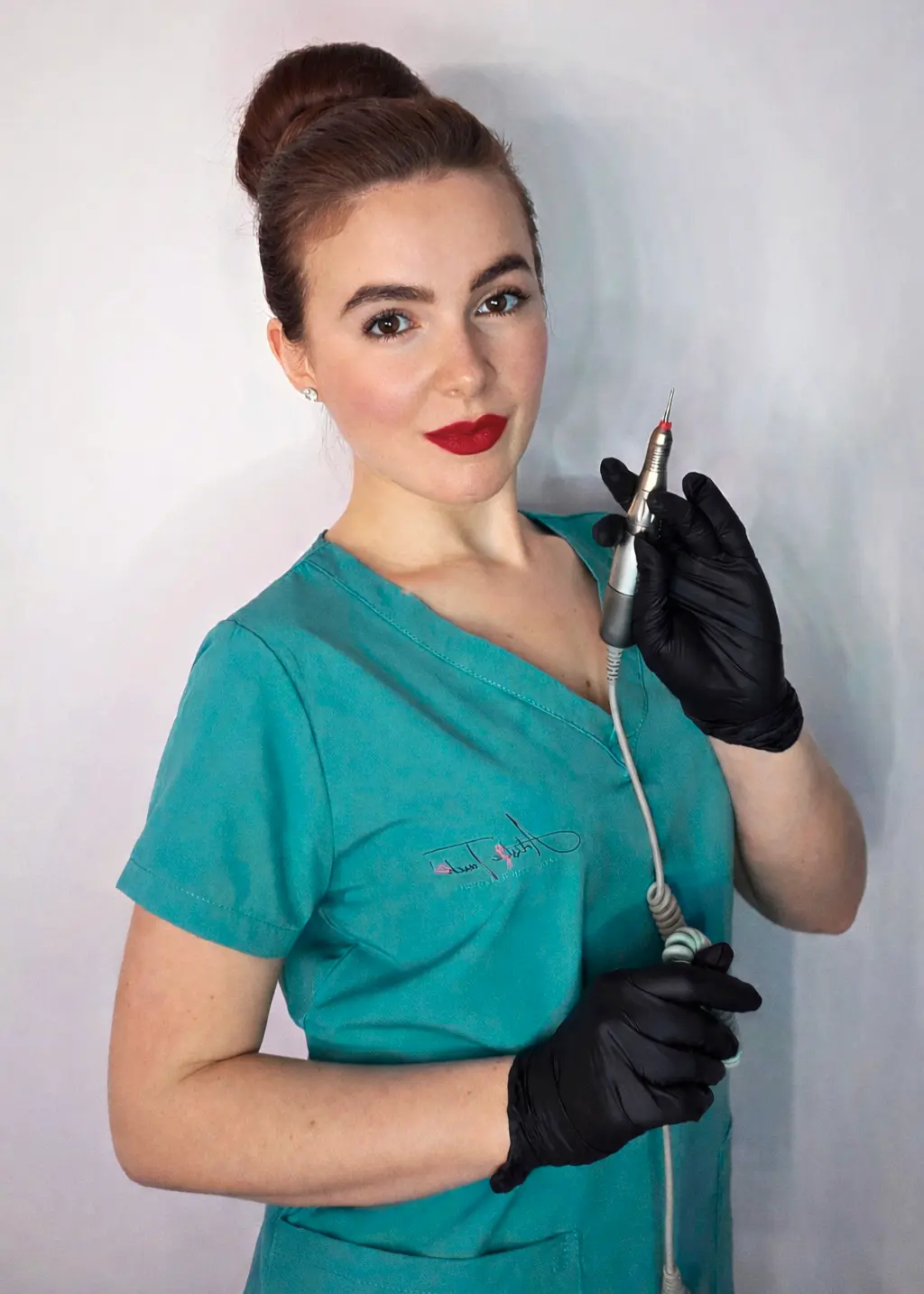
Radina Ignatova
Professional Nail Expert | International Nail Educator
I am Radina Ignatova, a Professional Nail Expert since 2014 and International Nail Educator, based in Scotland, UK. I am the Founder of Artistic Touch Nail Training Academy and TheNailWiki.
At Artistic Touch Nail Training Academy, I provide structured professional online nail courses specialising in dual forms, gel systems, polygel application, advanced nail structure, E-File work and Russian Manicure, with a strong focus on professional salon safety. I continue to work actively in salon practice, ensuring that all education reflects real client scenarios and current industry standards.
My teaching philosophy is simple: I show real salon challenges, real mistakes and real performance testing, not just perfect demonstrations. This is how you develop genuine technical competence and become a confident, capable nail professional.
Every Artistic Touch course includes lifetime access and access to a dedicated student support group, where I provide ongoing guidance and professional feedback.
Start With Understanding — The Free Course
If you are curious about retention problems but not ready to commit to the full course, I offer Why Your Nails Do Not Last – a free online course that introduces the diagnostic thinking behind retention failures.
This free course covers hidden causes of lifting, why product changes rarely help, and how to begin thinking diagnostically about retention. It is designed to help you decide if deeper learning through the full Nail Prep Course is right for you.
Ready to Stop Guessing and Start Diagnosing?
The Nail Prep Course – Adhesion & Retention teaches the complete system behind long-lasting nails. Professional e-file prep, true cuticle removal, contamination control, product connection, workflow timing, and troubleshooting for real salon situations.
Enrol in the Nail Prep Course →Lifetime access • Self-paced learning • Professional troubleshooting • Real salon focus
Frequently Asked Questions
Will this course teach me a new product system?
No. The course teaches principles that work with any professional product system. The goal is understanding retention, not learning a specific product line. These principles apply whether you use gel, BIAB, hard gel, or any other enhancement system.
Can I improve retention without changing my products?
Yes, absolutely. Many retention problems can be solved through better prep, improved workflow, and proper technique without changing products. Some clients do benefit from product adaptation, but this decision comes after understanding, not before.
How long does it take to improve retention after taking this course?
Many technicians report improved retention confidence within one week. Measurable improvements in client results usually appear within 2–4 weeks of applying the principles. Long-term transformation takes ongoing practice and refinement.
Is this course for beginners or experienced technicians?
Both. Beginners benefit from learning proper prep fundamentals from the start. Experienced technicians often discover they have been approaching prep incorrectly and learn to fix long-standing retention problems. The level of detail serves both audiences.
What if I am still confused after taking the course?
Every Artistic Touch course includes lifetime access and a dedicated student support group where you can ask questions and receive guidance. You have ongoing access to learning and professional feedback, not just one-time course content.
Will learning e-file prep change my entire workflow?
Not necessarily. The principles work with your existing system. You may refine your approach or adjust some techniques, but this is gradual integration, not complete workflow overhaul. Many technicians find that small changes create significant retention improvements.
Can I apply these principles to BIAB and other enhancement systems?
Yes. Contamination control, workflow timing, product connection, and nail plate assessment principles apply to all enhancement systems. The specific techniques differ, but the thinking framework is universal.
Disclaimer: This content is for professional nail technician education purposes only. Nail services should be performed by trained professionals following current hygiene and safety regulations. Always carry out a full client consultation and check for contraindications before performing any nail service.
About Artistic Touch Nail Training Academy
Artistic Touch Nail Training Academy delivers structured professional online nail education focused on practical skill development, professional standards, and safe salon practice. All courses are available online worldwide with lifetime access and ongoing student support.