How to Choose the Right Dual Form for the Natural Nail in Front of You
Author: Radina Ignatova, Professional Nail Expert, Educator | Last Updated: July 2026
Quick Answer
Choosing the right dual form starts with the natural nail, not the finished shape you have in mind. Before looking at sizing charts, identify the structural task the nail actually needs: strengthening a thin or fragile plate, correcting an uneven growth pattern, or extending a healthy nail that simply needs length. Each of these tasks places different demands on how the form should sit against the nail, particularly at the cuticle area and sidewalls. A form chosen only because it produces the desired finished shape can still be the wrong structural choice, and this is one of the most common reasons a technically neat-looking set does not hold its integrity over the following weeks.
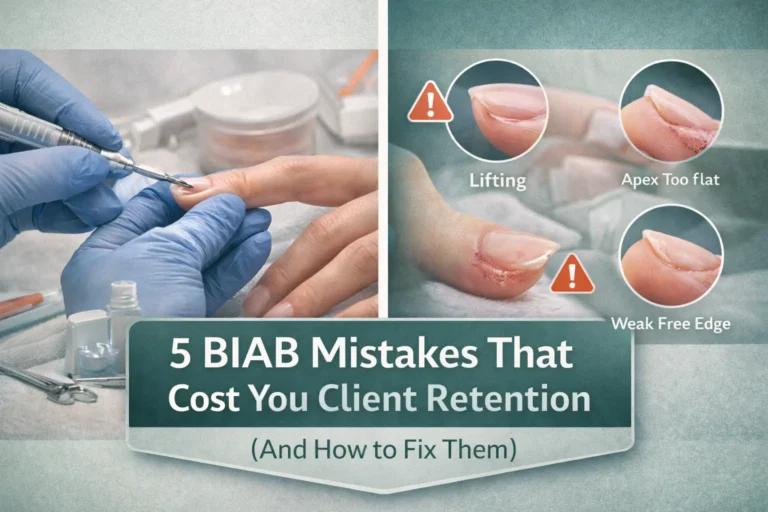
You chose a dual form that matched the width of the nail. The sizing looked correct, the shape you were aiming for was achievable with that form, and the finished set looked exactly as intended in the photograph. Weeks later, that same client is back with lifting at the sidewalls, or the extension has started to separate slightly at the free edge, and it is not obvious why.
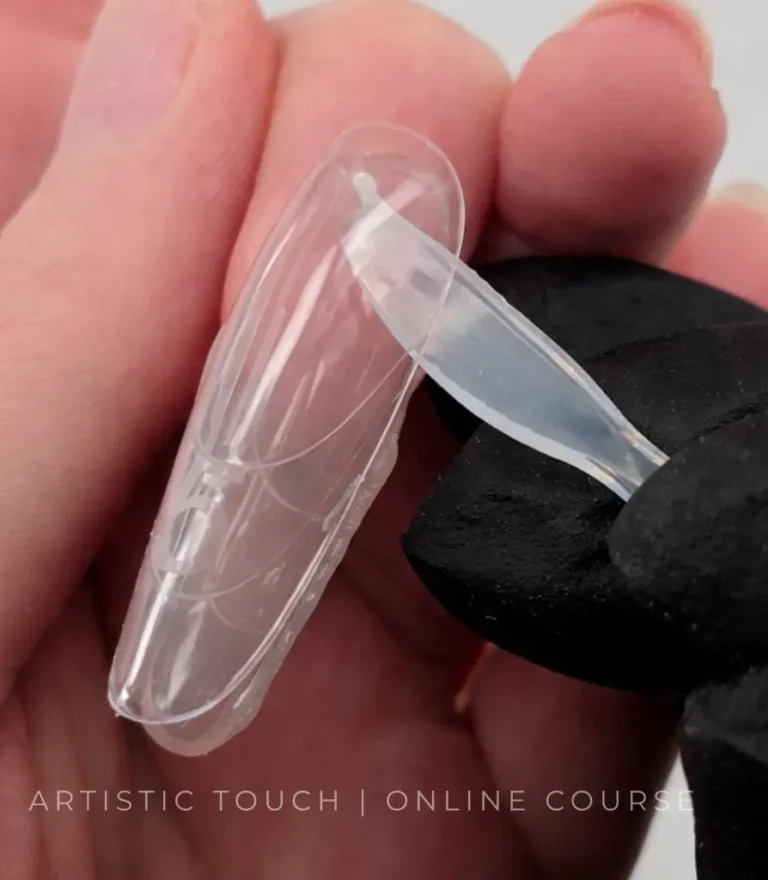
Many technicians select a dual form the same way they might select a shoe size: pick the desired outcome first, then find the closest match. The problem is that a dual form is not simply a mould for a shape. It is a structural support system that has to work with the natural nail underneath it, and that relationship depends on far more than the finished silhouette.
Start With the Structural Task, Not the Shape
Before any form is picked up, it is worth identifying which of three structural tasks the natural nail is actually asking for.
- Strengthening — the natural nail is thin, over-filed, prone to breakage, or structurally weak, and the enhancement needs to reinforce it without adding unnecessary bulk.
- Correction — the nail has an uneven growth pattern, an old injury, an irregular free edge, or an asymmetry between the two hands, and the enhancement needs to bring the shape back into balance gradually.
- Extension — the natural nail is structurally sound and simply needs additional length, meaning the form’s main job is to support growth rather than compensate for an existing problem.
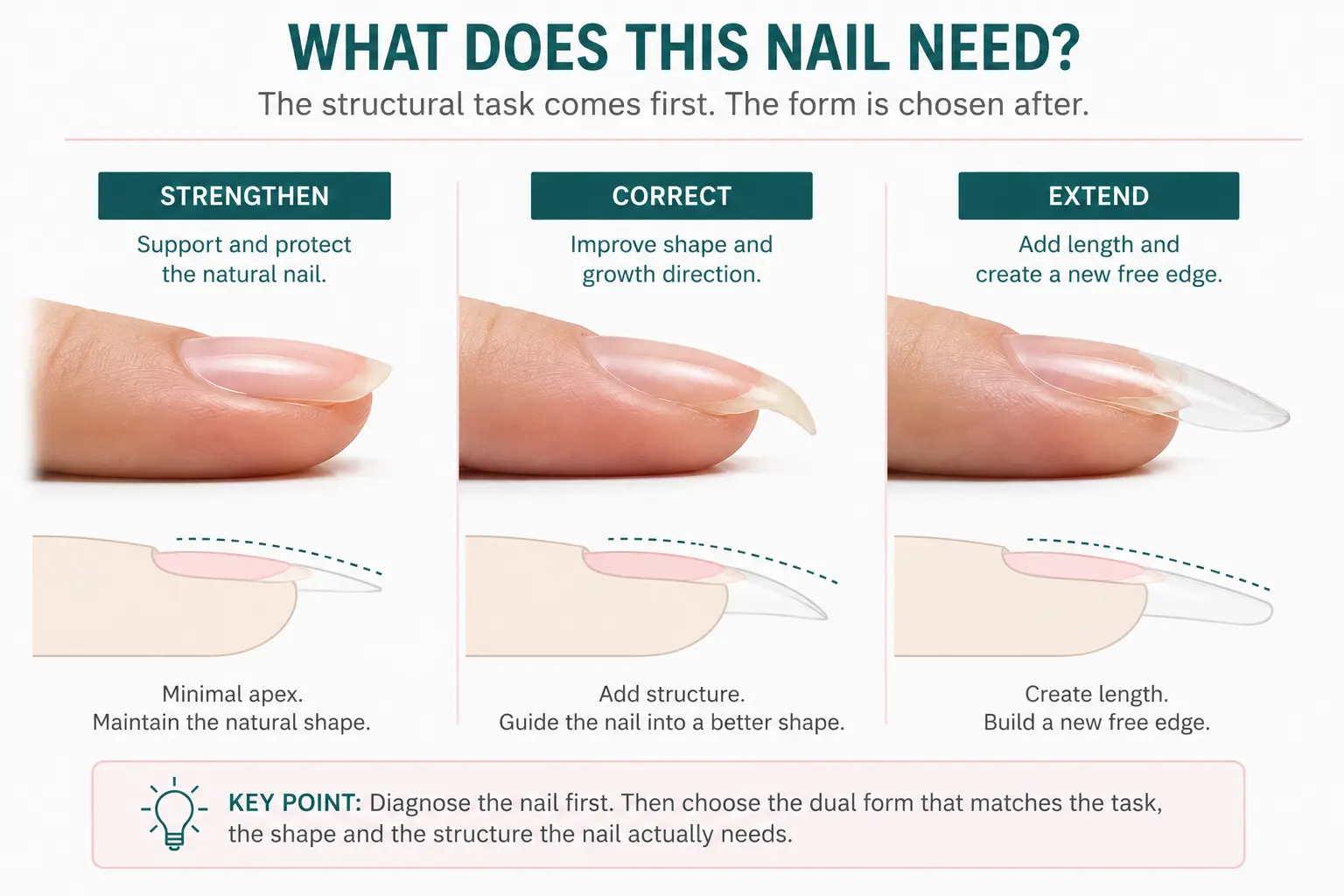
These are three genuinely different jobs, and a form that performs one job well will not automatically perform the other two equally well. A form chosen purely because it will produce a particular finished shape may be entirely inappropriate for a nail that actually needs correction first.
Assess the Nail Before You Assess the Form
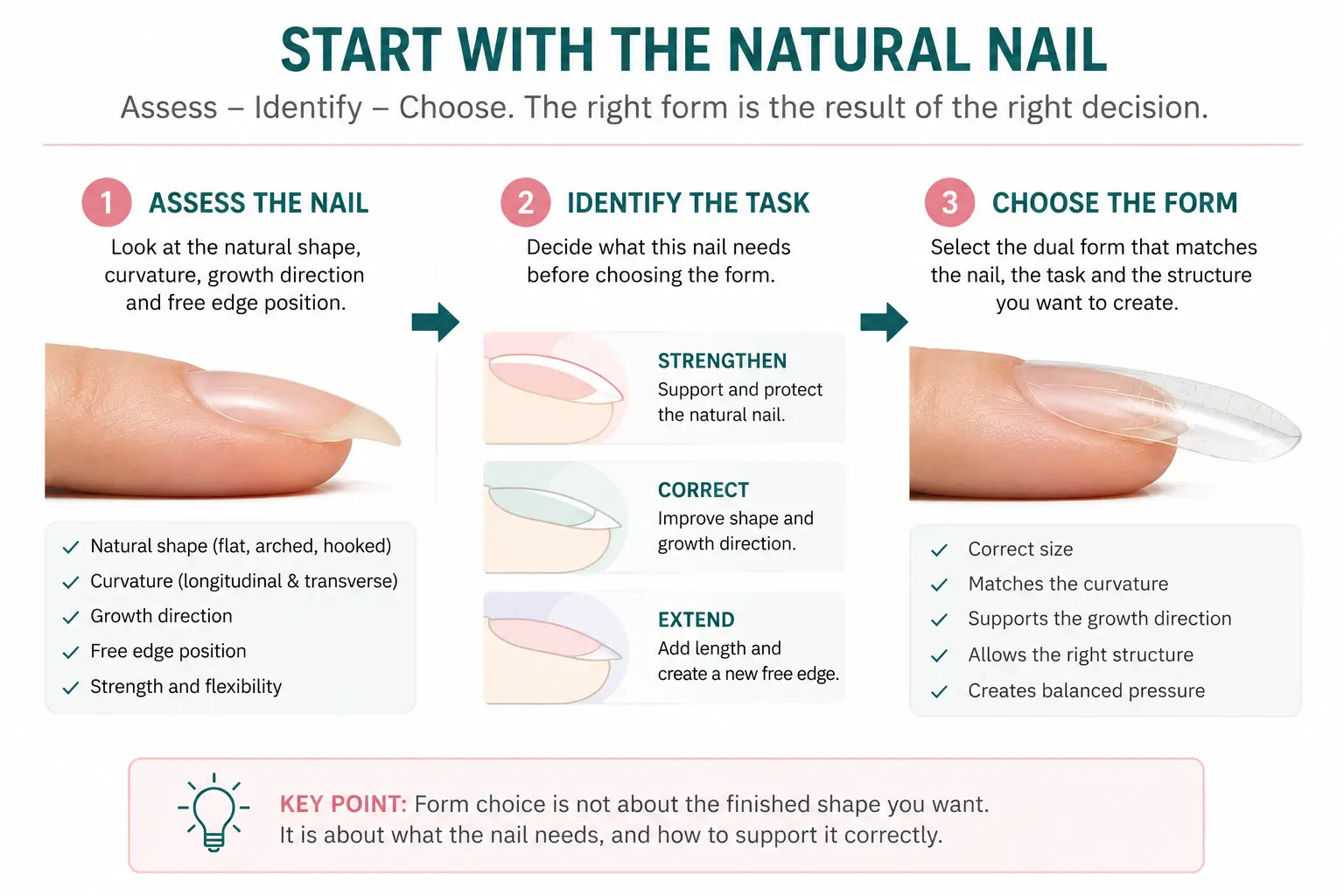
In salon work, I often see technicians reach for the form and the sizing chart before they have properly looked at the nail itself. A more reliable sequence is to assess the nail first, in this order:
- Growth direction — does the free edge grow straight, or does it curve to one side, upward or downward?
- Curvature — is the transverse curve flat, average or pronounced, and does the longitudinal curve change along the length of the nail?
- Sidewall and growth-point condition — is there enough healthy nail at the points of growth to support a form without over-extending onto compromised tissue?
- Where the natural nail sits inside the form — once the form is offered up to the nail, does it sit centrally and evenly, or is it forced to one side to achieve the desired width?
This does not automatically mean that every nail with an unusual growth pattern needs a corrective approach. It means the pattern must be assessed and understood before a form is selected, rather than discovered afterwards when the set has already started to fail.
Why Forcing a Form to Fit Creates Compensation
When a form is chosen for its finished shape rather than its structural compatibility, technicians frequently have to force it into position: pressing harder at the sidewalls, adding extra product to fill an uneven gap, or applying more pressure at the cuticle area than the nail can comfortably tolerate. Each of these adjustments is a compensation for a decision made earlier in the process.
The visually attractive form is not always the technically appropriate one. A form that creates the most elegant silhouette in isolation may be the wrong structural match for a nail that needed strengthening rather than a dramatic shape change. This is a distinction that copying a tutorial cannot make for you, because the tutorial is working with one specific nail, not the one in front of you.
A Practical Decision Sequence
- Identify whether the nail needs strengthening, correction or extension before considering shape.
- Assess growth direction and curvature with the natural nail bare, before any form is introduced.
- Offer the form to the nail and observe whether it sits evenly without being forced.
- Where the form requires noticeable pressure or filling to sit correctly, treat this as a signal to reconsider the choice, not a problem to solve with more product.
- Confirm that the chosen form supports the structural task identified in step one, not only the desired finished shape.
Understanding Over Memorisation
A sizing chart can tell you which form matches a given width. It cannot tell you whether that nail needs strengthening, correction or extension, and it cannot account for how that individual nail behaves once product is applied and cured. Professional decision-making means being able to read the nail in front of you and adapt, rather than applying the same selection process regardless of what the nail is actually asking for.
Still choosing forms by shape rather than structural need?
The Ultimate Dual Forms teaches how to assess and select the correct form for strengthening, correction or extension.
See Full Course DetailsContinue Learning
For a practical introduction to matching forms against nail bed shape, see the free masterclass How to Pick Dual Forms: A Practical Guide.
For the underlying nail structure referenced in this article, see Dual Forms and Nail Plate on TheNailWiki.
Frequently Asked Questions
How do I choose the correct dual form?
Begin by identifying whether the natural nail needs strengthening, correction or extension. Assess growth direction, curvature and where the nail sits inside the form before selecting based on the finished shape you want.
Should I choose a dual form by nail shape or nail width?
Width alone is not a reliable starting point. Structural factors such as growth direction, curvature and the condition of the sidewalls and growth points should be assessed first, alongside width, rather than instead of it.
What is the difference between strengthening, correcting and extending with dual forms?
Strengthening reinforces a thin or fragile natural nail. Correction gradually addresses an uneven growth pattern or asymmetry. Extension supports additional length on a natural nail that is already structurally sound. Each requires a different approach to form selection.
Why does a dual form fit at the cuticle but not the rest of the nail?
This pattern can indicate that the form’s assumed curve does not match the natural nail’s actual curvature along its length. A form can appear to fit at one reference point while sitting incorrectly elsewhere, which is why the whole nail should be assessed rather than a single measurement.
Can the wrong dual form damage retention?
A form that does not sit correctly against the natural nail can increase the risk of stress points and uneven product distribution, both of which can contribute to retention problems. This is one factor to assess when lifting or separation recurs despite a neat-looking application.

RADINA IGNATOVA
Professional Nail Expert | International Nail Educator
I am Radina Ignatova, a Professional Nail Expert since 2014 and International Nail Educator, based in Scotland, UK. I am the Founder of Artistic Touch Nail Training Academy and TheNailWiki.
At Artistic Touch Nail Training Academy, I provide structured professional online nail courses specialising in dual forms, gel systems, polygel application, advanced nail structure, E-File work and Russian Manicure, with a strong focus on professional salon safety. I continue to work actively in salon practice, ensuring that all education reflects real client scenarios and current industry standards.
My teaching philosophy is simple: I show real salon challenges, real mistakes and real performance testing, not just perfect demonstrations. This is how you develop genuine technical competence and become a confident, capable nail professional.
This article is provided for professional educational purposes and reflects general salon-based observation. It is not a substitute for structured training, professional assessment of an individual client, or medical advice. Outcomes referenced are based on professional experience and are not guaranteed.
© 2026 Artistic Touch Nail Training Academy. All rights reserved.