BIAB Overlay With Dual Forms: A Real-Time Step-by-Step on My Own Nails
Can you create a BIAB overlay with dual forms that looks smooth, thin and professionally finished without spending ages filing? It can be much faster than a traditional application, but only when the dual form fits correctly and the product is distributed where the nail actually needs it.
This article is the written companion to my real-time demonstration on the official YouTube channel, Radina Ignatova | Nail Academy. I did the natural nail overlays, using Andreia Professional BIAB and Imenka dual forms, on my own right hand, using my non-dominant left hand, which makes placement, pressure and product distribution harder to judge. That means you also see the mistakes and how I corrected them.
Quick Answer: Can You Do a Smooth BIAB Overlay With Dual Forms Quickly?
Yes, but the speed comes from getting the application right before you cure, not from rushing. Choose a dual form that fits the nail (trimming it if it pushes into the skin), place the BIAB so it covers the sidewalls and sits cleanly under the cuticle, press evenly on both sides, and cure pigmented BIAB for two rounds of 60 seconds because dual forms hold more product volume. In my real-time demonstration, the overlay came out smooth and thin with very little correction, although I still shaped and refined the free edge.
Watch the Video: BIAB Overlay With Dual Forms in Real Time
This is a real-time application, not a sped-up demonstration, so the video is long. These are the parts I would watch first:
- Checking the fit and trimming the dual form (1:01)
- Product on the sidewalls and under the cuticle (4:19)
- Dropping the form on with even pressure (8:06)
- Why I cure pigmented BIAB twice for 60 seconds (12:57)
- Removing the forms and correcting a nail (14:35)
- Finishing with shimmer and top coat (30:10)
What I Did Before the Overlay
Before starting, I had already done the Russian Manicure, prepped the nails and applied a base coat. I worked on my right hand with my left hand, which is slightly more challenging.
The product was Andreia Professional BIAB in a nude pink shade, with Imenka dual forms. Its viscosity is slightly more runny than a typical builder gel, which affects how it moves inside the form. I also planned to add a shimmer coat at the end, and I decided on the finish as I went. If the nail preparation under a BIAB is the weak point, read why nail prep is more than removing shine or explore the Nail Prep course.
Step 1: Check the Fit and Trim the Dual Form
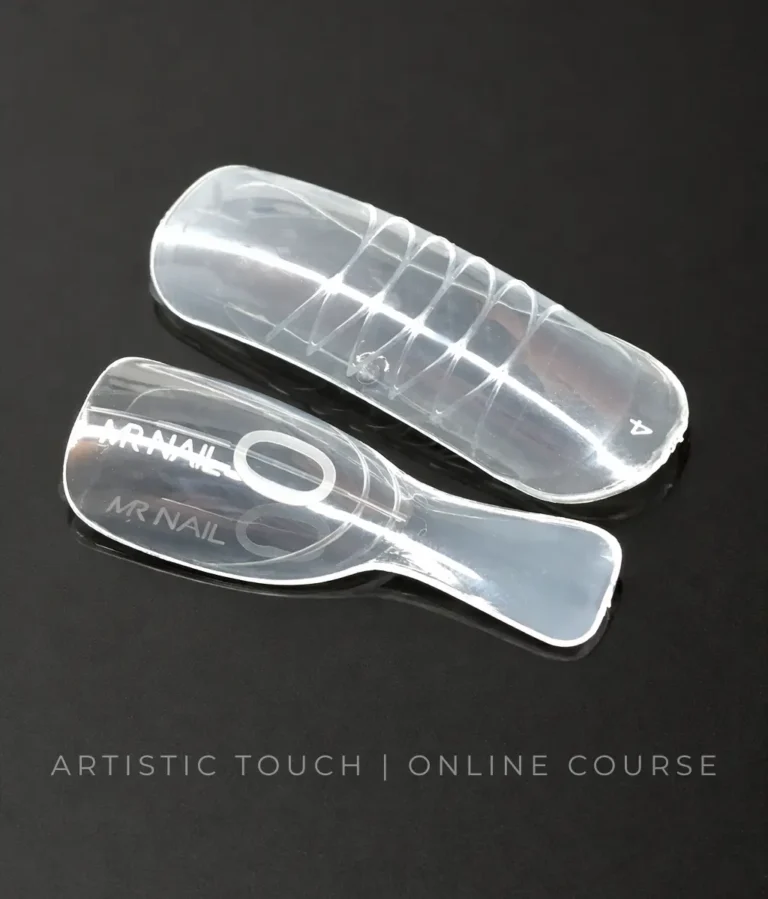
I already knew which dual forms suited my nails, but I noticed that the form on my little finger needed a small trim so it was not pushing into the skin. After trimming, it fitted perfectly. I then checked every form again for fit, because I noticed a tiny bit pushing into the skin on one.
Trimming has to be precise, because you do not want the form pushing into the skin. If you want a full guide to choosing the right form, read how to choose the right Dual Form for the natural nail in front of you and why your Dual Forms keep failing on different nail shapes.
Step 2: Work One Nail at a Time
I used a small flash lamp, operated with a foot pedal, and worked on one nail at a time. I did this because I did not want the gel running onto the sides. This was not an extension: I was doing natural overlays, so my length was the first margin of the dual form.
If you flash cure while working, read fast BIAB infill with dual forms: what flash cure problems taught me.
Step 3: Place the Product and Push It Where the Nail Needs It
I placed the BIAB inside the dual form, using the same amount of gel on each nail, and poked out any small bubble. I wanted enough product on the sidewalls so that they were properly covered, and I pushed the gel under the cuticle for a clean imprint and to close the growth points. Then I flash cured.
A bottle of BIAB can run onto the skin, so I took care to keep product off the sides where it does not belong. If your BIAB tends to lift, check why your BIAB still lifts even after training.
Step 4: Drop the Form On and Press Evenly
I dropped the dual form onto the nail, making sure that there was enough pressure on both sides, and then cured it. Uneven pressure was the cause of my main corrections later: on one nail I did not press enough and ended up with a small exposed growth point, and on another I pressed too much on one side, which I filed off afterwards.
Working on my own hand made this harder, because I could not see what was happening on the other side. It is much easier to do on a client.
| What I noticed | What it caused | What I did |
|---|---|---|
| Not enough pressure on one side | A small exposed growth point | Cleaned and reapplied a little product, then pressed again |
| Too much pressure on one side | Extra product to file off | Filed it off during shaping |
| Excess product underneath | Product where it should not be | Cleaned it away before curing |
| A hooked nail with too little product | A stress zone and a thicker-looking nail | Added a little more product underneath |
Why Dual Forms Can Make an Overlay Faster
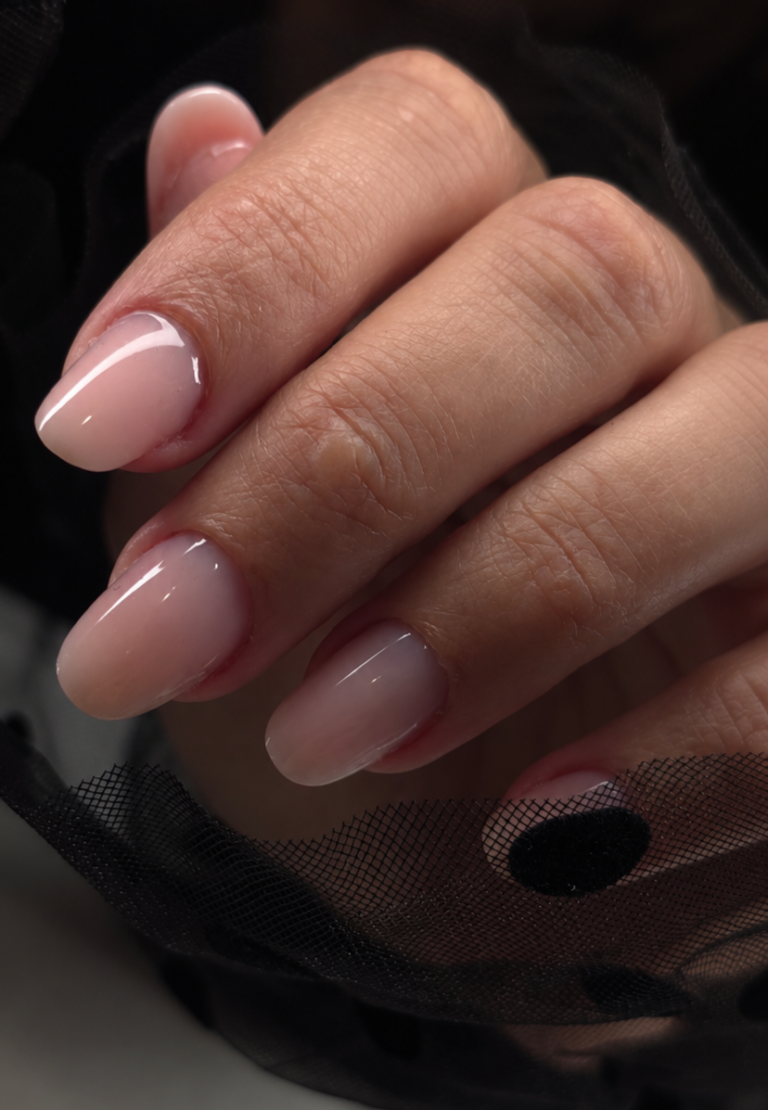
The technique is extremely fast. This video is real time, not sped up, and you can see how long it takes. With this technique you can do a BIAB application in around an hour, or even under an hour including the Russian Manicure.
The results come out smooth and thin, and in an ideal application you hardly need to file. In this demonstration I still filed and refined, because I wanted a short length and because my own hand made some of the placement imperfect. A short nail is also more difficult, and thinning the free edge on yourself is difficult. On a client, there is very little to refine, because I can see everything much better.
You can always add more product underneath when a nail needs it, whether you are doing extensions or overlays. For the hooked nail on my little finger, I did not put enough product, which would have caused me trouble when refining the free edge, so I added a little more underneath.
Why I Cure Pigmented BIAB Twice for 60 Seconds
This is an important caveat. When you work with pigmented products, whether BIAB or builder gel, I cannot see the polymerisation properly, even if the manufacturer says to cure for a set time. I always cure twice for 60 seconds, because dual forms hold more internal volume.
If the light does not penetrate well, you can end up with uncured product concentrated where the stress is, especially at the apex with arched dual forms. You may only find this when you start refining the free edge. I do two rounds of 60 seconds even with compatible or incompatible lamps, so that everything is properly polymerised and dry and I do not have problems later.
Check your own lamp and your own product instructions. This is my own cure routine for pigmented BIAB inside dual forms, not a universal rule.
Removing the Forms and Correcting a Nail
After curing, I took the forms off and cleaned the inhibition layer first, including underneath, before filing. Cleaning underneath stops the product clogging the drill bits. I also removed the flimsy bits first, otherwise I would not get a perfect application.
To correct the little finger, I applied a little product where it was needed, dropped the form and pressed again, and you can see how the product distributes itself. There was a small margin line, but since I planned to add a shimmer on top, it could be hidden. If this happens to you, brush on another coat of the same colour and it will be fine.
Shaping and Refining the Free Edge
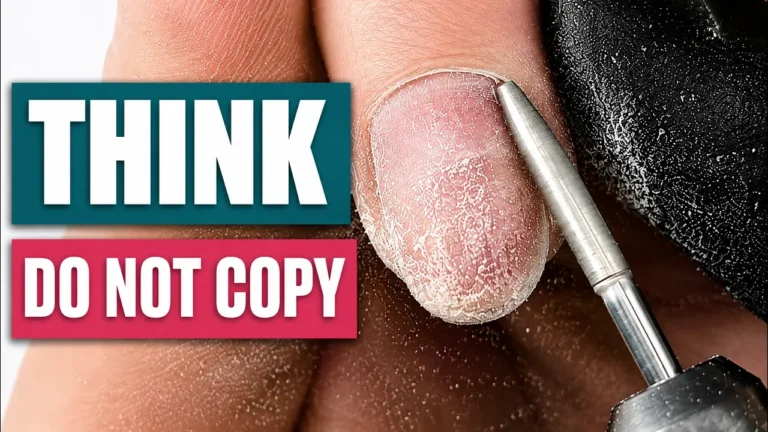
I cut off some length with a red abrasive bit and then changed bits. The shorter the nail, the more difficult the work, so I was careful. I thinned the free edge and cleaned the area very carefully without interfering with the hyponychium, especially on such a short length.
The hooked nail looked thicker on a short length, because there is a stress zone between the dual form and the product. That is why I went back and refined the free edge after filing, once I could see how the nail would look at the end. I shaped the nails with a file and thinned the free edge as much as I could. Some thickness on a short, hooked nail is acceptable.
The same ideas apply to simple finishes, where nothing hides the shape or thickness. See why plain nails demand better technique.
The Finish: Shimmer and Top Coat
After filing, I cleansed the dust with IPA and applied a glitter pink Andreia Professional BIAB for the shimmer. I was not trying to build thickness, only add shimmer, so I brushed it on like a gel polish with an almost dry brush. A thin coat only needed 60 seconds. I then top coated, cured, and cleaned the inhibition layer with a foam cleanser.
The result was smooth, thin and glossy, achieved in a short time. If you want to see how colour can be used inside the form, read about the dual form colour technique.
Choosing the Right Dual Form for Each Nail
With this technique, you need to know which dual form suits which nail. If you do not, you end up with very thick, bulky nails. That is why fit, shape and size matter more than the speed of the application. If you are wondering how many forms you really need, read the Dual Forms I actually use from my 46-box collection.
A Checklist for a BIAB Overlay With Dual Forms
- Prep and base coat first, so the overlay sits on a properly prepared nail.
- Choose the right form for the nail, and trim it if it pushes into the skin.
- Check the fit of every form before you pick up the product.
- Use the same amount of product, and remove bubbles before you place the form.
- Make sure the sidewalls are covered, and the product is pushed under the cuticle for a clean imprint.
- Press evenly on both sides when you drop the form on.
- Clean excess product from underneath before curing.
- Cure pigmented BIAB twice for 60 seconds to avoid uncured product at the apex.
- Clean the inhibition layer before filing, including underneath.
- Refine the free edge once you can see the finished shape.
In my Ultimate Dual Forms course I teach this in full: picking the forms, applying them properly, the clean imprint technique, extensions, overlays, corrections such as hooked nails, downloadable materials, and the business side, including how to price your services and charge premium prices. See also the Sandwich Dual Forms course and all online nail courses.
A general dual form tutorial shows the movements. Here I explain the reasoning behind each decision, from fit and pressure to curing and refining the free edge, including the mistakes. That is a deeper understanding of dual forms, and it is what lets you adapt when your client or your nail is different.
The Ultimate Dual Forms
Learn to choose, fit and apply dual forms for smooth overlays and extensions, with the clean imprint technique, nail corrections and the business materials to price your services.
View the Course Details →Frequently Asked Questions
Can you do a BIAB overlay with dual forms?
Yes. I demonstrate natural nail overlays with BIAB and dual forms in real time. The technique can be much faster than a traditional application when the form fits correctly and the product is distributed where the nail needs it.
How long does a BIAB overlay with dual forms take?
In my experience you can do a BIAB application in around an hour, or even under an hour including the Russian Manicure. The video is real time, not sped up.
Do you need to file after a dual form overlay?
Ideally very little. The results come out smooth and thin. In my demonstration I still shaped the nails and refined the free edge, because I wanted a short length and was working on my own hand with my non-dominant hand.
Why cure BIAB twice for 60 seconds in dual forms?
Dual forms hold more internal volume, and with pigmented products it is hard to see polymerisation. Light may not penetrate well, leaving uncured product at the apex, especially with arched forms. I cure twice for 60 seconds to avoid problems later. Check your own lamp and product instructions.
How do you stop BIAB running onto the skin when using dual forms?
I work one nail at a time, use the same amount of product, make sure the sidewalls are covered, press evenly on both sides and clean away excess product underneath before curing.
What if a dual form pushes into the skin?
Trim the form precisely so it does not push into the skin, then check the fit again before applying the product.
How do you fix a nail if you did not use enough product?
You can add more product underneath. For a hooked nail, I added a little product, pressed again, and refined the free edge once I could see the finished shape. If there is a small margin line, brush on another coat of the same colour.
Where can I watch the full video?
‘BIAB Overlay With Dual Forms | Working With My Non-Dominant Hand’ is on Radina Ignatova | Nail Academy, the official YouTube channel of Artistic Touch – Nail Training Academy. It is embedded at the top of this article.
Key Takeaway
Dual forms can make natural nail overlays considerably faster, but the real time saving comes from selecting the right form, controlling the product and getting the application right before curing. Understand how the form, the natural nail and the product work together, so that less correction is needed afterwards.
Learn the Whole Dual Forms System
The Ultimate Dual Forms teaches form selection, clean imprint technique, overlays, extensions and corrections, plus pricing and business materials.
View The Ultimate Dual Forms →About the Author
Professional Nail Expert | International Nail Educator
I am Radina Ignatova, a Professional Nail Expert since 2014 and International Nail Educator, based in Scotland, UK. I am the Founder of Artistic Touch – Nail Training Academy and TheNailWiki.
At Artistic Touch – Nail Training Academy, I provide structured professional online nail education specialising in dual forms, nail preparation and retention, nail structure, E-File work and Russian Manicure, with a strong focus on professional salon safety. I continue to work actively in salon practice, ensuring that all education reflects real client scenarios and current industry standards.
My teaching philosophy is simple: I show real salon challenges, real mistakes and real performance testing, not just perfect demonstrations. This is how you develop genuine technical competence and become a confident, capable nail professional.