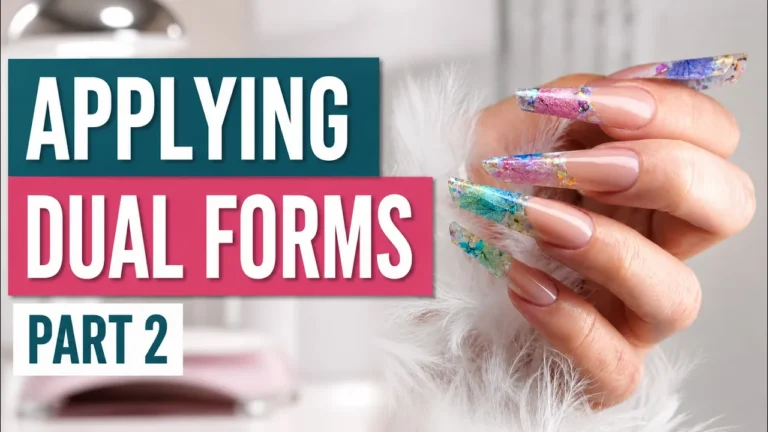
How to Get a Clean Imprint with Dual Forms
How do you get a clean imprint with dual forms, without a visible ridge around the cuticle and without filing or refining the result afterwards? In my video I put two applications side by side to show exactly what makes the difference.
This article follows that demonstration on the official YouTube channel, Radina Ignatova | Nail Academy. It is a deeper understanding of why the two results differ, not a general tutorial that only shows the steps, so that you can recognise the mistake in your own work.
Quick Answer: How Do You Get a Clean Imprint With Dual Forms?
Use a good quality, flexible form with a thin cuticle zone, keep the product thin towards the cuticle, wipe any gel off the outside of the form, and cover the sidewalls. Then do not stamp the form on: start from the cuticle, slide it right under the cuticle zone and slowly lower it while watching how the product distributes. Cure it, and you should have no ridge and nothing to file. A clean imprint depends on form selection, cuticle-zone flexibility, product distribution and placement control together, not just on using less product.
From Artistic Touch – Nail Training Academy
Want to learn this properly? The Ultimate Dual Forms
The Ultimate Dual Forms teaches form selection, product control and placement, and how to adapt your technique to every nail type.
Watch the Video: How to Get a Clean Imprint with Dual Forms
The video shows both methods being done and the two results side by side. These are the parts I would watch first:
- A flexible form compared with a rigid one (0:57)
- Keeping the product thin at the cuticle (2:21)
- Do not stamp: lower the form from the cuticle (3:49)
- What not to do (4:57)
- The two results: a clean imprint and a ridge (8:00)
- Why the outside of the form must be clean (8:29)
The Visible Difference: Clean Imprint vs Ridge
On one side, the clean imprint technique with no refinements and no filing at all: there is no ridge. On the other, a massive ridge, uneven product application and flooding. This is what I mean by a clean imprint: you do not have to file or refine the result afterwards.
| Clean imprint | Ridge and flooding | |
|---|---|---|
| Cuticle area | No ridge | A big ridge that has to be filed off |
| Product distribution | Even | Uneven, with flooding |
| Outside of the form | Wiped clean | Product smudged on the outside, leaving marks |
| Placing the form | Lowered slowly from the cuticle | Stamped on |
| Filing afterwards | None | Needed |
To be transparent, in this comparison I changed more than one thing between the two applications: the form was different, and so was my technique. That is deliberate, because a clean imprint is the result of several factors together, which I explain below.
Two Forms That Look Almost Identical
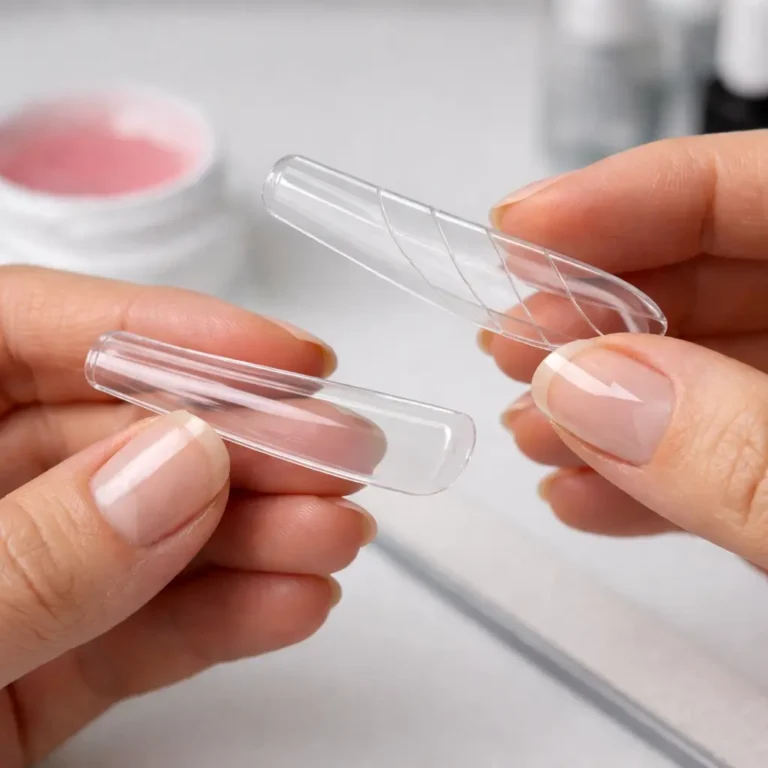
I used an Imenka stiletto form and a cheap, unbranded AliExpress form. From a first glance they look almost identical, but they are not.
When I handle them, the AliExpress form is rigid. The Imenka form flexes and bends, and its cuticle zone is much thinner than the rigid one. That cuticle zone matters, because it is where the form meets the skin and where a ridge forms.
| Imenka form | Unbranded AliExpress form | |
|---|---|---|
| Flexibility | Flexes and bends | Rigid |
| Cuticle zone | Much thinner | Thicker |
| Result in this test | Clean imprint, no ridge | A big ridge to file off |
To understand what separates a good sandwich form from a poor one, read what makes a good sandwich Dual Form and why this sandwich form gives cleaner imprints than traditional methods.
Step 1: Place the Product Inside the Form
I used a soft pink Andreia Professional builder gel, and I had already measured my dual forms. I pick up a relatively big bead of hard gel. I am not looking to create length in this test, only the imprint, and I use the letters on the form as a guide for the length.
- Place the gel inside the form from the free edge towards the cuticle.
- Make it very thin towards the cuticle. You do not want a concentration of product at the cuticle.
- Wipe away any excess smudged on the outside of the form. The form must be clean.
- Distribute the product slightly so the sidewalls are covered too.
If you do not yet know how to pick dual forms, I have a free dual forms mini course among my free courses, and I teach it in more detail in the Ultimate Dual Forms course.
Step 2: Do Not Stamp the Form On
Pay attention to this part. I would not simply place the dual form on like a stamp. I start from the cuticle, and I can push the form right under the cuticle zone because it flexes. Then I slowly lower it, while looking at how the product is distributing.
Then I flash cure for a couple of seconds, and cure the nail fully.
Learn it step by step. This is one part of what I teach in The Ultimate Dual Forms. Inside the course I teach the full method with real salon demonstrations, so you can make these decisions on your own clients.
See what is inside →What Not to Do
For the second application, I used the cheap AliExpress form and repeated the process almost identically, with some deliberate differences. I used a relatively bigger bead again, and on purpose I smudged a little product on the outside of the form. Whereas the first time I had cleaned everything very well, this time I left it.
Then I did not lower the form. I stamped it on, and I did not even look at how the product was distributed inside. I flash cured and then polymerised it.
For related application problems, read applying Dual Forms: why beautiful designs fail during application and why BIAB dual forms come out thick and bulky.
The Results: Why the Imprint Is Clean or Not
After polymerising, I removed the forms by giving them a pinch so they slowly pop off. The Imenka form came off nicely. A clean imprint means that you do not have to file or refine the result afterwards, and it also means you can push the product right under the cuticle for longer-lasting results.
On the Imenka nail there is no ridge at all. On the AliExpress nail there is a big ridge that I would have to file off, and where I had brushed product on the outside of the form, you can also see the marks. The dual form must be completely clean for it to give a clean imprint.
What Makes a Clean Imprint
A clean imprint is not simply about using less product. Four things work together.
| Factor | Why it matters |
|---|---|
| Form quality and flexibility | A flexible form with a thin cuticle zone can sit right under the cuticle |
| Product distribution | Thin at the cuticle, covering the sidewalls, with no concentration of product |
| A clean outside | Product smudged on the outside of the form shows on the nail |
| Control of placement | Lowering the form from the cuticle while watching the product, not stamping it |
For how to choose forms in the first place, read how to choose the right Dual Form for the natural nail in front of you and stop choosing sandwich Dual Forms by shape.
Where to Learn the Complete Method
If you want to know how to work with dual forms properly and get a clean imprint on every set of nails, this is what I teach in The Ultimate Dual Forms: how to select the dual form, the control, the product, the position, and how to adapt the technique to every different nail type. I also teach overlays, extensions, infills, troubleshooting, business and pricing, including how to increase your prices. Browse all online nail courses.
Tell me in the comments of the video: are you struggling with the visible ridge around the cuticle, or with controlling the product flooding when you press the form on?
The Ultimate Dual Forms
Learn form selection, product control and placement, and how to get a clean imprint on every nail type, from overlays to extensions and infills.
View the Course Details →Frequently Asked Questions
What is a clean imprint with dual forms?
It is a result with no ridge around the cuticle and no uneven product, so you do not have to file or refine the nail afterwards.
Why do I get a ridge at the cuticle with dual forms?
Common causes are product concentrated at the cuticle, a rigid form with a thick cuticle zone, product on the outside of the form, and stamping the form on instead of lowering it from the cuticle while watching the product.
Should I stamp the dual form onto the nail?
No. I start from the cuticle, push the form right under the cuticle zone and slowly lower it while looking at how the product is distributing.
Does the quality of the dual form matter?
Yes. A flexible form with a thin cuticle zone behaves differently from a rigid one, even when the two look almost identical. In my test the flexible Imenka form gave a clean imprint and the rigid AliExpress form left a ridge. I also changed my technique between the two, so quality is one factor among several.
How much product should I put at the cuticle?
Keep it very thin towards the cuticle. You do not want a concentration of product there. Wipe any excess off the outside of the form too.
Do dual forms have to be clean on the outside?
Yes. Product on the outside of the form can leave marks on the nail, so the form must be completely clean to give a clean imprint.
Can I use a clean imprint technique for overlays and extensions?
Yes. In The Ultimate Dual Forms I teach how to achieve a clean imprint on every set of nails, including overlays, extensions and infills.
Where can I watch the full video?
‘How to Get a Clean Imprint with Dual Forms’ is on Radina Ignatova | Nail Academy, the official YouTube channel of Artistic Touch – Nail Training Academy. It is embedded at the top of this article.
Key Takeaway
A clean imprint is not simply about using less product. Form selection, cuticle-zone flexibility, product distribution and placement control all influence the result. Keep the product thin at the cuticle, keep the form clean and lower it from the cuticle while you watch the product, instead of stamping it on.
Get a Clean Imprint on Every Set
The Ultimate Dual Forms teaches form selection, product control and placement, and how to adapt your technique to every nail type.
View The Ultimate Dual Forms →💬 FREE WHATSAPP COMMUNITY
Discuss real nail challenges, ask questions and submit case studies for a chance to be featured on my YouTube channel with educational feedback.
Request future video topics, share your experiences and be first to hear about professional insights, new courses and promotions.
Join Artistic Touch Insiders on WhatsAppAbout the Author

Professional Nail Expert | International Nail Educator
I am Radina Ignatova, a Professional Nail Expert since 2014 and International Nail Educator, based in Scotland, UK. I am the Founder of Artistic Touch – Nail Training Academy and TheNailWiki.
At Artistic Touch – Nail Training Academy, I provide structured professional online nail education specialising in dual forms, nail preparation and retention, nail structure, E-File work and Russian Manicure, with a strong focus on professional salon safety. I continue to work actively in salon practice, ensuring that all education reflects real client scenarios and current industry standards.
My teaching philosophy is simple: I show real salon challenges, real mistakes and real performance testing, not just perfect demonstrations. This is how you develop genuine technical competence and become a confident, capable nail professional.