One Natural Nail, Four Dual Forms: How Internal Volume and Length Change the Result
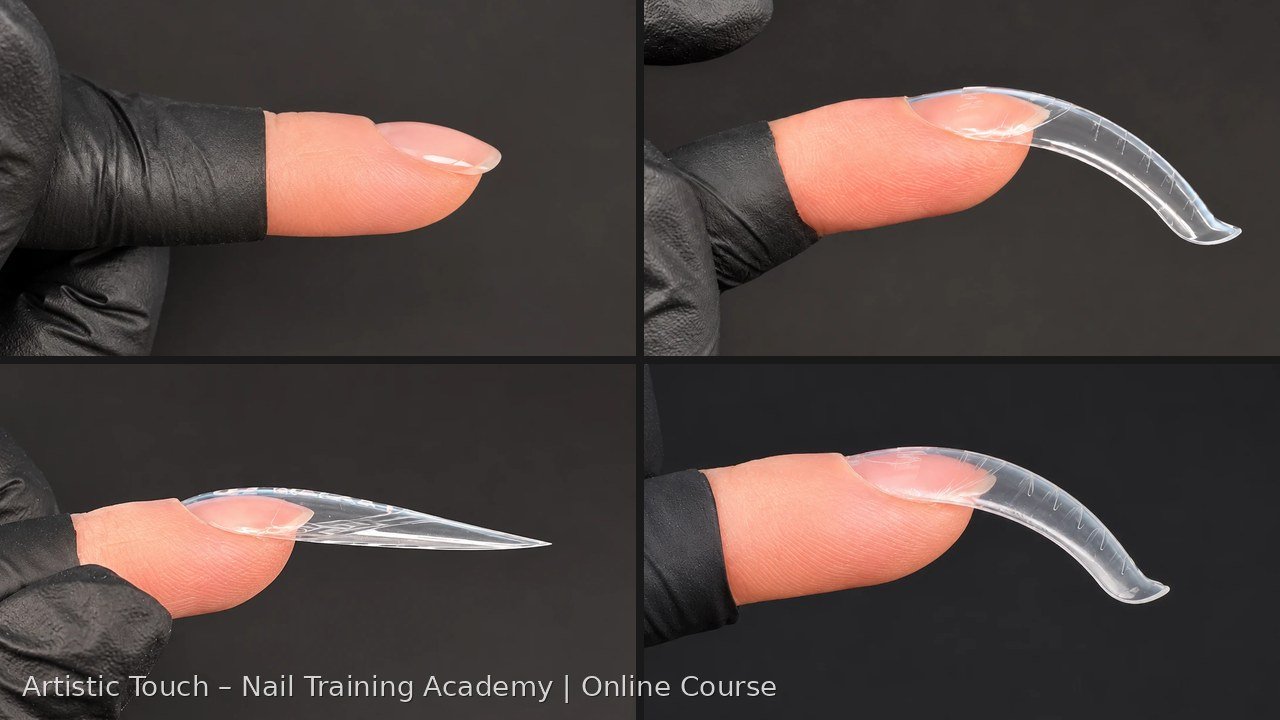
These images are screenshots from inside my online course, The Ultimate Dual Forms. They show the same natural nail four times: first with no form on it, and then with three different dual forms.
I use them in the course to demonstrate something that is difficult to explain with words alone: not every dual form is designed to create the same result, even when the forms appear suitable for the same nail.
One thing I always explain to my students is that choosing a dual form is not simply about finding one that fits. You need to understand what the form is designed to create, how much internal volume it has and whether it is suitable for the length and structure you want to achieve.
This is particularly important when working with short natural nails, something that I focus on throughout my course because this is the type of work many of us do every day in the salon.
Quick Answer: How Do You Choose a Dual Form for the Finished Result?
Choose the dual form according to the structure and length you want to create, not only by its shape or whether it covers the natural nail. In these screenshots from my Ultimate Dual Forms course, the same hooked natural nail is shown with three different forms: one with little internal volume for natural, shorter nails, a long stiletto form for longer extensions, and another form for natural, shorter nails that holds considerably more product. The internal volume, length and structure of the form all matter. Understanding these differences helps you make better decisions before you even start applying the product.
From Artistic Touch – Nail Training Academy
Want to learn this properly? The Ultimate Dual Forms
The Ultimate Dual Forms covers form selection, short natural nail overlays, extensions, hooked nail corrections, infills, product control and salon efficiency, with practical demonstrations and explanations.
The Natural Nail: A Hooked Nail
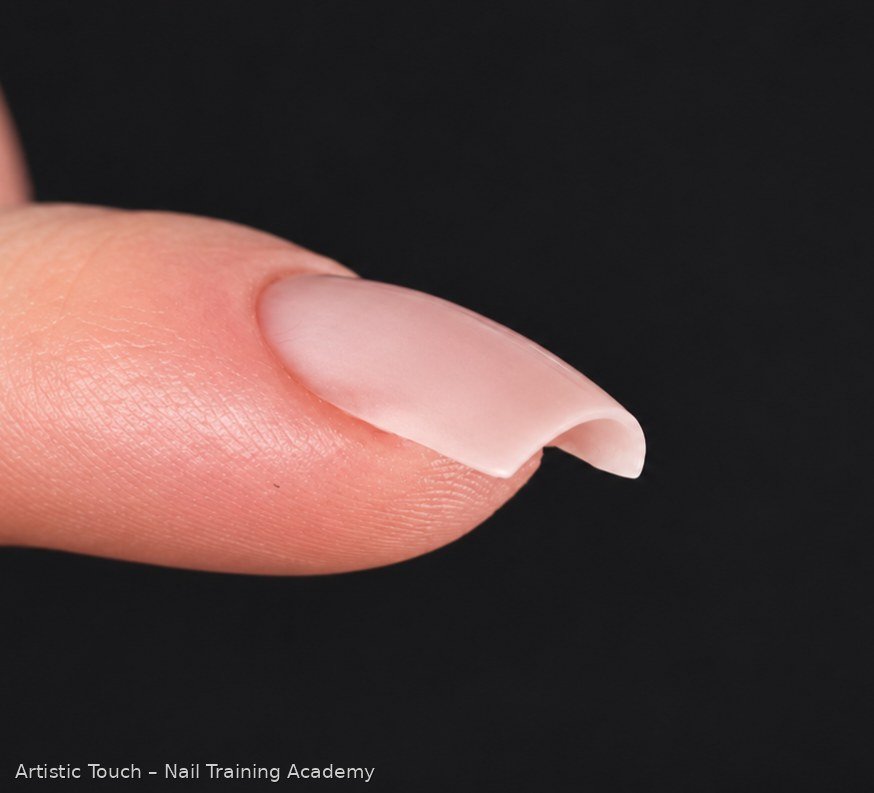
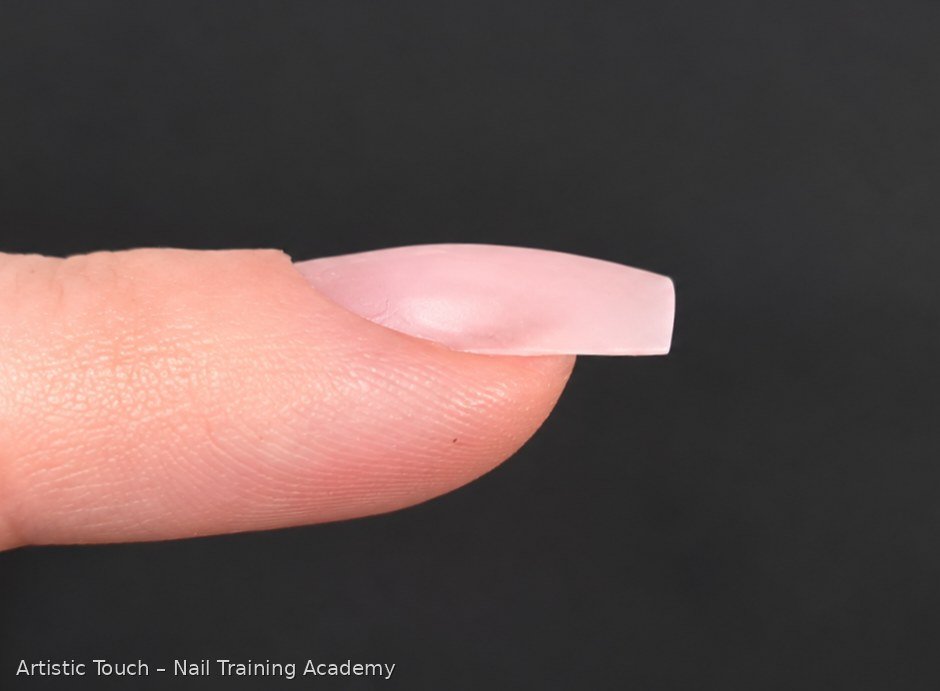
The first image shows the natural nail on its own. As you can see, it is a hooked nail, meaning that the free edge grows downwards.
Every other image in this article shows exactly the same natural nail, with a different dual form placed on it.
I deliberately use this type of nail because it makes the differences between the forms easier to understand. It also shows why we need to consider the natural nail’s growth direction rather than simply choosing a form based on its appearance.
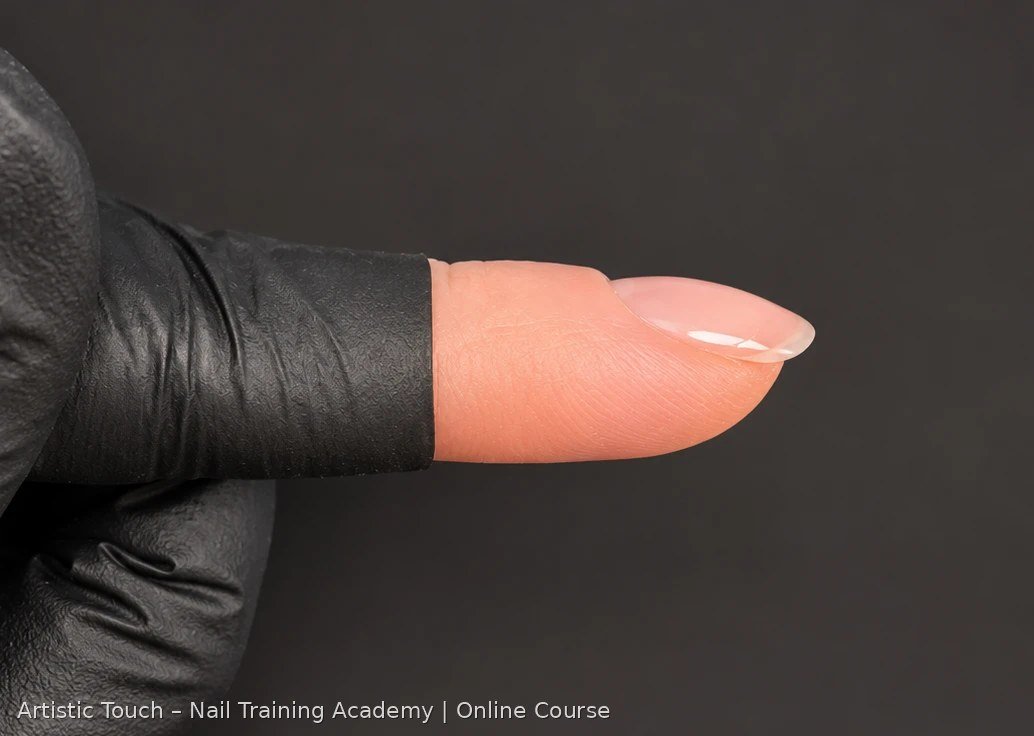
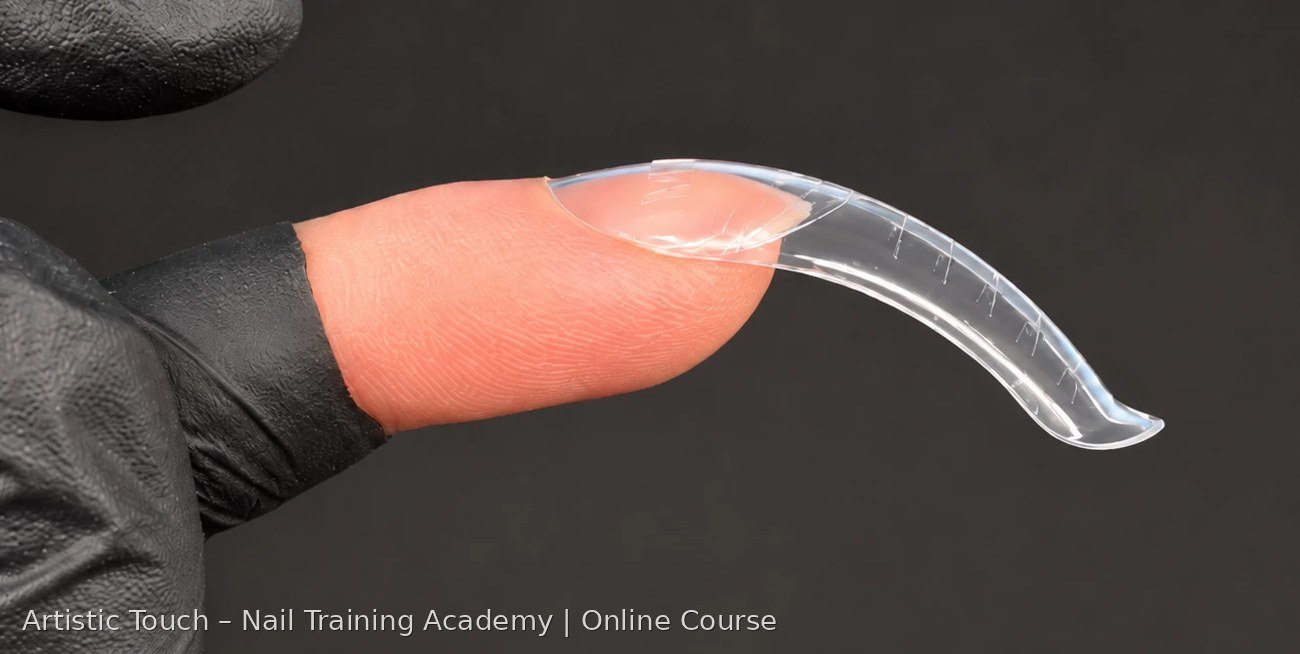
Form 1: Little Internal Volume, for Natural and Shorter Nails
The second image shows a dual form with little internal volume. This type of form is intended for natural and shorter nail lengths.
Pay attention to how much space is available inside the form.
When working with short nails, we do not necessarily want a large amount of product. However, we still need to create the correct structure.
One thing I have found through my own work is that short nails are not necessarily easier to create with dual forms. Sometimes they can actually be more challenging because we have less length to work with when creating the structure.
Form 2: A Long Stiletto for Longer Extensions
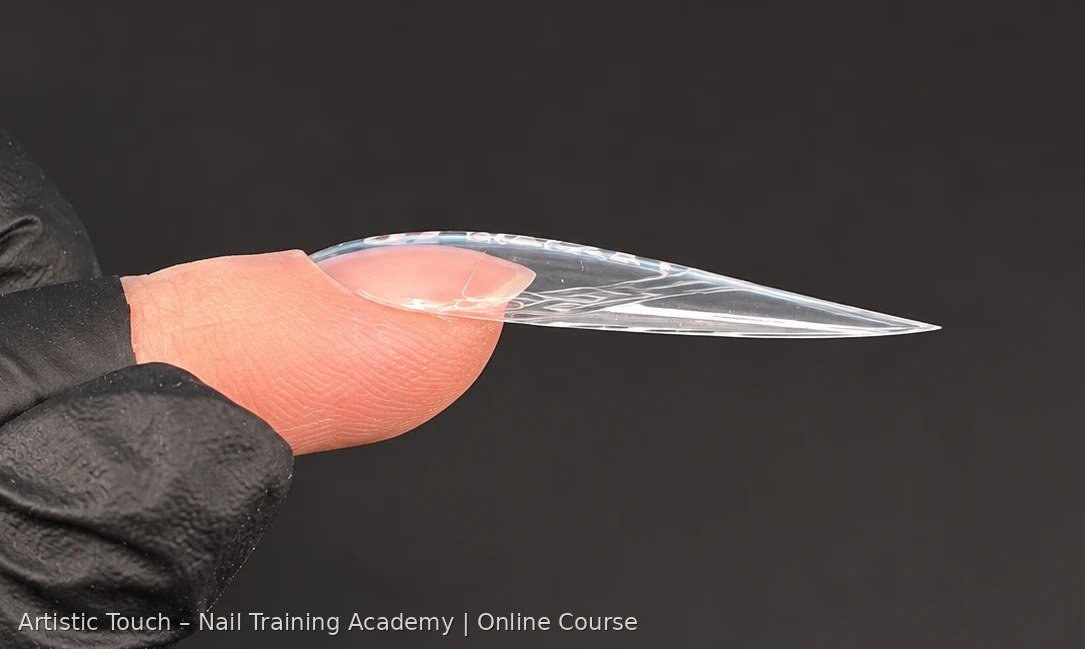
The third image shows a longer stiletto dual form. This form is intended for creating longer nail extensions.
You can clearly see how different its length and internal structure are compared with the previous form.
However, a longer form is not automatically better, and having more space inside does not mean we should simply fill it with more product.
The form needs to be appropriate for the result we want to achieve.
Form 3: Natural and Shorter, but Holding a Lot More Product
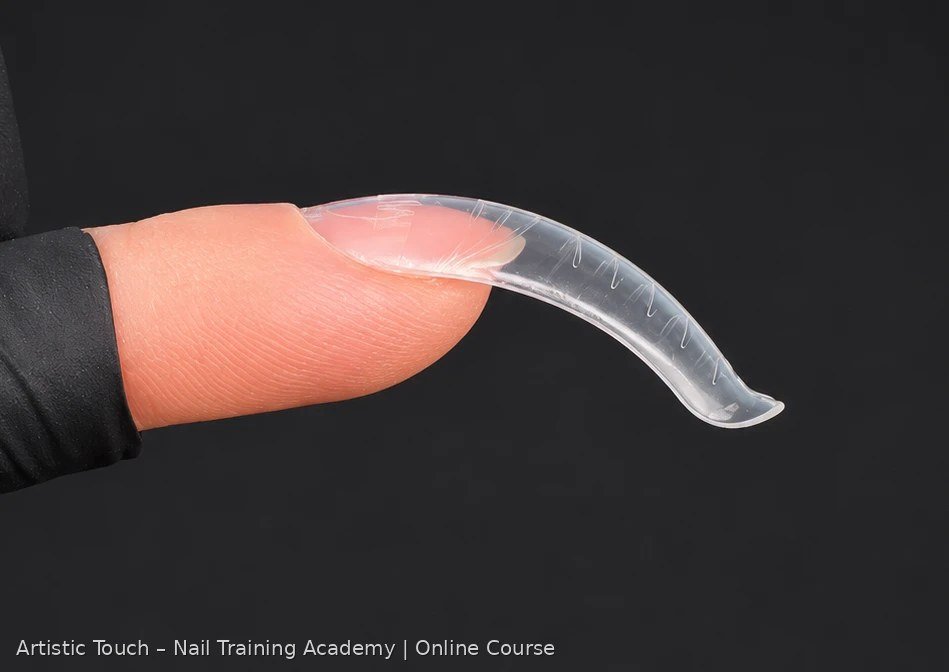
The last image shows another dual form intended for natural and shorter nail lengths.
What I want you to notice here is the difference in internal volume compared with the second image.
Both forms are intended for shorter nails, yet one holds considerably more product than the other.
This is exactly why I teach students to understand the forms they are working with instead of choosing them purely by their appearance.
Two forms can be intended for a similar nail length but create very different structures.
If you do not understand these differences, you may end up with nails that are unnecessarily thick, require additional filing or do not have the structure you intended to create. For the causes of thick results, read why your BIAB dual forms come out thick and bulky.
The Four Images Side by Side
Two of these forms are intended for natural, shorter nails, yet their internal volume is very different.
This is the main point I want you to understand from these images: you cannot choose a dual form based on length or shape alone.
Learn it step by step. This is one part of what I teach in The Ultimate Dual Forms. Inside the course I teach the full method with real salon demonstrations, so you can make these decisions on your own clients.
See what is inside →Why the Finished Result Comes First
When choosing a dual form, do not look only at whether it fits from side to side.
You need to understand what the form is intended to create, how it sits over the natural nail and whether there is enough internal space for the product.
Something else I explain inside the course is that a form can appear to fit the natural nail but still not provide sufficient space for the product, particularly around the growth points.
Covering the nail with plastic is not necessarily the same as creating the correct structure.
This is why checking the fit from different angles is so important. I show how in how to check if a dual form fits your natural nail.
Seeing the same natural nail with different forms makes the principle much easier to understand.
For more information, read Dual Forms Are About Volume, Not Shape and How to Choose the Right Dual Form for the Natural Nail in Front of You.
Why Having More Dual Forms Does Not Always Mean Better Results
Something that stood out to me when reviewing questions from other nail technicians was how many struggle with form selection, despite already owning numerous different sets.
Some described buying more forms without improving their results. Others struggled with flooding, exposed sidewalls or spending too much time correcting their work.
And I think this is something worth discussing.
You can have 20 different boxes of dual forms, but if you do not understand their purpose and how to select them correctly, having more choices is not necessarily going to help.
For me, understanding the forms you already have is far more valuable than constantly buying new ones. I wrote about my own collection in the Dual Forms I actually use from my 46-box collection.
That is also why I focus on teaching students how to make their own decisions rather than simply recommending a particular brand or shape.
Selecting the Form Is Only the Start
Choosing the correct form is just one part of working with dual forms.
You also need to consider the size, natural nail structure, product behaviour, placement and pressure.
For example, flexible and rigid dual forms do not behave in exactly the same way. A flexible form can change its shape when pressure is applied, which may affect how it fits the nail. I explain what separates good and poor forms in what makes a good sandwich dual form.
There is also a difference between checking an empty form and understanding how it will behave once product is placed inside.
These are the types of details that can make a significant difference to your results, particularly when working on real salon clients with different natural nail shapes.
I cover related topics in How to Choose the Correct Dual Form Size, How to Check If a Dual Form Fits Your Natural Nail and How to Get a Clean Imprint with Dual Forms.
If your nails come out thick, Why Your BIAB Dual Forms Come Out Thick and Bulky explains some of the common causes.
What You Learn Inside The Ultimate Dual Forms
These four images are only a small part of what I teach inside The Ultimate Dual Forms.
My course is not focused only on creating beautiful long nail extensions. I teach the type of work we actually need in the salon, including short natural nail overlays, BIAB and builder gel applications, corrections, extensions and infills.
In fact, some of the shortest applications can be the most challenging, and this is why I believe they deserve just as much attention as long extensions.
Inside the course, I teach:
- How to select dual forms according to the natural nail and the finished result you want.
- How to understand different form structures, internal volume and fitting.
- How to work with different natural nail types, including hooked nails.
- Short natural nail overlays using BIAB and builder gel.
- Nail extensions, corrections and infills.
- How product control and placement affect the finished structure.
- How to reduce unnecessary filing and improve salon efficiency.
- The business side of nail services, including pricing and positioning your work.
My goal is not simply to show you how I create a particular set of nails.
I want you to understand why I choose a certain form, why I use a particular technique and how to make those decisions independently when working on your own clients.
You can see everything the course includes on the course page, or browse all online nail courses.
The Ultimate Dual Forms
Learn how to select the right dual forms, create short natural nail overlays and longer extensions, correct different nail shapes and work towards more consistent results with less unnecessary filing.
View the Course Details →Frequently Asked Questions
How do you choose the right dual form?
Do not choose a form only because it covers the natural nail. Consider its internal volume, structure, intended length and how it fits the natural nail. The form needs to be suitable for the result you want to achieve. I teach this step by step in The Ultimate Dual Forms.
What does internal volume mean in a dual form?
Internal volume refers to the space available inside the dual form. Different forms provide different amounts of space for the product and natural nail. Two forms intended for similar nail lengths can have very different internal structures.
Which dual form is used for longer nail extensions?
Longer extensions require a form suitable for the intended length and structure. The stiletto form shown in the third image is one example.
Are all dual forms for natural, shorter nails the same?
No. As these images demonstrate, two forms intended for short nails can have very different internal volumes and create different structures.
Are short nails easier to create with dual forms?
Not necessarily. Short overlays can be challenging because there is less length available to create the correct structure. Form selection, internal volume and product control become particularly important.
Can a dual form fit the natural nail but still be unsuitable?
Yes. A form may cover the natural nail but not provide enough internal space for the product. This is particularly important around the growth points and when working with different natural nail shapes. See how to choose the correct dual form size and how to check if a dual form fits your natural nail.
Why do you show the same natural nail with different dual forms?
Because I want students to see how much the choice of form matters. The natural nail remains the same, but the different forms are designed to create different results.
Can dual forms help with a hooked nail?
Dual forms can be used for certain hooked nail corrections, depending on the natural nail and the intended result. Inside The Ultimate Dual Forms, I demonstrate how I assess and approach these corrections.
Where do these images come from?
They are screenshots from inside my online course, The Ultimate Dual Forms, where I demonstrate form selection and different applications in more detail.
Key Takeaway
The natural nail remains the same throughout these four images, but the forms are very different. The important thing is not how many dual forms you own or whether they appear to fit. It is understanding what each form is designed to create and how to select it for the nail in front of you. This is what I teach inside The Ultimate Dual Forms: not just how to use dual forms, but how to understand them and make better decisions in real salon work.
Learn to Select the Right Dual Form for Every Nail
The Ultimate Dual Forms covers form selection, short natural nail overlays, extensions, hooked nail corrections, infills, product control and salon efficiency, with practical demonstrations and explanations.
View The Ultimate Dual Forms →💬 FREE WHATSAPP COMMUNITY
Discuss real nail challenges, ask questions and submit case studies for a chance to be featured on my YouTube channel with educational feedback.
Request future video topics, share your experiences and be first to hear about professional insights, new courses and promotions.
Join Artistic Touch Insiders on WhatsAppAbout the Author

Professional Nail Expert | International Nail Educator
I am Radina Ignatova, a Professional Nail Expert since 2014 and International Nail Educator, based in Scotland, UK. I am the Founder of Artistic Touch – Nail Training Academy and TheNailWiki.
At Artistic Touch – Nail Training Academy, I provide structured professional online nail education specialising in dual forms, nail preparation and retention, nail structure, E-File work and Russian Manicure, with a strong focus on professional salon safety. I continue to work actively in salon practice, ensuring that all education reflects real client scenarios and current industry standards.
My teaching philosophy is simple: I show real salon challenges, real mistakes and real performance testing, not just perfect demonstrations. This is how you develop genuine technical competence and become a confident, capable nail professional.