How to Learn Russian Manicure: A Training Pathway for Nail Technicians
Many nail technicians reach the same point with Russian Manicure. You can use an e-file. You have watched demonstrations, perhaps several. The result is acceptable on one client and uncertain on the next, and you cannot always explain why.
This is rarely a problem of effort. It is usually a problem of how the technique was learned. This article describes a practical training pathway for working nail technicians, what each stage develops, and what to look for when choosing further training.
Quick Answer: How Should a Nail Technician Learn Russian Manicure?
A nail technician who already uses an e-file learns Russian Manicure most reliably in stages. Anatomy and tissue condition come first, e-file control second, then the ability to assess each client, select tools and adapt the technique. Practice, feedback and correction refine the result. Copying a demonstration develops a sequence of movements. Structured training develops the judgement to decide what each client’s tissue actually requires.
Why Learning the Movements Alone Is Not Enough
The most common assumption is that Russian Manicure is a fixed set of steps. Choose a bit, follow the order of movements, repeat. If the steps are followed accurately, the result should follow.
That assumption fails because the sequence is fixed and clients are not. Pocket depth, skin condition, the shape and position of the surrounding folds and sensitivity all vary. A movement that suits one client’s tissue can overwork another’s, and a list of steps cannot tell you which situation you are in.
What is missing is not more movements. It is the ability to recognise what is in front of you and decide what that tissue requires. Our article on why performing the same technique on every client causes problems explains this in detail.
Anatomy and Tissue Condition Come Before Technique
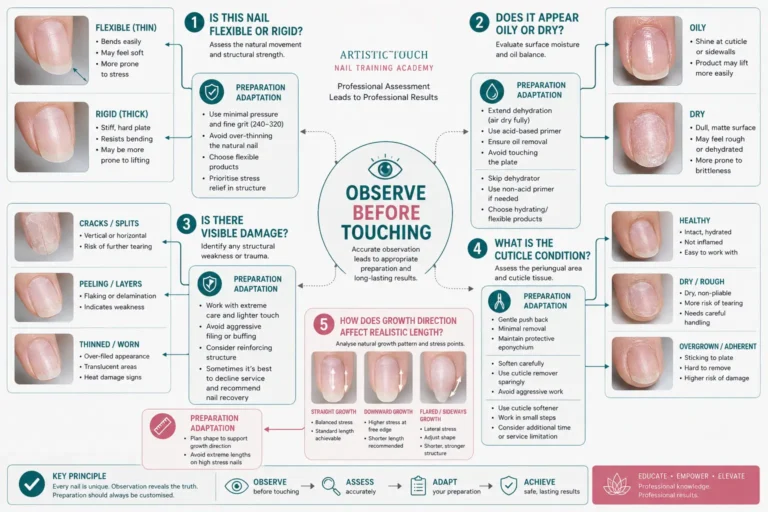
Technique is a response to what you see. If you cannot distinguish true cuticle from living tissue, or recognise how the structures around the nail differ between clients, you are choosing movements without information.
This is why understanding anatomy comes first in a sound pathway. It does not mean memorising terminology. It means being able to look at a client’s hand and form a reasoned assessment before the bit touches the skin. The principle is explained further in our article on what to assess before using a flame bit.
E-File Control Involves More Than Choosing an RPM
A common shortcut is to ask for the correct speed. Speed, however, is only one variable. Pressure, angle, direction of movement, the shape and condition of the bit, hand position and stability all act together, and a change in one alters the effect of the others.
When a setting is learned without these variables, it becomes a number to recall rather than a decision to make. The same setting can be controlled and appropriate in one situation and too aggressive in another. Control means understanding how the variables interact, so that you can adjust deliberately when the client, the tool or the area changes.
Assessment, Tool Selection and Adaptation
Assessment informs tool selection, and tool selection shapes the technique. A bit is chosen because of what the tissue and the task require, not because it is the one used in a video.
Adaptation is the next step in the same chain. When the tissue is drier, thinner, more sensitive or deeper than that of the previous client, the plan changes. Technicians who have relied on a fixed routine often experience this as inconsistency. Technicians who understand the reasoning experience it as a normal part of the work.
Why Copying Demonstrations Does Not Build Professional Judgement
A demonstration shows one client, one set of tissue and one successful outcome. It rarely shows the decisions made along the way, the alternatives that were rejected, or what the technician does when something does not go as expected.
Copying that demonstration can reproduce the movements. Judgement develops from seeing variation: different clients, different conditions, and the reasoning applied to each. This is why watching the technique performed across several clients, with the decisions explained, teaches something that a single demonstration cannot.
A Training Pathway for Working Nail Technicians
The earlier sections explain why each part of Russian Manicure matters. This section places those parts in a sensible order. It is an overview, not a lesson. The time each stage takes depends on your existing experience and on how much careful practice you are able to do.
Before you begin (not a stage): you should already have basic e-file handling, sound hygiene and consultation habits, and a clear understanding of what your insurer and local requirements expect.
1. Anatomy and Safety
Develop: a working understanding of nail and skin structure, how tissue condition varies between clients, and where the risks lie.
Ready to progress when: you can explain in your own words why one area needs more care than another, and what would make you stop work.
2. Assessment
Develop: the ability to read the client’s nail and skin condition before any tool is used, and to decide what the service should and should not involve.
Ready to progress when: your plan for each client rests on what you observed, and you can justify it.
3. E-File Control
Develop: steady, deliberate control of the machine, treated as a set of variables you manage rather than a setting you recall.
Ready to progress when: you can keep that control consistently and adjust one variable deliberately without losing it.
4. Tool Selection
Develop: choosing a tool for its purpose and for the condition of the tissue in front of you.
Ready to progress when: you can state why you chose a tool and what you would change if the tissue were different.
5. Adaptation
Develop: adjusting the plan as the client’s condition becomes clearer during the service.
Ready to progress when: differences between clients no longer push you back onto a fixed routine, and you recognise when to simplify or stop.
6. Practice and Feedback
Develop: reviewing your own work, receiving expert correction and repeating with adjustments. This stage feeds back into stage 2.
Evidence of progress: the corrections you receive are becoming smaller, and you can identify issues yourself before you are told.
There is no reliable fixed timeline for this pathway. Progress depends on practice, feedback and the quality of the correction you receive, not on a deadline.
Why Structured Practice, Feedback and Correction Matter
Practice improves whatever you practise. If a habit is slightly wrong, repetition makes it more consistent, not more correct. Without correction, a technician can become quick and confident at something that still needs refining.
Feedback shortens that loop. An experienced eye can identify what is working, what needs refinement and what to focus on next, often before a problem appears in the client’s skin or in the finish. It also connects what you did with why it happened.
Timing matters as well. Technicians return to practice when work and family life allow, not when a course timetable ends. Some courses limit support to a fixed period, which can end before a technician has had the opportunity to apply what was learned.
What Structured Russian Manicure Training Provides
Russian Manicure – Beyond Technique is an online course designed around this pathway for nail technicians who want to develop professional judgement, not only movements. It provides:
- Anatomy-led assessment, so that technical decisions are based on what you can observe.
- E-file control and tool selection explained as decisions, not as fixed settings.
- Real-client demonstrations across different skin conditions, including normal skin, dry overgrown cuticles, thin skin and sensitive skin.
- A complete course of nearly 12 hours of training.
- Lifetime access, so that you can return to a lesson when a particular client presents a particular challenge.
- Lifetime personal educator feedback. Your feedback is part of your lifetime access, so you can return, ask questions and submit your practical work for review when you are ready.
The course is intended for nail technicians developing their professional skills. Basic e-file experience is recommended, and previous Russian Manicure training is not required. It is professional development training, not an accredited qualification. On completion you receive a non-accredited Certificate of Completion for your professional records.
What to Look for When Choosing Further Training
Whichever training you choose, these questions help separate familiarity with the steps from understanding:
- Does it state honestly which experience level it is designed for?
- Does it explain the reasons for decisions, or only show the steps?
- Does it show more than one client and more than one condition?
- What happens after the videos end? Is feedback offered, and for how long?
- Is it honest about certification? A certificate of completion is not an accredited qualification, and your insurer may have its own requirements.
- Does it teach when to adapt, and when to stop?
For a curriculum checklist, see our guide on how to choose a Russian Manicure course that teaches safety, not just steps.
Is This Pathway Right for You?
This pathway suits you if you already use an e-file, you know the movements but your results are inconsistent, you want to understand why a technique works as well as how it is performed, and you value feedback on your own work.
It is not the right starting point if you are new to the e-file and need foundations first, or if you need an accredited qualification for employment or insurance. In that case, confirm the requirements with your insurer and local professional body before choosing training.
Review the full curriculum to see whether Russian Manicure – Beyond Technique fits your current stage of development.
Russian Manicure – Beyond Technique
An online course covering anatomy-led assessment, e-file control, tool selection and adapting to the client in front of you, with real-client demonstrations.
Nearly 12 hours · Lifetime access · Lifetime personal educator feedback · Non-accredited Certificate of Completion
View the Course Details →Frequently Asked Questions
How long does it take to learn Russian Manicure?
There is no reliable fixed timeline. It depends on your existing experience, how much careful practice with real clients you can do, and the feedback and correction you receive. Progress through the stages is more useful than a deadline.
Can you learn Russian Manicure online?
Online training can teach anatomy, assessment, e-file control and decision-making through detailed demonstration. It does not replace careful practice with clients or checking your insurance and local requirements. Feedback on your own work helps connect the two.
Do I need e-file experience before starting?
For Russian Manicure – Beyond Technique, basic e-file experience is recommended. Previous Russian Manicure training is not required.
Will I receive an accredited qualification?
No. The course provides a non-accredited Certificate of Completion for your professional records. It is not intended for insurance, licensing or regulated qualification purposes. Check requirements with your insurer and your local professional body.
Key Takeaway
Russian Manicure is learned through understanding, control, assessment and adaptation, supported by practice, feedback and correction. Copying a sequence of movements does not develop that judgement.
About the Author
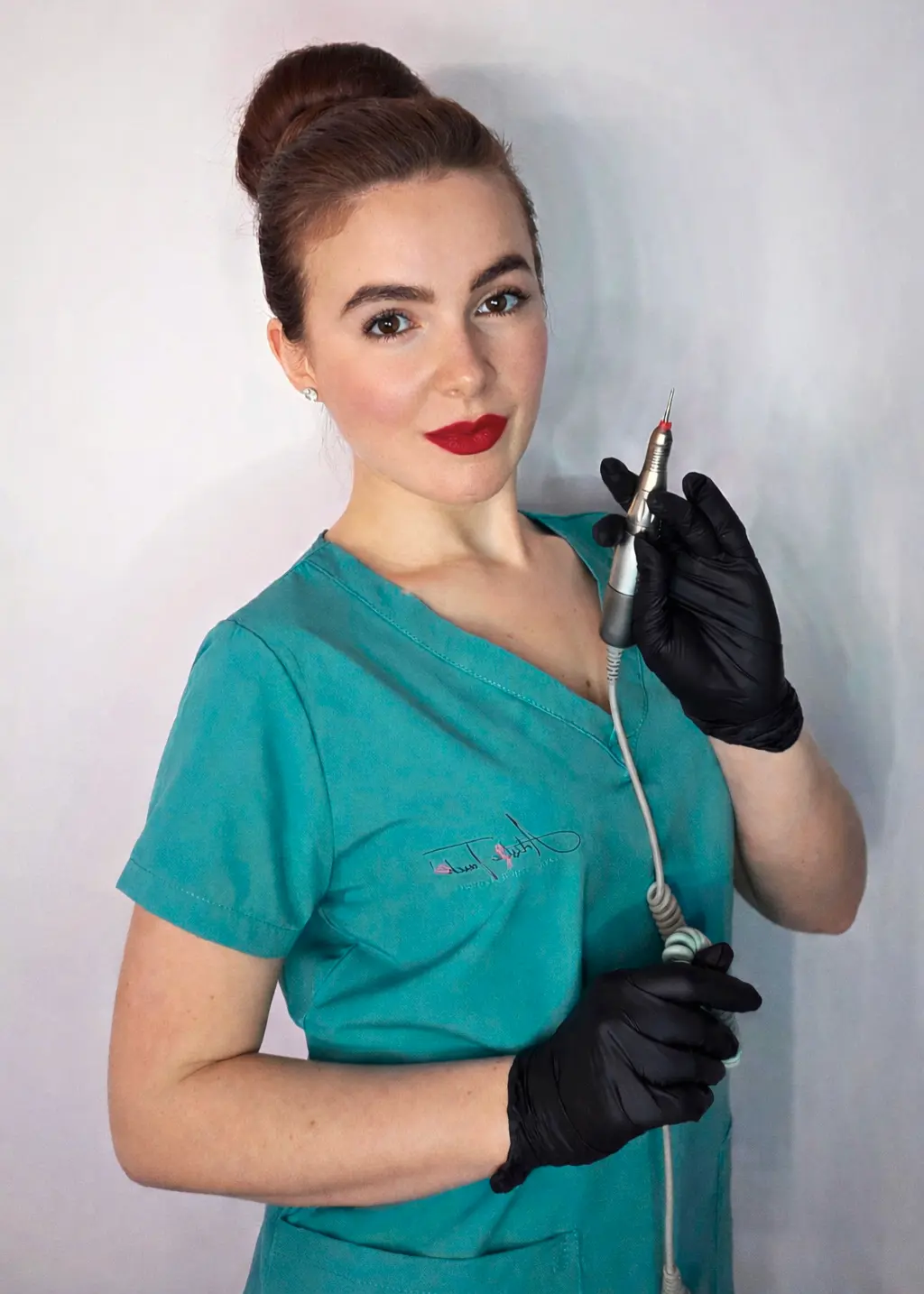
Professional Nail Expert | International Nail Educator
I am Radina Ignatova, a Professional Nail Expert since 2014 and International Nail Educator, based in Scotland, UK. I am the Founder of Artistic Touch Nail Training Academy and TheNailWiki.
At Artistic Touch Nail Training Academy, I provide structured professional online nail education specialising in dual forms, nail preparation and retention, nail structure, E-File work and Russian Manicure, with a strong focus on professional salon safety. I continue to work actively in salon practice, ensuring that all education reflects real client scenarios and current industry standards.
My teaching philosophy is simple: I show real salon challenges, real mistakes and real performance testing, not just perfect demonstrations. This is how you develop genuine technical competence and become a confident, capable nail professional.