The Biggest Mistake in Russian Manicure: Performing the Same Technique on Every Client
You have learned the Russian manicure technique. You know the steps. You know where to work. You have the right tools.
So you perform the same technique on every client. The same pressure. The same depth. The same amount of skin removal.
But every client’s anatomy is different. Some proximal nail folds lift easily. Others are thick and immobile. Some nail sinuses are accessible. Others are tight and deep. Some cuticle pockets are naturally shallow. Some are deep.
When you perform the same technique on different anatomies, you create damage on some clients whilst under-preparing others. Professional Russian manicure is not about repeating steps. It is about understanding anatomy and adapting your approach.
Why Technique Cannot Be One-Size-Fits-All
Russian manicure requires understanding nail anatomy and adapting your technique to each client’s specific structure. Proximal nail fold flexibility, cuticle pocket depth, nail sinus accessibility, and lateral fold characteristics vary dramatically between clients. Using identical pressure, depth, and technique on different anatomies creates damage on some clients and under-prepares others.
Before your next Russian manicure, stop asking “what is my next step?” Start asking “what does this client’s anatomy actually allow me to do?”
The Problem: Technique Without Anatomy Understanding
Many nail technicians learn Russian manicure as a sequence of steps. Step one, step two, step three. They memorise the sequence and repeat it on every client.
This creates predictable problems. Clients with tight anatomy bleed. Clients with sensitive tissue experience pain. Clients with shallow pockets end up with inadequate preparation. Clients with naturally deep structures end up with unnecessary trauma.
The sequence is useful. It tells you the general order of what to do. But the sequence does not tell you whether you should do it at all on a particular client, or how to adapt when anatomy is different.
Professional Russian manicure is not about following a sequence perfectly. It is about understanding what anatomy you are looking at and making intelligent decisions about what needs to happen next.
The Difference Between Trained and Professional
A trained technician knows the steps. A professional technician knows the anatomy and adapts the steps to match what she is looking at.
Understanding Nail Plate Structure: Not Uniform Thickness
The nail plate is the visible part of the nail that you work with. It feels hard and durable. But it is not uniformly thick everywhere.
The nail is thinner near the base. The area where you work during Russian manicure—near the cuticle, the matrix area—is the softest and most fragile part of the entire nail plate. This is where the nail is thinnest and most vulnerable to damage.
This is why control matters more than pressure. This is why understanding what you are removing matters more than aggressively attacking the area. You are working in the most delicate zone of the nail. Every movement should have purpose.
The nail plate layers are also relevant—understanding that you are not simply filing keratin, but working with living and non-living tissue differently.
True Cuticle: Identifying What You Are Actually Removing
One of the most common mistakes is removing too much. But you cannot know if you are removing too much unless you understand what you are supposed to remove in the first place.
True cuticle is the translucent layer that grows from the matrix onto the nail plate. This is non-living tissue. This is what you remove during Russian manicure.
Eponychium is living skin at the lower edge of the proximal nail fold. This is not the same as true cuticle.
Many technicians confuse these structures. The difference matters because you work on them completely differently. You remove true cuticle. You gently lift and open the eponychium and proximal nail fold—but this is a different action.
Once true cuticle is removed, continue lifting. What you see next is not cuticle. That is you simply filing the nail plate. That is where damage happens.
Understand the eponychium and cuticle distinction, and you immediately become more precise with your work.
The Proximal Nail Fold: Not Everyone’s Is The Same
The proximal nail fold (PNF) is living skin at the base of the nail. During Russian manicure, you gently lift and open part of it. This allows you to access and remove true cuticle from underneath.
But every proximal nail fold is different.
Some are soft and flexible. They lift easily and open widely. You can work deeply and create substantial cuticle pockets with minimal resistance.
Some are thick and firm. They do not lift easily. They resist opening. Applying more pressure is not the answer—it is the wrong approach.
If the fold does not lift easily, your technique is the problem, not the client’s anatomy. The goal is not to force a deep pocket. The goal is to work with what the anatomy allows and adapt your depth accordingly.
Professional Russian manicure means working intelligently with soft folds and respecting tight folds. Not forcing every client’s anatomy to produce the same result.
Nail Sinuses: Where Damage Happens Most Often
The nail sinuses are where the curve of the nail meets the corners. They are where the proximal nail fold meets the lateral sides of the nail.
These are one of the most commonly damaged areas in Russian manicure. They are also one of the areas that most easily causes bleeding.
The problem is not depth. The problem is visibility and angle. When you cannot see into the sinus clearly, you feel like you need to go deeper. But deeper access does not always mean you need to go deeper. The problem might be that your finger position is awkward. Your bit angle is wrong. The cuticle pocket was not opened enough.
Before going deeper into a sinus, assess whether you can actually see what you are doing. If not, change your approach. Open the pocket more. Reposition the client’s hand. Change your bit angle. But do not simply apply more pressure and hope for the best.
Nail sinuses vary dramatically between clients. Some are wide and accessible. Others are tight and narrow. Your technique should adapt to what you actually see, not force a standard approach.
Lateral Structures: Living Skin and Grooves
The lateral nail folds are the living skin along the sides of the nail. The lateral nail grooves are the narrow channels between the nail plate and the folds.
During Russian manicure, you gently exfoliate these areas with your flame bit to clean any debris and dead skin. But again, the approach should vary based on what you see.
Some grooves are wide and easy to access. You can work more comfortably and remove debris readily.
Some grooves are tight and deep. They are harder to reach. Applying aggressive pressure does not improve access—it creates damage.
The goal is not to push the bit as deeply as possible. The goal is to identify what needs to be removed and work only where necessary. Some clients’ lateral structures allow deep work. Others do not. Respect that difference.
Cuticle Pockets: Deep, Shallow, and Everything In Between
Opening the cuticle pocket means gently lifting the proximal nail fold away from the nail plate. This allows access to true cuticle from underneath. It also allows you to place a small amount of builder product there, which extends the longevity of the manicure as the nail grows.
But cuticle pockets vary dramatically in depth and how much they can be opened.
Some clients have naturally deep pockets that open easily and allow substantial product placement. This client might look like Instagram results.
Some clients have naturally shallow pockets that do not open significantly. This is normal. This is their anatomy.
The mistake is trying to force every client to produce the same result. Chasing deep, “Instagram-worthy” pockets on a client with naturally shallow anatomy creates damage. It creates excessive trauma. It creates bleeding.
Your job is to adapt to the client in front of you. Open the pocket enough to give you better visibility of the true cuticle and better access to the nail sinuses. Stop there. Do not chase depth.
Where Damage Happens: The Lunula and Soft Tissue
The softest, most fragile part of the nail unit is the uncalcified part of the matrix—the area where new nail cells are still being formed and have not yet hardened. This is sometimes called the lunula or the soft matrix area.
If this area is visible on the nail (signs of damage or extreme thinning), you must be extremely cautious. You should barely touch it. You should not file it. You should not apply pressure to it.
Understanding nail matrix structure and lunula characteristics helps you recognise these fragile areas and work around them rather than through them.
This is why adaptation matters. A client with a visible matrix area needs a completely different approach than a client with mature, calcified matrix. Same sequence? No. Same technique? Absolutely not.
Technique Versus Understanding: The Core Difference
Consider two clients. Client A has soft, flexible skin. Their proximal nail fold opens easily. Their nail sinuses are wide and accessible. Their cuticle pocket opens naturally and deeply.
Client B has firm proximal nail fold. Their fold does not lift easily. Their nail sinuses are tight. Their cuticle pocket is naturally shallow.
Should you use exactly the same pressure on both clients? No.
Should you use the same depth? No.
Should you perform the same number of passes? No.
Should you remove the same amount of skin? No.
This is why professional Russian manicure is not simply about learning a sequence and repeating it. A sequence tells you what to do next. Understanding anatomy helps you decide whether you should do it at all on this particular client.
This is the thinking behind Russian Manicure – Beyond Technique: learning to assess what you are seeing, understand what the tissue needs and make the appropriate decision for the client in front of you.
Before your next Russian manicure, stop asking: “What is my next step?”
Start asking: “What am I looking at? What does this client actually need? What needs to change in my technique?”
About Radina Ignatova and Her Teaching Philosophy
About the Author
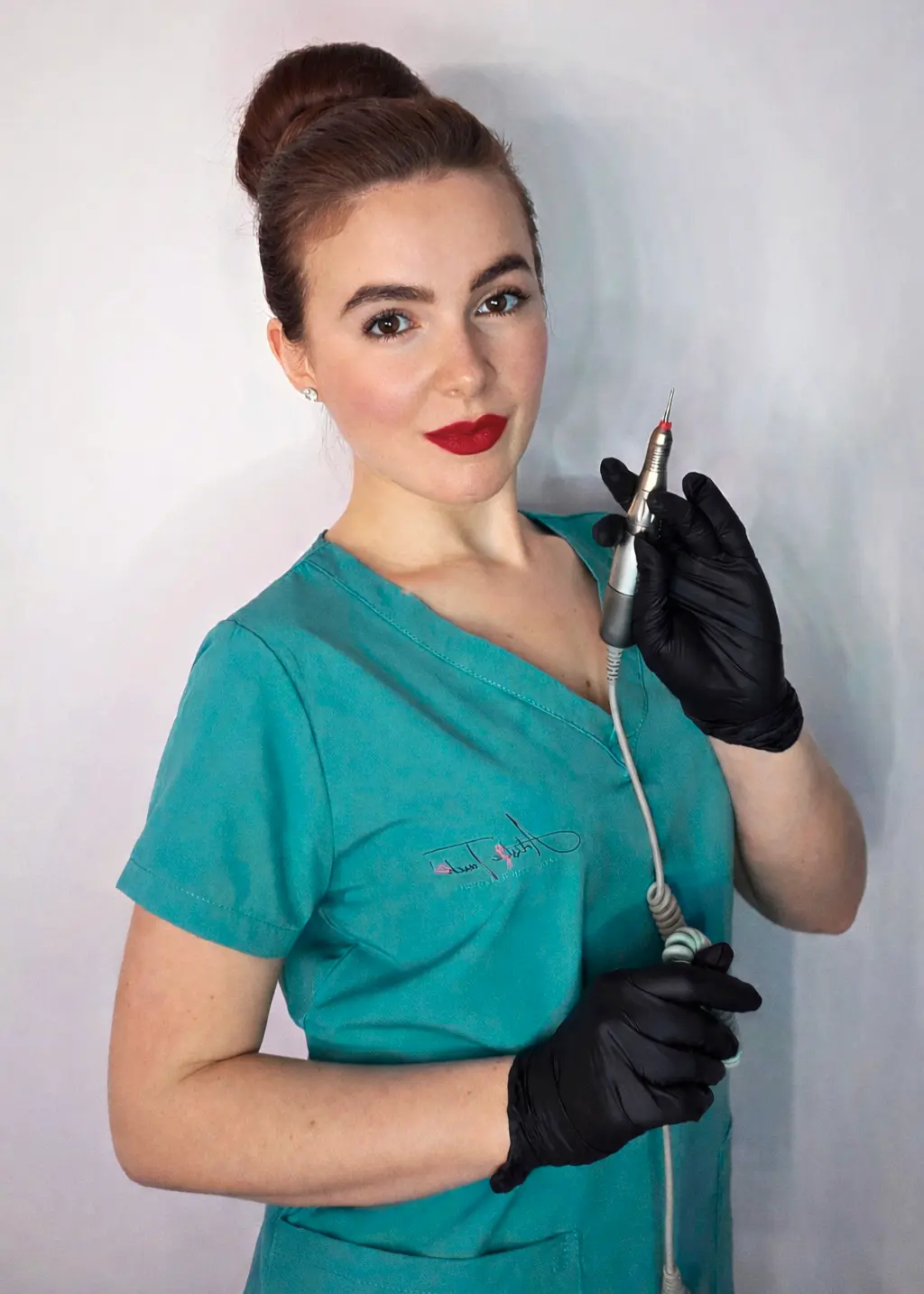
Professional Nail Expert | International Nail Educator
I am Radina Ignatova, a Professional Nail Expert since 2014 and International Nail Educator, based in Scotland, UK. I am the Founder of Artistic Touch Nail Training Academy and TheNailWiki.
At Artistic Touch Nail Training Academy, I provide structured professional online nail courses specialising in dual forms, gel systems, polygel application, advanced nail structure, E-File work and Russian Manicure, with a strong focus on professional salon safety. I continue to work actively in salon practice, ensuring that all education reflects real client scenarios and current industry standards.
My teaching philosophy is simple: I show real salon challenges, real mistakes and real performance testing, not just perfect demonstrations. This is how you develop genuine technical competence and become a confident, capable nail professional.
Master Russian Manicure Properly
Understanding anatomy is the foundation of professional Russian manicure. Learn how to assess, adapt, and work safely with different nail anatomies in the dedicated course.
Explore the Russian Manicure Course →Lifetime access • Self-paced • Anatomy-focused • Real salon application
Frequently Asked Questions
How do I know if a proximal nail fold is too tight to open deeply?
If the fold is resisting opening with gentle pressure, it is telling you that this is as far as it wants to go. Applying more pressure is not the answer. Respect the anatomy and work with what you have. A shallow pocket is sometimes simply what that client’s anatomy provides.
What should I do if I cannot see into a nail sinus?
Stop and reposition. Change the client’s hand position. Open the cuticle pocket more to gain better visibility. Change your bit angle. Try a different approach. Do not simply go deeper hoping to see better. Visibility comes first, then technique.
Is it normal to have different results on different clients?
Absolutely normal and healthy. Professional Russian manicure adapts to anatomy. Some clients will have deep pockets, some shallow. Some will have accessible sinuses, some tight. This is not a failure—this is respecting anatomy.
What is the difference between removing true cuticle and filing the nail plate?
True cuticle is translucent non-living tissue growing from the matrix onto the plate. Once you remove it, continuing to file is simply filing the nail plate. The moment you feel you are past cuticle, stop. You are now in the fragile matrix area.
Should I always create a product pocket on every Russian manicure?
Only if the anatomy allows and the client’s cuticle pocket opens naturally. Some clients’ anatomy does not allow deep pockets. Forcing one creates unnecessary trauma. If the pocket opens naturally, yes—it extends the manicure. If it does not, that is fine.
Coming Soon: Russian Manicure Free Course
A foundational free course on Russian manicure basics and anatomy understanding is coming to Artistic Touch Nail Training Academy. Check back soon.
Disclaimer: This content is for professional nail technician education purposes only. Nail services should be performed by trained professionals following current hygiene and safety regulations. Always carry out a full client consultation and check for contraindications before performing any nail service. Russian manicure is an advanced technique requiring proper understanding of nail anatomy and professional training.
About Artistic Touch Nail Training Academy
Artistic Touch Nail Training Academy delivers structured professional online nail education focused on practical skill development, professional standards and safe salon practice. All courses are available online worldwide with lifetime access and ongoing student support.