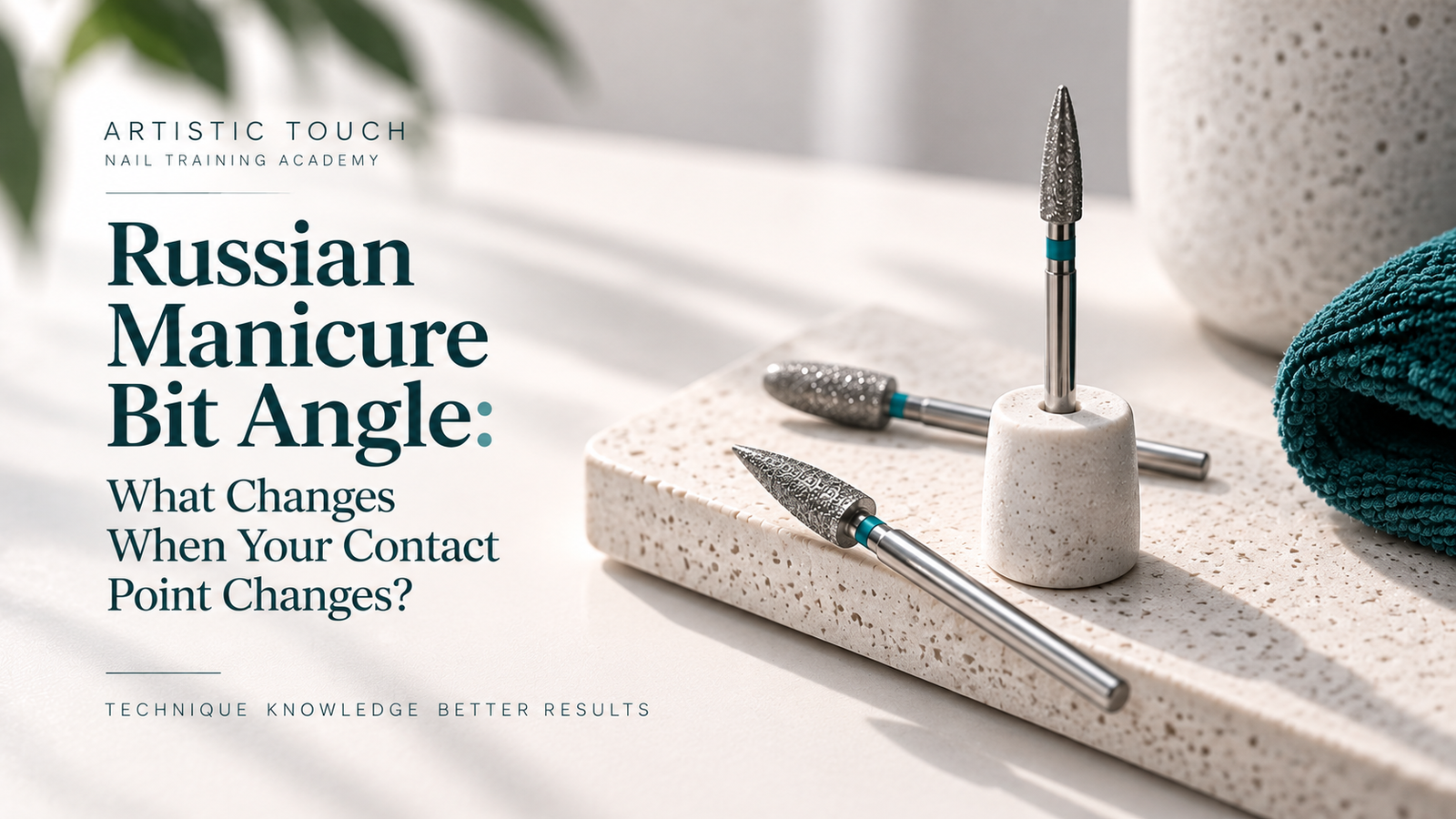
Russian Manicure Bit Angle: What Changes When Your Contact Point Changes?
What Does Bit Angle Actually Change in Russian Manicure?
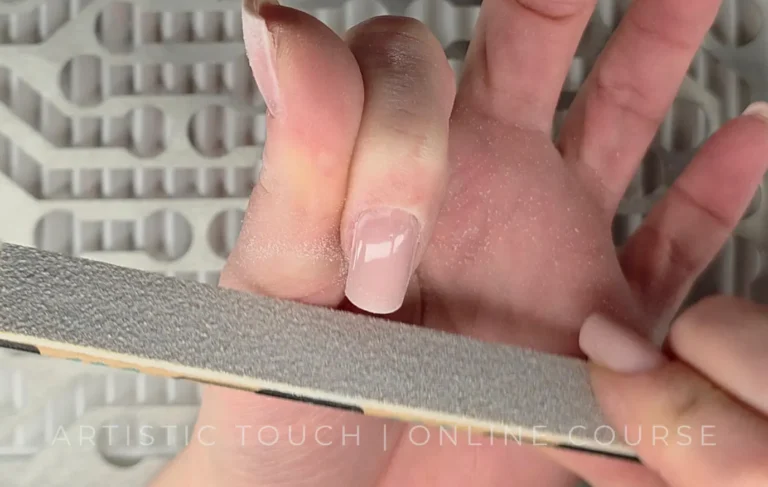
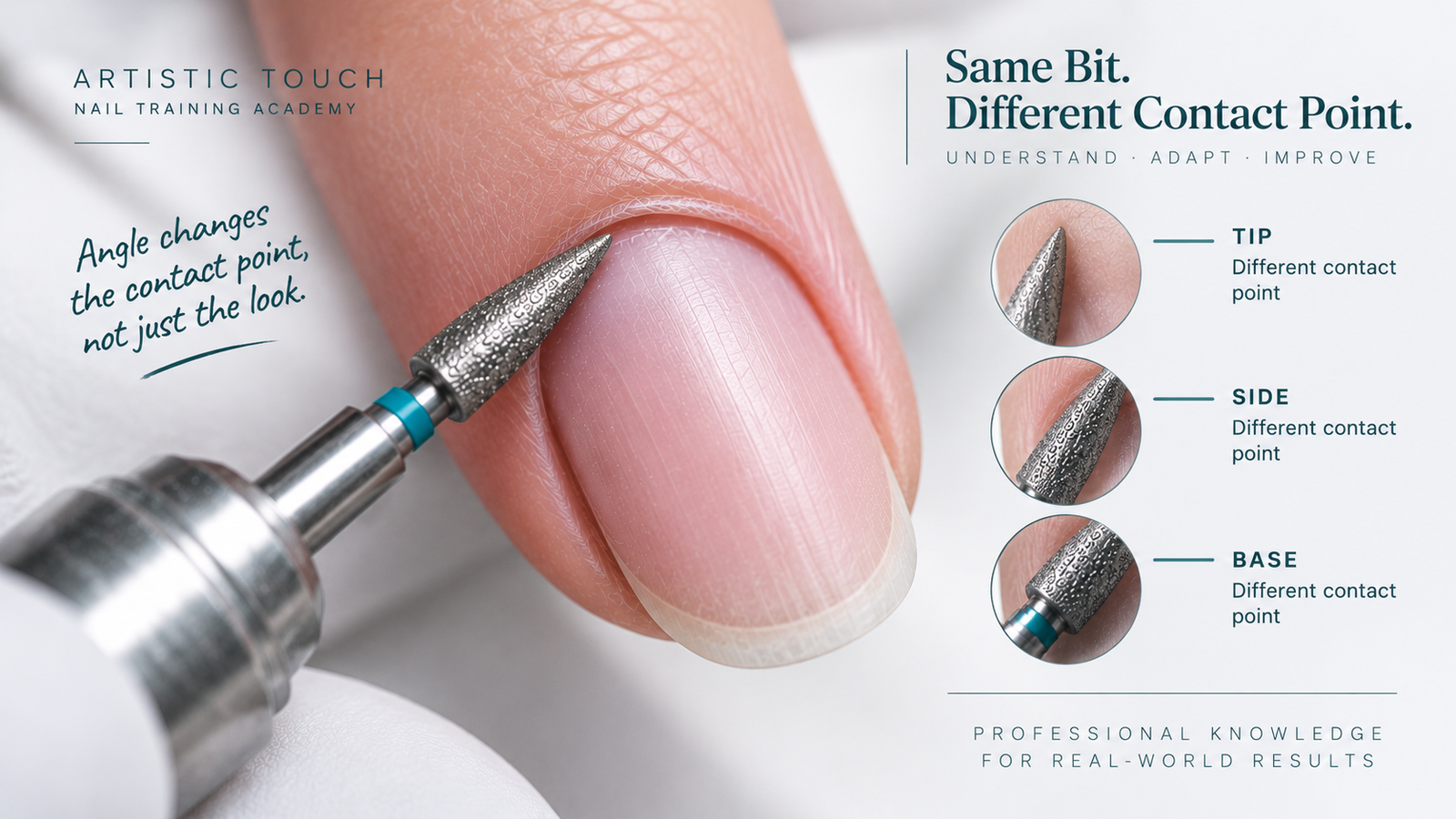
Changing the angle of the bit changes which part of the bit’s surface is in contact with the tissue. Because of that, bit angle in Russian Manicure is better understood through contact point — where the bit is actually touching — rather than memorised as a single fixed number. Radina’s course material teaches bit angle and contact point together as part of e-file control, alongside speed, pressure, movement and tool selection.
Angle is one of the most commonly discussed topics in Russian Manicure, and one of the least usefully explained. Technicians are often told to hold the bit “at an angle” without a clear sense of what that angle is actually supposed to achieve.
The angle itself is not really the point on its own. It is connected to something more specific: where on the bit’s surface the tissue is being contacted.
Angle Advice That Sounds Precise but Explains Nothing
“Hold it at an angle” sounds like specific, technical guidance. In practice, it rarely tells a technician anything they can actually apply, because it does not say what that angle is meant to produce, or how to recognise whether the angle being used is achieving it.
Without that explanation, angle becomes something technicians copy visually from a demonstration, rather than something they understand well enough to adjust when their own hand, their own bit, or the tissue in front of them is different from what they watched.
What “Contact Point” Actually Means
A flame bit is not a single point — it has a shape, and where on that shape the tissue is contacted is what “contact point” refers to. This is part of why Radina’s course teaches bit angle and contact point together, under e-file control, rather than as separate topics: adjusting the angle is really a way of adjusting which part of the bit is doing the work.
Understood this way, “hold it at an angle” is an incomplete instruction on its own, because it does not specify what that angle is meant to achieve in terms of contact.
Why the Same Angle Can Behave Differently Moment to Moment
The finger is not flat — it has a curve. As a hand moves during Russian Manicure, the bit is moving across that curved surface, not a flat one.
This is a simple point of geometry, but it is part of why “hold it at this angle” is a difficult instruction to apply consistently: a single fixed wrist position does not map onto a curved surface the same way at every point along it. Radina’s course addresses bit angle and contact point together for exactly this reason — as something understood in relation to the surface being worked, not as an isolated setting.
Contact Point and a Related Topic: the Nail Sinus
Catching the nail sinus — the sides of the finger, near the nail fold — is a specific, more detailed topic than bit angle and contact point on their own, and it is covered in its own right in Why You Keep Catching the Nail Sinus During Russian Manicure.
That article is worth reading alongside this one if catching is a specific problem you are working through, because it goes into the relevant mistakes in more detail than is useful to repeat here. The purpose of this article is the broader concept — contact point as something to track deliberately, wherever you are working on the nail — rather than any one specific outcome.
Understanding contact point conceptually is a genuinely useful shift. Developing the physical hand control to track it in real time, across a moving surface, still comes through your own practice — but Russian Manicure – Beyond Technique explains this alongside the rest of e-file control and demonstrates it across real hands and real tissue, so you have a clearer sense of what you are practising toward.
Reading the Contact Point Instead of Memorising a Number
Rather than trying to recall a fixed angle, it is more useful to ask a different question while working: which part of the bit is actually touching the tissue right now, and is that still where I intend it to be?
That question can be asked continuously, because it is based on what is actually happening under the bit rather than on a number that was never going to describe every position your hand moves through during the service.
Why This Is a Moving Decision, Not a Fixed Position
Bit angle in Russian Manicure is best understood as something adjusted continuously as your hand moves, rather than a position you find once and hold for the rest of the service.
Russian Manicure – Beyond Technique works through bit angle and contact point as part of its e-file control teaching, alongside speed, pressure, movement and tool selection, using explanation, demonstration and professional reasoning across real client tissue. The physical control itself still develops through your own practice and application.
Develop Real Control Over Contact Point, Not Just Angle
Russian Manicure – Beyond Technique connects anatomy, e-file control and real-client adaptation into one professional system, demonstrated across different tissue types.
About the Author
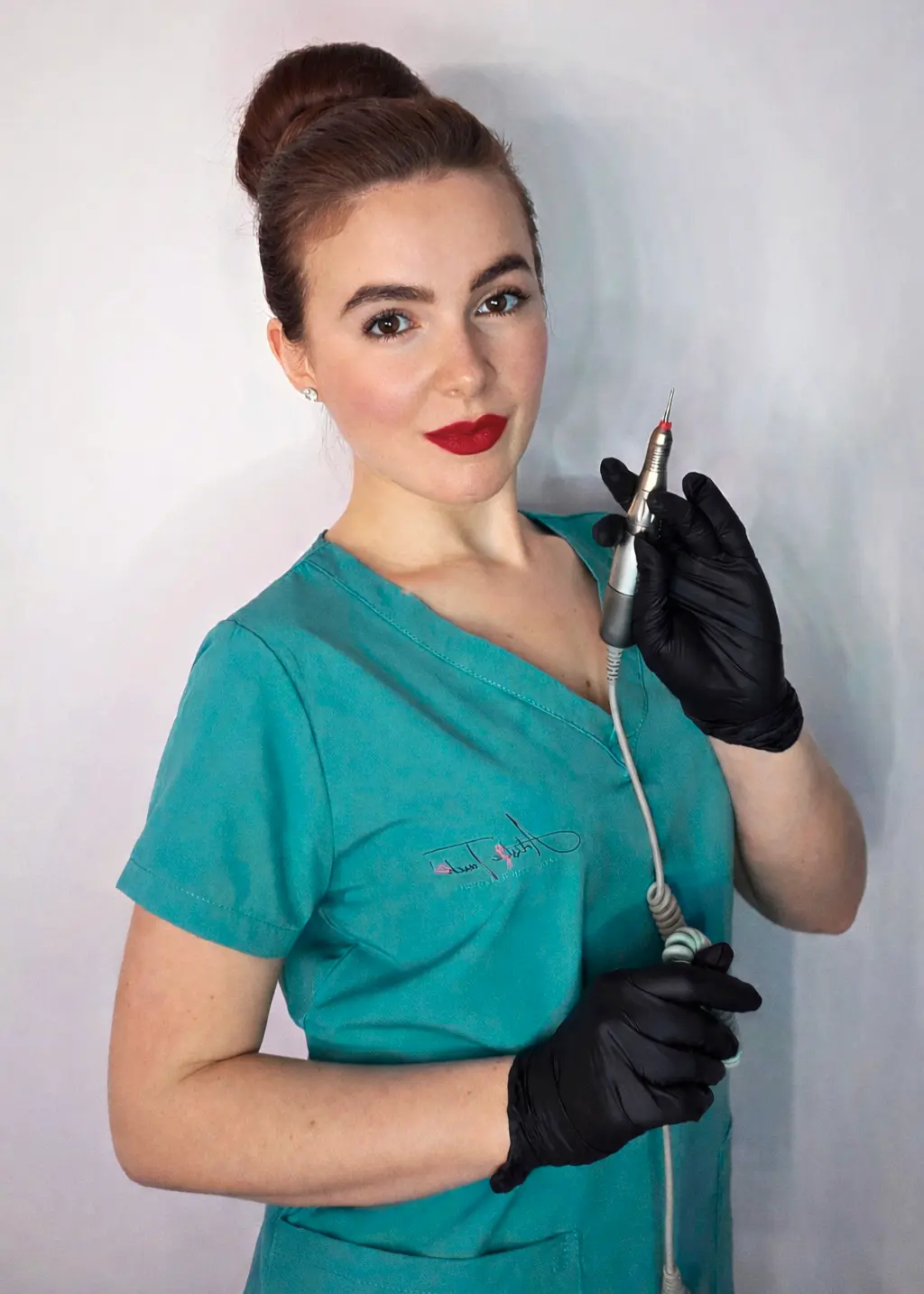
Professional Nail Expert | International Nail Educator
I am Radina Ignatova, a Professional Nail Expert since 2014 and International Nail Educator, based in Scotland, UK. I am the Founder of Artistic Touch Nail Training Academy and TheNailWiki.
At Artistic Touch Nail Training Academy, I provide structured professional online nail education specialising in dual forms, nail preparation and retention, nail structure, E-File work and Russian Manicure, with a strong focus on professional salon safety. I continue to work actively in salon practice, ensuring that all education reflects real client scenarios and current industry standards.
My teaching philosophy is simple: I show real salon challenges, real mistakes and real performance testing, not just perfect demonstrations. This is how you develop genuine technical competence and become a confident, capable nail professional.
Disclaimer: This content is for professional nail technician education purposes only. Russian Manicure and e-file work should be performed only by trained professionals following current hygiene and safety protocols. Always carry out a full client consultation and check for contraindications before performing any nail service.
About Artistic Touch Nail Training Academy: Professional online nail education delivered by Radina Ignatova, Dundee, Scotland, UK, specialising in Russian Manicure, dual forms, nail preparation and retention, and e-file technique.