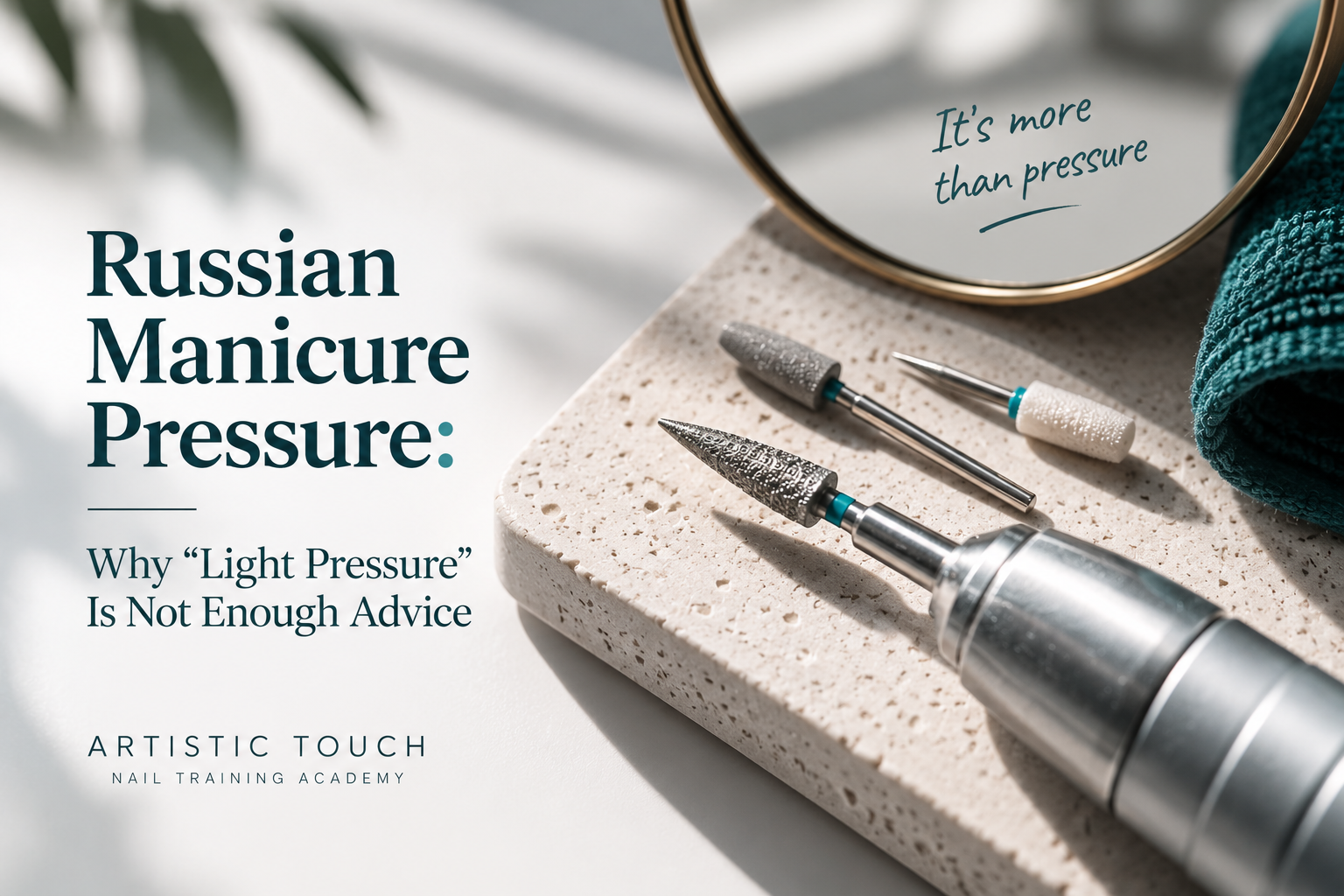
Russian Manicure Pressure: Why “Light Pressure” Is Not Enough Advice
Why Isn’t “Use Light Pressure” Enough Guidance for Russian Manicure?
“Light pressure” is not enough guidance because pressure is only one part of a connected system — it works together with movement, contact point, angle, speed and tool selection, and has to be applied based on an assessment of the client in front of you. Telling someone to use light pressure without explaining how it connects to everything else leaves the instruction technically correct but incomplete.
If you have ever been told to “use light pressure” during Russian Manicure and still ended up unsure whether what you were doing counted as light, you are not missing something obvious. The advice itself is incomplete.
It is not wrong. Pressure genuinely matters. But as a standalone instruction, it assumes you already know what you are meant to be feeling for, which is usually the part nobody explained.
Why “Light Pressure” Gets Repeated So Often
It is easy to understand why this phrase is so common. It is short, it is memorable, and it is not technically wrong — few technicians would argue that heavy-handed e-file work is a good idea. As a warning, “use light pressure” does its job.
As instruction, though, it stops at the warning. It tells you what to avoid without telling you what you are supposed to be doing instead, or how you would know the difference in your own hand.
What “Pressure” Is Actually Standing In For
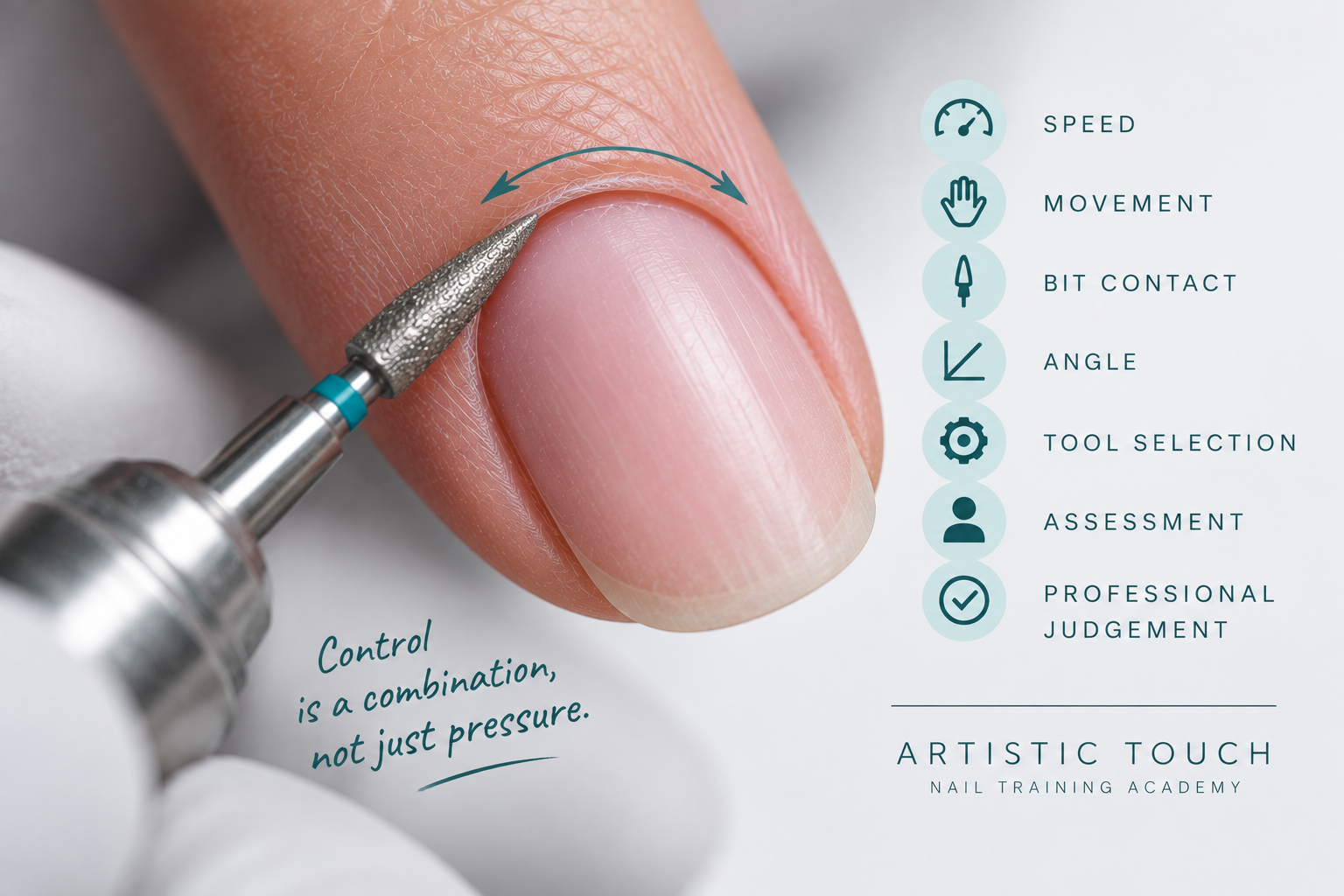
When people talk about pressure in Russian Manicure, they are usually describing several separate things at once: how firmly the bit is meeting the tissue, how steadily the hand is moving, how long the bit stays in one spot, and how much the technician is actively adjusting in response to what they feel.
Collapsing all of that into a single word makes it sound like one adjustable dial. It is closer to several things happening together, and it is the coordination between them — not any one setting — that determines whether the result feels controlled.
Contact, Movement and Control Are Not the Same as Force
It is possible to press firmly and still be in control, if the movement is steady and the bit is not lingering. It is also possible to press very lightly and still cause a problem, if the hand is unsteady or the same spot is contacted repeatedly without the technician noticing.
This is why “light” on its own is not a reliable measure of safety or skill. Force is only one part of what is happening. Movement and awareness of contact matter just as much, and neither of those is captured by the word “pressure” alone.
Why “Light” Cannot Be a Fixed Standard Across Clients
What counts as appropriate pressure is not the same for every client, because it has to be judged against the tissue you assessed at the start of the service — thinner or more delicate tissue calls for a different standard than tissue that is thicker or more resistant. A single instruction to “use light pressure” does not account for that difference.
This is part of why a phrase learned once cannot simply be carried into every appointment unchanged. What “light” means has to be reconsidered for the client in front of you, based on the same assessment that shapes the rest of the service.
Understanding that pressure is not one fixed setting is a useful starting point. Developing the physical feel for how pressure, movement and contact work together still comes through your own practice — but Russian Manicure – Beyond Technique explains the reasoning behind it and demonstrates it across different real tissue, so you know what you are practising toward rather than guessing.
What Happens When Pressure Is Treated as a Fixed Setting
Technicians who learn “light pressure” as a fixed rule, without the surrounding context of movement, contact and assessment, often carry it into every appointment the same way, regardless of what the client’s tissue actually calls for.
This is rarely a failure of care. It is what happens when a single phrase is treated as complete instruction, rather than as one part of a wider system that has to be applied through judgement, not repeated automatically.
Building the Feedback Loop Between Hand and Tool
Reliable pressure control comes from paying attention while you work — to the bit, to your own hand stability, and to what you assessed about that client’s tissue before you began — and adjusting continuously rather than setting an amount at the start and holding it fixed.
Russian Manicure – Beyond Technique works through this system in detail — pressure alongside movement, contact, angle, speed and tool selection — through explanation, demonstration and professional reasoning across real client tissue. The physical control itself still comes from your own practice and application, the same way it does with any hand skill.
Learn to Control Contact, Not Just Follow “Light Pressure”
Russian Manicure – Beyond Technique connects anatomy, e-file control and real-client adaptation into one professional system, demonstrated across different tissue types.
About the Author
Professional Nail Expert | International Nail Educator
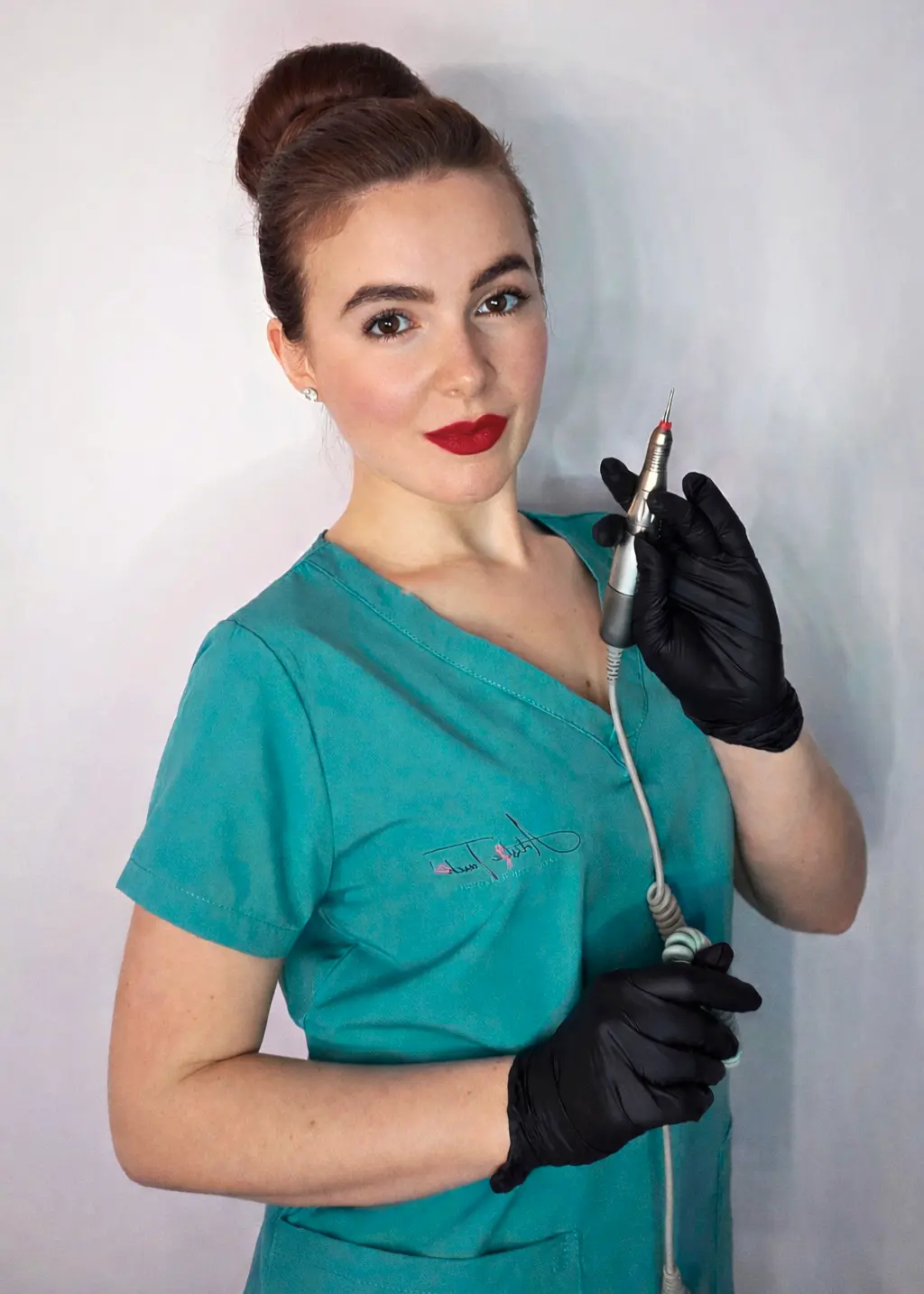
I am Radina Ignatova, a Professional Nail Expert since 2014 and International Nail Educator, based in Scotland, UK. I am the Founder of Artistic Touch Nail Training Academy and TheNailWiki.
At Artistic Touch Nail Training Academy, I provide structured professional online nail education specialising in dual forms, nail preparation and retention, nail structure, E-File work and Russian Manicure, with a strong focus on professional salon safety. I continue to work actively in salon practice, ensuring that all education reflects real client scenarios and current industry standards.
My teaching philosophy is simple: I show real salon challenges, real mistakes and real performance testing, not just perfect demonstrations. This is how you develop genuine technical competence and become a confident, capable nail professional.
Disclaimer: This content is for professional nail technician education purposes only. Russian Manicure and e-file work should be performed only by trained professionals following current hygiene and safety protocols. Always carry out a full client consultation and check for contraindications before performing any nail service.
About Artistic Touch Nail Training Academy: Professional online nail education delivered by Radina Ignatova, Dundee, Scotland, UK, specialising in Russian Manicure, dual forms, nail preparation and retention, and e-file technique.