What Is Nail Retention? What It Means and What Decides It
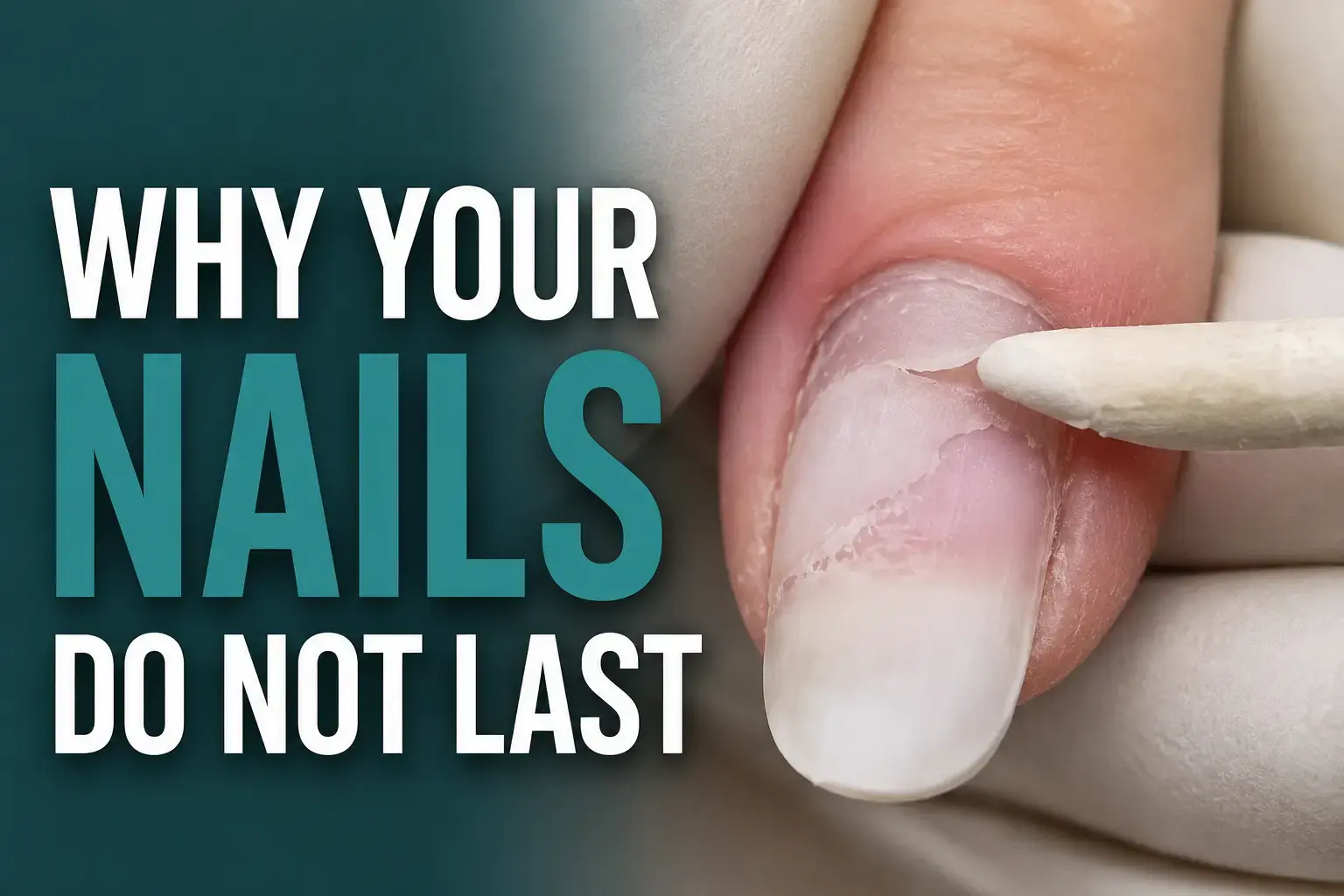
If you search for nail retention, you will find plenty of advice on what to change when a service lifts, but very little that explains what the word means and what decides it. I teach nail technicians to understand the why before they change anything, so this article starts with the definition.
In my Nail Prep course I teach preparation step by step on real nails. Here I explain what retention is and what decides it.
Quick Answer: What Is Nail Retention?
Nail retention is how well a nail service stays attached to the natural nail for its intended wear time, without lifting, peeling or breaking. It depends on four things: how thoroughly the nail was prepared, the structure of the enhancement, respect for the anatomy around the nail, and the application technique. When a service lifts early, preparation is the most likely cause, and changing the product rarely fixes it.
What Nail Retention Means
Retention is how well a nail service stays on the natural nail. A service with good retention lasts its intended wear time without lifting, peeling or breaking. A service with poor retention lifts early, at the cuticle, the side walls or the free edge. I expect a set to last at least two to three weeks.
Retention starts with adhesion, which is the bond between the product and the natural nail itself. Adhesion is not magic and it is not brand loyalty. It is the result of correct surface preparation, correct product choice and correct application. The product has to adhere to the nail plate, not to the skin, the cuticle or debris.
The Four Things That Decide Retention
| What decides it | What it means | What goes wrong |
|---|---|---|
| Preparation | The surface the product is applied to is clean, dry and ready | Contamination, dead cuticle or moisture left on the nail plate |
| Structure | The enhancement distributes stress correctly, including where the apex sits | Stress lands in the wrong place and the product breaks or lifts |
| Anatomy | The product stays off the skin around the nail | Product touches the skin and lifts |
| Application | The product is applied with correct technique | Technique errors create tension in the product |
I explain this in more detail in Why Nail Retention Problems Are Usually Not Product Problems.
Where Lifting Starts, and What It Tells You
Lifting always has a cause, and it is your job to find it. It is usually a combination of small details, not one big mistake, and it often begins as a tiny separation that the client cannot see. Once air and moisture get in, it can spread. Where it starts tells you what to look at.
| Where it lifts | What it often points to |
|---|---|
| At the cuticle | True cuticle, the thin translucent layer on the nail plate, left behind before the product was applied |
| At the side walls | The side walls were not prepared or cleaned properly, with debris, dust or shine left behind |
| At the free edge | Often preparation or structure, and sometimes what the client does with her hands every day |
Daily life matters too, but not all lifting is client behaviour. Learn to read the cues, so that you fix the real cause and not just the visible problem.
Preparation Is the Most Likely Cause When a Service Lifts
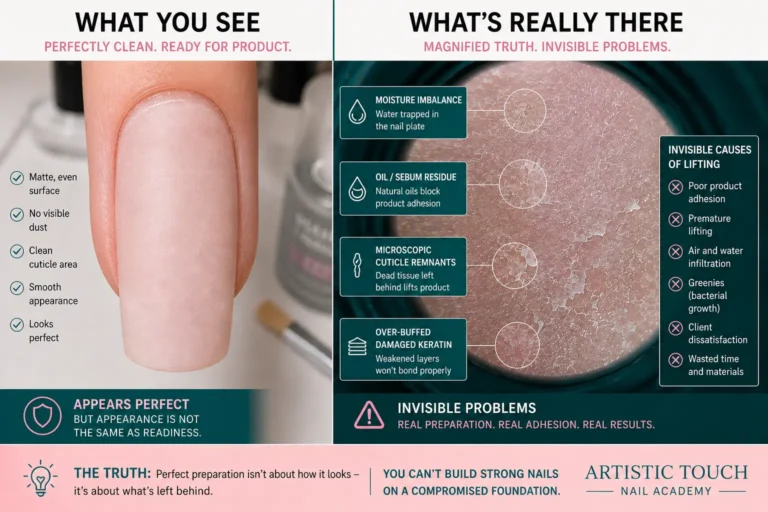
The product can only perform as well as the surface it is applied to. Preparation means cleaning, dehydrating and readying the natural nail surface so that it is clean, dry and free of oil for the coating to bond to. If a service lifts or fails early, preparation is the most likely cause.
Dead cuticle left on the nail plate is a common reason for lifting near the cuticle, because the coating will not bond to the nail underneath it. Read my nail prep steps for gel for the order I follow.
The Role of Dehydrator and Primer
A dehydrator removes the final traces of surface moisture and oils, and the effect is temporary, so the product goes on as soon as it has fully evaporated. It is not interchangeable with a cleanser, and wiping it off removes its function. Skipping it is a frequent cause of early lifting.
A primer creates a bridge between the nail plate and the product. It is not a fix for incomplete preparation, and gel polish does not require a primer. Neither type of primer should touch the skin. I compare them in Nail Dehydrator vs Primer.
More Preparation Is Not Better Preparation
Aggressive buffing thins the nail plate, which can cause heat sensitivity during curing, so filing more does not mean better adhesion. I explain why in Over-Prepping Nails.
Moisture Balance, Not Maximum Dryness
A well-prepared, appropriately dry surface generally supports better adhesion than one holding residual water. But the nail does not need to be kept as dry as possible. The goal is balance, not maximum dryness. Soaking the nails before gel is a mistake, because water makes the plate swell temporarily.
Why Changing the Product Rarely Fixes It
When a service lifts, many technicians change the gel, the primer or the base coat. Most retention failures point to preparation gaps, structural errors or application technique, which a different product cannot fix. That is why I teach technicians to find the cause first. The full guide is Why Nails Lift Even When Your Prep Looks Clean.
For the science behind it, see my TheNailWiki pages on nail plate preparation, nail hydration and nail porosity.
Learn Preparation Properly
The Nail Prep course teaches nail plate preparation on real nails, so you understand why each step affects retention.
View the Nail Prep Course →Frequently Asked Questions
What is nail retention?
It is how well a nail service stays attached to the natural nail for its intended wear time, without lifting, peeling or breaking.
What does good nail retention look like?
The service lasts its intended wear time with no lifting at the cuticle, side walls or free edge. I expect a set to last at least two to three weeks.
What decides nail retention?
Preparation, the structure of the enhancement, respect for the anatomy around the nail and the application technique.
Where does lifting usually start?
At the cuticle, the side walls or the free edge. Each points to something different: leftover true cuticle, side walls that were not properly prepared, or preparation, structure or daily wear at the free edge.
Why do my nails lift even when my prep looks clean?
A clean-looking nail can still have contamination or moisture on it, and lifting can also come from structure or technique. Preparation is the most likely cause when a service lifts early.
Does primer improve retention?
A primer creates a bridge between the nail plate and the product, but it is not a fix for incomplete preparation. Gel polish does not require a primer.
Can over-buffing hurt retention?
Yes. Aggressive buffing thins the nail plate, so filing more does not mean better adhesion.
Will changing my product fix lifting?
Rarely. Most retention failures come from preparation, structure or technique, which a different product cannot fix.
Where can I learn nail preparation properly?
In my Nail Prep course, where I teach preparation on real nails.
Key Takeaway
Retention is how well a service stays attached for its intended wear time. It is decided by preparation, structure, anatomy and technique, and preparation is the most likely cause when a service lifts early.
About the Author

Professional Nail Expert | International Nail Educator
I am Radina Ignatova, a Professional Nail Expert since 2014 and International Nail Educator, based in Scotland, UK. I am the Founder of Artistic Touch – Nail Training Academy and TheNailWiki.
At Artistic Touch – Nail Training Academy, I provide structured professional online nail education specialising in dual forms, nail preparation and retention, nail structure, E-File work and Russian Manicure, with a strong focus on professional salon safety. I continue to work actively in salon practice, ensuring that all education reflects real client scenarios and current industry standards.
My teaching philosophy is simple: I show real salon challenges, real mistakes and real performance testing, not just perfect demonstrations. This is how you develop genuine technical competence and become a confident, capable nail professional.