Why You Must Open the Cuticle Pocket Before Using a Flame Bit
Have you seen people online going straight in with their flame bits before they have opened the cuticle pocket? I see it a lot, and it is something I really do not want you to copy. It is one of the quickest ways to start working without enough access or visibility.
This article explains the reasoning behind opening the pocket first, and then walks through how I do it, in the same order as my demonstration on the official YouTube channel, Radina Ignatova | Nail Academy. It is written for nail technicians who already use an e-file, and it is about understanding why the area needs to be prepared first, not copying where somebody places their drill bit.
Quick Answer: Why Open the Cuticle Pocket Before Using a Flame Bit?
A closed pocket gives you no access and no visibility. Going in with a flame bit can catch the skin from the inside, tear it, over-cut the tissue, put too much pressure on the natural nail and, if you keep forcing the bit, create grooves and rings of fire. Opening the pocket first, gently and from the sinus with the side of an orangewood stick, gives you enough space to see and clean the true cuticle safely. The aim is enough room to work, not the deepest pocket possible.
Watch the Video: Do Not Work Inside the Cuticle Pocket Until You Open It
The video combines the explanation with a live demonstration. These are the parts I would watch first:
- What a closed pocket can damage (0:10)
- Opening the pocket with an orangewood stick (1:20)
- Working with the e-file at 14 RPM (2:41)
- More dust can mean overworking (3:14)
- Do not force the deepest pocket possible (5:53)
What Can Go Wrong If the Pocket Is Still Closed
If the pocket is closed and you go in with the bit, you can damage the natural nail and the tissue, including the cuticle and live skin. This is where the damage happens.
| What can happen | Why it happens |
|---|---|
| Catching the skin from the inside | The skin fold is still against the nail plate, so the bit has nowhere clean to work |
| Tearing the skin | You cannot see what the bit is touching |
| Over-cutting the tissue | Without access, tissue is removed without control |
| Too much pressure on the natural nail | The bit is pushed into an area with no room |
| Grooves and rings of fire | Forcing the bit against the nail plate in a closed area |
| Damage to the natural plate | Repeated pressure on the nail itself, not the tissue you meant to remove |
Opening the cuticle pocket is not an optional step. It is what gives you the access and visibility to work safely with the e-file.
How I Open the Cuticle Pocket
I use an orangewood stick, because I find it the best tool for this job. I start from the sinus, and I do not poke the sharp point straight into the cuticle zone. I use the sides of the stick and open the pocket gently.
After opening it, I go back once more to double-check that everything is open. Then I can see the difference between a closed pocket and an open one. With the pocket open, I have clear visibility of what I am trying to remove.
For more on the area around the sidewalls, read why you keep catching the nail sinus during Russian Manicure.
What You Are Trying to Remove
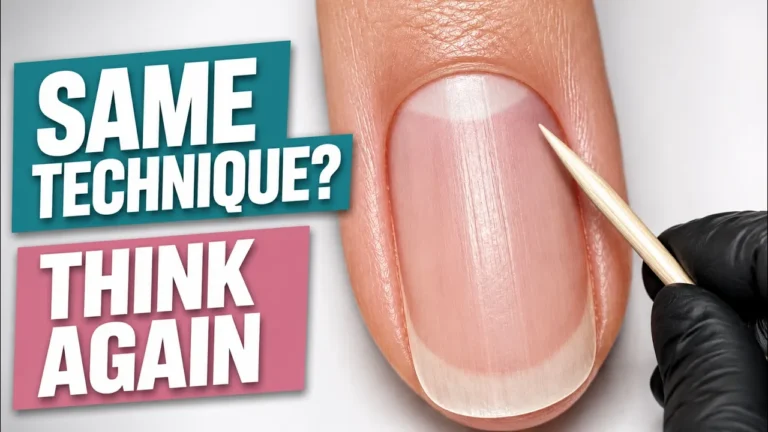
What I am working to remove is the true cuticle and non-living tissue that is stuck to the nail plate. With the pocket open, you can see it, including in the sinus areas. This is not the live skin. Seeing the difference is what allows you to remove it with control instead of working by feel inside a closed fold.
If you want help recognising what you are looking at, see how to read the cuticle before Russian Manicure. The principle behind it is in Russian Manicure is not about removing more cuticle.
Working With the E-File After the Pocket Is Open
Once the pocket is open and checked, I introduce the e-file. In the demonstration I use 14 RPM, working from the middle towards the left sinus with an angle. I then switch direction and work from the middle towards the right.
As I work, I can see the dead skin lifting and coming away, and I have clear visibility of what I am working on. I do this without pressure. For more on how angle and pressure change the result, read what changes when your contact point changes and why light pressure is not enough advice.
| Step | What I do |
|---|---|
| 1. Open | Orangewood stick, starting from the sinus, using the sides and not the sharp point |
| 2. Check | Go back to double-check that everything is open |
| 3. Assess | See what is true cuticle and what is live skin |
| 4. Create access | Open the pocket a little more if the cuticle needs it |
| 5. Work | E-file at 14 RPM from the middle towards each sinus, without pressure |
| 6. Check again | Clean sinus, clean pocket, clear visibility |
Why More Dust Is Not Always a Good Sign
A little dust while you clean the pocket is fine, as long as you are not over-pressing. But if you start to get more dust, it might be a sign that you are overworking the natural plate rather than removing tissue.
If you are unsure when to stop, read when should you stop during Russian Manicure.
To Cut or Not to Cut
In the demonstration, this client did not have much overgrowth, so I left the cuticle without cutting. Technicians who prefer to cut can remove it. To me, in a case like this the cuticle can be left as it is, and I can go straight on with the nail prep and the product.
That choice depends on the client in front of you, which is why assessing before you work matters more than following a fixed routine.
Opening the Pocket Does Not Mean the Deepest Pocket Possible
Opening the pocket does not mean creating the deepest pocket possible. You cannot achieve that with everyone, so do not try to force it. The goal is enough space to work safely and properly with the bit: enough room to go underneath and clean the pocket.
Some clients have a deeper natural pocket and some have a shallower one, so it varies between clients. For the shallow pocket, read what changes with a shallow cuticle pocket.
The Main Rule: Open First, Then Work
Do not go straight in with your e-file bits before you open the pocket first. Expose the area properly, create access, and then start working. That is how you reduce the risk of catching the skin, overworking the natural nail and leaving hidden tissue behind.
- Is the pocket actually open?
- Do I have enough access?
- Can I see what I am working on?
- Am I forcing depth the client does not have?
- Am I removing true cuticle, or risking live tissue?
- Is more dust a sign that I am overworking the plate?
Choosing the right bit is part of the same decision. See red vs blue diamond flame bit for how abrasiveness should match the tissue.
Understand the Sequence, Not Just the Movement
This is exactly what I teach in my Russian Manicure training: understanding what you are doing, not just copying movements. Russian Manicure – Beyond Technique explains why each stage comes where it does, and how to assess and adapt to the cuticle pocket in front of you. You can also browse all online nail courses.
Russian Manicure – Beyond Technique
Learn the reasoning behind e-file work: how to assess different cuticle pockets and skin types, create access safely and adapt to every client. Includes lifetime access, direct feedback and private student support.
View the Course Details →Frequently Asked Questions
Why should you open the cuticle pocket before using a flame bit?
Opening the pocket gives you access and visibility, so the bit can work on the true cuticle without catching live skin. A closed pocket can lead to catching or tearing the skin, over-cutting tissue and too much pressure on the natural nail.
Can you damage the nail by working in a closed cuticle pocket?
Yes. Forcing the bit against a closed area can put too much pressure on the natural nail and create grooves and rings of fire, as well as damage the natural plate.
How do you open the cuticle pocket?
I use an orangewood stick, starting from the sinus and using the sides of the stick rather than the sharp point, and open the pocket gently. I then go back to double-check that everything is open.
What RPM do you use after opening the pocket?
In my demonstration I use 14 RPM, working from the middle towards one sinus with an angle and then switching direction. The right setting depends on the client and your technique.
What does more dust mean when cleaning the cuticle?
A small amount of dust is normal if you are not over-pressing. Noticeably more dust can be a sign that you are overworking the natural plate.
Do you always cut the cuticle after opening the pocket?
No. If the client does not have much overgrowth, I can leave the cuticle without cutting and go straight on with the nail prep and the product. Technicians who prefer to cut can remove it.
Should you try to make the cuticle pocket as deep as possible?
No. The goal is enough space to work safely and clean the pocket. Some clients naturally have a deeper pocket and some a shallower one, and you cannot achieve the same depth on everyone.
Where can I watch the full video?
‘Do Not Work Inside the Cuticle Pocket Until You Open It’ is on Radina Ignatova | Nail Academy, the official YouTube channel of Artistic Touch – Nail Training Academy. It is embedded at the top of this article.
Key Takeaway
Do not work inside the cuticle pocket until you have opened it. Opening the pocket gives you access and visibility, so you can reduce the risk of catching the skin, overworking the natural nail and leaving hidden tissue behind. The aim is enough space to clean safely, not the deepest pocket possible.
Learn Why, Not Just Where the Bit Goes
Russian Manicure – Beyond Technique teaches the reasoning behind e-file work, so every decision is based on what you see rather than what you copied.
View Russian Manicure – Beyond Technique →About the Author
Professional Nail Expert | International Nail Educator
I am Radina Ignatova, a Professional Nail Expert since 2014 and International Nail Educator, based in Scotland, UK. I am the Founder of Artistic Touch – Nail Training Academy and TheNailWiki.
At Artistic Touch – Nail Training Academy, I provide structured professional online nail education specialising in dual forms, nail preparation and retention, nail structure, E-File work and Russian Manicure, with a strong focus on professional salon safety. I continue to work actively in salon practice, ensuring that all education reflects real client scenarios and current industry standards.
My teaching philosophy is simple: I show real salon challenges, real mistakes and real performance testing, not just perfect demonstrations. This is how you develop genuine technical competence and become a confident, capable nail professional.