Why Your Dual Forms Keep Failing on Different Nail Shapes
Author: Radina Ignatova, Professional Nail Expert, Educator | Last Updated: July 2026
Quick Answer
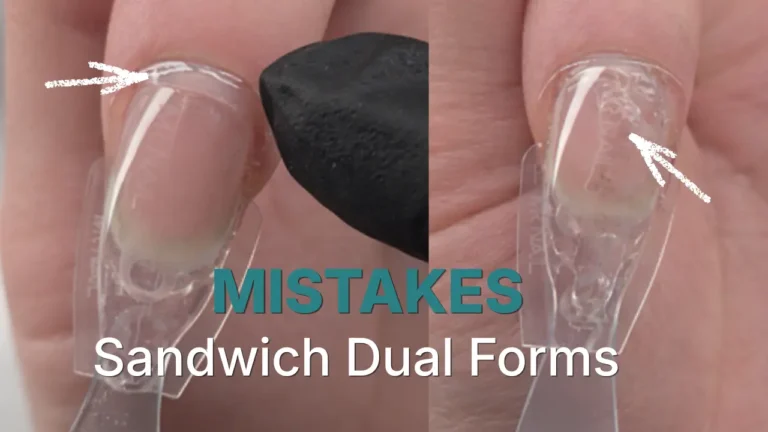
Dual forms fail inconsistently across clients because width is only one measurement of fit, and it is rarely the one causing the problem. The natural nail also has a longitudinal curve, a transverse curve, a growth direction and a level of flexibility, all of which influence whether a form sits correctly and cures under even pressure. A form that matches the width can still be structurally incompatible with a flat, arched or downward-growing nail. When technicians choose forms by width alone, they often compensate for a poor structural match with extra product, which is where bulk, gaps and premature lifting begin. The correct approach is to assess the natural nail before selecting the form, not after the result has already gone wrong.
The nail looked perfect when the client left the chair. The dual form matched her nail width exactly, the sidewalls were tucked in, and the finished set had the smooth, even curve you were aiming for. Three days later, a different client walked in with what looked like the same size and shape of natural nail, and you used the same size form. This time the extension pointed downwards at the free edge, and no amount of filing at the tip corrected it.
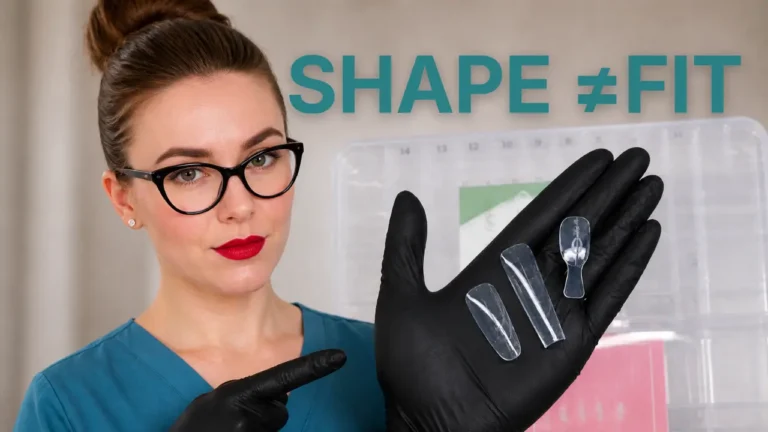
If this pattern feels familiar, you are not making a beginner mistake. You are running into a limitation of how most technicians are taught to choose dual forms in the first place: by matching the width printed on the packet to the width of the nail bed. Width is easy to measure, so it becomes the default decision-making tool. The problem is that width tells you almost nothing about whether the form will actually sit correctly on that particular nail.
Why the Same Form Behaves Differently on Different Nails
Every natural nail has a structure that exists in three dimensions, not one. Alongside width, there is a longitudinal curve running from cuticle to free edge, a transverse curve running from sidewall to sidewall, and a growth direction that is not always straight. There is also the flexibility of the plate itself, which affects how much the nail moves once the client leaves the salon and starts using her hands normally.
A dual form is designed around an assumed curve and an assumed growth path. When the natural nail matches that assumption, the form fits with very little intervention. When it does not, the technician is left compensating in real time, usually without realising that a compensation is even taking place.
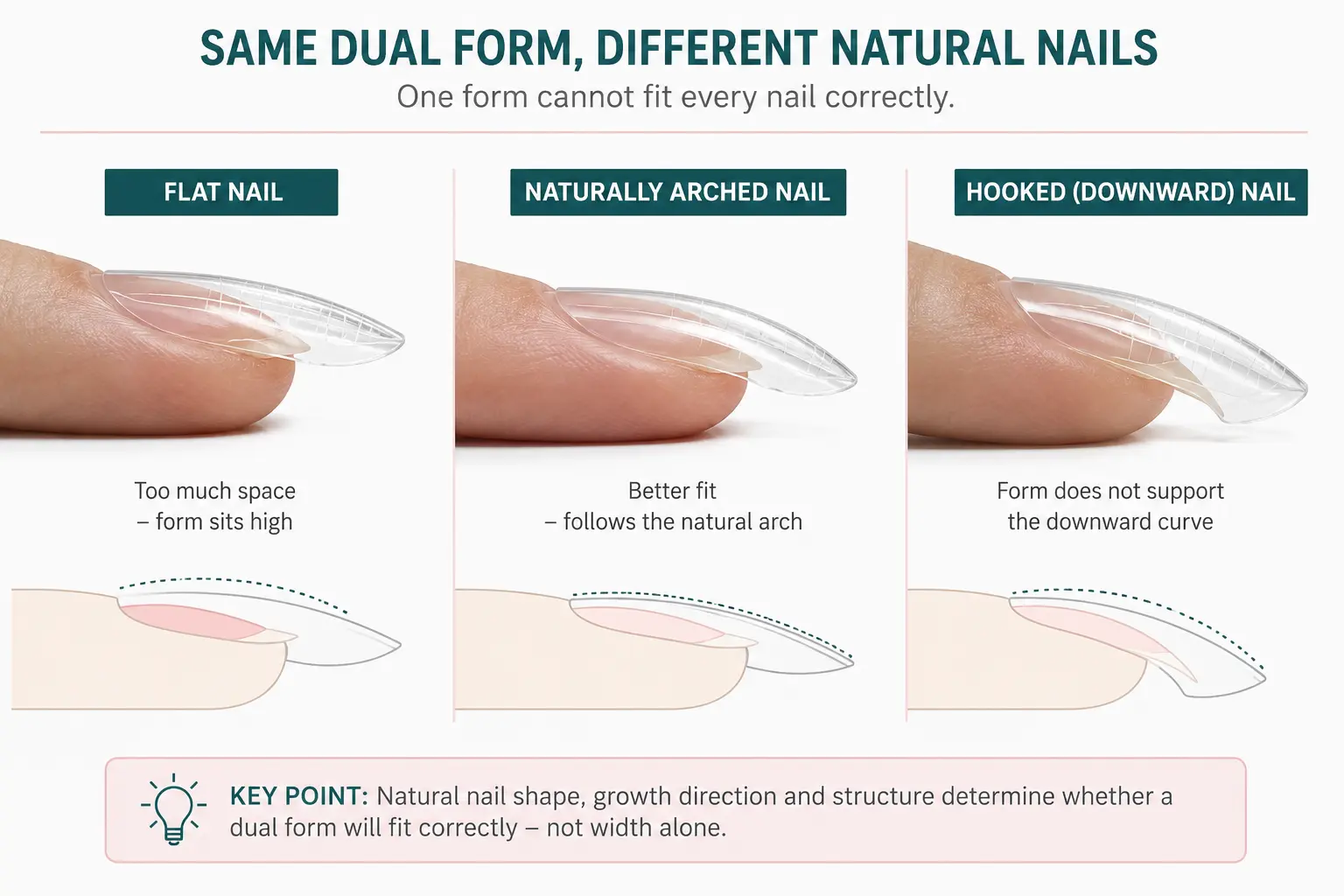
- Flat nail plates often sit loosely inside a form built around an average transverse curve, which creates a gap that gets filled with product rather than corrected structurally.
- Arched nail plates can force the form to sit at an angle, changing where the product pools and where stress concentrates once cured.
- Hooked or downward-growing nails pull the extension in a direction the form was never designed to control, which is why the free edge continues to point down no matter how the tip is filed afterwards.
- Highly flexible nails move more after curing than rigid nails, placing ongoing stress on the bond between the form and the natural plate, even when the initial application looked correct.
Why Extra Product Is Not a Fix
When a form does not sit correctly, the most common instinct is to add more product to fill the space and hold the shape. In salon work, this is one of the most repeated patterns I see behind bulky, uneven or unstable dual-form sets. Extra product can disguise a structural mismatch for the length of one appointment, but it does not resolve the underlying issue, and it often introduces new ones.
Excess product changes the weight distribution across the nail. It can create pressure points that were not present in the natural structure, and it makes the enhancement more dependent on the strength of the product rather than the compatibility between the form and the nail. This does not automatically mean every thick or heavy set was caused by poor form selection, but it is one of the first factors worth investigating when bulk is a recurring complaint rather than an occasional one.
A form can match the nail width perfectly when viewed from above, yet still fail to match the natural nail’s profile when viewed from the side.
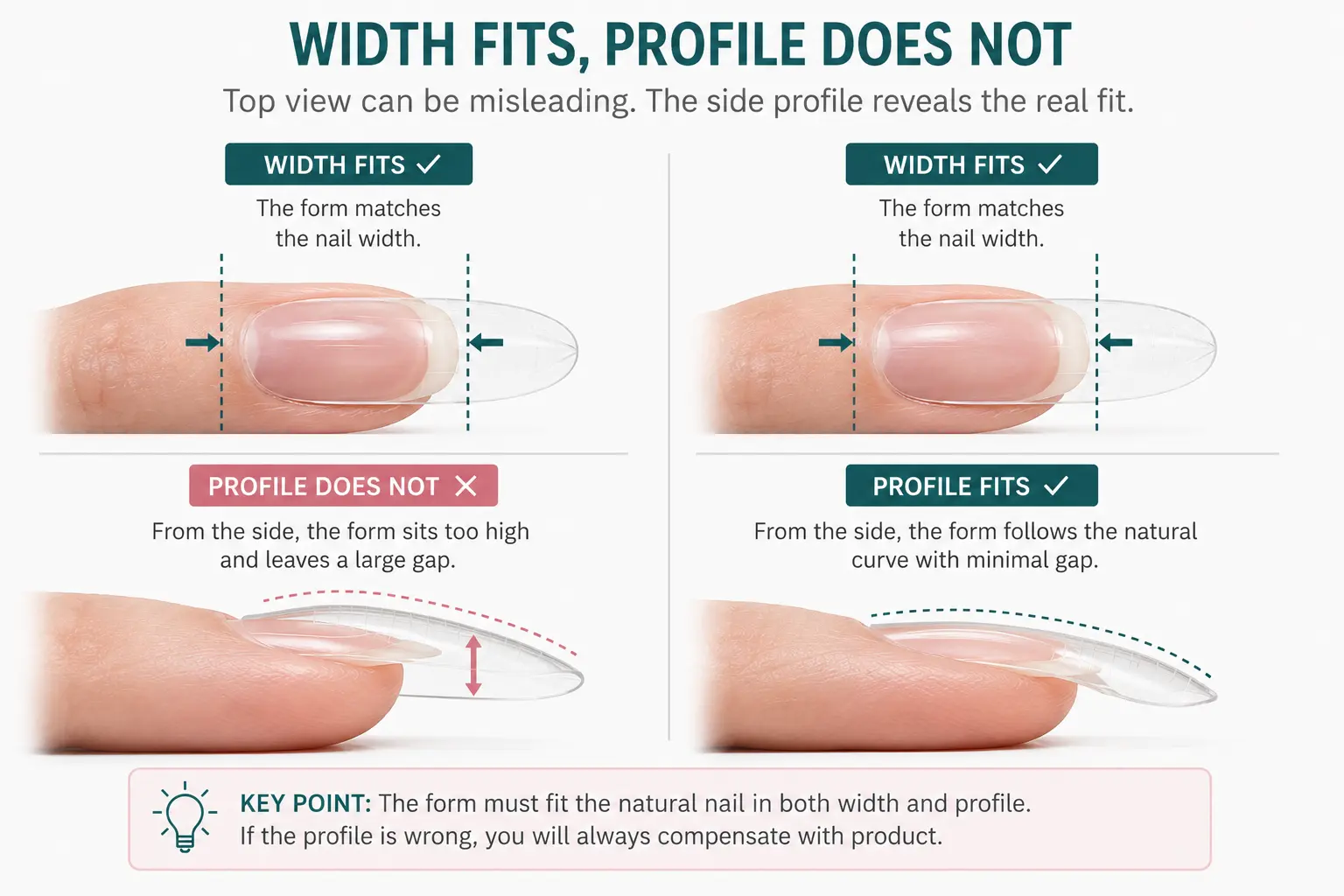
The Diagnostic Question to Ask Before Choosing a Form
Instead of asking “which size fits this width,” the more useful question is: what is this natural nail actually asking the enhancement to do?
A nail that is structurally sound but simply needs length is asking for extension. A nail that is thin, over-filed or prone to breakage is asking for strengthening. A nail with an irregular growth pattern, an old injury, or an uneven free edge is asking for correction. These are three different structural tasks, and a form chosen purely by width does not distinguish between them. This is one factor to investigate whenever a set that “should have worked” does not hold its shape or its direction.
A Practical Checklist Before You Apply the Form
- Assess the longitudinal curve from cuticle to free edge, not only the width at the widest point.
- Check the transverse curve across the nail bed, and note whether it is flat, average or pronounced.
- Observe the growth direction of the free edge before any product is applied.
- Test the flexibility of the natural nail by gently assessing how much it moves under light pressure.
- Decide whether the nail requires strengthening, correction or extension before selecting form size.
- Where the form does not sit naturally against the nail, treat that as diagnostic information, not a problem to be solved with extra product.
Diagnosis Over Imitation
A dual-form tutorial can only ever show you one nail. It cannot show you the nail sitting in front of you, with its own curve, its own growth direction and its own history. Copying the exact steps of a tutorial will work when your client’s nail happens to resemble the one used in that demonstration, and it will quietly fail when it does not. Structure over appearance means judging a set by whether it is built correctly for that specific nail, not only by how clean it looks the moment it is finished.
Ready to understand dual forms beyond copying steps?
The Ultimate Dual Forms teaches form choice, fit, correction and structure for real natural nail shapes.
See Full Course DetailsContinue Learning
If you want a practical starting point before committing to the full course, the free masterclass How to Pick Dual Forms: A Practical Guide walks through the basics of matching forms to nail bed shape.
For the underlying science of nail structure referenced in this article, see Dual Forms and Points of Growth on TheNailWiki.
Frequently Asked Questions
Why do dual forms work on some nails but not others?
Because dual forms are built around an assumed curve and growth direction. When the natural nail matches that assumption closely, the form fits with little intervention. When the natural nail has a different curve, flexibility or growth pattern, the same form requires compensation, which is where inconsistent results come from.
How do I know whether a dual form fits correctly?
A well-fitted form should sit against the natural nail with minimal gapping along the sidewalls and cuticle area, without needing to be forced or heavily filled to hold its shape. If the form only appears to fit once extra product has been added, this is one factor worth investigating before assuming the fit was correct.
Can I use the same dual forms on every client?
The same brand and size range can be used across clients, but the selection decision should not be based on width alone. Curve, growth direction and flexibility vary between clients even when the width measurement is identical.
Why do dual forms create bulky nails?
Bulk often develops when extra product is used to compensate for a form that does not sit correctly against the natural nail. This can increase the risk of pressure points and an unnatural finished shape, though it does not automatically mean every thicker set was caused by poor form fit alone.
Why does my dual-form extension point downwards?
This pattern can indicate that the natural nail’s growth direction was not accounted for during form selection. A form designed for a straight growth path may not control a hooked or downward-growing nail, and filing the tip afterwards typically does not correct the underlying direction.
Does dual-form width alone determine fit?
No. Width is one measurement among several, alongside longitudinal curve, transverse curve, growth direction and flexibility. Relying on width alone is one of the most common reasons the same form size produces inconsistent results across different clients.

RADINA IGNATOVA
Professional Nail Expert | International Nail Educator
I am Radina Ignatova, a Professional Nail Expert since 2014 and International Nail Educator, based in Scotland, UK. I am the Founder of Artistic Touch Nail Training Academy and TheNailWiki.
At Artistic Touch Nail Training Academy, I provide structured professional online nail courses specialising in dual forms, gel systems, polygel application, advanced nail structure, E-File work and Russian Manicure, with a strong focus on professional salon safety. I continue to work actively in salon practice, ensuring that all education reflects real client scenarios and current industry standards.
My teaching philosophy is simple: I show real salon challenges, real mistakes and real performance testing, not just perfect demonstrations. This is how you develop genuine technical competence and become a confident, capable nail professional.
This article is provided for professional educational purposes and reflects general salon-based observation. It is not a substitute for structured training, professional assessment of an individual client, or medical advice. Outcomes referenced are based on professional experience and are not guaranteed.
© 2026 Artistic Touch Nail Training Academy. All rights reserved.