The Difference Between Copying and Understanding in Nail Education
Quick Answer: What Is the Difference Between Copying and Understanding Nail Technique?
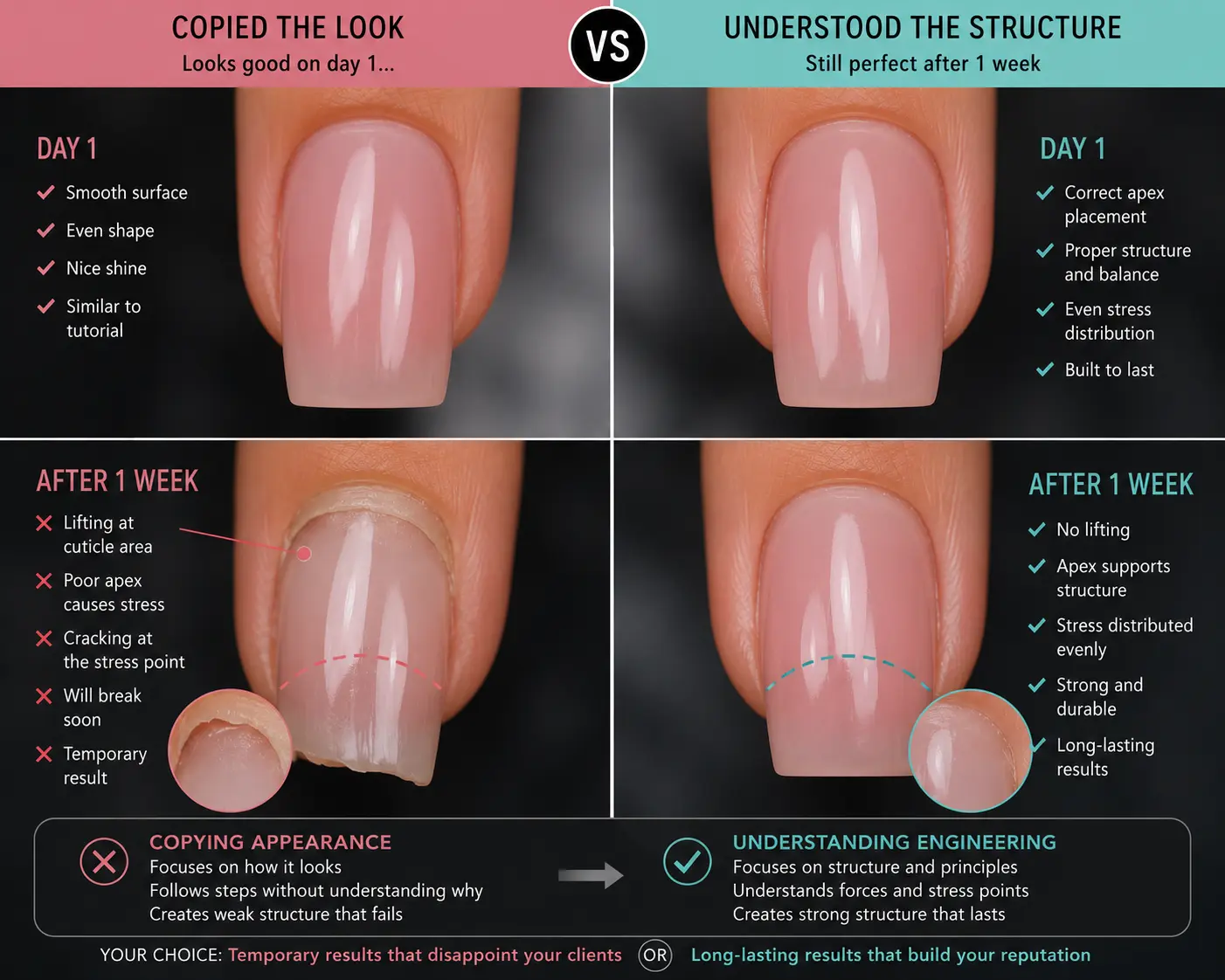
Copying replicates visible shapes and movements without comprehending the structural principles creating reliable performance. Nail techs who only copy struggle when client nail geometry differs from tutorial examples because they never learned why techniques work—only what they should look like. Understanding enables adaptation, problem diagnosis and consistent results across all nail types because you recognise the engineering principles determining success.
This article explains why understanding separates professionals from perpetual students.
When Copying Works Until It Does Not
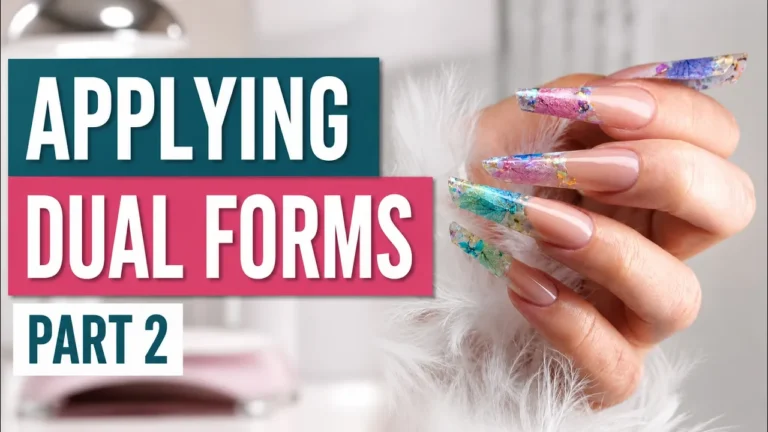
You watch dual form demonstrations. You replicate the shape, product placement and curing protocol exactly. Your practice nails look acceptable. You book a client. Their nail plates are significantly flatter than tutorial models. You apply the same technique. The enhancement pops off during application or lifts within two days. You copied the procedure perfectly. You never understood why that specific arch level matched that specific nail geometry structurally.
This is copying without understanding. It works when conditions match your examples. It fails immediately when variables change because you never learned the underlying principles determining success. You know what correct dual form application looks like. You do not know why it looks that way or what happens mechanically when nail architecture changes.
Professional nail work requires adaptation more than replication. Most clients present with geometry, damage history or lifestyle factors requiring some modification from textbook technique. Copying leaves you helpless when adaptation is needed. Understanding lets you reason through changes confidently.
What Structural Understanding Actually Means
Understanding nail structure means recognising that apex placement determines stress distribution through the enhancement during normal use. The apex is not a shape preference. It is the thickest point designed to intercept and distribute force before it concentrates at weak points. When you understand this, you recognise that apex position must change based on nail length, natural arch and client lifestyle because stress patterns change with these variables.
When you only copy apex position from demonstrations, you place it where tutorials showed without comprehending why. Flat nails need more distal apex than curved nails. Long nails need lower apex than short nails. Heavy-use lifestyles need reinforced apex zones. These adaptations come from understanding force mechanics, not from copying one demonstration repeatedly.
The difference between copying and understanding determines whether your technique works reliably or randomly. Copying produces results that seem inconsistent because you repeat the same procedure expecting different outcomes. Understanding produces consistent results because you adapt technique to individual requirements systematically.
Why Same Technique Fails on Different Clients
You master BIAB application on practice tips. Product self-levels beautifully. Structure looks balanced. You apply identical technique to a client with hooked nails. Product pools at the tip. Structure is compromised. The tutorial never explained that nail growth direction affects product flow behaviour or that hooked geometry requires modified application sequence.
This failure is not about your skill level. It is about education teaching you to replicate ideal conditions without teaching you to adapt for non-ideal reality. Most nail education shows you perfect execution on cooperative nail types. It does not show you the diagnostic thinking that would modify technique when nails present differently.
Real professional capability means handling the infinite variations real clients present: severe natural arch, flat plates, lateral curvature differences between fingers, growth direction anomalies, previous damage, unusual stress patterns. Copying gives you one recipe. Understanding gives you reasoning that adapts the recipe to available ingredients.
The Panic Copying Creates
Nail techs who only learned copying panic when problems occur because they have no diagnostic framework for identifying causes. Your enhancement lifts. Your thought process is: “Which step did I do wrong?” You replay the procedure mentally, comparing it against tutorial memory. Everything seemed correct. The real cause—microscopic preparation inadequacy, product touching skin or structural stress concentration—is invisible to your assessment because you never learned what adequate preparation looks like objectively or how stress concentration manifests before failure.
Understanding eliminates this panic. You recognise lifting patterns indicating specific causes. Proximal lifting suggests preparation or skin contact issues. Sidewall lifting indicates structural problems or movement incompatibility. Free edge lifting suggests apex misplacement or weak stress distribution. You can diagnose because you learned the mechanical reasons why specific errors create specific failure patterns.
Professionals who understand do not panic during complications because they can reason through causation even for scenarios they have not encountered before. Their knowledge includes principles that apply across situations, not just memorised responses to familiar problems.
What Copying Looks Like in Practice
Copying means: using the same dual form size the tutorial used without assessing whether it matches your client’s nail bed coverage, placing apex where demonstrations showed without evaluating whether that position suits this nail’s length and arch, applying the same product amount regardless of nail surface area differences, following the same curing protocol without adjusting for lamp power variations or product behaviour observation.
This mechanical replication works occasionally—when your conditions happen to match tutorial examples closely enough. It produces frustrating inconsistency the rest of the time because real salon work presents endless variable combinations that copying cannot accommodate.
The nail tech who only copies constantly seeks new tutorials hoping different demonstrations will solve their inconsistency problems. They do not recognise that more copying will not fix understanding gaps. They need education teaching principles, not additional examples to replicate.
What Understanding Enables
When you understand that C-curve affects sidewall stress distribution, you recognise why nail geometry requiring tight C-curve needs different product placement than nails with shallow curvature. When you only copy C-curve shapes from photos, you attempt identical technique on all nails and wonder why some fail.
Understanding lets you troubleshoot instinctively. Product is not self-levelling as expected. You recognise: room temperature is lower than usual, affecting viscosity behaviour. You adjust application technique or environment rather than assuming product failure. Copying gives you no diagnostic path when product behaves differently than demonstrations.
The nail tech who understands can work across product brands, nail types and environmental variations because they recognise the underlying principles that determine success regardless of specific variables. The nail tech who copies needs conditions matching their learned examples or results degrade unpredictably.
Why Flat Nails Versus Curved Nails Breaks Copying
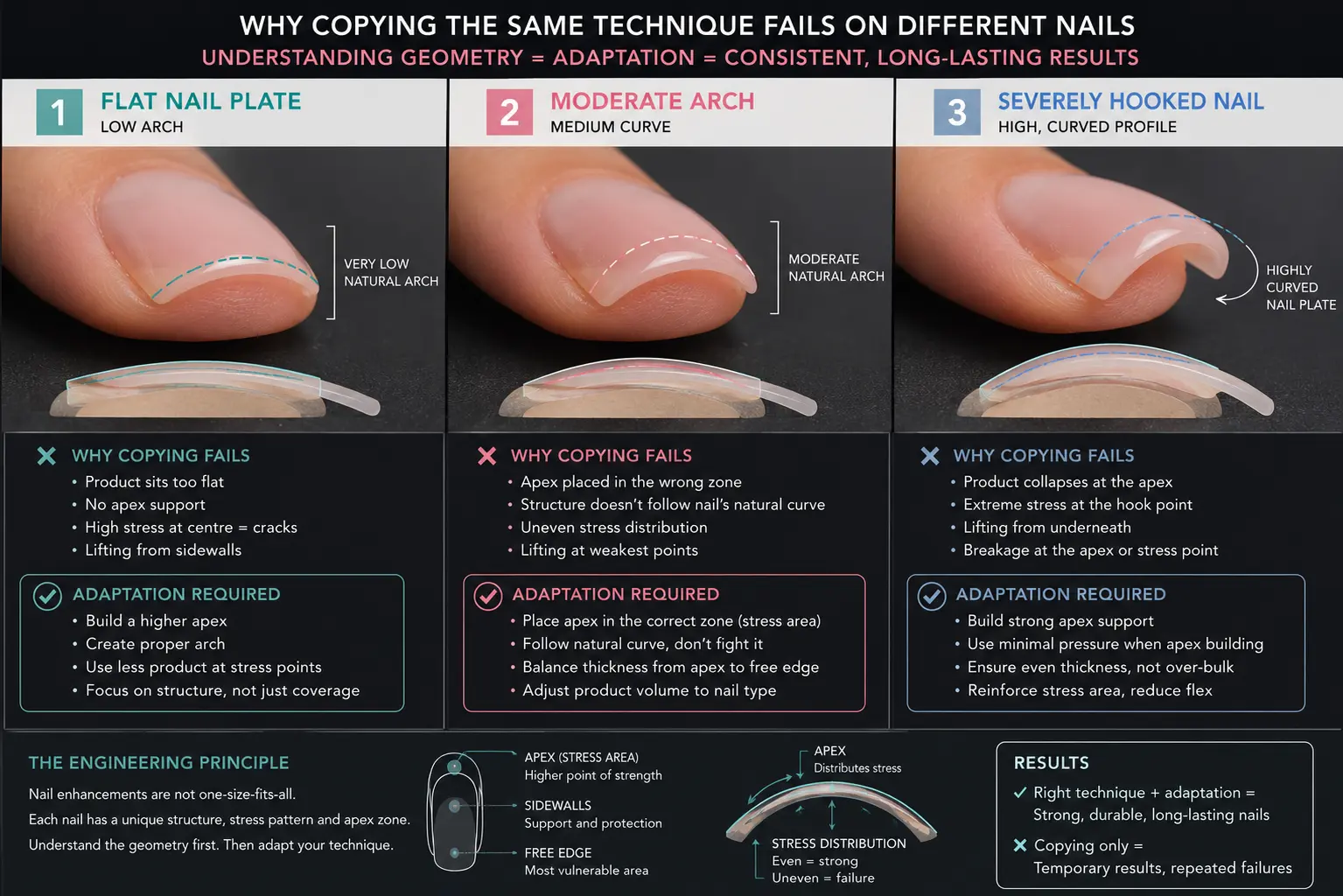
Demonstrations show dual form application on moderately arched nails. You replicate the technique successfully on similar nails. A client arrives with completely flat nail plates. You attempt the same approach. Forms do not seat properly. Product distribution is wrong. Finished structure fails quickly. The tutorial never explained that dual form architecture must match natural nail geometry or why architectural mismatch creates specific problems.
Understanding teaches you: flat nails need flatter forms because arch mismatch creates pressure lifting, product placement must change because flat geometry alters stress patterns, C-curve formation requires different technique because natural curvature affects how product sits. Copying cannot teach these adaptations because it only showed you one scenario.
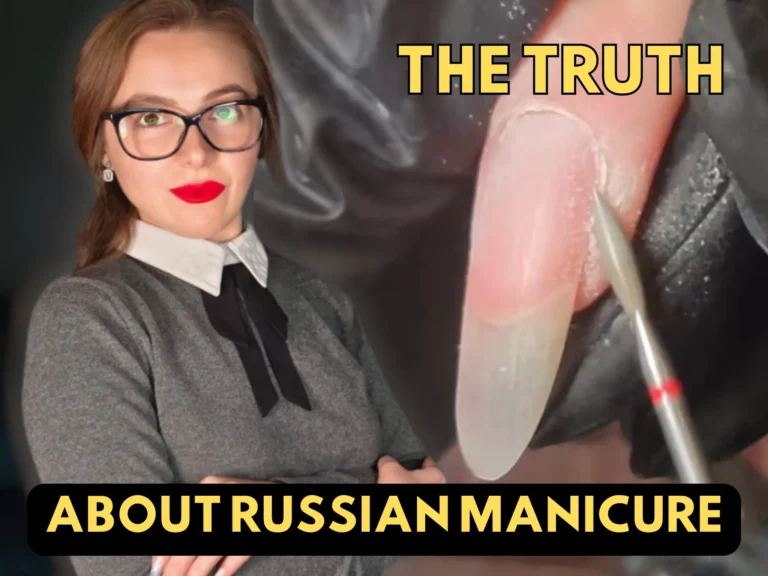
This principle applies across all techniques. Russian Manicure demonstrations show cooperative proximal nail folds. Your client has tight, sensitive tissue. Copying the same approach causes trauma. Understanding teaches you to assess tissue tension and modify technique accordingly.
The Hooked Nail Problem
Hooked nails—those with significant downward curvature at the free edge—break copying completely. Every tutorial technique you learned assumed moderate nail geometry. Hooked nails change everything: product flows differently, structural requirements shift, apex placement must adapt, dual form selection needs modification, filing technique requires adjustment.
The nail tech who copies has no framework for these adaptations. They attempt standard technique, achieve poor results and blame the nail type rather than recognising their education gap. The nail tech who understands recognises: growth direction affects product behaviour, downward curve creates different stress patterns requiring repositioned apex, dual form arch must accommodate existing curvature or pressure mismatch causes failure.
Difficult nail types expose the difference between copying and understanding immediately. Copying works on easy nails similar to tutorial models. Understanding works on all nails because you recognise the principles determining success regardless of geometry presented.
Why Understanding Takes Longer to Develop
Copying is faster initially. Watch tutorial, replicate steps, achieve results on cooperative nails within weeks. Understanding requires more investment: learning structural principles, studying force mechanics, comprehending material behaviour, practising diagnostic analysis, developing problem recognition beyond pattern matching.
Many nail techs choose copying because understanding feels slower and more complex. This creates short-term progress followed by long-term plateau. You can copy your way to acceptable results on ideal nail types quickly. You cannot copy your way past that plateau without developing the understanding that enables real professional growth.
The investment in understanding pays returns over your entire career. Copying requires constantly seeking new tutorials when conditions change. Understanding lets you adapt existing knowledge to new situations indefinitely. The education that teaches you to think will always exceed the value of education that teaches you to replicate.
How to Develop Understanding Instead of Just Copying
Stop watching demonstrations passively. Pause frequently and ask: Why this product amount? Why this apex position? What would change if the nail was flatter? What is this preventing? What would I do differently for a hooked nail? Force yourself to reason through decisions rather than just observing actions.
Study your own failures deeply. Not “this set failed” but “sidewall lifting on these three nails indicates I’m missing lateral stress distribution principles.” Specific technical diagnosis beats vague disappointment. You need to identify exactly what you do not understand, not just that results are inconsistent.
Seek education showing problems alongside solutions. Perfect demonstrations teach you what success looks like. Mistake demonstrations teach you what inadequate looks like so you recognise it in your work before clients experience failures. Value troubleshooting content over aesthetic inspiration.
Copying Versus Reasoning
The nail industry provides abundant content teaching you to copy techniques onto cooperative nail types under ideal conditions. It provides far less education teaching you to understand the structural principles and diagnostic thinking that create consistent results across all nail variations. This gap explains why your technique plateaus despite consuming more content.
Ask yourself: Am I learning to think like a professional or just accumulating more examples to copy? The answer determines your long-term capability ceiling.
Learn Structural Principles, Not Just Steps
Artistic Touch courses teach you why techniques work mechanically, how to diagnose problems structurally and how to adapt methods to different nail types—not just demonstrate perfect execution to copy.
View All Courses →Lifetime access • Private student community • Start immediately
Frequently Asked Questions
Why does my technique work on practice tips but fail on clients?
Practice tips have ideal geometry allowing copied technique to work without adaptation. Real clients present with flat nails, hooked nails, unusual arch, previous damage and lifestyle factors requiring technique modification. Copying works on cooperative nail types similar to your practice examples. Understanding enables adaptation to the variations real salon work presents constantly.
How do I know if I am copying or understanding?
If you panic when nail geometry differs from tutorial examples or cannot explain why specific technique choices matter structurally, you are copying without understanding. If you can adapt confidently to unusual nail types and diagnose failure causes mechanically, you have developed understanding. Copying creates results that seem random. Understanding creates consistent adaptation to individual requirements.
What should I do when technique that worked before suddenly fails?
Analyse what changed: nail geometry, environmental conditions, product batch, client lifestyle or your execution precision. Nail techs who only copy blame products or clients. Nail techs who understand diagnose specific variable changes and adapt technique accordingly. Develop systematic comparison between successful and failed applications identifying exact technical differences.
How do I develop understanding instead of just copying more techniques?
Study structural principles explaining why techniques work mechanically. Analyse your failures with specific technical diagnosis identifying exactly what went wrong. Seek education showing problems and corrections alongside perfect execution. Practice asking why each decision matters rather than just replicating demonstrated steps. Prioritise depth over breadth—master understanding one technique completely before accumulating more to copy.
Why do some nail techs adapt easily while I struggle with different nail types?
Nail techs who adapt easily learned structural understanding allowing them to reason through modifications for individual nail variations. Nail techs who struggle learned by copying demonstrations without developing the diagnostic thinking that enables adaptation. This is not about natural talent. It reflects whether your education taught you principles or just procedures.
Can I still use tutorials if I want to develop understanding?
Yes, but watch actively rather than passively. Pause to analyse why decisions were made, what the educator is preventing and how technique would adapt for different nail types. Seek demonstrations explaining structural reasoning behind visible actions, not just showing perfect execution. Use tutorials as starting points for deeper analysis rather than scripts to replicate exactly.
About the Author
Radina Ignatova
Professional Nail Expert | International Nail Educator
I am Radina Ignatova, a Professional Nail Expert since 2014 and International Nail Educator, based in Scotland, UK. I am the Founder of Artistic Touch Nail Training Academy and TheNailWiki.
At Artistic Touch Nail Training Academy, I provide structured professional online nail courses specialising in dual forms, gel systems, polygel application, advanced nail structure, E-File work and Russian Manicure, with a strong focus on professional salon safety. I continue to work actively in salon practice, ensuring that all education reflects real client scenarios and current industry standards.
My teaching philosophy is simple: I show real salon challenges, real mistakes and real performance testing, not just perfect demonstrations. This is how you develop genuine technical competence and become a confident, capable nail professional.
Every Artistic Touch course includes lifetime access and access to a dedicated student support group, where I provide ongoing guidance and professional feedback.
Disclaimer: This content is for educational purposes only. Nail services should be performed by trained professionals following current hygiene and safety regulations. Always carry out a full client consultation and check for contraindications before performing any nail service.
About Artistic Touch Nail Training Academy
Artistic Touch Nail Training Academy delivers structured professional online nail education focused on practical skill development, professional standards and safe salon practice. All courses are available online worldwide.