Why Watching Perfect Nails Does Not Improve Your Technique
Quick Answer: Why Does Watching More Tutorials Not Fix Your Technique?
Perfect demonstrations hide the diagnostic decisions, mid-application corrections and problem-solving that create professional results. You see the finished work but not the structural thinking that prevented problems or the adaptations made when conditions deviated from ideal. Passive observation teaches you what professional nails look like, not how to create them when your client’s nails behave differently from tutorial models.
This article explains why consuming more content keeps your technique plateaued.
The Illusion Perfect Demonstrations Create
You watch a gel application demonstration. The educator’s movements are fluid. Product self-levels beautifully. The enhancement cures without heat spike. Finished result is flawless. You attempt the same procedure. Your product pools unevenly. Heat spike makes your client flinch. Finished surface needs excessive filing. The demonstration made it look simple because you only saw when everything worked perfectly.
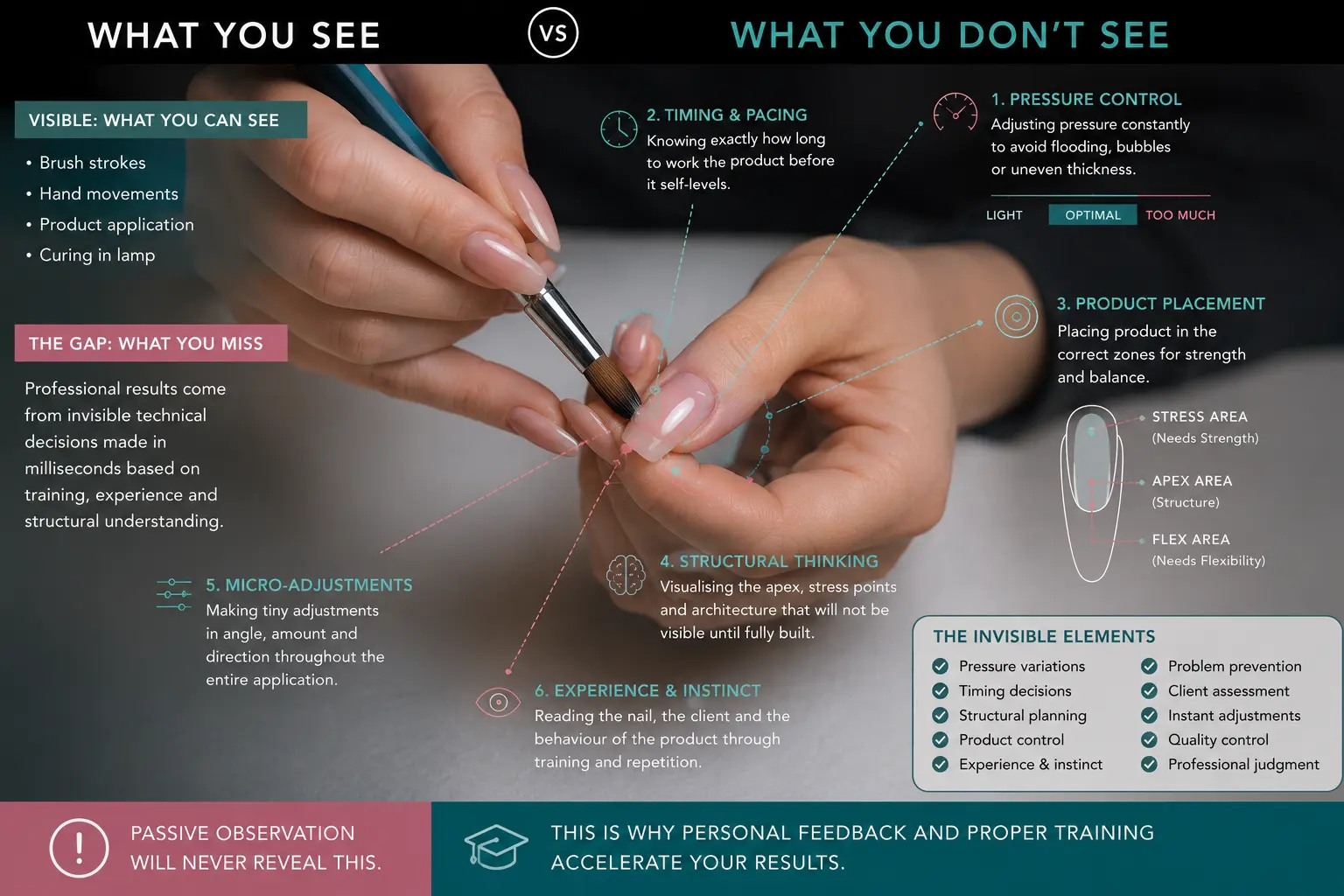
What you did not see: the educator adjusted application pressure mid-stroke when product began pooling, changed lamp positioning to prevent heat concentration, selected that specific viscosity because room temperature was higher than usual, modified curing time based on product behaviour observation. These micro-decisions happen automatically for experienced professionals. They are invisible in finished demonstrations. This is why watching does not translate to doing.
Perfect nails hide the thinking that created them. You see the result. You do not see the diagnostic process that prevented problems before they occurred or the corrections made when deviations appeared.
What Social Media Editing Removes
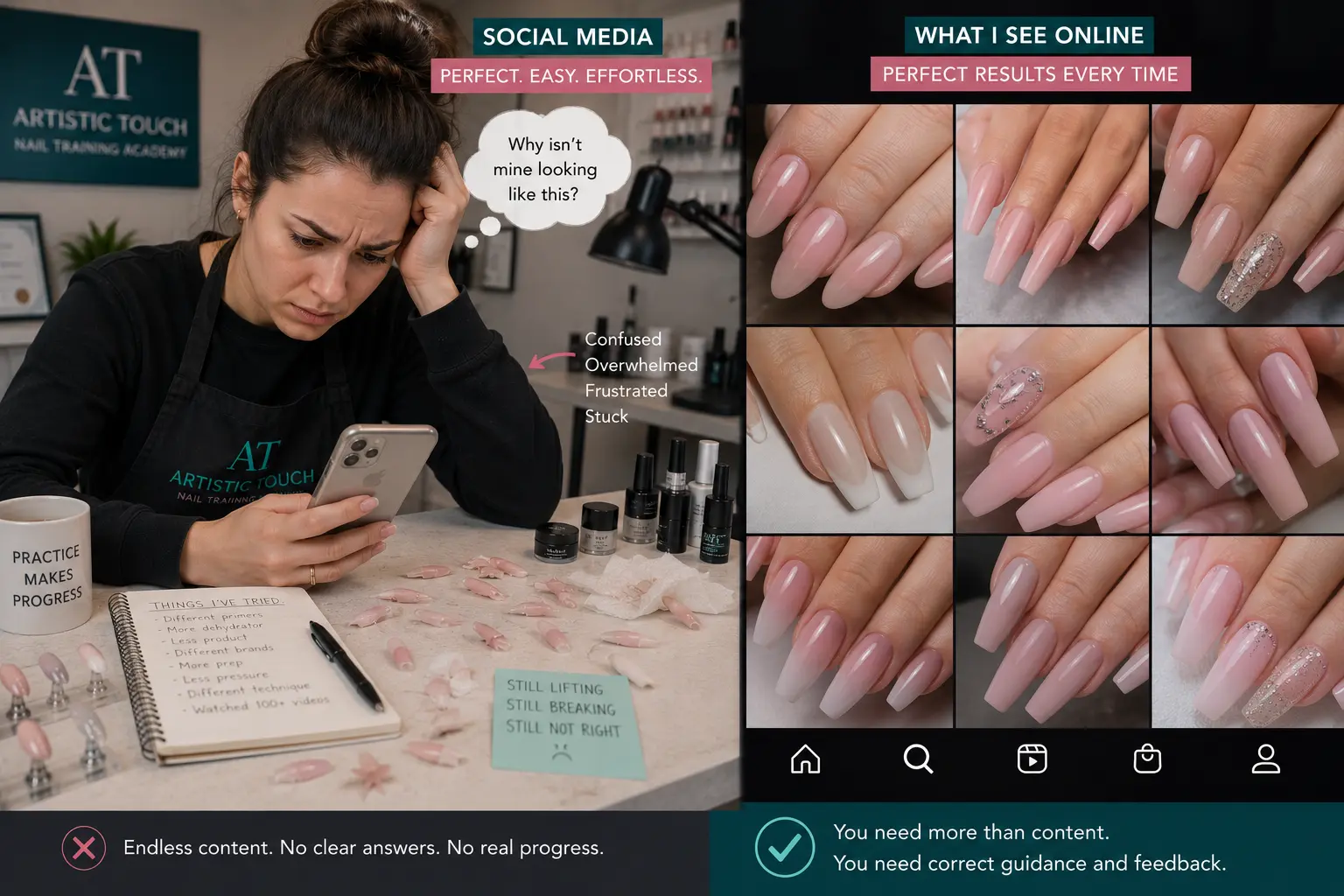
Instagram reels and TikTok videos show thirty seconds of perfect execution. Mistakes are edited out. Mid-application corrections are cut. Problem-solving is invisible. Real appointments taking ninety minutes compress to clips showing only flawless moments. This creates false understanding about how professional nail work actually happens.
Real salon work includes: assessing nail condition and deciding whether to proceed, recognising when preparation is adequate versus when it needs additional attention, noticing product viscosity behaving differently than expected and adjusting technique, identifying early signs of problems and correcting before they worsen, adapting to client discomfort or anatomical variations.
None of this appears in perfect social media content. You watch polished performance. You do not learn the decision-making and troubleshooting that happened between edited clips. Then you wonder why your real work feels chaotic compared to tutorial smoothness.
Why You Cannot Copy What You Cannot See
Demonstrations show movements. They rarely show the pressure control creating those movements. You see the brush stroke. You do not feel the slight pressure increase at the apex zone or the lighter touch near cuticle area. You attempt replication using visual observation alone. Your pressure is wrong because pressure cannot be seen—only its effects show later.
The same invisibility affects: product amount judgment, timing decisions, anatomical assessment, structural evaluation, problem recognition. These skills determine results but photographs cannot capture them. You watch dozens of BIAB applications. None teach you to feel when the brush is overloaded or recognise when product has reached the lateral nail fold before it should.
Professional technique includes tactile feedback, timing instinct and diagnostic observation that perfect demonstrations assume you already possess. When you do not, copying visible movements produces different results because the invisible elements were never taught.
The False Confidence Perfect Tutorials Create
After watching twenty dual form tutorials, you feel you understand the technique. The demonstrations were clear. Steps made sense. Application looked straightforward. You book a client. Their nail geometry differs from tutorial models. Suddenly you realise you know what dual form application should look like but not how to adapt when nails present unexpected characteristics.
This is passive learning creating false confidence. You absorbed information. You did not develop capability. The gap only becomes apparent when conditions deviate from tutorial examples—which real clients always do. Flat nails, hooked nails, nails with significant lateral curvature variation, nails damaged by previous work. None of these appeared in perfect demonstrations. None prepared you for reality.
True confidence comes from understanding why techniques work, recognising problems before they cause failures and knowing how to modify approaches for individual variations. Watching perfect execution builds none of these skills.
What Demonstration Performance Hides
Educators filming demonstrations often work on practice hands, models or colleagues—not challenging client nails. The demonstration nail has ideal geometry, healthy nail plate, cooperative cuticles. Real clients present with: previous damage, unusual growth patterns, health conditions affecting nails, sensitivity requiring technique modification, lifestyle factors creating non-standard wear patterns.
When you watch perfect results on ideal nails, you learn technique for best-case scenarios. You do not learn how to assess damage severity, when contraindications should prevent service, how to adapt technique for compromised nail plates or what to do when standard procedures produce unexpected responses.
Professional nail work requires handling non-ideal conditions more than replicating ideal demonstrations. But non-ideal scenarios are not photogenic content. So they disappear from your education, leaving you unprepared for the reality that most client nails require some adaptation from textbook technique.
Why Real Clients Never Match Tutorial Models
Tutorial models are selected or prepared for optimal demonstration conditions. Thorough preparation has occurred. Nail geometry is moderate. Product behaviour is predictable. No complications interrupt filming. This controlled environment creates teaching clarity but poor real-world preparation.
Your actual clients arrive with: nails you cannot fully see until removal reveals damage, time pressure requiring efficient work, budget constraints limiting product options, previous enhancement history affecting adhesion, expectations not matching nail reality, contraindications requiring difficult conversations.
Demonstrations cannot teach you these complexities. They show you perfect execution on cooperative nails. They do not show you professional judgment under imperfect conditions. This is why nail techs can watch hundreds of tutorials and still panic when real appointments deviate from demonstration scenarios.
The Problem with Passive Observation
Watching is passive. Your brain receives information without processing it actively. You see what happens but not why it happens. When you attempt application, you cannot reconstruct the invisible thinking behind visible actions. Your movements mimic surface technique while missing the underlying reasoning.
Active learning requires: questioning why specific decisions were made, analysing what would happen if conditions changed, predicting problems before they occur, evaluating whether finished work meets structural standards beyond appearance. None of this happens during passive tutorial consumption.
You need to watch demonstrations while asking: Why that product amount? Why that pressure? Why that apex position? What prevents problems here? What would I do if this nail was flatter? These questions transform passive observation into active analysis. Without them, watching teaches recognition but not reasoning.
What Professional Analysis Actually Looks Like
Advanced nail professionals watch the same tutorials you watch. They extract different information because they analyse actively. They notice: structural decisions in apex placement, pressure variations creating different results, product behaviour indicating environment factors, timing choices revealing expertise, preventive actions avoiding common problems.
This analytical viewing comes from understanding principles that demonstrations assume but rarely explain. Why does this educator thin product at this specific moment? Because product viscosity changed due to temperature and continuing without adjustment would create application problems. Beginners watching do not recognise this invisible correction because demonstrations do not narrate internal thinking.
You need education that makes invisible thinking visible—showing you not just what professionals do but why they do it, what they are watching for and how they decide when to adapt. Perfect demonstrations without this explanation leave gaps you cannot fill through observation alone.
Why Mistakes Are Better Teachers Than Perfection
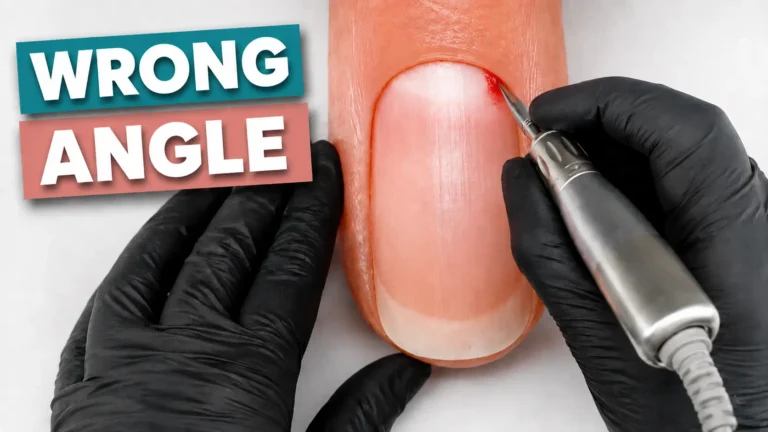
Watching mistakes get corrected teaches you more than watching perfect execution. When you see preparation that looks adequate but fails adhesion, then see correction bringing it to standard, you learn what adequate actually means objectively. Perfect demonstrations show the goal. Mistake demonstrations show the gap between subjective assessment and professional standard.
Real professional development requires: seeing what inadequate looks like so you recognise it in your work, understanding why specific errors cause specific failures, learning the correction sequence for each common problem, developing diagnostic ability to identify issues before they worsen.
Demonstrations showing only perfection provide none of this. They create aspiration without the diagnostic education needed to close the gap between your current work and professional standard. You need to see the problems you encounter, not just the results you want.
How to Watch Content More Effectively
When you watch demonstrations, pause frequently and ask: What decision just happened here? Why this product selection? What is this educator preventing? What would happen if the nail was different? How would I recognise if my version went wrong? These questions shift watching from passive absorption to active analysis.
Compare your own work against demonstrations critically. Not “mine does not look as good” but “my apex is 2mm too proximal and that creates stress concentration at the growth line.” Specific technical diagnosis beats vague dissatisfaction. You need to know exactly what differs and why that difference matters structurally.
Seek content showing problems and corrections, not just perfect results. Look for educators who demonstrate common errors alongside correct execution. Value troubleshooting content over aesthetic perfection. Prioritise understanding over inspiration.
Observation Versus Understanding
You can watch perfect nails endlessly without developing the diagnostic thinking that creates them. Visual observation teaches you what results look like. It does not teach you the invisible reasoning, pressure control, timing judgment or problem recognition that produced those results. This is why more content consumption does not fix technique plateaus.
Real improvement requires active analysis, mistake recognition, correction understanding and diagnostic thinking that perfect demonstrations cannot provide through passive viewing.
Learn Professional Diagnostic Thinking
Artistic Touch courses show real mistakes alongside corrections, explain why problems happen structurally and teach you to analyse your own work critically—not just watch more perfect demonstrations.
View All Courses →Lifetime access • Private student community • Start immediately
Frequently Asked Questions
Why does my technique not improve despite watching many tutorials?
Perfect demonstrations show finished results without revealing the diagnostic thinking, pressure control, timing decisions and problem prevention that created them. Passive observation teaches you what professional nails look like, not how to create them when your conditions differ from tutorial examples. Improvement requires active analysis and mistake recognition that viewing perfection cannot provide.
What should I watch instead of perfect nail demonstrations?
Look for content showing mistakes and their corrections, troubleshooting real problems and explaining why techniques work structurally rather than just demonstrating perfect execution. Content teaching you to recognise errors in your own work and understand failure causes develops technique more than watching additional polished demonstrations.
How can I learn from demonstrations more effectively?
Watch actively by pausing to ask why specific decisions were made, what the educator is preventing and how technique would adapt for different nail types. Compare your work against demonstrations with specific technical diagnosis, not vague dissatisfaction. Seek understanding of invisible reasoning behind visible actions rather than just copying movements.
Why do techniques that looked easy online fail on my clients?
Tutorial models have ideal nail geometry and controlled conditions making techniques appear simpler than reality. Real clients present with unusual growth patterns, previous damage, anatomical variations and service constraints requiring adaptation. Demonstrations show best-case execution, not the judgment needed to modify technique for non-ideal conditions most professional work requires.
What creates the gap between watching and doing in nail technique?
Perfect demonstrations hide invisible elements: pressure variations you cannot see, timing decisions based on product behaviour observation, structural thinking preventing problems before they occur and adaptations made when conditions change. Visual observation alone cannot teach tactile feedback, diagnostic recognition or professional judgment that create results matching demonstrations.
Should I stop watching nail tutorials completely?
Continue watching for technique exposure and creative inspiration, but recognise that observation alone cannot develop diagnostic ability. Supplement watching with education teaching you to analyse mistakes, understand structural principles and develop critical evaluation of your own work. Shift focus from consuming more content to understanding principles behind techniques you already watched.
About the Author
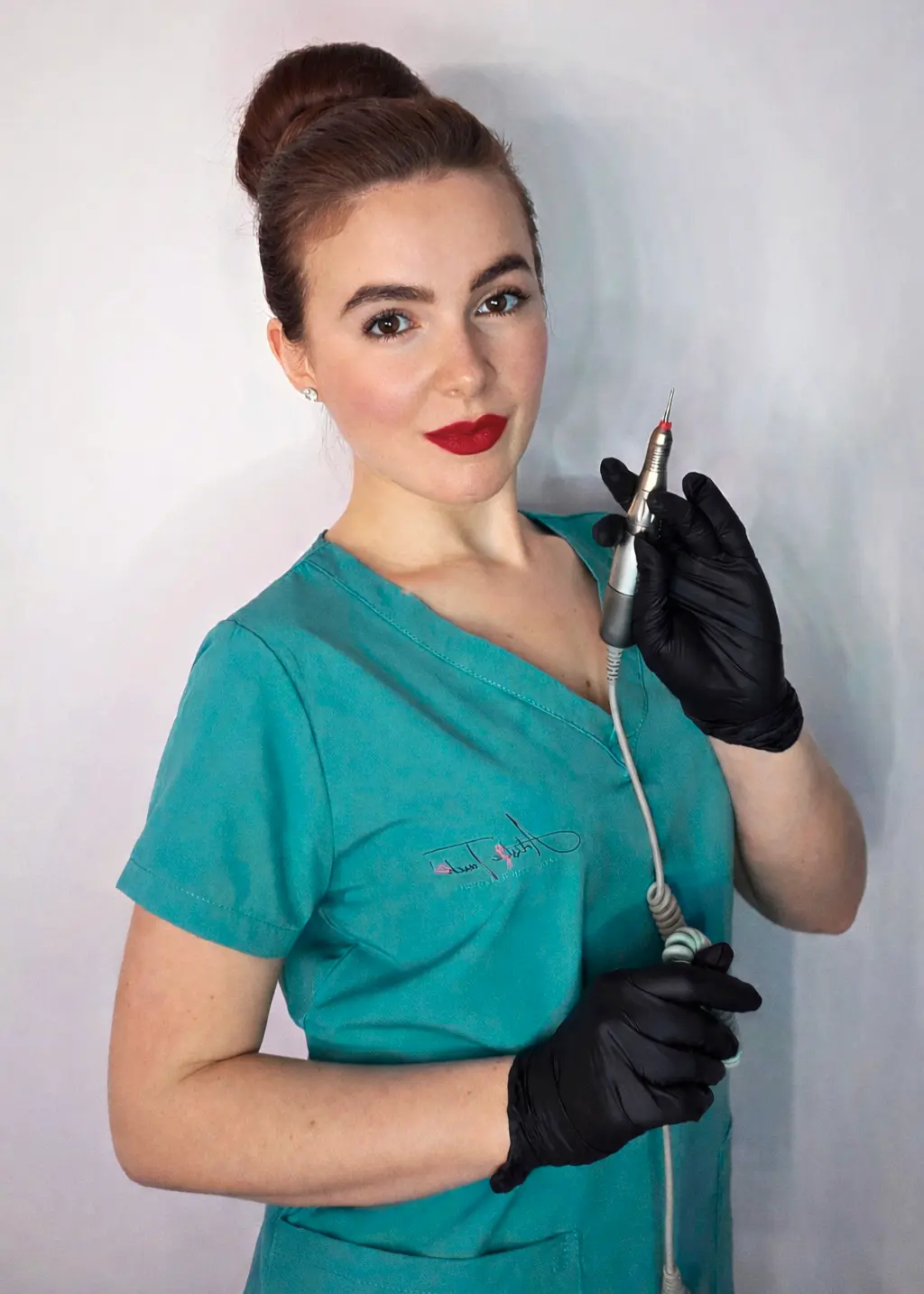
Radina Ignatova
Professional Nail Expert | International Nail Educator
I am Radina Ignatova, a Professional Nail Expert since 2014 and International Nail Educator, based in Scotland, UK. I am the Founder of Artistic Touch Nail Training Academy and TheNailWiki.
At Artistic Touch Nail Training Academy, I provide structured professional online nail courses specialising in dual forms, gel systems, polygel application, advanced nail structure, E-File work and Russian Manicure, with a strong focus on professional salon safety. I continue to work actively in salon practice, ensuring that all education reflects real client scenarios and current industry standards.
My teaching philosophy is simple: I show real salon challenges, real mistakes and real performance testing, not just perfect demonstrations. This is how you develop genuine technical competence and become a confident, capable nail professional.
Every Artistic Touch course includes lifetime access and access to a dedicated student support group, where I provide ongoing guidance and professional feedback.
Disclaimer: This content is for educational purposes only. Nail services should be performed by trained professionals following current hygiene and safety regulations. Always carry out a full client consultation and check for contraindications before performing any nail service.
About Artistic Touch Nail Training Academy
Artistic Touch Nail Training Academy delivers structured professional online nail education focused on practical skill development, professional standards and safe salon practice. All courses are available online worldwide.