Online Nail Courses UK: How to Choose the Right Nail Training in 2026
Quick Answer: What Should You Actually Look for in Online Nail Training?
Real professional nail training teaches you why techniques work structurally, how to recognise problems before they cause failures, how to adapt methods to different nail types and how to troubleshoot when results do not match expectations. Most online nail courses only teach you to copy steps from perfect demonstrations—which is why your technique still struggles with real client nails.
This guide explains what separates understanding-based education from copying-based content.
Why You Can Watch Hundreds of Tutorials and Still Not Understand Your Own Mistakes
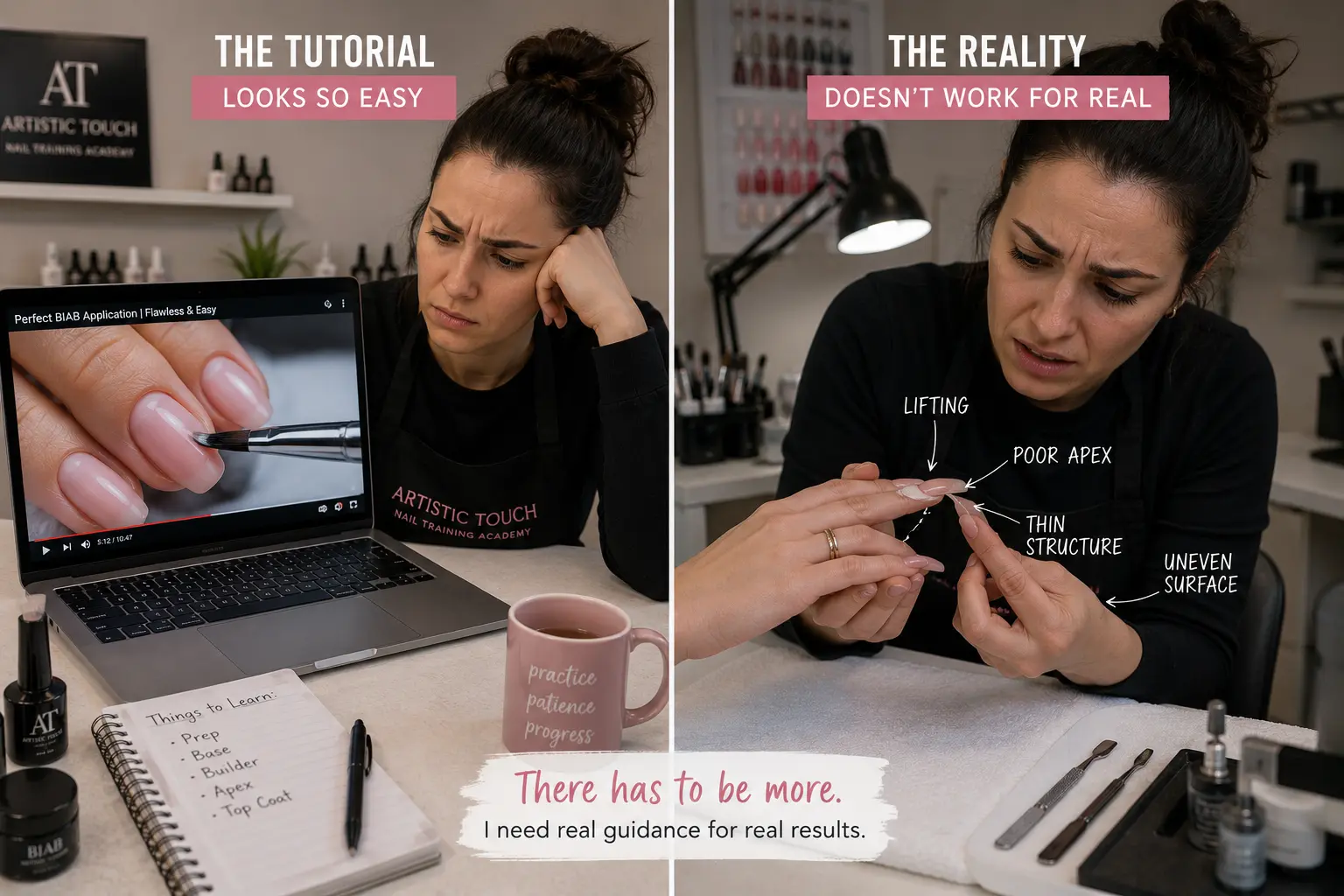
You have watched countless online nail courses. YouTube demonstrations, Instagram reels, paid tutorial platforms. You can describe perfect BIAB application steps. You know what correct apex placement should look like. You have seen Russian Manicure demonstrated dozens of times. Your technique still produces inconsistent results. Client nails lift. Structure fails. Finished work looks acceptable in photos but does not last two weeks.
The problem is not that you need more tutorials. The problem is that watching perfect demonstrations teaches you to copy movements without understanding the structural reasons those movements work. When your client’s nail geometry differs from the demonstration model, when your product behaves slightly differently, when environmental conditions change—you have no diagnostic framework for adapting because you learned replication, not reasoning.
This is the gap between most online nail training and the kind of professional understanding that actually creates consistent salon results.
What Copying Without Understanding Looks Like
You watch a BIAB online course. The demonstration shows product placed at specific points, cured at specific timing, filed to specific shape. You replicate these exact steps on practice nails. Results look acceptable. You attempt the same procedure on a client with flat nail plates and the enhancement lifts within days. The tutorial did not explain why product placement changes based on natural nail architecture. It showed you what to do on one ideal nail type, not how to think about structure.
This pattern repeats across techniques. Russian Manicure demonstrations show perfect cuticle work on cooperative proximal nail folds. Your client has tight, sensitive eponychium. The tutorial did not teach you how to assess tissue behaviour or adapt technique to individual anatomy. Dual form courses show flawless application producing perfect C-curves. Your client has hooked nails. The course never explained how nail growth direction affects form selection or why arch matching matters structurally.
You learned procedures. You did not learn diagnosis. This is why your confidence disappears the moment conditions deviate from tutorial ideals.
Why Perfect Demonstrations Create False Understanding
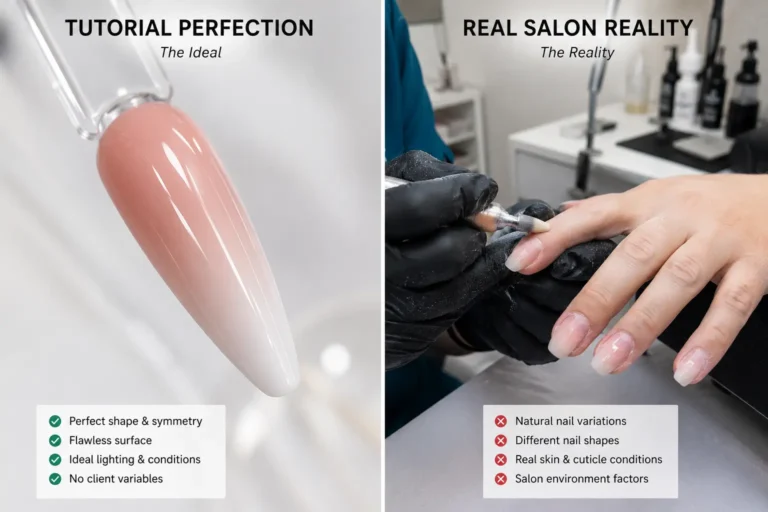
Social media nail content shows polished final results. Mistakes are edited out. Corrections are not shown. Problem-solving is invisible. You see beautiful nails and assume the technique is straightforward. You attempt replication and encounter problems the demonstration never addressed because the demonstration never encountered them—or edited them out.
This creates a painful gap between what online nail training appears to teach and what you actually need to know for salon work. The tutorial made it look simple because you only saw successful execution. You did not see the structural thinking that prevented problems, the mid-application adjustments that corrected deviations or the diagnostic decisions that adapted technique to that specific nail.
Real professional education has to show you mistakes alongside corrections. It has to explain why problems happen, not just demonstrate when they do not happen. Otherwise you are learning performance, not understanding.
The Questions Most Nail Courses Never Answer
Why does this specific apex placement work on this nail geometry? What happens structurally when product extends too far toward the lateral nail fold? How do you recognise when preparation is adequate versus when it only appears adequate? What actually causes lifting at the proximal zone versus lifting at sidewalls versus lifting at the free edge—and why do these different lifting patterns require different corrections?
Most nail technician courses online do not address these questions because they focus on showing you perfect execution, not teaching you diagnostic thinking. You learn that apex should be placed “here” but not why that placement distributes stress correctly or what happens when nail growth direction changes where “here” should be.
This is why you can complete multiple courses and still panic when a client presents with nail characteristics that do not match tutorial examples. You were never taught to analyse. You were taught to copy.
What Structural Understanding Actually Means
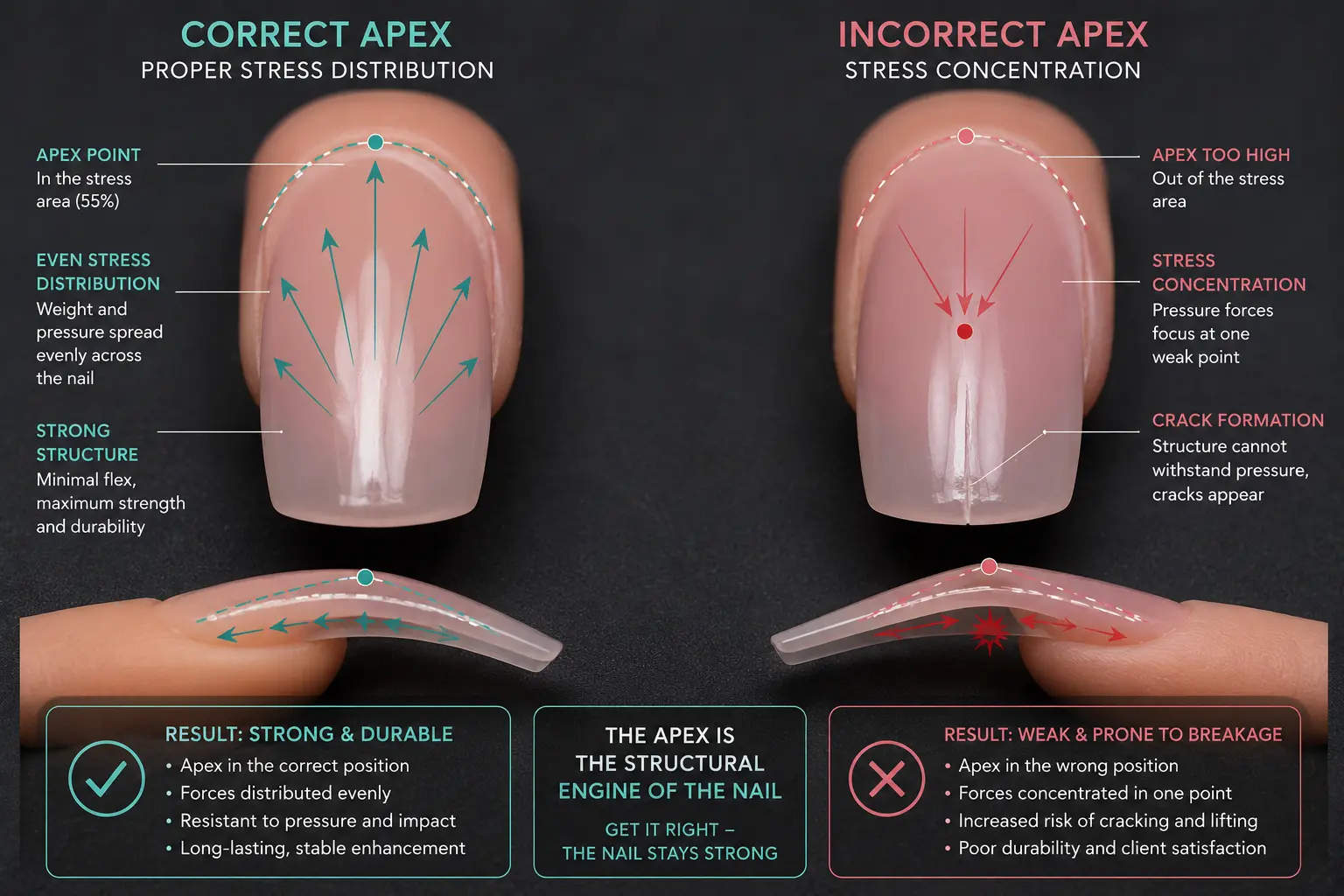
Understanding nail structure means recognising that apex placement is not an aesthetic choice—it is engineering. The apex position determines how stress distributes through the enhancement during normal use. Incorrect apex placement creates stress concentration points that cause premature structural failure regardless of how perfectly you executed product application.
When you understand structure, you recognise that flat nail plates require different dual form architecture than curved nail plates because the form’s built-in arch must match natural nail geometry. When you only copy technique, you select forms by desired shape and wonder why results are inconsistent.
Structural thinking changes how you approach every technical decision. Product selection becomes about matching flexibility characteristics to nail stress patterns, not just choosing brands. Preparation becomes about creating specific surface energy conditions for molecular adhesion, not just following dehydrator-primer-base coat steps. This depth of understanding is what separates professionals who troubleshoot instinctively from technicians who repeat steps hoping for different results.
Why Retention Problems Are Almost Never Product Problems
Most nail techs blame lifting on products first. “This BIAB does not work.” “This base coat is rubbish.” Meanwhile the actual causes are: incomplete preparation leaving microscopic contamination, product touching living skin creating a lifting pathway, incorrect apex placement creating stress concentration, over-filing weakening the nail plate, incompatible product flexibility for that client’s nail movement or application technique creating shrinkage tension.
Learn nails online platforms sell you technique replication. Real professional understanding teaches you to diagnose why failures happen. When you understand that retention depends on preparation thoroughness, structural engineering, anatomical respect, product chemistry and application precision—not just brand selection—you stop wasting money switching products and start fixing actual technical gaps.
This diagnostic ability is what you should be evaluating when choosing online nail courses. Does the training teach you to recognise these failure causes? Does it show you what inadequate preparation looks like, not just adequate preparation? Does it explain the mechanical reasons why specific errors cause specific failure patterns?
The Difference Between Beginner and Advanced Thinking
Beginner nail techs focus on making nails look good in photos. Advanced nail techs focus on making nails perform well for two to three weeks of normal use. This is not about skill level. It is about what you were taught to prioritise.
If your online nail training emphasised Instagram aesthetics, trend techniques and polished demonstrations, you learned beginner priorities regardless of how many courses you completed. If your training emphasised structural integrity, growth behaviour, stress distribution and long-term performance, you learned advanced thinking even if you are still developing application precision.
Advanced nail techs think about: Will this apex position handle the client’s typing force? Will this product flexibility accommodate their natural nail movement? Will this sidewall coverage support the stress pattern their nail geometry creates? Does this free edge thickness balance strength against brittleness for their lifestyle? Beginner thinking never reaches these questions because it stops at: Does this look good right now?
What Real Salon Work Teaches You That Courses Often Do Not
Working on real paying clients forces you to confront problems that tutorial models never present. Nail plate damage from previous technician errors. Severe natural nail curvature variations between fingers. Clients with health conditions affecting nail growth. Lifestyle factors creating unusual stress patterns. Budget constraints limiting product or time options. Unrealistic expectations requiring difficult conversations.
Professional nail training online should prepare you for these realities, not just show you ideal conditions. This means teaching contraindication recognition, damage assessment, client communication, expectation management and adaptation techniques for non-ideal situations. Most courses skip this because it is not photogenic content. But this is precisely what creates professional confidence versus tutorial confidence.
When evaluating nail courses UK options, ask whether the educator maintains active salon practice. Current client work ensures instruction reflects real professional challenges, not just demonstration filming under controlled conditions.
Why Some Nail Techs Improve Faster
Faster-improving nail techs share specific habits. They analyse their own failures deeply instead of blaming products or client behaviour. They seek feedback even when uncomfortable. They study structural principles, not just application steps. They practise with intention, focusing on specific technical gaps rather than hoping general repetition improves everything. They review their own work critically against objective standards, not just subjective satisfaction.
Slower progress usually indicates: blind copying without analysis, avoiding correction feedback, constantly switching techniques before mastering fundamentals, chasing trends without understanding basics or focusing only on aesthetic replication without structural comprehension.
This has nothing to do with natural talent. It has everything to do with whether your learning approach prioritises understanding or just accumulating more tutorial exposure. Real online nail educator instruction should teach you how to analyse your own work, how to recognise systematic errors and how to implement targeted corrections—not just demonstrate more perfect examples.
What Creates Actual Professional Confidence
Confidence does not come from certificates. It comes from understanding problems well enough that you can troubleshoot them when they occur. When you know why lifting happens mechanically, you do not panic when a client shows early separation—you diagnose the cause and explain the correction. When you understand structural engineering principles, difficult nail geometries become interesting challenges rather than anxiety triggers.
Many nail techs look confident in social media content but feel anxious during real appointments because their education taught performance, not problem-solving. They can execute procedures when conditions match tutorials. They cannot diagnose deviations or adapt when reality differs from demonstrations.
Professional nail training should build diagnostic confidence—the kind that handles unexpected problems calmly because you understand the underlying mechanics well enough to reason through solutions even for situations you have not encountered before.
The Hidden Skill Most Courses Never Teach
Decision-making. Not application technique—decision-making. Which product system suits this nail type? Should I proceed with this service given this contraindication concern? How do I adapt this technique for this unusual growth pattern? When should I refuse a service because risk exceeds my capability? How do I communicate limitations without losing the client?
These decisions determine professional success more than application precision. But most nail technician courses online teach steps, not judgment. They show you what to do but not how to decide whether to do it, when to modify it or when to choose an alternative approach entirely.
Real professional understanding includes knowing when not to do something. Recognising when a client’s expectations are unrealistic. Identifying when nail condition contraindicates your intended service. Understanding when a technique you learned is inappropriate for this specific situation. This judgment comes from education that teaches reasoning, not just replication.
Why Expensive Courses Are Not Always Better
Course pricing often reflects marketing sophistication and platform technology rather than teaching quality. Expensive professional nail training online can still just teach copying if the educational approach prioritises polished demonstrations over diagnostic instruction. Affordable courses from experienced salon educators can teach deeper understanding if the focus is on showing real problems and real thinking.
Evaluate what you are actually receiving: Does the instruction show mistakes and corrections or only perfect execution? Does it explain structural reasoning or just demonstrate procedures? Does the educator work on real clients currently or only create educational content? Is the focus on helping you think professionally or just showing you what professional work looks like?
Price indicates market positioning. Teaching quality requires different evaluation criteria entirely.
What to Actually Look for When Choosing Training
Look for educators who show you their mistakes and explain what went wrong structurally. Look for instruction that demonstrates problems you encounter, not just results you want. Look for teaching that explains why techniques work mechanically, not just how to execute them. Look for courses addressing difficult nail types, complication management and troubleshooting—not just ideal demonstrations.
Ask: Does this teach me to think like a professional or just copy like a student? Does it show me what inadequate looks like so I can recognise it in my own work? Does it explain failure causes so I can diagnose them when they happen? Does it prepare me for real salon challenges or just tutorial conditions?
The best online nail training does not make nail work look easy. It makes the complexity visible, the decision-making explicit and the professional thinking accessible. It respects your intelligence enough to show you why things fail, not just demonstrate when they succeed.
Understanding Over Replication
The nail industry has abundant tutorial content teaching you to copy techniques. It has far less education teaching you to understand why those techniques work, how to diagnose when they fail and how to adapt them to the infinite variations real client nails present. This is the gap you should evaluate when choosing where to invest your professional development time and money.
Do you want to watch more perfect demonstrations? Or do you want to develop the diagnostic thinking that creates consistent professional results regardless of which specific client sits in your chair?
Nail Training That Teaches Professional Thinking
Artistic Touch courses show you real salon problems, real mistakes and real structural thinking—not just polished demonstrations. Learn to diagnose issues, understand why techniques work and develop professional judgment alongside application skills.
View All Courses →Lifetime access • Private student community • Start immediately
Frequently Asked Questions
Why do my nails still fail even after taking multiple online nail courses?
Most courses teach you to copy perfect demonstrations without teaching you to diagnose why techniques work structurally. When your client’s nail geometry differs from tutorial examples or when conditions vary, you have no framework for adapting because you learned steps, not reasoning. Real improvement requires understanding failure causes, recognising problems early and developing diagnostic thinking—not just watching more demonstrations.
How do I know if an online nail course will actually improve my technique?
Look for courses that show mistakes and corrections alongside perfect execution, explain structural reasons why techniques work, demonstrate troubleshooting for problems you actually encounter and come from educators maintaining current salon practice. Avoid courses that only show polished demonstrations without explaining why problems happen or how to diagnose failures when they occur.
Are expensive nail courses worth the investment?
Price often reflects marketing and platform technology rather than teaching quality. An expensive course teaching only perfect demonstrations provides less value than an affordable course from an experienced educator teaching diagnostic thinking and showing real problems. Evaluate what teaching approach you receive, not what the platform looks like or what marketing claims.
Can I learn Russian Manicure or BIAB effectively through online courses?
Yes, when courses teach you to understand tissue behaviour, recognise contraindications, diagnose problems and adapt technique to individual anatomy—not just replicate perfect demonstrations. Russian Manicure online courses should show you what problematic eponychium looks like and how to modify technique for safety. BIAB online courses should explain structural engineering and how to adapt for different nail geometries.
Why do my enhancements look good but lift within days?
This usually indicates structural or preparation problems that photographs cannot reveal. Common causes include: preparation that appears adequate but leaves microscopic contamination, apex placement creating stress concentration points, product touching skin creating lifting pathways or application technique creating shrinkage tension. Learn to diagnose these hidden causes rather than assuming product failure.
What makes Artistic Touch different from other nail training?
Artistic Touch shows real salon problems, real mistakes and real correction logic—not just polished demonstrations. Teaching focuses on why techniques work structurally, how to recognise problems before they cause failures and how to develop professional diagnostic thinking. All instruction comes from an educator maintaining active salon practice since 2014, ensuring content reflects current professional challenges.
About the Author

Radina Ignatova
Professional Nail Expert | International Nail Educator
I am Radina Ignatova, a Professional Nail Expert since 2014 and International Nail Educator, based in Scotland, UK. I am the Founder of Artistic Touch Nail Training Academy and TheNailWiki.
At Artistic Touch Nail Training Academy, I provide structured professional online nail courses specialising in dual forms, gel systems, polygel application, advanced nail structure, E-File work and Russian Manicure, with a strong focus on professional salon safety. I continue to work actively in salon practice, ensuring that all education reflects real client scenarios and current industry standards.
My teaching philosophy is simple: I show real salon challenges, real mistakes and real performance testing, not just perfect demonstrations. This is how you develop genuine technical competence and become a confident, capable nail professional.
Every Artistic Touch course includes lifetime access and access to a dedicated student support group, where I provide ongoing guidance and professional feedback.
Disclaimer: This content is for educational purposes only. Nail services should be performed by trained professionals following current hygiene and safety regulations. Always carry out a full client consultation and check for contraindications before performing any nail service.
About Artistic Touch Nail Training Academy
Artistic Touch Nail Training Academy delivers structured professional online nail education focused on practical skill development, professional standards and safe salon practice. All courses are available online worldwide.