Why Some Nail Techs Improve Faster Than Others
Quick Answer: What Makes Some Nail Techs Improve Faster?
Faster-improving nail techs analyse their failures with specific technical diagnosis, seek external feedback even when uncomfortable, study structural principles beyond application steps, practice with clear improvement targets and focus on mastering fundamentals before chasing trends. Slower progress usually indicates avoiding correction, constantly switching techniques before mastering any, blaming external factors or hoping general repetition will somehow improve everything.
This article explains the specific habits separating rapid improvement from plateau.
When Talent Is Not the Variable
Two nail techs take the same course. Six months later, one produces consistently professional results across all nail types while the other still struggles with unpredictable outcomes. The slower-progressing tech assumes the faster one has natural talent. The actual difference is how they approached learning between course completion and now.
The faster-improving tech analyses every failure with specific technical diagnosis, seeks feedback from more experienced professionals, studies structural principles explaining why techniques work, practices with deliberate focus on identified weaknesses and reviews their own work against objective standards before client sees it.
The slower tech blames product quality when sets fail, avoids showing work to others who might criticise, watches more tutorials hoping exposure will somehow improve results, practices randomly without targeting specific gaps and assumes more experience will naturally create better outcomes.
This is not about innate ability. It is about learning approach and willingness to confront uncomfortable truths about current performance.
The Deep Failure Analysis Habit
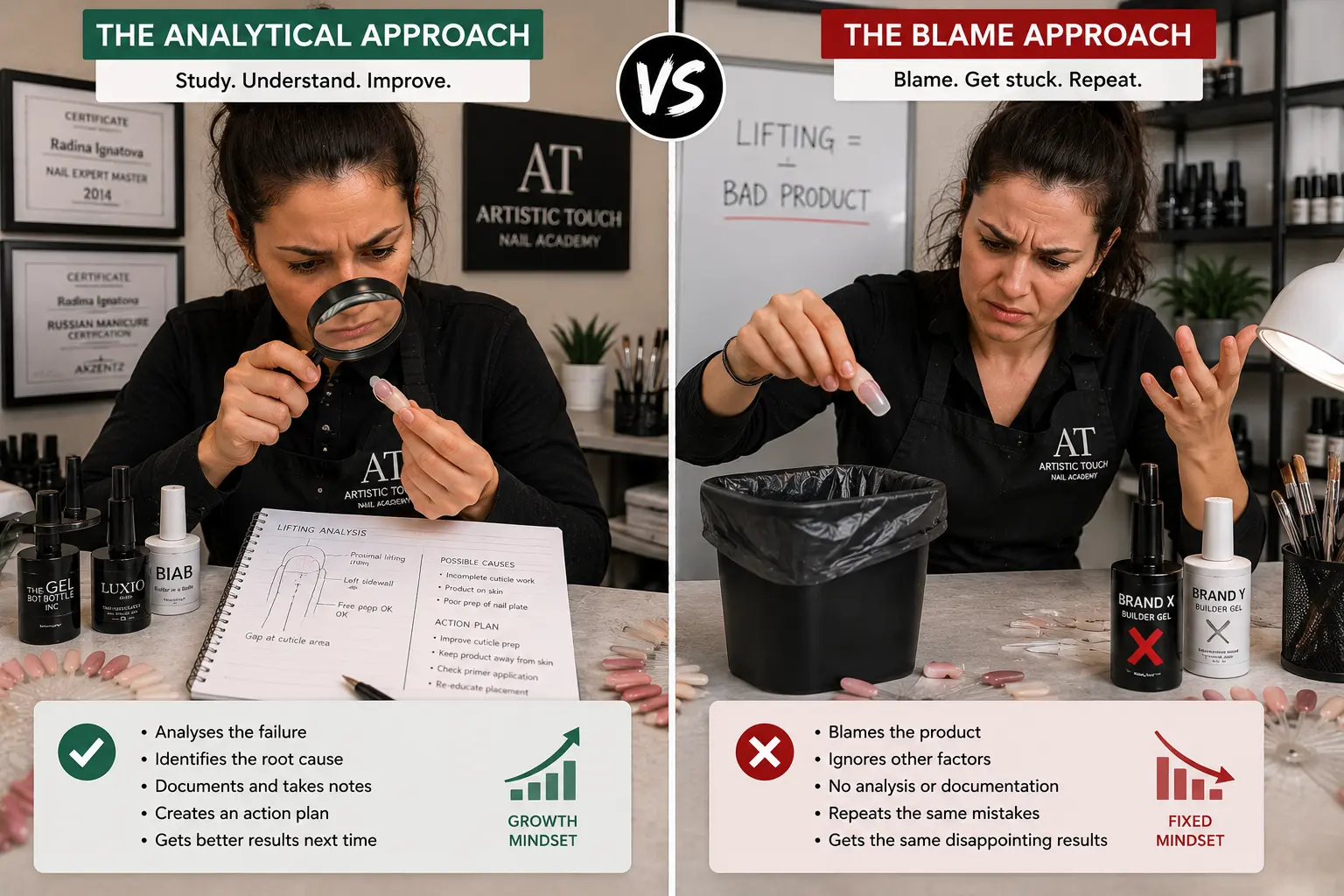
When enhancements lift, faster-improving techs ask: Which specific nails lifted? What do those nails have in common? Did lifting begin at proximal zone, sidewalls or stress point? What does that pattern indicate about preparation, structure or technique? What objective evidence suggests my assessment of adequate preparation was wrong? How do I verify next time before assuming adequacy?
Slower-progressing techs think: “This set failed. Maybe the BIAB is bad. I will try a different brand.” They identify the problem generally and respond generally. No specific diagnosis. No targeted correction. Just hope that changing one variable will somehow fix unidentified root causes.
Deep analysis requires brutal honesty about your own execution. This is uncomfortable. Many nail techs avoid discomfort by externalising blame to products, clients or luck. But external blame prevents learning because you cannot fix problems you refuse to acknowledge as yours.
Faster improvement requires accepting: My preparation may look adequate to me but clearly was not. My apex placement appears correct but structural failure indicates otherwise. My self-assessment has gaps. These gaps are my responsibility to identify and fix.
Seeking Feedback Versus Avoiding Critique
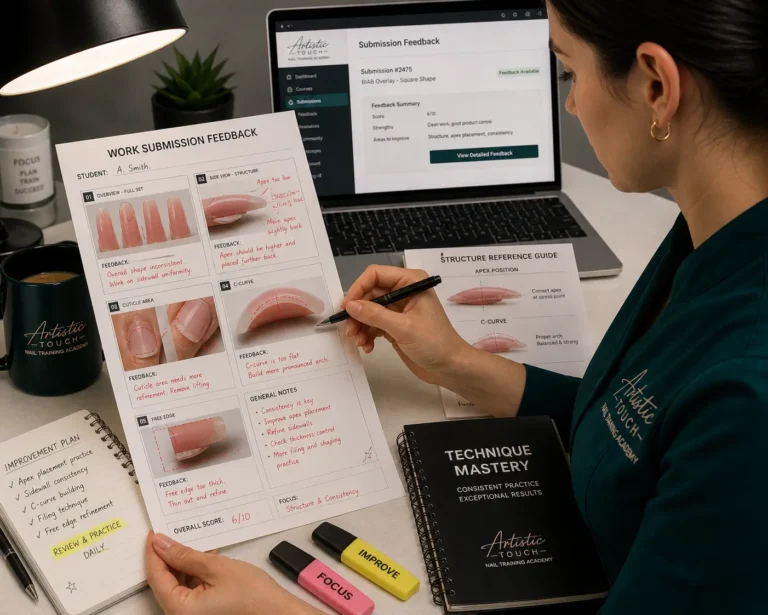
Faster-improving nail techs actively seek external assessment even when they fear criticism. They submit work to educators, ask experienced professionals for honest evaluation, participate in peer review knowing weaknesses will be exposed and specifically request identification of their blind spots rather than just praise.
This is psychologically difficult. Showing your work to someone who will identify errors triggers defensive reactions. But external assessment reveals systematic problems you cannot self-diagnose. Your preparation looks adequate to you. An experienced eye recognises microscopic inadequacies you miss. You cannot improve problems you cannot see.
Slower-progressing techs avoid feedback. They share only successful work on social media, become defensive when problems are mentioned, interpret constructive criticism as personal attack or surround themselves with peers at similar skill levels who will not challenge current execution.
This protective behaviour feels emotionally safe. It prevents improvement because you never hear the uncomfortable truths about technical gaps creating your inconsistent results.
Studying Principles Not Just Procedures
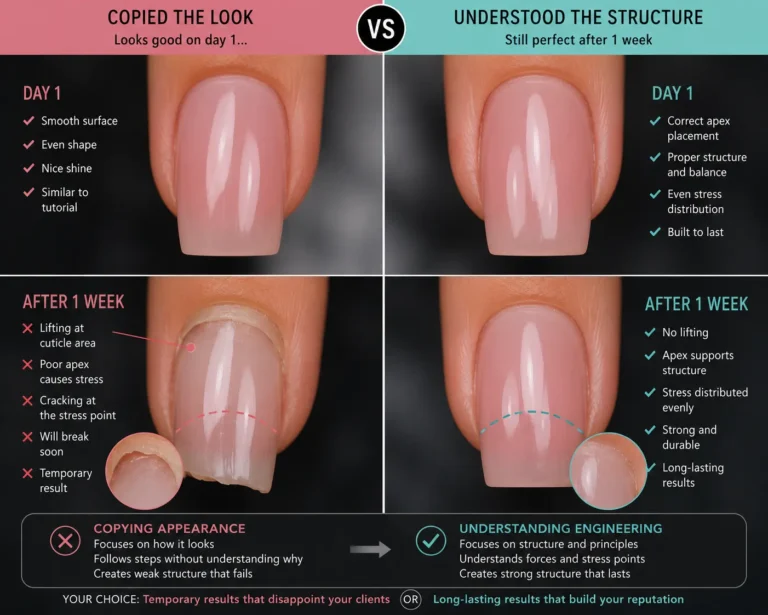
When faster-improving techs learn new techniques, they study: Why does this apex position work for this nail geometry? What mechanical principles determine product placement? How does C-curve affect structural requirements? What happens if I change this variable? Why does this specific error create this specific failure?
They learn reasoning, not just steps. This allows adaptation when conditions vary because they understand underlying mechanics determining success. One technique mastered deeply through principled understanding develops transferable knowledge applying to related situations.
Slower-progressing techs collect procedures. They learn: Place product here, cure for this time, file at this angle. They accumulate steps without understanding why each matters. When conditions deviate from tutorials, they have no framework for adaptation because they memorised actions without comprehending principles.
This creates apparent diversity—they know many techniques—without actual capability because none are understood deeply enough to modify for individual requirements.
Deliberate Practice Versus Hopeful Repetition
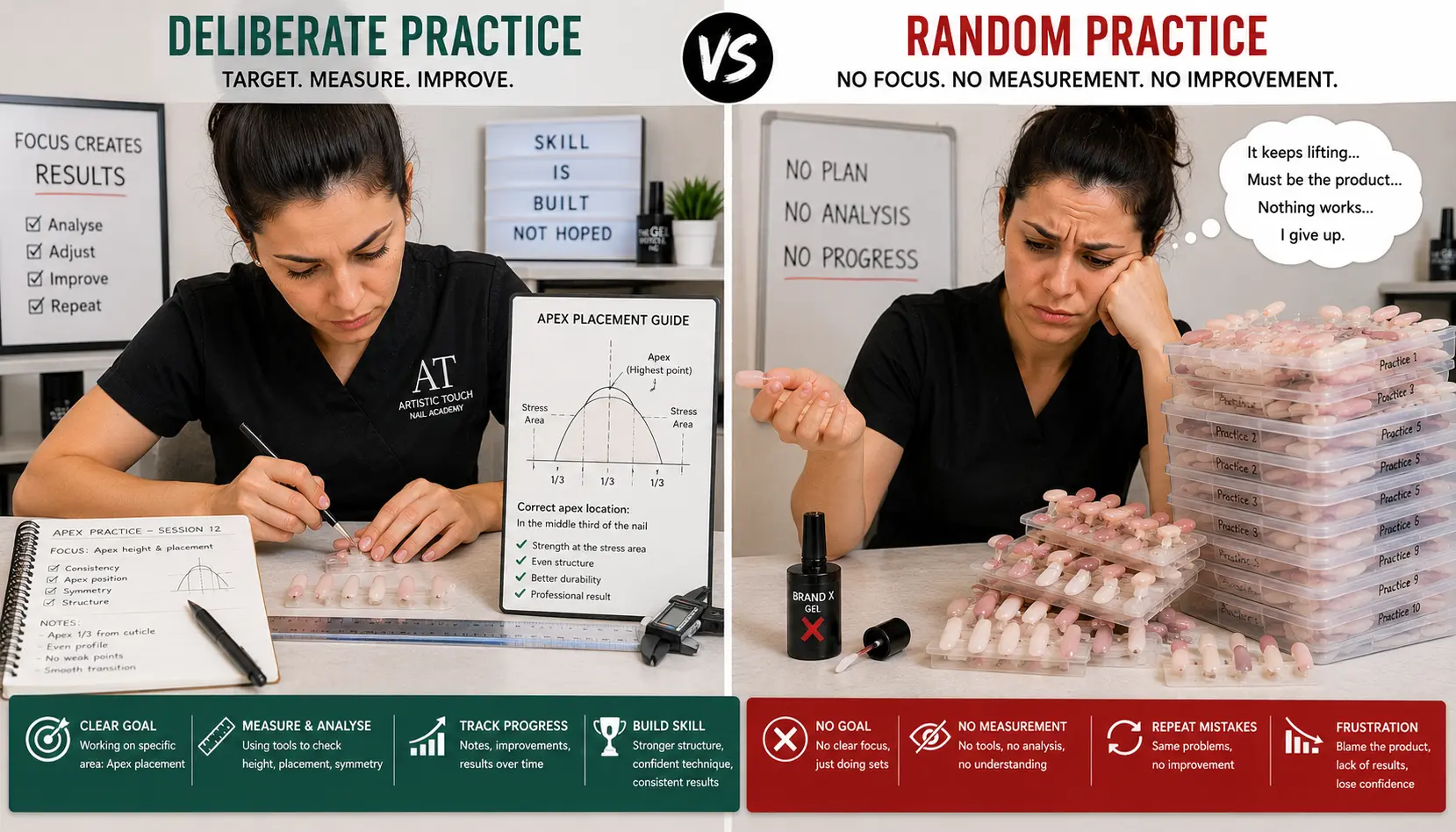
Faster-improving techs practice with specific targets. Today I am improving preparation thoroughness. I will practise preparation five times, photograph each result and assess against objective standards before proceeding to product application. Tomorrow I will practise apex placement consistency. I will execute ten applications focusing only on apex precision and measure deviation from target placement.
This is deliberate practice: isolating specific skills, practising with focused attention, measuring against standards and correcting immediately based on objective feedback. Each practice session targets identified weaknesses systematically.
Slower-progressing techs practice complete procedures repeatedly hoping general exposure will somehow improve everything. They complete full applications without targeted focus, evaluate results subjectively based on whether they look okay and assume repetition volume will create improvement without specific attention to systematic errors.
This diffuse practice reinforces existing patterns—including errors—rather than correcting specific technical gaps. Years of unfocused practice can produce minimal improvement because the same mistakes get repeated thousands of times.
Fundamentals Mastery Before Trend Chasing
Faster-improving techs ensure preparation competence, structural understanding and basic application precision before attempting advanced techniques. They recognise that fancy methods built on inadequate foundations fail unpredictably. Master basics. Add complexity only after fundamentals are solid.
Slower-progressing techs jump between trending techniques constantly. They see Instagram posts showing new products or methods and immediately attempt replication without mastering prerequisites. They collect surface familiarity with many techniques while lacking depth in any.
This creates perpetual beginner status. They always feel slightly capable at everything but never reliably competent at anything because they never invested sustained focus needed for mastery before chasing the next trend.
Mastery requires uncomfortable period of depth over breadth. You practise the same fundamental skill repeatedly beyond the point where it feels productive. But this is precisely where breakthrough happens—after surface competence, through the frustration zone, into automatic execution that frees mental resources for higher-level thinking.
External Standards Versus Subjective Satisfaction
Faster-improving techs evaluate work against objective professional standards. They measure apex position, assess C-curve consistency, verify preparation thoroughness through specific checks and compare finished work to clearly defined benchmarks rather than asking themselves if they feel satisfied.
This objective assessment reveals discrepancies between what they think they executed and what actually occurred. Their subjective impression says preparation is adequate. Objective checks find contamination. This gap is where improvement happens.
Slower-progressing techs assess work subjectively. Does this look okay to me? Do I feel good about it? Would a client probably accept it? These vague evaluations allow systematic errors to persist because there is no external reference revealing the gap between subjective satisfaction and professional standard.
Without objective standards, you cannot accurately identify what needs improvement. You practice what you think you did, not what you actually did. This explains why some techs can work for years without meaningful improvement—they never accurately diagnosed their actual performance level.
The Product-Switching Trap
When results disappoint, slower-progressing techs immediately change products hoping new formulations will solve their problems. They spend money constantly trying different brands, systems and tools. Nothing produces consistent improvement because product was not the variable causing failures.
Faster-improving techs investigate systematically: Is this retention problem product-related or technique-related? What evidence would distinguish between them? Do failures show consistent patterns suggesting technique or random distribution suggesting product batch? They change products only when diagnosis identifies product as the actual cause.
Product-switching feels productive because you are taking action. But it prevents improvement when technique inadequacies—not formulation—cause problems. You can spend thousands on products while your systematic preparation gaps remain unaddressed and failures continue.
Critical Self-Review Before Client Exposure
Faster-improving techs review their own work critically before clients see finished results. During this assessment they identify and correct: Minor structural imperfections, surface finish inadequacies, symmetry inconsistencies, subtle preparation gaps or small errors accumulating into professional-appearing but technically flawed work.
This self-correction habit develops higher internal standards over time. You stop accepting work from yourself that appears “good enough” and demand work meeting objective professional benchmarks.
Slower-progressing techs show clients work they feel satisfied with based on subjective assessment. Client acceptance reinforces their current standards rather than pushing them higher. They mistake client satisfaction—often based on limited technical knowledge—for professional quality.
This creates comfortable plateau where you reliably produce work clients accept without developing the precision actual professional standards require.
The Patience for Sustainable Growth
Faster-improving techs understand skill development requires sustained focus over months. They commit to mastering fundamentals even when it feels boring, continue practising basics even after achieving minimum competence and resist trend-chasing until current techniques are reliably excellent.
Slower-progressing techs want immediate transformation. They expect rapid results, become frustrated when improvement requires sustained effort and abandon techniques before mastery when progress feels slow. This creates perpetual dissatisfaction as they chase quick fixes that never produce sustainable development.
Professional competence builds gradually through accumulation of deliberately practised fundamentals. There are no shortcuts. The faster-appearing improvement of focused practitioners comes from efficient practice, not from avoiding the work.
Learning Approach Not Natural Talent
The difference between rapid improvement and plateau is not innate ability. It is whether you analyse failures honestly, seek uncomfortable feedback, study structural principles, practise deliberately, master fundamentals before chasing trends and evaluate against objective standards rather than subjective satisfaction.
These are choices about learning approach, not gifts some possess and others lack. If your improvement has stalled, examine your habits. The answer is not more courses, products or time. It is changing how you approach learning itself.
Accelerate Development Through Structured Learning
Artistic Touch courses teach you to analyse failures systematically, develop objective self-assessment and understand structural principles that enable rapid improvement—not just demonstrate procedures you will struggle to replicate.
View All Courses →Lifetime access • Private student community • Start immediately
Frequently Asked Questions
Is fast improvement about natural talent or learning approach?
Learning approach. Faster-improving techs analyse failures deeply, seek uncomfortable feedback, study structural principles, practise deliberately and evaluate against objective standards. Slower progress indicates avoiding critique, changing products randomly, hoping repetition will improve everything or staying comfortable with current standards. These are choices about how you learn, not innate capabilities you either possess or lack.
Why does my technique not improve despite constant practice?
Unfocused practice reinforces existing patterns including systematic errors. You need deliberate practice targeting specific identified weaknesses with objective measurement against professional standards. Repeating complete procedures hoping general exposure will improve everything produces minimal development because you never isolate and correct the specific technical gaps causing inconsistent results.
Should I ask others for feedback on my work?
Yes, especially from more experienced professionals whose assessment will identify systematic problems you cannot self-diagnose. External feedback reveals the gap between what you think you executed and what actually occurred. This is uncomfortable but essential. Your self-assessment has blind spots. Outside perspective exposes them so you can address technical gaps preventing improvement.
How do I analyse failures to improve faster?
Identify specific technical problems with precise diagnosis. Not “this set failed” but “proximal lifting on three nails suggests my preparation left microscopic contamination I assessed as adequate.” Specific diagnosis enables targeted correction. General blame prevents learning because you cannot fix problems you do not accurately identify. Honest technical assessment is uncomfortable but essential.
Why should I master basics before trying advanced techniques?
Advanced techniques built on inadequate fundamentals fail unpredictably. You cannot reliably execute complex work when basic skills are inconsistent. Mastery requires sustained depth focus creating automatic execution that frees mental resources for higher-level complexity. Jumping between trending techniques before mastering any creates surface familiarity without actual competence.
How long does real improvement take?
Sustainable skill development requires months of deliberate focused practice. Faster-improving techs appear to progress rapidly because their efficient learning approach accelerates development, not because they avoid the work. There are no shortcuts to professional competence. The time investment is required. The question is whether you invest it efficiently through systematic practice or waste it through unfocused repetition.
About the Author
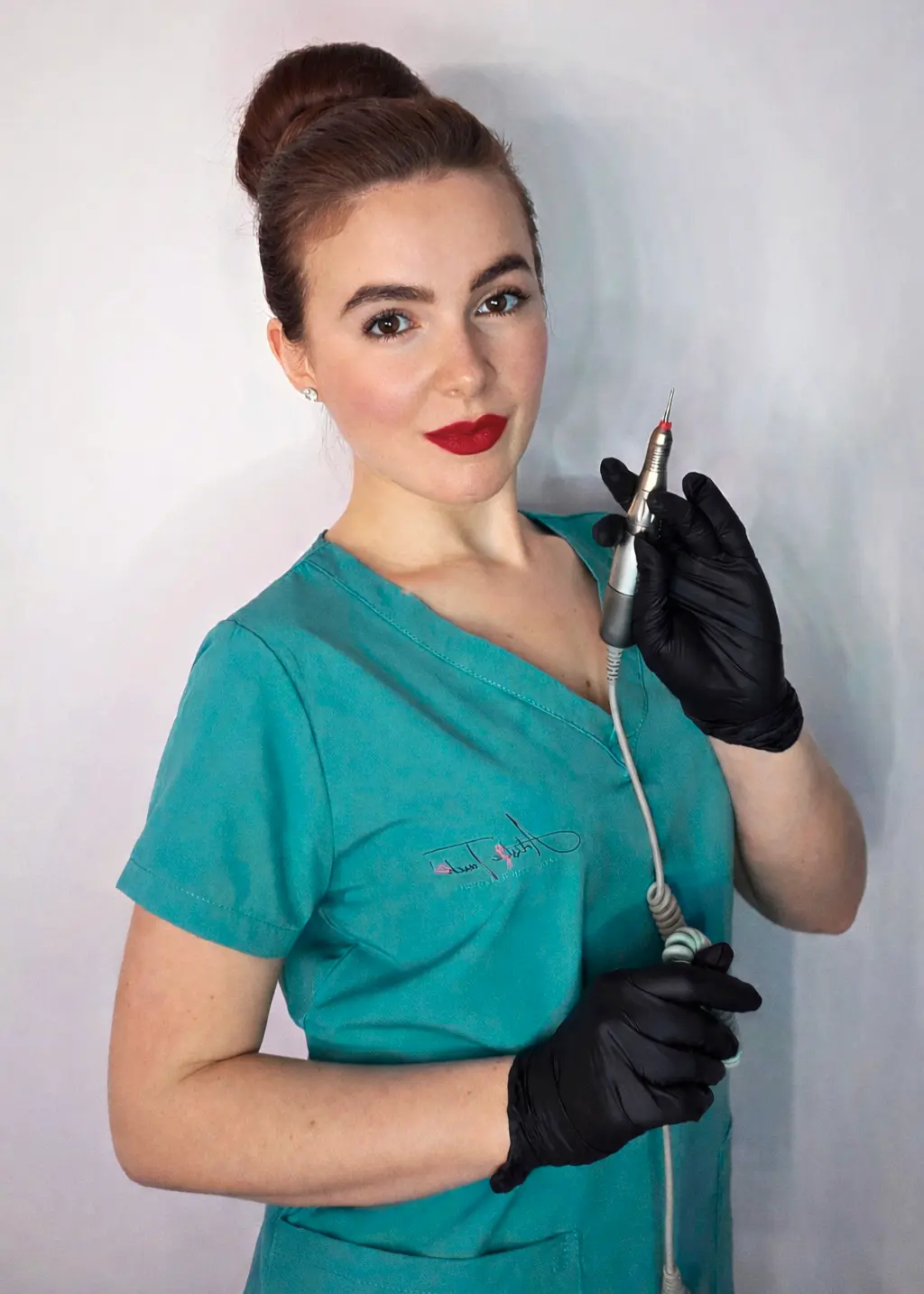
Radina Ignatova
Professional Nail Expert | International Nail Educator
I am Radina Ignatova, a Professional Nail Expert since 2014 and International Nail Educator, based in Scotland, UK. I am the Founder of Artistic Touch Nail Training Academy and TheNailWiki.
At Artistic Touch Nail Training Academy, I provide structured professional online nail courses specialising in dual forms, gel systems, polygel application, advanced nail structure, E-File work and Russian Manicure, with a strong focus on professional salon safety. I continue to work actively in salon practice, ensuring that all education reflects real client scenarios and current industry standards.
My teaching philosophy is simple: I show real salon challenges, real mistakes and real performance testing, not just perfect demonstrations. This is how you develop genuine technical competence and become a confident, capable nail professional.
Every Artistic Touch course includes lifetime access and access to a dedicated student support group, where I provide ongoing guidance and professional feedback.
Disclaimer: This content is for educational purposes only. Nail services should be performed by trained professionals following current hygiene and safety regulations. Always carry out a full client consultation and check for contraindications before performing any nail service.
About Artistic Touch Nail Training Academy
Artistic Touch Nail Training Academy delivers structured professional online nail education focused on practical skill development, professional standards and safe salon practice. All courses are available online worldwide.