Why Your Dual Forms Keep Leaking (And How to Fix It)
By Radina Ignatova | Last Updated: 2 April 2026 | Nail Techniques
Why Do Dual Forms Leak?
Dual forms leak when gel overflows from edges during application, typically caused by excessive product amount, incorrect form fit, improper pressure technique, or gel consistency issues.
Professional techniques to prevent leaking include controlled product placement, proper form selection, graduated pressure application, and using sandwich dual form systems that contain gel between two moulds rather than relying on single-sided containment.
You have measured perfectly, filed the form, applied the gel… and it is everywhere except where it should be. Gel seeps from the sidewalls, pools under the cuticle area, creates lumpy build-up on the nail plate, and leaves you with excessive cleanup and filing work after curing.
Traditional dual form leaking is one of the most frustrating problems nail technicians face, especially when you cannot identify why it keeps happening. The issue rarely comes from just one factor — it is usually a combination of product amount, form fit, application technique, and gel behaviour working against you.
This article explains the five most common reasons traditional dual forms leak, how to diagnose which problem you are experiencing, and why sandwich dual forms solve these overflow issues through their containment system.
Reason 1: Incorrect Product Amount (Too Much OR Too Little)
Product amount errors go both ways. Too much gel overflows from edges. Too little gel creates weak structure, gaps in coverage, or exposes the stress point where natural nail meets extension — leading to breakage.
Too Much Gel: The Overflow Problem
When gel volume exceeds the space inside the dual form, it has nowhere to go except out through the edges — particularly at sidewalls and the free edge where pressure is applied during placement.
Too Little Gel: The Structural Problem
Using too little product creates a different problem. When forms are too small or product amount is insufficient, the point of growth (where natural nail ends and extension begins) becomes exposed or structurally weak. This creates the primary breakage point where extensions snap under pressure.
How Much Product to Use
Product amount depends on extension length:
- Short/Natural Length: 2-3 very small beads — almost like thin coating, not volume
- Medium Length: Slightly more in middle (apex area), still thin everywhere else
- Long Nails: More product overall, but concentrated in centre with less at edges
The “First Pancake” Rule
Your first dual form nail will likely have product amount errors — like the first pancake that never turns out right. This is normal. You will get it right with practice as you learn how your specific gel behaves and spreads.
The Fix
- Start with less than you think you need — you can always add more on the next nail
- Apply gel in the centre of the form, not near edges where overflow occurs first
- Watch gel spread during application — stop pressing before it reaches form edges
- Test one nail first before applying full sets to gauge correct amount for your gel
- Expect the first nail to be imperfect — use it as a learning experience
Reason 2: Incorrect Form Fit and Size Selection
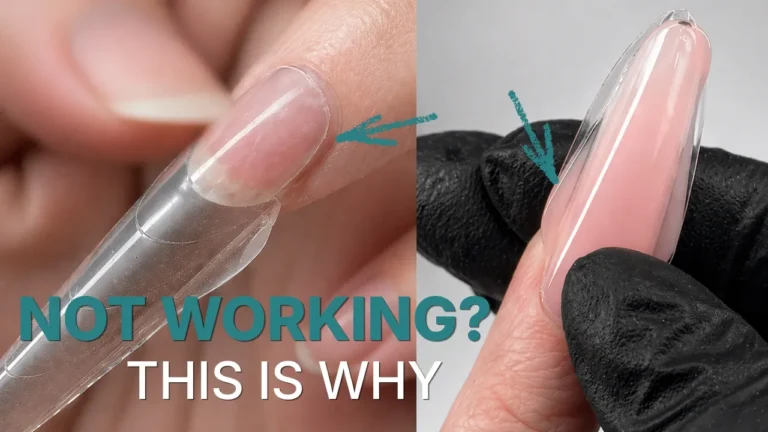
Dual forms that do not fit your natural nail properly create gaps where gel escapes during application. More critically, forms that are too small expose the point of growth — the stress point where natural nail ends and extension begins — creating structural weakness that leads to breakage.
How Form Fit Affects Leaking AND Breakage
⚠️ Critical: Point of Growth Exposure
When forms are too small, they do not cover the entire nail plate properly. This exposes the point of growth — the exact area where maximum stress occurs during normal hand use. Extensions break at this weak point, not because of poor gel quality, but because of improper form selection.
The Fix
- Test multiple sizes on each finger before applying product
- Form should cover entire nail plate without exposing the point of growth
- Form should fit snugly without gaps at sidewalls or free edge
- Match curve to natural nail bed — flat nails need flatter forms
- Check fit under natural light to see gaps clearly before application
Stop Fighting Gel Overflow
Sandwich dual forms solve the leaking problem by containing gel between top and bottom moulds rather than relying on single-sided pressure. Learn professional application techniques designed to eliminate overflow.
- ✓ Clean imprint technique with minimal filing required
- ✓ Form selection guidance for different nail bed types
- ✓ Troubleshooting methods for overflow prevention
- ✓ Lifetime access with expert guidance from Radina
Reason 3: Improper Pressure and Application Speed
How you press the dual form onto the nail directly affects gel distribution. Pressing too quickly, too hard, or unevenly forces gel to escape from edges before it can settle into the correct shape.
Common Pressure Mistakes
❌ Pressing Too Fast
Rapid pressure does not give gel time to move into correct position inside form. Gel gets pushed out sideways instead of spreading evenly.
✓ Correct Technique
Apply gentle, graduated pressure over 2-3 seconds. Watch gel spread through clear form and stop when it reaches desired position.
The Fix
- Press slowly and gradually — count to three whilst applying pressure
- Start pressure at centre, not at edges where overflow happens
- Watch gel movement through clear form and adjust pressure accordingly
- Use consistent pressure across entire form surface to distribute gel evenly
Reason 4: Gel Consistency and Product Behaviour
Different builder gels and poly gels have different viscosities. Thin, runny gels leak more easily than thick, high-viscosity products because they spread quickly under minimal pressure.
How Product Type Affects Leaking
Thin/Runny Gels: Flow easily into gaps, require less product and lighter pressure to prevent overflow. Work quickly because they self-level rapidly.
Thick/High-Viscosity Gels: Stay in place better, can handle more pressure without overflow, but may need more product to fill form completely.
⚠️ Temperature Matters
Warm gel (from warm room or warm hands) becomes thinner and flows more easily. Cold gel is thicker and harder to spread. Room temperature affects how much pressure you need and how quickly gel will leak from forms.
The Fix
- Test your gel consistency before starting full sets
- Adjust product amount based on viscosity — less for thin gels
- Work faster with runny gels to prevent excessive spreading
- Consider switching products if current gel consistently leaks despite correct technique
Reason 5: Nail Preparation Issues
Poor nail prep contributes to dual form leaking in multiple ways. Oil, moisture, or product residue on the nail plate prevents gel from adhering properly, causing it to slide sideways instead of bonding to the nail surface during application. Additionally, improper cuticle work prevents forms from sitting flush against the nail plate.
Critical Prep for Dual Forms
If you use Russian manicure or e-file manicure techniques, proper cuticle preparation is crucial for dual forms. Clean cuticle work allows forms to sit flush under the cuticle zone, creating a proper seal and preventing gaps where gel can leak. Without this, forms cannot position correctly regardless of size selection.
Why Russian Manicure Matters for Dual Forms
Proper e-file cuticle work creates the clean nail plate surface dual forms need to seal correctly. When cuticle tissue remains on the nail plate, forms cannot sit flush, creating gaps where gel escapes during application.
Learn professional Russian manicure and e-file technique in our Russian Manicure Course — designed for safe cuticle preparation and clean nail plate work.
The Fix
- Remove cuticle tissue properly from nail plate surface for flush form fit
- Cleanse nail plate thoroughly with alcohol before gel application
- Use dehydrator to remove oils and moisture if your system includes one
- Avoid touching prepped nails with fingers before applying gel
- Check for product buildup on nail plate from previous applications
Why Sandwich Dual Forms Solve the Leaking Problem
Traditional single dual forms rely on pressure to hold gel in correct position whilst you cure. This pressure often forces gel out from edges, creating the overflow problem. Sandwich dual forms use a different approach entirely.
How Sandwich Forms Prevent Overflow
Sandwich dual forms contain gel between two moulds (top form + bottom form) creating physical barriers that prevent sideways flow. Instead of relying on pressure to shape gel, the moulds themselves control gel distribution.
Traditional Dual Forms
✗ Single-sided mould
✗ Relies on pressure to contain gel
✗ Gel can escape from any edge
✗ Underside requires filing
Sandwich Dual Forms
✓ Top + bottom mould system
✓ Gel contained between moulds
✓ Physical barriers prevent overflow
✓ Clean underside imprint
Frequently Asked Questions About Dual Form Leaking
Why does gel leak from my dual forms even with small amounts?
Even small gel amounts can leak if form fit is incorrect or pressure is applied too quickly. Check that your form size matches your natural nail width and curve, and apply pressure gradually over 2-3 seconds whilst watching gel spread.
Can I use less gel to prevent leaking?
Yes, but using too little gel can create weak structure or gaps in the extension. Start with a small bead, watch how it spreads during application, and adjust amount based on results. Correct amount fills the form without reaching edges.
Do sandwich dual forms completely prevent gel overflow?
Sandwich dual forms significantly reduce overflow because gel is contained between top and bottom moulds. However, excessive product or improper technique can still cause leaking. Proper application with correct gel amount designed to achieve clean results requires following manufacturer guidance.
How do I clean up gel overflow after it happens?
If gel overflows during application, remove excess with clean brush dipped in alcohol before curing. After curing, use file to remove hardened overflow from sidewalls and underside. Prevention through correct technique reduces cleanup time significantly.
Radina Ignatova
Professional Nail Expert | International Nail Educator

I am Radina Ignatova, a Professional Nail Expert since 2014 and International Nail Educator, based in Scotland, UK. I am the Founder of Artistic Touch Nail Training Academy and TheNailWiki.
At Artistic Touch Nail Training Academy, I provide structured professional online nail courses specialising in dual forms, gel systems, polygel application, advanced nail structure, e-file work and Russian manicure, with a strong focus on professional salon safety. I continue to work actively in salon practice, ensuring that all education reflects real client scenarios and current industry standards.
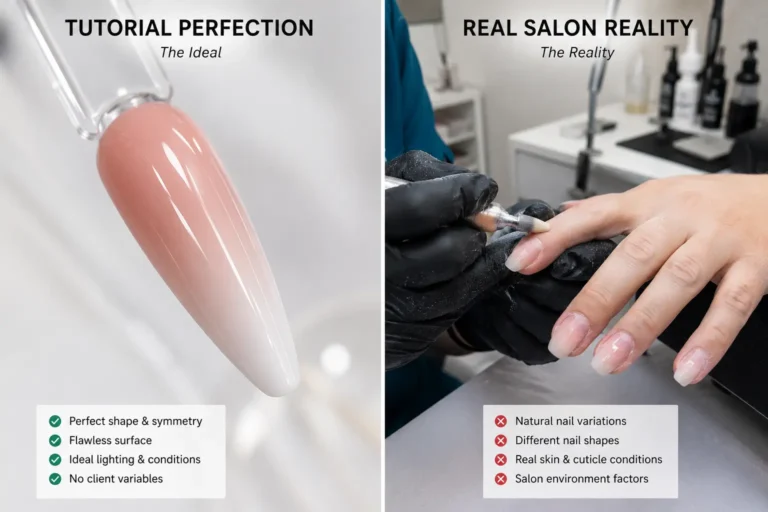
My teaching philosophy is simple: I show real salon challenges, real mistakes and real performance testing, not just perfect demonstrations. This is how you develop genuine technical competence and become a confident, capable nail professional.
Every Artistic Touch course includes lifetime access, a certificate of completion and access to a dedicated student support community (Discord), where I actively participate and provide ongoing guidance and expert feedback.
About Artistic Touch Nail Training Academy
Artistic Touch Nail Training Academy delivers structured professional online nail education focused on practical skill development, professional standards and safe salon practice. All courses are available online worldwide.
Stop Gel Overflow With Professional Techniques
Understanding why dual forms leak is the first step, but professional mastery requires learning controlled application techniques, form selection methods, and troubleshooting approaches designed to prevent overflow entirely.
Master Sandwich Dual Forms and Eliminate Leaking:
- ✓ Clean imprint technique designed to reduce filing and cleanup time
- ✓ Form selection guidance for different nail bed shapes and problem nails
- ✓ Overflow prevention methods and troubleshooting techniques
- ✓ Lifetime access with private student support and expert guidance from Radina
Learn Professional Sandwich Dual Forms
Stop fighting gel overflow and achieve clean, professional results
Enrol Now — £97 →Lifetime access • Certificate included • Start immediately
Learn professional sandwich dual form techniques designed to prevent gel overflow and achieve clean imprints in our comprehensive online training at Artistic Touch Nail Training Academy.