Working Faster Is Not the Same as Working More Efficiently
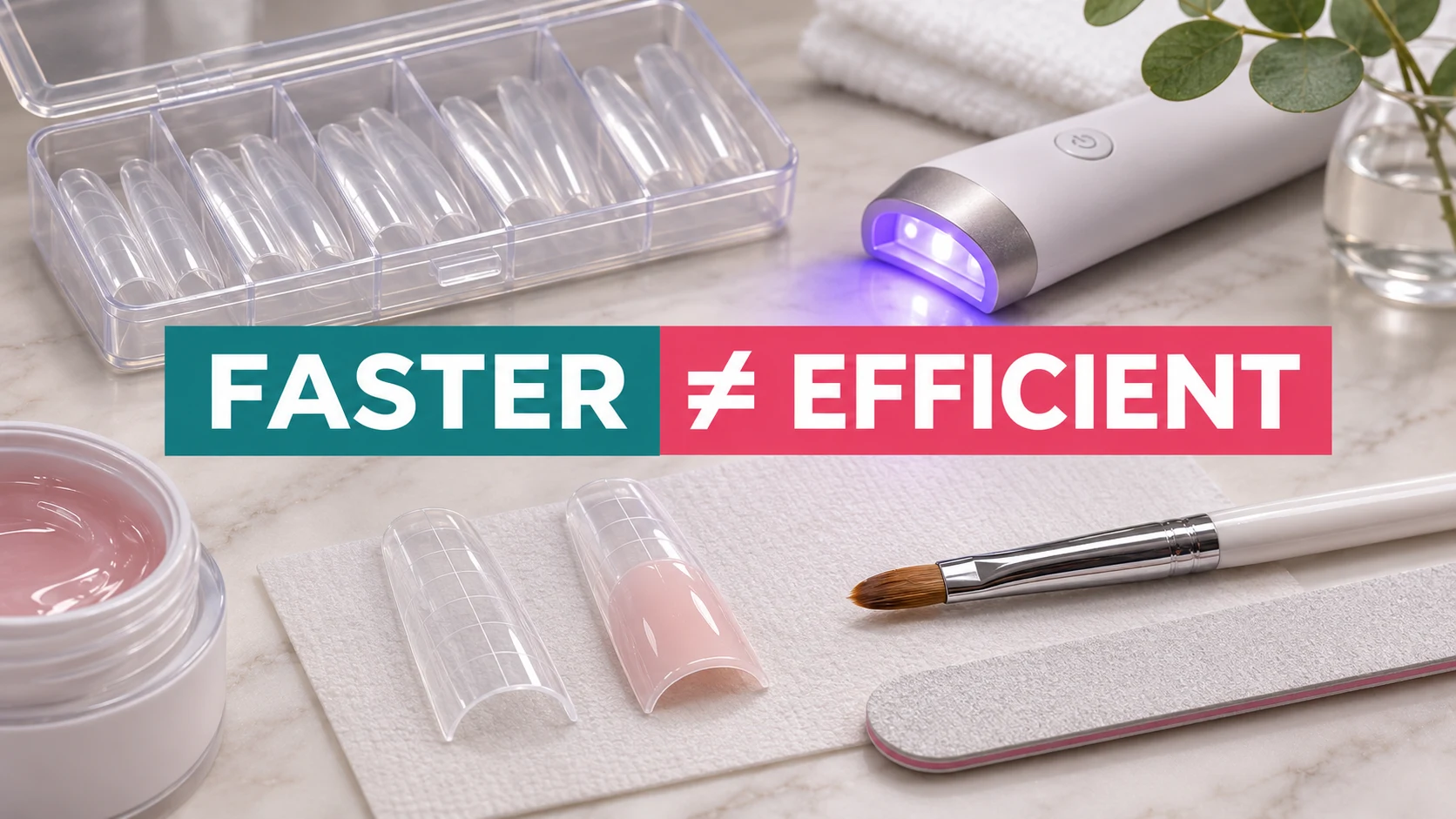
Technicians often talk about how long an appointment takes, and the conversation is usually about how to work faster. I think we need to separate working faster from working more efficiently. If you spend half your appointment correcting something you could have prevented earlier, the problem is not that your hands need to move faster.
I still work with clients in the salon, and that is where I find out which time-savers actually save time. Here is one that did not, and what I now look at before trying to speed anything up.
Quick Answer: How Do I Work Faster Without Rushing?
Do not start by moving faster. Find out where the appointment time is lost: unnecessary filing, repeated steps, switching tools, correcting what could have been prevented earlier. Efficiency comes from choosing the right method, preparing correctly and removing work that adds nothing, without cutting corners on safety or curing.
A Time-Saver That Cost Me Time
I used to ask clients to hold a small handheld lamp and flash cure their own nails, thinking it would save me time. It slowed me down. Clients forgot the instructions even on repeat visits, so I had to explain it again most appointments. The lamp could block my view, or be held at an angle that cured one side of the nail and left the other under-set with bubbles. Some clients also pointed the LED into my eyes.
That was an older method of mine, and my current system takes the step away from the client. It does not mean every client-assisted workflow fails, only that this one did not save the time I expected. It also shows why the first question should not be how to work faster: a method that looks quicker can create extra work. I wrote about it in Fast BIAB Infill With Dual Forms: What Flash Cure Problems Taught Me.
One thing matters whoever holds the lamp. Flash curing begins the polymerisation process and helps hold the dual form in place, but it does not replace the full curing process. The product must still receive the manufacturer’s recommended curing time using a compatible lamp. An initial flash cure does not mean the gel is fully cured, and an unevenly set nail has to be corrected before the service continues.
Ask Where the Time Is Going, Not How to Move Faster
A long appointment does not automatically mean thorough work, and a fast one does not automatically mean corners were cut. The useful question is which parts of the service are essential and which are spent correcting avoidable problems. Until you know that, working faster only makes the same problems happen sooner.
Filing Is Often the Symptom of an Earlier Decision
With dual forms, the amount of refinement depends on choices made before the product is applied: form selection, fit, internal space, how much product you use and where you place it, and the structure that results. A rigid cuticle zone can leave a ridge that has to be filed away, which adds time to every appointment and increases the risk of over-thinning the natural nail. A flexible cuticle zone that gives a clean imprint removes that step. I explain that difference in Imenka Dual Forms Size S: Old Version vs New Version.
Bulk works the same way. If the form and the nail do not agree, you may be filing for a long time to correct a result that the first decision created. See Why Your BIAB Dual Forms Come Out Thick and Bulky and How to Check if a Dual Form Fits Your Natural Nail. I am not saying filing can always be avoided. I am saying it is worth asking why it is needed. If you want to learn how form, fit and structure decisions reduce the correction a set needs, that is what The Ultimate Dual Forms teaches.
Repeated Movements Cost More Than You Think
Time disappears in small repeated actions: going back to a finished area, changing tools again and again, or switching between measuring, filling and applying. In my infill workflow I batch each stage, filling all the forms before applying any, and I remove the forms together after completing the full curing process according to the manufacturer’s instructions, instead of one at a time. Repeating small movements across ten fingers adds up across a working day.
Cleaning the inhibition layer from the top and from underneath is another small step that prevents a bigger delay: if it is left, it can clog the bit during refinement and you have to stop mid-service to clean your tools.
You can see this workflow in Infills With Dual Forms in 64 Minutes. That is one real appointment with one client, not a target time for every technician or every set.
Not Every Time-Saver Suits Every Client
Nail condition, skin sensitivity, architecture, the corrections needed and the client themselves all change how the appointment runs. Safety and proper curing cannot be traded for a target time.
Why Time Matters for What You Earn
A service price has to cover more than the minutes you spend applying product. It also pays for materials, running costs, preparation, cleaning and the non-client work around each appointment. If a long appointment is spent correcting avoidable problems, you are absorbing that time yourself.
Two things are separate here. Better quality, structure and results can justify premium pricing, which I discuss in Why Improved Nail Work Deserves Higher Prices. Rising product costs and running expenses can also make a price review necessary whatever your standard of work. I am not giving you an earnings figure, because your costs and your diary are your own.
What Efficient Working Looks Like
An efficient technician knows what needs to be done, why it needs to be done and what can be left out without harming the quality or safety of the service. In my own work that has meant fewer repeated movements, fewer corrections and a sequence I can follow without going back.
Reduce the Work Before You Reach for a File
Learn to see how your choice of form, its fit and the product you place decide how much correction a set needs, so you spend the appointment building the structure, not repairing it. Previous gel-product and nail application experience is recommended.
Explore The Ultimate Dual Forms →Frequently Asked Questions
How can I work faster without rushing?
Find where time is lost before you move faster: unnecessary filing, repeated steps, switching tools and correcting avoidable problems. Remove those first.
Why does my dual form work need so much filing?
Often because of earlier decisions: form choice, fit, product amount and placement, or a rigid cuticle zone that leaves a ridge. Look at those before you file.
Is asking the client to flash cure a good time-saver?
It did not save me time. Clients forgot the instructions, blocked my view or held the lamp at an angle that cured the nail unevenly. It does not mean every client-assisted method fails.
Can flash curing replace the main lamp?
No. Flash curing begins polymerisation and holds the form in place, but the product still needs the manufacturer’s full cure with a compatible lamp.
Key Takeaway
Speed and efficiency are not the same. Find where your time is lost, fix the earlier decisions that create extra work and never trade away safety or the manufacturer’s full cure.
About the Author
Professional Nail Expert | International Nail Educator
I am Radina Ignatova, a Professional Nail Expert since 2014 and International Nail Educator, based in Scotland, UK. I am the Founder of Artistic Touch – Nail Training Academy and TheNailWiki.
At Artistic Touch – Nail Training Academy, I provide structured professional online nail education specialising in dual forms, nail preparation and retention, nail structure, E-File work and Russian Manicure, with a strong focus on professional salon safety. I continue to work actively in salon practice, ensuring that all education reflects real client scenarios and current industry standards.
My teaching philosophy is simple: I show real salon challenges, real mistakes and real performance testing, not just perfect demonstrations. This is how you develop genuine technical competence and become a confident, capable nail professional.