Why Are My Dual Forms So Thick? It Is Not Always Too Much Gel
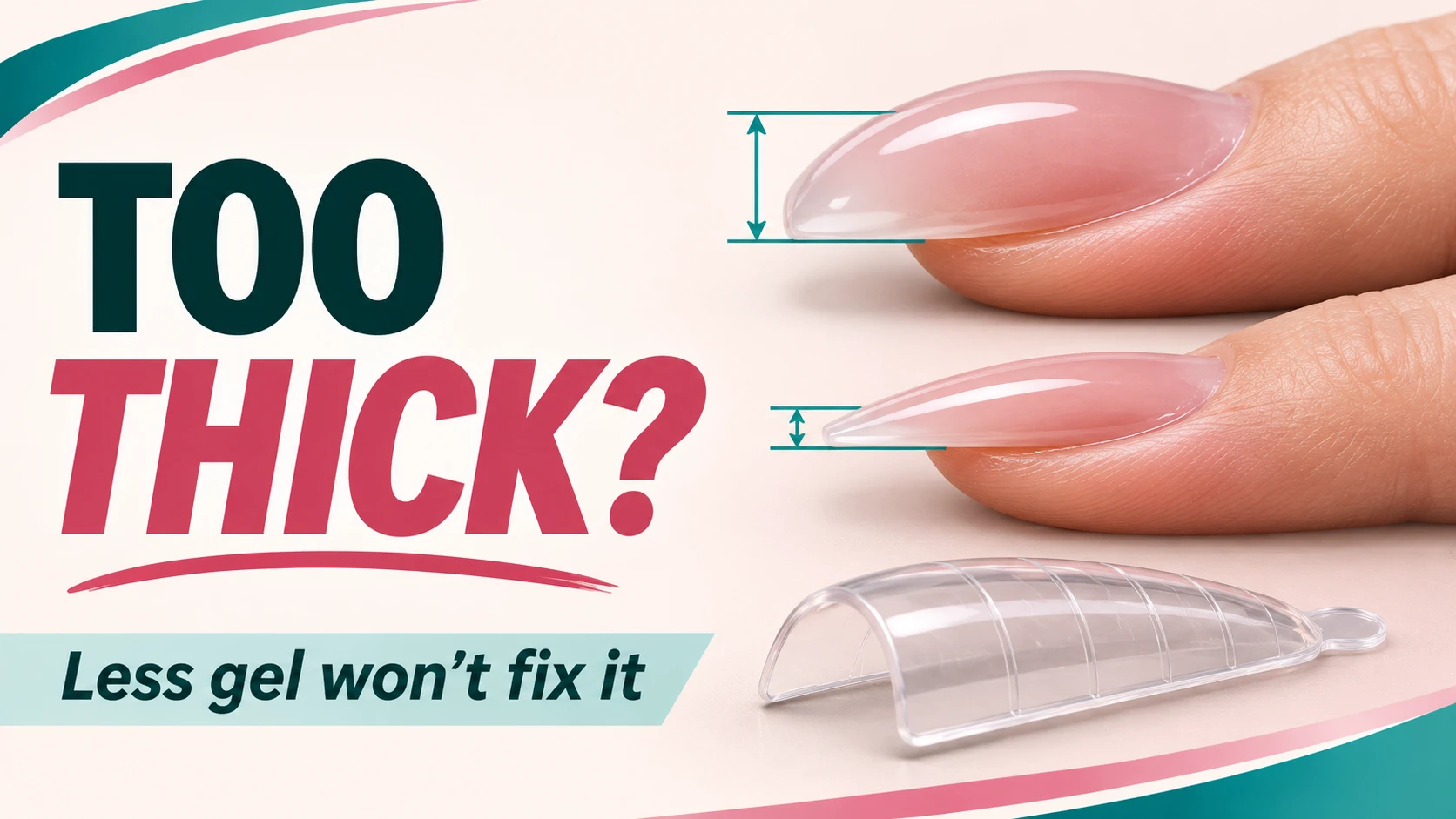
You tried using less gel and the nails still come out thick, heavy at the free edge and slow to file. You may have decided you need more practice or different products. Sometimes the cause is earlier: the form you chose and how it fits.
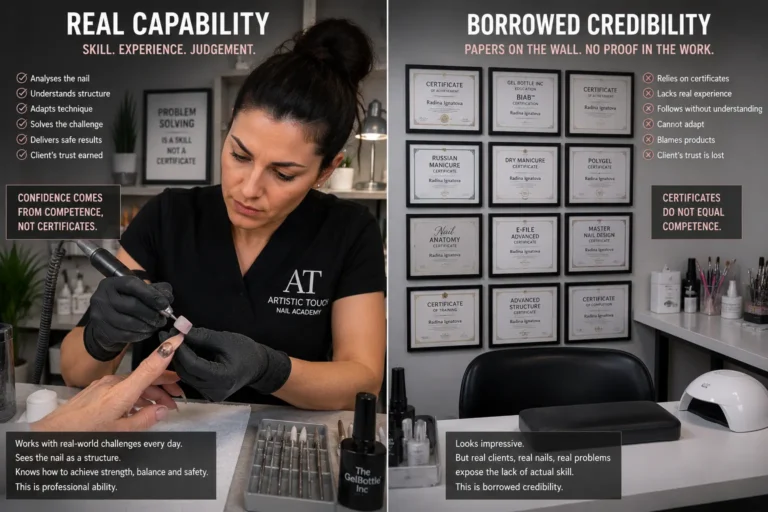
I am Radina Ignatova, a Professional Nail Expert since 2014, and I work in a salon every day. This is a deeper understanding of dual forms, with the reasons behind it, not a tutorial that only shows what to do.
Quick Answer: Why Are My Dual Forms Too Thick?
Too much product is one possible reason, but it is not the only one. The form’s internal curve, the fit, the intended length and the way product is distributed all affect the finished thickness. A form that leaves too much internal space for a particular nail can create bulk even when you are trying to use less product. Before you reduce the gel, check whether the form and placement can create the structure you need.
If you want the full explanation rather than a tip, see The Ultimate Dual Forms, which teaches why form architecture, fit and length decide the result.
Start With What the Form Was Designed to Create
Every form is designed to create a particular shape and architecture. Choose by what the form is designed to create and by the length you want, not only by the shape of the nail you see on a photo. If the design and the nail do not agree, product can end up filling the gap, and the gap becomes thickness.
An arched form on flat nail beds at a very short length is a good example. It can give negative space, a stress area, a negative apex, nails that point upwards and a thick free edge. At a shorter length the profile and the direction of the free edge change, so the form needs to drop faster, and a form built for a longer length may not behave the same way when used short.
Covering the Nail Is Not Fitting the Nail
A form can cover the nail and still not fit it. Check the internal space from the top and from underneath so there is room for the product, and so the product is not forced to fill space the nail does not need. Size matters too: assess without pressing, because the form flexes and gives a false reading, cover the growth points and always check the next size. Too small can leave the growth points exposed or poorly supported; too big can sit on the skin, where product can flood, lift and let water in.
I explain these checks in How to Check if a Dual Form Fits Your Natural Nail and How to Choose the Correct Dual Form Size.
The Product Behaves Differently Inside the Form
| What changes | Effect on thickness |
|---|---|
| Arched forms hold more volume than flatter ones | The amount of product needed changes with the form, so a habit that works in one form overfills another. |
| Gel and polygel behave differently | Some gels flow and travel more and polygel is a paste that stays more where it is placed, but both can move under pressure. Behaviour depends on the formulation and how you handle it. |
| Too much product | Overfilling can resist you and push product towards the free edge and the skin. It is one possible cause of thickness, not the only one. |
| Pressing instead of lowering the form | Pressure can move product where it was not meant to go. |
More on this in Dual Forms Are About Volume, Not Shape. Notice what ties it together: thickness often comes from a mismatch between form, nail, length and product, not from one wrong amount. That article is about sandwich systems, so not every observation applies identically to every kind of dual form application.
What to Check Before You Blame Your Technique
- Is the form designed for the shape and length you wanted?
- Does the nail bed suit the arch of this form, or is it flat?
- Did you check the fit from the top and from underneath?
- Did you check the next size?
- Is your material the one you assumed, gel or polygel, and does it behave as you expect?
If you would like the free lesson first, How to Choose the Right Dual Forms is open now.
Where to Go Deeper
The Ultimate Dual Forms goes beyond tutorials into how form architecture, internal space, fit and intended length decide the result, so you can choose and adjust for each nail instead of guessing. Previous gel-product and nail application experience is recommended; previous dual forms experience is not required.
Build the Structure Instead of Filing Away the Bulk
Learn how to select and fit dual forms, control product placement and create thinner, properly structured nails with less unnecessary refinement. Previous gel-product and nail application experience is recommended.
Explore The Ultimate Dual Forms →Frequently Asked Questions
Why are my dual form nails so thick?
Too much product can be the reason, but the form, fit or length may not suit the nail either. An arched form on a flat nail bed at a short length can leave negative space and a thick free edge.
Will using less gel fix thick dual forms?
Not always. Check form architecture, fit, internal space and intended length as well as the amount and placement of product.
Does the size of the form matter?
Yes. Too small can leave growth points exposed, too big can sit on the skin. Assess without pressing and always check the next size.
Is gel or polygel better for avoiding thickness?
Neither automatically. They behave differently and depend on the formulation, so each needs its own handling.
Do I need a bigger collection of forms?
Not necessarily. Understanding what each form is designed to create matters more than owning many.
Key Takeaway
Thick dual forms can come from too much product, but also from a mismatch between form, nail, length and placement. Check architecture, fit, internal space and length before you only reduce the gel.
About the Author

Professional Nail Expert | International Nail Educator
I am Radina Ignatova, a Professional Nail Expert since 2014 and International Nail Educator, based in Scotland, UK. I am the Founder of Artistic Touch – Nail Training Academy and TheNailWiki.
At Artistic Touch – Nail Training Academy, I provide structured professional online nail education specialising in dual forms, nail preparation and retention, nail structure, E-File work and Russian Manicure, with a strong focus on professional salon safety. I continue to work actively in salon practice, ensuring that all education reflects real client scenarios and current industry standards.
My teaching philosophy is simple: I show real salon challenges, real mistakes and real performance testing, not just perfect demonstrations. This is how you develop genuine technical competence and become a confident, capable nail professional.