Same Prep, Same Gel: Why Do Only Some Clients’ Nails Lift?
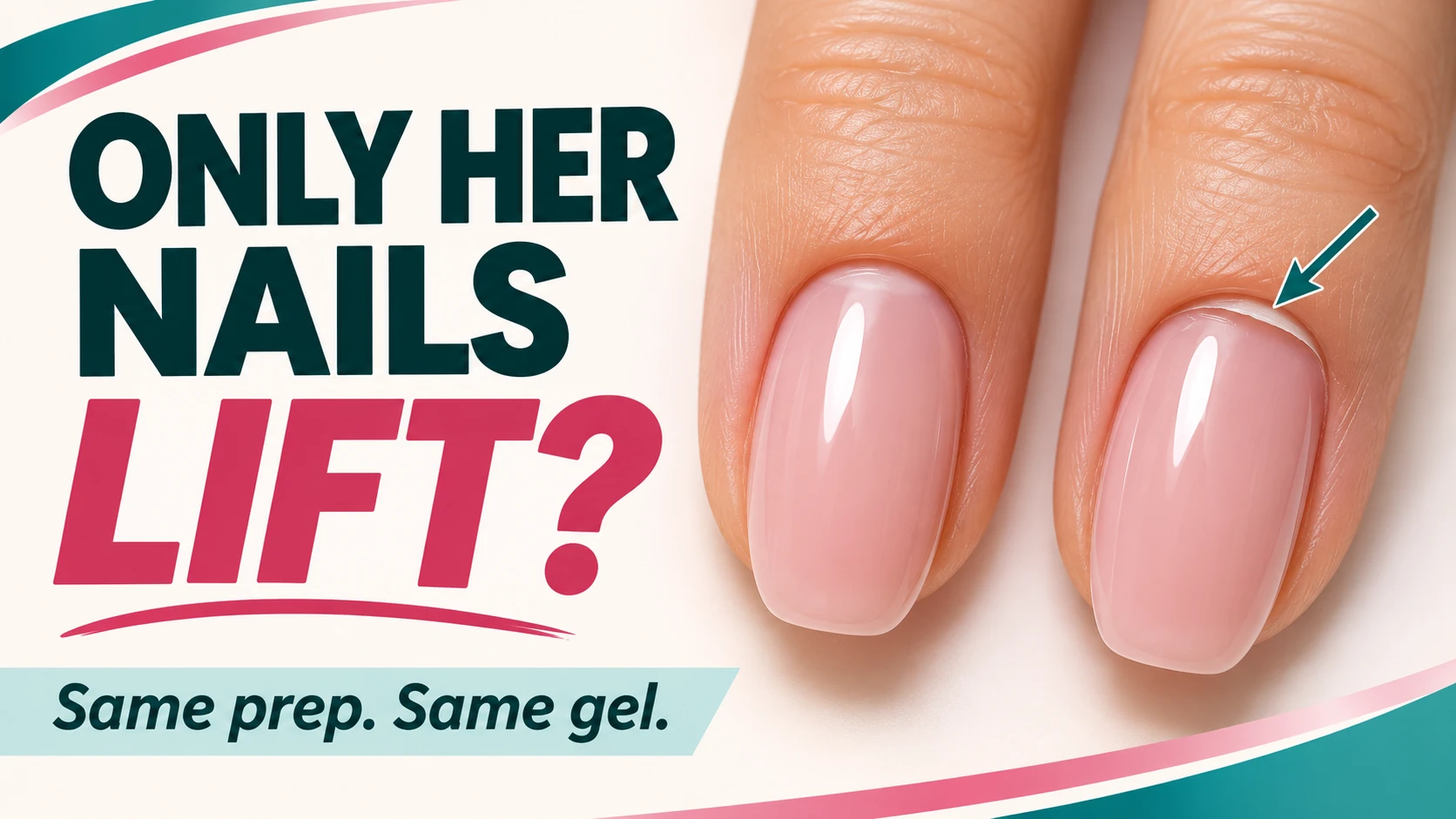
Same preparation, same gel, same routine. Most clients are fine and one keeps coming back with lifting. It feels personal, and the easy conclusion is that the product is wrong or the client is hard on her hands.
I am Radina Ignatova, a Professional Nail Expert since 2014, and I work in a salon every day. In my teaching, lifting always has a cause, and finding it is the technician’s job.
Quick Answer: Why Does Only One Client Lift?
Because the same preparation and products do not always give the same result on different nails. Nail plate condition, flexibility, application, contamination and structural stress can all influence retention. When one client lifts repeatedly, look at where the separation begins, how that nail behaves and what may be different about that application before deciding the product needs changing.
If you want the full explanation rather than a tip, see Nail Prep – Adhesion & Retention, which teaches how to find the cause of lifting instead of changing products.
Lifting Always Has a Cause
Lifting is rarely one big mistake. It is usually a combination of small details in preparation, application, structure and the client’s nail type. It starts as a tiny separation, then air and moisture get in and it can spread. If one client lifts and others do not, something in that combination is different for that client. It may be the nail, but it may also be how the product was applied, cured or built on that particular set.
I do not judge clients for everyday life. Daily movement, pressure and water make lifting worse, but they are not a reason to stop looking for the cause.
Look at Where It Starts
| Where it lifts | What it can point to |
|---|---|
| At the cuticle | Leftover true cuticle, the translucent layer still attached to the nail plate. Skin contact, contamination or how the product was applied can also play a part. |
| At the side walls | Side walls not prepared or cleaned properly, with debris or remaining shine. |
| At the free edge | Often preparation or structure, and sometimes flexibility or the way the client uses her hands every day. |
Where it lifts gives you clues, not a diagnosis. I explain the pattern in more detail in What Is Nail Retention?
Why the Same Routine Gives Different Results
Nails are not all the same. Dry or oily nail plates and different levels of flexibility affect retention differently from one nail to the next, so a routine that works on one plate can fall short on another. That is why copying a routine without understanding it is risky: it was built for someone else’s nails.
- The nail plate: how dry, oily or flexible it is changes how well product connects.
- What is left on the plate: residue around the cuticle area can cause lifting even when the nail looks clean.
- Over-preparation: more filing does not mean better adhesion. See Over-Prepping Nails.
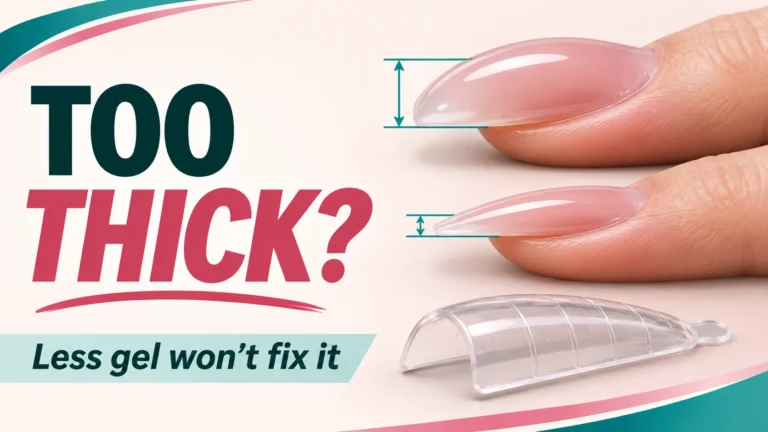
- Structure: where the product is thick or thin changes how the free edge and the side walls behave.
- Application and curing: product placement, skin contact and curing can differ from one set to the next, even with the same products.
Good retention is built before the base coat touches the natural nail. A primer does not rescue poor preparation, and a stronger product is not automatically a better one.
A Better Question Than “Which Product?”
Instead of changing products again, ask three things about the client who lifts: where does it start, what is different about this nail, and what did I do differently on this client without noticing? A client who is the exception is telling you something specific.
For the wider picture, read Why Nails Lift Even When Your Prep Looks Clean.
Stop Changing Products Without Understanding the Problem
Learn to recognise hidden preparation mistakes, understand product connection and investigate why retention fails, even when your preparation looks correct.
Explore Nail Prep – Adhesion & Retention →Frequently Asked Questions
Why does gel lift on only one client?
Because the same routine does not always behave the same on every nail. Dryness, oiliness, flexibility, leftover true cuticle, side-wall preparation, application and structure can all differ from one client to the next.
Is it the client or the product?
Usually neither on its own. Lifting has a cause, often a combination of small details in preparation, application, structure and nail type, and finding it is the technician’s job.
Where should I look first?
Where the lifting starts: at the cuticle, at the side walls or at the free edge. Each points to different causes.
Should I change my products?
Not before you have found where and why it lifts. Changing products without a cause often repeats the problem.
Do clients cause lifting with daily use of their hands?
Daily movement, pressure and water make lifting worse, but I do not blame clients for everyday life. Look for the cause first.
Key Takeaway
When only one client lifts, do not assume it is the product or the client. Find where the lifting starts and what is different about that nail and that application before changing your products.
About the Author
Professional Nail Expert | International Nail Educator
I am Radina Ignatova, a Professional Nail Expert since 2014 and International Nail Educator, based in Scotland, UK. I am the Founder of Artistic Touch – Nail Training Academy and TheNailWiki.
At Artistic Touch – Nail Training Academy, I provide structured professional online nail education specialising in dual forms, nail preparation and retention, nail structure, E-File work and Russian Manicure, with a strong focus on professional salon safety. I continue to work actively in salon practice, ensuring that all education reflects real client scenarios and current industry standards.
My teaching philosophy is simple: I show real salon challenges, real mistakes and real performance testing, not just perfect demonstrations. This is how you develop genuine technical competence and become a confident, capable nail professional.