What Are Sandwich Dual Forms? How the System Works and Why the Underside Matters
Sandwich dual forms are one of the most searched dual form terms I see, and also one of the least clearly explained. Most tutorials show what to do. In this article I explain what the system actually is and why it works, as a deeper understanding of dual forms rather than another general tutorial.
I teach this method in my Sandwich Dual Forms online course. Here I cover the definition, how it differs from a single form, and what the forms cannot do for you.
Quick Answer: What Are Sandwich Dual Forms?
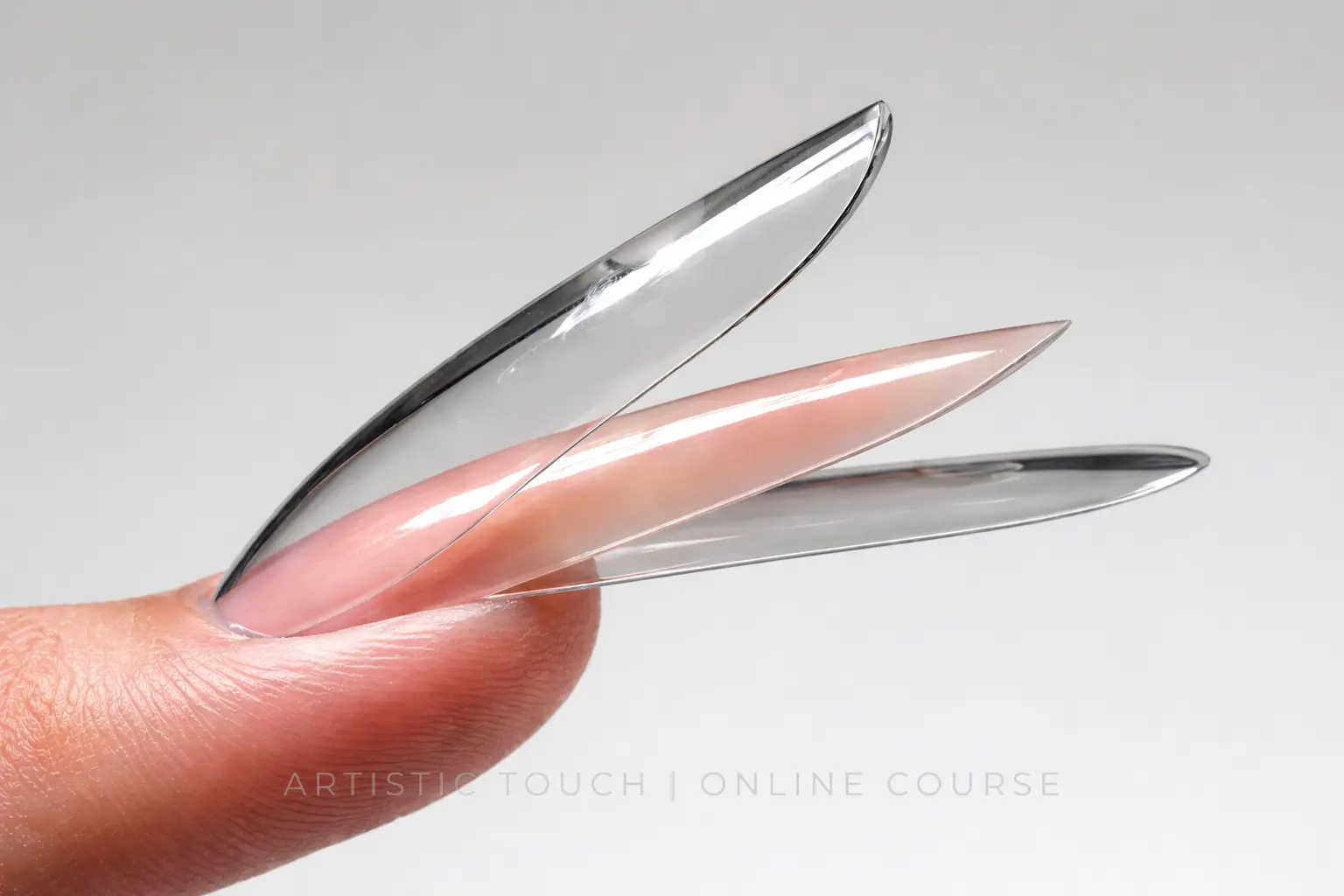
Sandwich dual forms are a two-part form system. A top form shapes the upper surface of the nail and a bottom form shapes the underside that bonds to the nail plate. Because the underside is controlled as well as the top, there are fewer hollow areas and less filing is needed afterwards. The forms control shape, but you still control the structure: product placement, fit, preparation and safety.
What a Sandwich Dual Form Is
A dual form is a pre-shaped mould pressed over the nail to shape the gel as it cures. It defines the length, the surface contour and the c-curve in one step. A sandwich dual form system uses two parts: a top form that shapes the upper surface, and a bottom form that shapes the underside, the surface that bonds to the nail plate. The product sits between them, which is where the name comes from.
I also describe it in my reference library on TheNailWiki: Sandwich Dual Forms System and, for the basics, Dual Forms.
How It Differs From a Single Form
| Single form | Sandwich system | |
|---|---|---|
| What is shaped | The top surface | The top surface and the underside |
| The underside | Not controlled, so hollow areas can form where air is trapped and adhesion is weaker | Given a consistent shape by the bottom form |
| Filing | Often heavier, to tidy the surface | Less filing afterwards, because more of the shape is already formed |
For a longer comparison, read Sandwich Dual Forms vs Traditional Dual Forms.
Why the Underside Matters
With a single form, the part of the nail you cannot see is left to chance. Hollow areas and weak adhesion usually start there. The bottom form gives the underside a consistent shape, and I place the thickest product at the stress zone before pressing. That placement is a decision you make, not something the form does for you.
Shape Is Not Structure
Dual forms control shape. They do not automatically control structure. I choose a form by what it is designed to create and by the length I want, not only by whether it covers the nail. An arched form at a very short length, for example, can leave a lot of space underneath and push the result in the wrong direction. I explain how I choose in Stop Choosing Sandwich Dual Forms by Shape and how I control the c-curve and apex in this guide.
Fit Comes First
A form has to match the width and the curvature of the nail. Covering the nail is not the same as fitting it. I check the next size, I make sure the growth points are enclosed, and I look at the internal space so there is room for the product. Heavily arched or pinched nails need careful assessment before you choose this method.
Preparation and Safety Still Apply
The system does not compensate for poor preparation. Cuticle work, dehydration and primer still decide how well the product holds. Keep uncured product off the skin, and carry out a consultation first so you can spot contraindications such as onycholysis.
Mistakes I See
- Choosing a form by width alone
- Misplacing the apex
- Using a product with the wrong viscosity
- Relying on filing to fix a structural error
To see what a correct result looks like, read What a Correct Sandwich Dual Forms Nail Should Look Like. If you are new to forms, start with the beginners step-by-step guide.
Go Deeper
- Sandwich Dual Forms With Builder Gel or Polygel: What Changes?
- How to Clean Sandwich Dual Forms Between Clients
- Sandwich Dual Forms Bottom Form Fit: When It Works and When It Fails
Learn the Sandwich Dual Forms System Properly
The Sandwich Dual Forms course explains structure, control and troubleshooting so you understand why each step works.
View the Sandwich Dual Forms Course →Frequently Asked Questions
What are sandwich dual forms?
A two-part form system. A top form shapes the upper surface of the nail and a bottom form shapes the underside that bonds to the nail plate, with the product between them.
How are sandwich dual forms different from normal dual forms?
A single form controls the top surface only, so the underside is left uncontrolled and can have hollow areas. The sandwich system also shapes the underside, which means less filing afterwards.
Do sandwich dual forms control the structure of the nail?
No. They control shape. Structure still depends on where you place the product, especially at the stress zone, and on form choice, fit and preparation.
Do sandwich dual forms work for every nail shape?
Not automatically. The form has to match the width and curvature of the nail, and heavily arched or pinched nails need careful assessment before you choose this method.
Can sandwich dual forms stop lifting?
Not on their own. Lifting usually comes back to preparation, so the system does not replace cuticle work, dehydration and primer.
Where can I learn sandwich dual forms properly?
In my Sandwich Dual Forms online course, which explains structure, control and troubleshooting.
Key Takeaway
A sandwich dual form system shapes the underside of the nail as well as the top, which gives you a more controlled result with less filing. It does not replace your decisions: you still choose the form, check the fit, place the product and prepare the nail.
About the Author

Professional Nail Expert | International Nail Educator
I am Radina Ignatova, a Professional Nail Expert since 2014 and International Nail Educator, based in Scotland, UK. I am the Founder of Artistic Touch – Nail Training Academy and TheNailWiki.
At Artistic Touch – Nail Training Academy, I provide structured professional online nail education specialising in dual forms, nail preparation and retention, nail structure, E-File work and Russian Manicure, with a strong focus on professional salon safety. I continue to work actively in salon practice, ensuring that all education reflects real client scenarios and current industry standards.
My teaching philosophy is simple: I show real salon challenges, real mistakes and real performance testing, not just perfect demonstrations. This is how you develop genuine technical competence and become a confident, capable nail professional.