How to Choose the Correct Dual Form Size for the Natural Nail
How do you know which dual form size is actually correct for your natural nail? Choosing a dual form that is too small or too big can create problems before you even start the product application.
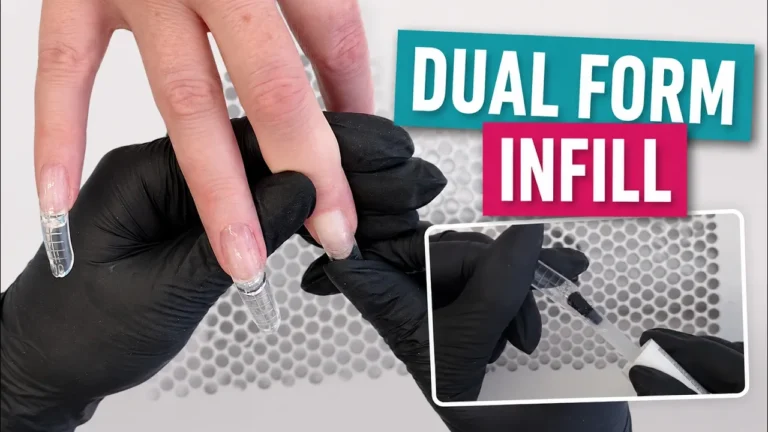
This article follows my demonstration on the official YouTube channel, Radina Ignatova | Nail Academy, where I compare sizes 4, 5, 6 and 7 on the same natural nail. It is the start of my dual forms series, and it goes beyond a general application tutorial: it explains why each check matters, so you can recognise problems instead of simply copying steps.
Quick Answer: How Do You Choose the Correct Dual Form Size?
Place the form into the groove between the skin and the natural nail and check it without moving or pressing it down. The correct size covers the growth points at the base of the nail, leaves room for the product, and does not go onto the skin. Pressing down can flex the plastic and give you a false reading, so a form that looks right when pressed may be too small once it is filled with product. Always compare the next size too: in my demonstration size 4 fitted best, size 5 looked as if it fitted, and sizes 6 and 7 were too small.
Watch the Video: How to Choose the Correct Dual Form Size
I test each size on the same nail, one after another. These are the parts I would watch first:
- Why the growth points must be covered (0:27)
- How to measure: placing the form in the groove (1:31)
- The false reading when the form flexes (2:10)
- Why size 4 fitted best (3:50)
- What happens when the form is too big (5:11)
- What happens when the form is too small (6:21)
Why the Growth Points Matter
When you work with dual forms on a natural nail, the main areas to think about are the growth points, which sit near the base of the nail. They are the most fragile part, and they need to be covered.
That is the starting point for every sizing decision: a form that does not cover the growth points is not the right size, however good it looks elsewhere.
How to Measure a Dual Form on the Natural Nail
I take out several sizes from the box. In the demonstration I use sizes 4, 5, 6 and 7, and I test them one by one, starting with the smallest, which is size 7.
To measure, hold the dual form and place it into the groove between the skin and the natural nail. Then assess the fit without moving the form.
- Take out several sizes around the one you expect to need.
- Place the form into the groove between the skin and the natural nail.
- Assess it without moving it. Look at the growth points and the sides.
- Do not press down to make it fit. Pressing can flex the form and mislead you.
- Check the next size even if the first one seems suitable.
- Choose the form that covers the growth points, leaves room for the product and does not go onto the skin.
The False Reading: When the Form Flexes
If you press the form down, it flexes. When the plastic flexes, you can get a false reading: the form seems to cover the nail, but once you fill it with product, it will not fit.
This is why I assess the form without pressing. A form that only fits when you press it down is too small for the nail.
Comparing Sizes 7, 6, 5 and 4
The sizes below belong to the forms I used in the demonstration, and the numbers are specific to that range, so use them as an example of the method, not as a size chart.
| Size | What I saw | Verdict |
|---|---|---|
| 7 | Clearly too small when placed in the groove | Too small |
| 6 | Flexes when pressed. The growth point may look fine at first glance, but it does not cover properly | Does not fit |
| 5 | Looks as if it is fitting | Worth checking against the next size |
| 4 | A lot of room for the product, and it covers the growth points | Fits best |
Size 5 looked as if it fitted, but it is always worth going one size up or down and checking again. That is how I found that size 4 fitted this nail best, with plenty of room for the product and the growth points covered.
What Happens When the Dual Form Is Too Small
A form that is too small leaves not enough room for the product, and the growth points can be exposed. That can damage the natural nail underneath, and the nails can start to break.
To understand the space inside a form, which is the next part of fitting, read how to choose the right Dual Form for the natural nail in front of you and why your Dual Forms keep failing on different nail shapes.
What Happens When the Dual Form Is Too Big
When I go to the next larger size, I can clearly see it is too big, because it goes onto the skin. We do not want any product on the skin at all. Product on the skin can lift, water can get underneath it, and bacteria and other things we never want to see on a client’s nails can grow.
| Too small | Too big |
|---|---|
| Not enough room for the product | The form goes onto the skin |
| Growth points can be exposed | Product can end up on the skin and lift |
| Can damage the natural nail underneath | Water can get underneath, and bacteria can grow |
| Nails can start to break | The fit is not controlled |
Choosing the Width Is Only One Part of Fitting
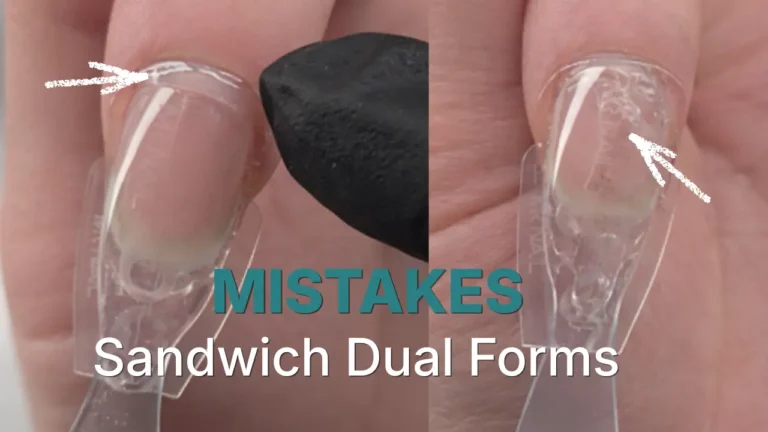
Dual forms are not as straightforward as they look. Choosing the right width is only one part of fitting. You also need to consider the natural nail, the growth points and the internal space of the form, which I cover in the next video of the series. For the thinking behind choosing a form, read stop choosing sandwich Dual Forms by shape and applying Dual Forms: why beautiful designs fail during application.
If you work with Imenka forms, you may also like my comparisons of size S, old version vs new version.
Where to Learn the Complete Method
This is a deeper understanding of dual forms, with proper explanations of why each check matters, rather than a general tutorial that only shows steps. In The Ultimate Dual Forms I teach the complete method of sizing and fitting with different dual forms: the natural nail, the growth points, the internal space and how to adapt different forms. It may look straightforward, but there are very important caveats that I cover inside the course. I also have a completely free dual forms mini course, which you can find with my free courses, and you can browse all online nail courses.
The Ultimate Dual Forms
Learn the complete method of sizing and fitting: the natural nail, the growth points, internal space and how to adapt different dual forms.
View the Course Details →Frequently Asked Questions
How do you choose the correct dual form size?
Place the form into the groove between the skin and the natural nail and assess it without moving it. The right size covers the growth points, leaves room for the product and does not go onto the skin. Compare the next size too.
Why shouldn’t I press the dual form down to check the fit?
Pressing makes the form flex, which can give you a false reading. The form may seem to cover the nail, but it will not fit once it is filled with product.
What are the growth points and why do they need to be covered?
They are the most fragile part of the natural nail, near its base. A dual form must cover them, and a form that leaves them exposed can damage the natural nail underneath.
What happens if the dual form is too small?
There is not enough room for the product, the growth points can be exposed, the natural nail underneath can be damaged and the nails can start to break.
What happens if the dual form is too big?
It goes onto the skin. Product on the skin can lift, and water can get underneath it, letting bacteria grow, which we never want on a client’s nails.
Should I try the next size even if the first one fits?
Yes. It is always useful to check one size up or down. In my demonstration size 5 looked as if it fitted, but size 4 fitted best.
Are the sizes in your demonstration a size chart?
No. They are the sizes of the forms I used. The method of testing applies to any dual form.
Where can I watch the full video?
‘How to Choose the Correct Dual Form Size’ is on Radina Ignatova | Nail Academy, the official YouTube channel of Artistic Touch – Nail Training Academy. It is embedded at the top of this article.
Key Takeaway
A dual form that is too small or too big creates problems before you even start the product application. Cover the growth points, leave room for the product, keep product off the skin, and never trust a fit you only get by pressing the form down. Choosing the width is only one part of fitting a dual form.
Learn to Size and Fit Dual Forms Properly
The Ultimate Dual Forms teaches the complete method of sizing and fitting, from growth points to internal space.
View The Ultimate Dual Forms →About the Author

Professional Nail Expert | International Nail Educator
I am Radina Ignatova, a Professional Nail Expert since 2014 and International Nail Educator, based in Scotland, UK. I am the Founder of Artistic Touch – Nail Training Academy and TheNailWiki.
At Artistic Touch – Nail Training Academy, I provide structured professional online nail education specialising in dual forms, nail preparation and retention, nail structure, E-File work and Russian Manicure, with a strong focus on professional salon safety. I continue to work actively in salon practice, ensuring that all education reflects real client scenarios and current industry standards.
My teaching philosophy is simple: I show real salon challenges, real mistakes and real performance testing, not just perfect demonstrations. This is how you develop genuine technical competence and become a confident, capable nail professional.