Online Nail Courses for Nail Techs Who Still Struggle with Lifting
Quick Answer: What Causes Persistent Nail Lifting After Basic Training?
Persistent lifting typically results from incorrect nail plate preparation, inadequate product curing, improper apex placement or incomplete bond coverage at stress points. Most basic courses teach application steps but do not teach diagnostic assessment or correction protocols for when results fail.
This article explains why surface-level training leaves gaps in your technical understanding and what professional online nail courses teach you to do differently.
Why Basic Training Does Not Eliminate Lifting
You completed a nail course. You learned gel application, builder gel technique, dual forms. You practised the steps exactly as demonstrated. Your applications still lift within days, and you cannot work out why because the course showed you what to do but did not teach you how to diagnose what went wrong.
This is the most common problem nail technicians face after basic training. The course taught you procedure. It did not teach you diagnosis. When your result does not match the demonstration, you have no framework for identifying which specific step failed or what technical adjustment will fix it.
Professional online nail courses teach diagnostic assessment. They show you what incorrect preparation looks like, demonstrate multiple failure modes, explain the mechanical cause of each lifting pattern and walk you through the exact correction sequence that eliminates it. This is what stops lifting consistently rather than occasionally.
What Lifting Patterns Reveal About Your Technique
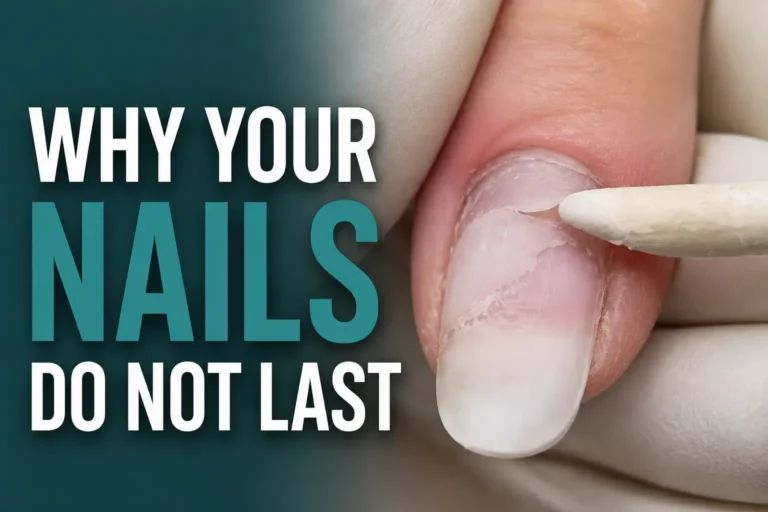
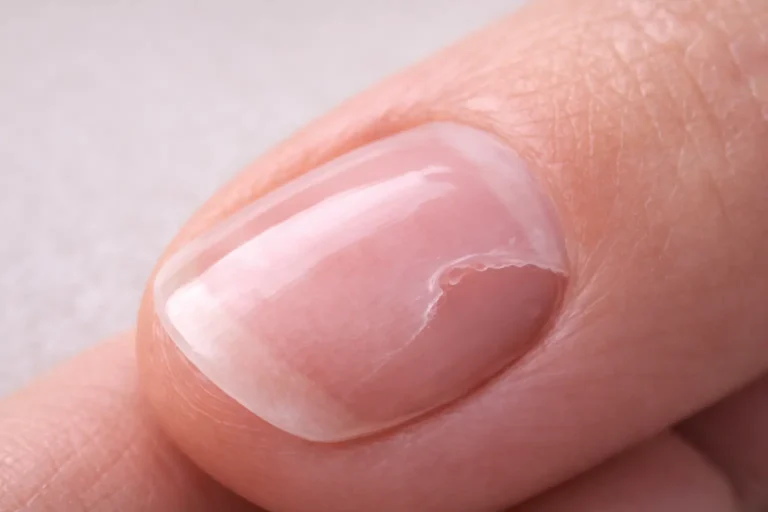
Lifting does not happen randomly. Each lifting pattern corresponds to a specific technical error. Edge lifting indicates incomplete seal or contamination during application. Proximal lifting suggests inadequate preparation or moisture exposure. Corner lifting reveals structural weakness or improper apex placement.
When you understand what each pattern reveals, you can identify your technical gap and correct it. When you do not, you try random solutions—switching products, adding extra primer, applying thicker layers—and the lifting continues because you are not addressing the actual mechanical cause.
Professional training teaches you to read failure patterns the way a mechanic reads fault codes. The location, timing and progression of lifting tell you exactly which part of your technique requires adjustment.
Preparation Standards vs Preparation Steps
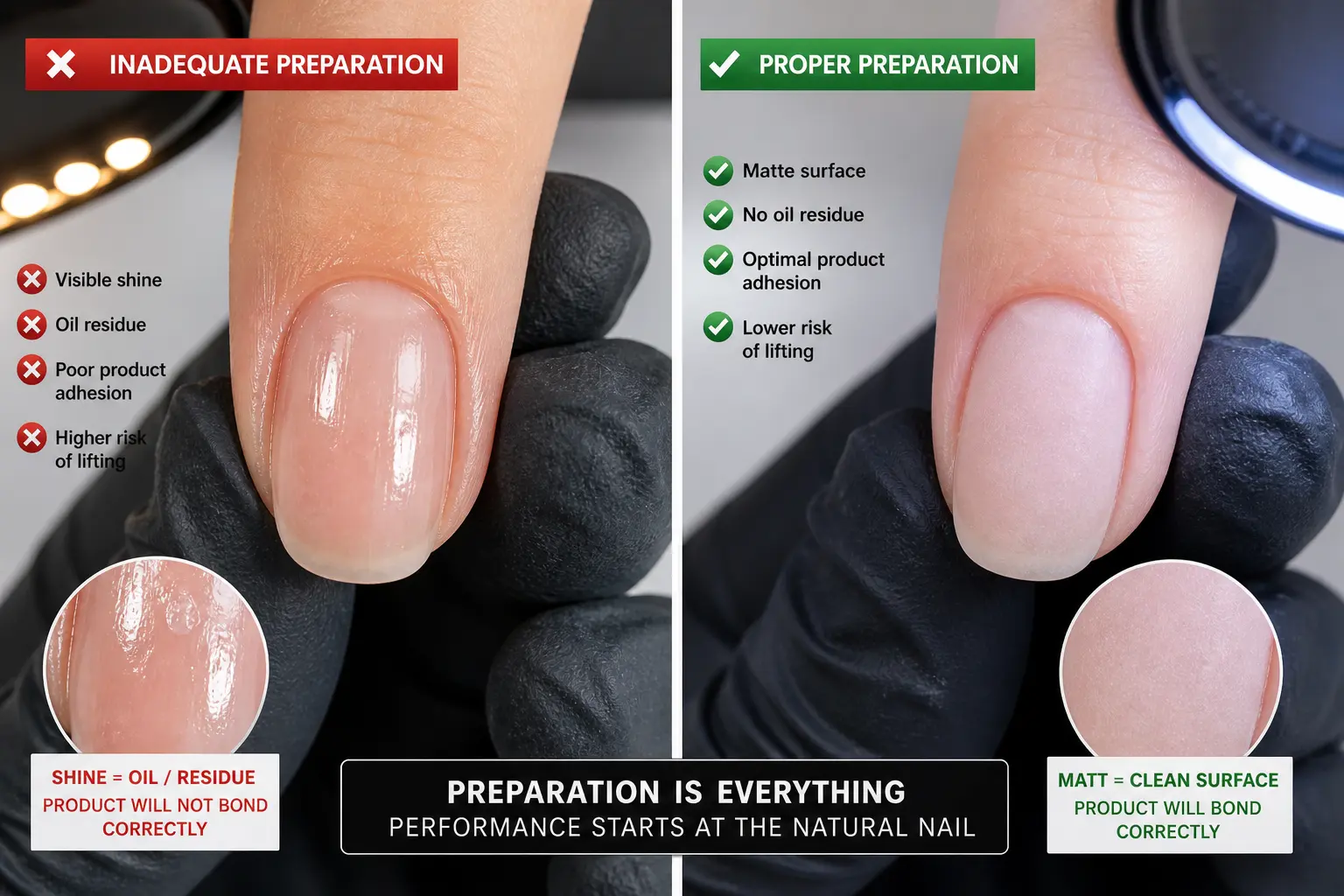
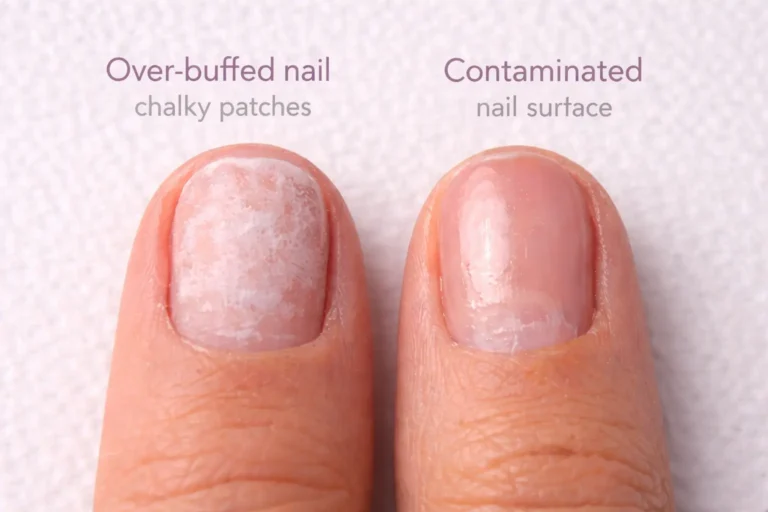
Basic courses teach you preparation steps: buff the nail, apply dehydrator, apply primer. Professional courses teach you preparation standards: what degree of surface texture creates mechanical bond, what contamination indicators to check for, how to verify complete product removal from previous applications.
Following steps without understanding standards means you might be under-preparing or over-preparing the nail plate and not recognising it until the enhancement lifts. You buffed the nail, but you did not remove enough natural oil. You applied dehydrator, but moisture remained in the lateral folds. You applied primer, but it pooled rather than spreading in a thin film.
Professional courses demonstrate what correct preparation looks like under magnification, show you the common errors that appear adequate to the naked eye but cause premature failure, and teach you the assessment checks that confirm readiness before product application.
Product Behaviour vs Product Instructions
Product instructions tell you application steps. They do not tell you what the product should look like when applied correctly, what it looks like when applied incorrectly, or how to recognise the difference before curing.
You applied the builder gel in a thin layer as instructed. But you do not know whether your layer was actually thin enough, whether it self-levelled properly, whether air bubbles formed during placement or whether the apex ended up in the correct position. You cured it and discovered the problem only on removal when the enhancement lifted or the structure failed.
Professional online nail courses show you what correct product behaviour looks like at each application stage. They demonstrate viscosity flow, self-levelling patterns, bubble formation and apex positioning in real time, then show you the incorrect versions and explain how to identify and correct them before curing. This is how you prevent failures instead of reacting to them.
Stress Point Coverage That Actually Holds
Enhancements fail at stress points: the free edge, the lateral walls, the proximal fold, the apex transition. These areas experience the most mechanical force during normal hand use. If your product coverage or bond is inadequate at any stress point, lifting will begin there.
Basic training shows you where to place product. Professional training shows you how to verify complete coverage and adequate bond at each stress point before the client leaves. This means checking lateral seal under magnification, confirming apex placement relative to the nail’s natural stress curve, verifying free edge encapsulation and ensuring proximal coverage without skin contact.
When you can assess these points accurately, you catch potential failures before they occur. When you cannot, you discover them when the client sends you a photograph of their lifted enhancement three days later.
Performance Testing vs Procedure Completion
Most lifting problems persist because no one assesses your actual technical execution and tells you what you are doing incorrectly. You complete the course, you follow the steps, you assume your technique is correct because you did what the demonstration showed.
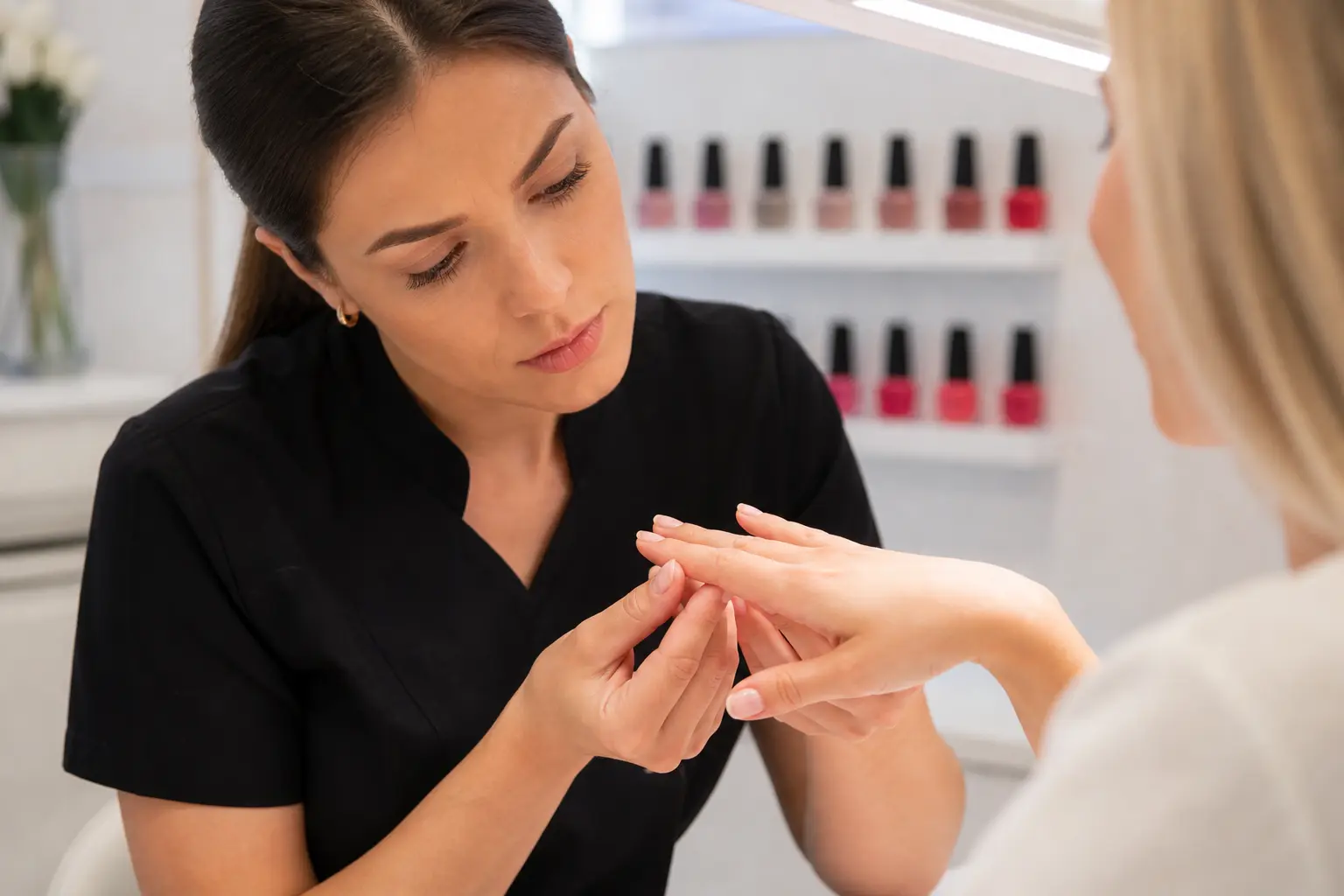
Professional online nail courses include work submission and technical feedback. You complete an application. You photograph your result. An educator reviews your preparation quality, product placement, apex structure, stress point coverage and curing adequacy, then identifies the specific errors present and explains the exact corrections required.
This feedback loop is what eliminates persistent problems. You discover that your “thin layer” is actually too thick, that your dehydrator application missed the lateral folds, that your apex placement is too far forward. You make the specific adjustment. Your results improve. This is how professional competence develops.
What Diagnostic Training Changes
The difference between knowing application steps and achieving consistent results is diagnostic ability. When you can identify which technical factor caused a failure, you can correct it. When you cannot, you repeat the same errors and blame the products, the weather or the client’s lifestyle.
Professional online nail courses teach you to diagnose your own work, recognise failure patterns before they progress and apply the specific technical corrections that eliminate lifting. This is what allows you to move from inconsistent results to reliable professional performance.
Stop Guessing. Start Diagnosing.
Artistic Touch online nail courses teach diagnostic assessment, demonstrate common failure modes and provide professional feedback on your submitted work. Learn what causes lifting and how to correct it before your client notices.
View Courses →Lifetime access • Private student community • Start immediately
Frequently Asked Questions
Why do my gel enhancements still lift after I completed a course?
Lifting after basic training typically indicates gaps in preparation technique, product application or curing protocol that the course did not diagnose or correct. Most courses teach application steps but do not include performance assessment or technical feedback, which means errors in your execution go undetected until enhancements fail on clients.
What is the most common cause of lifting in gel nails?
Inadequate nail plate preparation is the most common cause, specifically incomplete removal of natural oils, moisture or previous product residue. Proper preparation requires more than buffing—it requires complete surface decontamination, correct dehydrator application and appropriate primer coverage when indicated by the product system.
How can I tell if my preparation technique is correct?
Correct preparation produces a uniformly matte surface with no shine, complete removal of previous product, no visible moisture in the lateral folds or under the free edge, and appropriate surface texture for mechanical bond. If your enhancements lift consistently in the same pattern or location, your preparation standard at that specific area requires correction.
Will switching products fix my lifting problem?
Switching products rarely fixes lifting caused by incorrect technique. If your preparation, application or curing protocol has technical errors, those errors will cause lifting regardless of which product system you use. Identify and correct the technical cause before changing products.
How long should gel enhancements last without lifting?
Properly applied gel enhancements should last 2-3 weeks minimum without lifting when technique is correct and the client follows aftercare guidance. Lifting within the first week indicates technical error. Lifting after 3-4 weeks is normal wear as natural nail growth creates stress at the enhancement margin.
Can online courses help me fix lifting problems?
Online courses that include diagnostic training, failure demonstration and professional feedback on submitted work can effectively resolve lifting problems. The course must show you what incorrect technique looks like and provide specific corrections based on assessment of your actual work, not just repeat application demonstrations.
About the Author
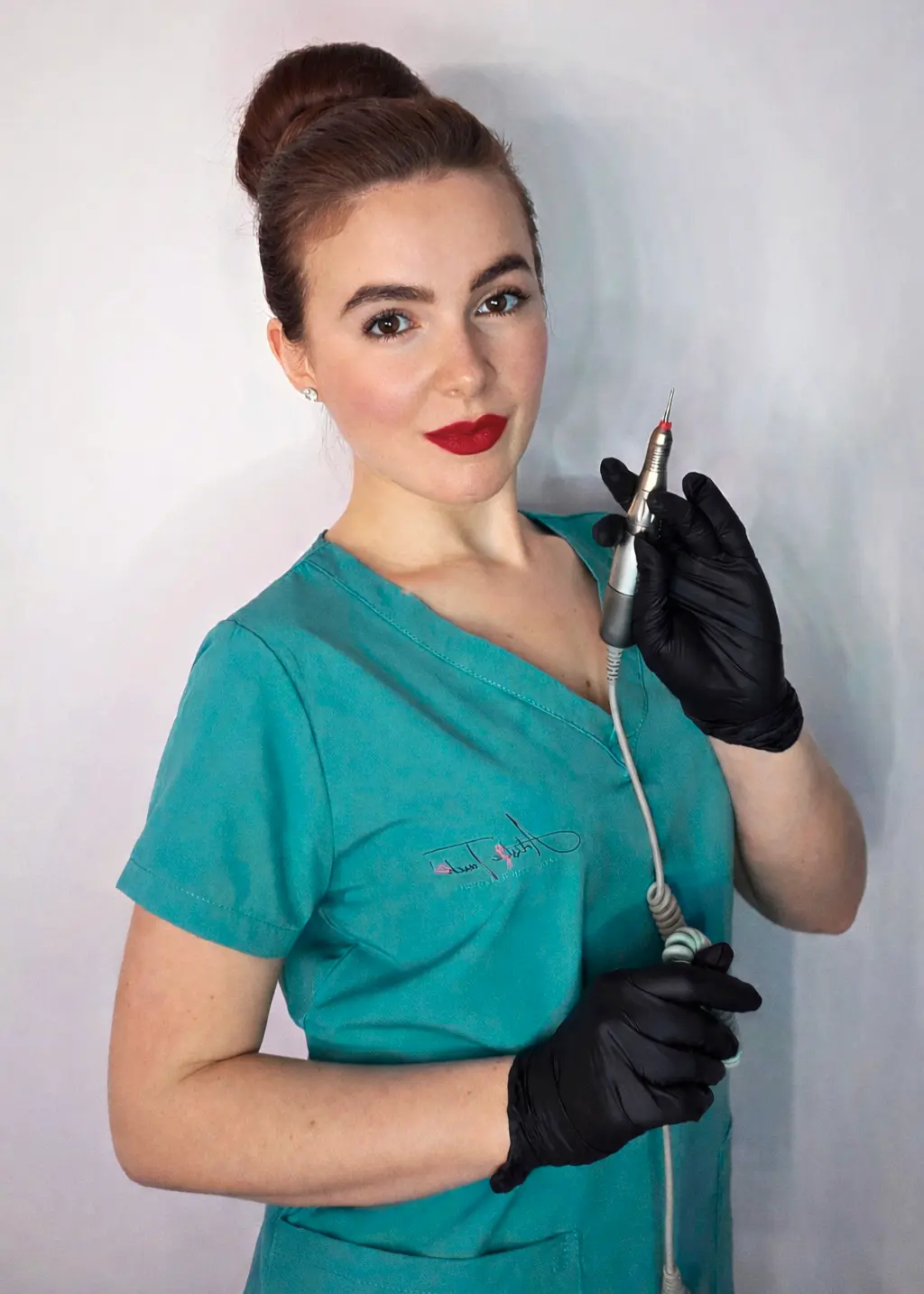
Radina Ignatova
Professional Nail Expert | International Nail Educator
I am Radina Ignatova, a Professional Nail Expert since 2014 and International Nail Educator, based in Scotland, UK. I am the Founder of Artistic Touch Nail Training Academy and TheNailWiki.
At Artistic Touch Nail Training Academy, I provide structured professional online nail courses specialising in dual forms, gel systems, polygel application, advanced nail structure, E-File work and Russian Manicure, with a strong focus on professional salon safety. I continue to work actively in salon practice, ensuring that all education reflects real client scenarios and current industry standards.
My teaching philosophy is simple: I show real salon challenges, real mistakes and real performance testing, not just perfect demonstrations. This is how you develop genuine technical competence and become a confident, capable nail professional.
Every Artistic Touch course includes lifetime access and access to a dedicated student support group, where I provide ongoing guidance and professional feedback.
Disclaimer: This content is for educational purposes only. Nail services should be performed by trained professionals following current hygiene and safety regulations. Always carry out a full client consultation and check for contraindications before performing any nail service.
About Artistic Touch Nail Training Academy
Artistic Touch Nail Training Academy delivers structured professional online nail education focused on practical skill development, professional standards and safe salon practice. All courses are available online worldwide.