Best Online Nail Courses UK 2025: What to Look For (Buyer’s Guide)

Quick Answer: What Makes a Quality Online Nail Course?
Quality online nail courses prioritise real-world salon skills over certificates. Look for courses taught by active nail professionals with genuine industry experience, offering structured troubleshooting training, lifetime access, and honest transparency about certification status.
Essential features: Video demonstrations of actual techniques, problem-solving modules, client safety protocols, professional business training, and realistic skill expectations.
Investment range: Professional masterclass training typically ranges from £47-£297 depending on course depth and specialisation. Quality training pays for itself within 1-2 client appointments.
Why Online Nail Training Has Transformed Professional Education
The nail industry has undergone a dramatic shift in how professionals learn advanced techniques. Ten years ago, mastering specialised skills like BIAB (Builder in a Bottle) or Russian-style e-file manicure required travelling to expensive workshops, often in London, with limited follow-up support.
Today, online nail courses offer something traditional workshops never could: unlimited access to expert demonstrations, the ability to pause and replay complex techniques, and lifetime support – all without leaving your home or salon.
But not all online nail courses deliver equal value.
The UK online nail training market now includes everything from £20 certificate-printing services with no real content to comprehensive £300+ masterclasses taught by active salon professionals. The difference in quality – and the impact on your career – is staggering.
This guide reveals exactly what separates professional-grade online nail training from expensive disappointments. Whether you are a complete beginner exploring nail artistry or an experienced technician adding advanced techniques, understanding these critical factors will save you time, money, and frustration.
10 Essential Features of Quality Online Nail Courses
Before investing in any online nail training, evaluate courses against these ten critical criteria:
1. Real Salon Experience from Active Professionals
The most important factor is rarely mentioned: Is your instructor currently working with real clients?
Many online courses are taught by educators who transitioned away from salon work years ago. They teach theory and basic technique but cannot address the real-world problems you will encounter: difficult cuticles, clients with oily nail beds, retention issues, or how to handle allergic reactions.
What to verify:
- Does the instructor currently operate a salon or see clients regularly?
- Are there recent photos or videos of their actual client work?
- Do they share real troubleshooting experiences and solutions?
- Can they demonstrate techniques on actual clients, not just practice hands?
Why This Matters
Techniques that work beautifully on practice hands often fail on real clients with thin nails, excessive cuticles, or nail plate damage. Active salon professionals teach you how to adapt techniques to challenging real-world situations – the skill that separates confident technicians from struggling beginners.
2. Troubleshooting Training, Not Just Application Steps
Most nail courses teach you how to apply products. Exceptional courses teach you why things go wrong and how to fix them.
The difference becomes apparent the moment you encounter your first problem client: gel that lifts within two days, BIAB that peels at the cuticle, or heat spikes that make clients uncomfortable. Without troubleshooting training, you waste hours searching YouTube for solutions that may not apply to your specific situation.
Quality courses include:
- Common problem modules: Dedicated lessons on lifting, peeling, cracking, and retention issues
- Cause-and-solution frameworks: Clear explanations of why problems occur and multiple solution approaches
- Client-specific adaptations: How to modify techniques for thin nails, oily nail beds, damaged plates
- Prevention protocols: Systems that stop problems before they start
3. Lifetime Access with Regular Updates
Nail techniques, products, and safety protocols evolve constantly. A course filmed in 2020 may teach methods that are now outdated or contain product recommendations for discontinued items.
Premium courses offer:
- Lifetime access: Return and review techniques as many times as needed
- Content updates: New modules added as techniques evolve
- Community support: Ongoing access to instructor guidance and peer support
- Skill refreshers: Ability to review specific techniques before client appointments
Avoid courses with time-limited access (30 days, 90 days) or those requiring repurchase for updated content. Professional development is ongoing – your training resources should reflect this reality.
4. Honest Transparency About Certification Status
The UK nail industry has no legal requirement for qualifications or certifications to practice. However, insurance companies often require specific credentials, creating confusion about which certificates hold value.
Red flag: Courses that imply their certificates carry official weight without clearly stating accreditation status.
What honest course providers disclose:
- Clear statement: “Non-Accredited Certificate of Completion” or “Insurance-Recognised Qualification”
- Explanation of what the certificate represents (skill completion, not professional qualification)
- Guidance on insurance requirements and whether the course meets those standards
- Realistic expectations about career advancement and client trust
Important Distinction
Non-accredited certificates from expert professionals often provide superior practical training compared to basic accredited courses. The value lies in the skills gained, not the paper certificate. Choose courses based on instructor expertise and content quality, not certification status alone.
5. Comprehensive Safety and Client Health Protocols
Professional nail services involve chemical products, power tools, and direct skin contact. Quality training prioritises client safety as heavily as technique perfection.
Essential safety modules:
- Patch testing protocols: When required, how to perform, documentation requirements
- Allergy awareness: Recognising reactions, emergency protocols, legal responsibilities
- Sanitation and hygiene: Tool sterilisation, workspace cleanliness, cross-contamination prevention
- Client consultation: Health screening, contraindications, informed consent
- Product safety: Chemical handling, storage, COSHH compliance
Courses that rush through or skip safety training create liability risks and endanger clients. This content should comprise at least 20-30% of total course material.
6. Professional Business Training Integration
Technical skill without business knowledge leads to underpricing, scope creep, and professional burnout. Comprehensive courses address the business side of nail services.
Business modules should cover:
- Pricing strategies: Cost calculation, market positioning, service menus
- Client communication: Consultations, managing expectations, handling complaints
- Legal protection: Terms and conditions, liability waivers, refund policies
- Appointment management: Scheduling, deposits, cancellation policies
- Professional boundaries: Scope of practice, when to refuse services, ethical considerations
7. Structured Progressive Learning Modules
Professional techniques build upon foundational skills. Quality courses follow logical progression rather than random topic presentation.
Effective course structure:
- Foundation: Nail anatomy, safety basics, workspace setup
- Preparation: Nail preparation, cuticle work, surface preparation
- Core technique: Product application, layering, curing
- Refinement: Finishing techniques, corrections, polish
- Troubleshooting: Problem identification and solutions
- Advanced applications: Complex scenarios, difficult clients, specialty techniques
- Business integration: Pricing, marketing, client management
Avoid courses that present advanced techniques before covering fundamentals or those structured as random video collections without clear learning pathways.
8. High-Quality Video Production with Multiple Angles
You cannot learn precision techniques from blurry, poorly-lit videos filmed on mobile phones. Professional training requires professional video quality.
Production quality indicators:
- Clear visibility: Close-up shots showing exact hand positions, brush angles, product placement
- Multiple camera angles: Overhead, side view, client perspective
- Proper lighting: No shadows obscuring technique demonstration
- Clear audio: Instructor explanations easily understood
- Edited pacing: Unnecessary repetition removed, key steps emphasised
9. Realistic Skill Timeline and Practice Expectations
Beware courses promising “master BIAB in 2 hours” or “become a professional nail technician in one weekend.” Complex techniques require dedicated practice time.
Honest courses provide:
- Realistic timelines: “Confidence in 4-6 weeks with regular practice”
- Practice recommendations: Minimum practice hours before accepting paid clients
- Skill progression markers: Clear indicators of readiness for client work
- Continued learning emphasis: Acknowledgment that mastery requires ongoing refinement
10. Clear Return on Investment Demonstration
Professional training is an investment. Quality courses demonstrate exactly how quickly that investment returns.
Example ROI calculation for BIAB training:
Course investment: £297
Average BIAB service price: £60-75
Clients needed to recover investment: 4-5 appointments
Timeline to profitability: 1-2 weeks for active technicians
Every appointment after that is pure profit increase from your new skill.
Understanding Different Online Nail Course Categories
Not all online nail courses serve the same purpose. Understanding the four main categories helps you choose training that matches your current skill level and career goals.
Category 1: Business Training & Legal Protection
These courses address the professional infrastructure supporting your technical skills. Often overlooked by beginners, business training becomes critical the moment you encounter your first difficult client, legal question, or pricing dilemma.
Essential business courses include:
- Client consultation and safety: Health screening, consent forms, liability protection
- Patch testing protocols: When required, proper procedure, documentation, allergy management
- Terms and conditions: Legal language, service agreements, refund policies
- Professional communication: Managing expectations, handling complaints, boundary setting
Example: Nail Consultation Form Course
Investment: £297
Value: Legal protection against liability claims, professional client screening, comprehensive health and safety compliance
ROI: Prevents costly legal disputes and protects your business reputation. One avoided claim pays for the course hundreds of times over.
Best for: All nail technicians, especially those working independently or from home
Category 2: Specialised MasterClasses
Targeted training addressing specific skills, safety protocols, or problem-solving techniques. These courses typically focus on one critical area in depth.
Example: Nail Patch Testing MasterClass
Investment: £47
Value: Proper patch testing procedure, legal documentation, allergy recognition, emergency protocols
ROI: Protects clients and your business. Demonstrates professional standards. Provides clear documentation if allergic reactions occur.
Best for: Technicians offering gel, acrylic, or BIAB services; those expanding client base; anyone prioritising client safety
Category 3: Core Skills & Theory
Comprehensive training in specific nail services. These courses teach complete systems from preparation through finishing, including product selection, application technique, and troubleshooting.
Example: BIAB Masterclass – Application & Troubleshooting
Investment: £297
Value: Complete BIAB system training including structure, apex creation, troubleshooting lifting and peeling, safe removal, client aftercare
ROI: BIAB services command £60-75 per appointment. Course pays for itself in 4-5 clients. Every subsequent BIAB client represents pure profit increase.
Typical timeline: 4-6 weeks practice to confident client-ready application
Best for: Technicians adding strengthening services; those seeking alternatives to extensions; professionals wanting longer-lasting options than gel polish
Category 4: Advanced Techniques
Sophisticated methods that significantly elevate service quality and client retention. Advanced technique courses assume existing nail knowledge and focus on precision, problem-solving, and professional refinement.
Example: E-File Manicure & Gel Polish Course – Long-Lasting Results
Investment: £297
Value: Russian-style e-file technique for superior cuticle preparation, gel polish retention of 3-4 weeks, safe removal methods, skin polishing for professional finish
ROI: Justify premium pricing (£10-15 increase per service). Reduce client complaints about lifting. Increase client retention through superior results. Differentiate from competitors still using traditional methods.
Skill impact: Transforms basic gel polish application into premium service. The single most impactful skill upgrade for retention improvements.
Best for: Experienced technicians struggling with lifting; professionals ready to charge premium prices; those wanting to offer superior retention
Red Flags: Avoiding Low-Quality Online Nail Courses
Recognising warning signs saves time, money, and frustration. Avoid courses displaying these characteristics:
⚠️ Critical Warning Signs
- Unrealistic promises: “Become a professional nail technician in 2 hours” or “Master advanced techniques this weekend”
- No instructor credentials: No information about who teaches the course or their professional background
- Certificate-focused marketing: Emphasises certificate over skills gained
- Vague course content: No detailed curriculum or module breakdown provided
- No sample videos: Cannot preview teaching style or video quality before purchasing
- Time-limited access: Course expires after 30-90 days requiring repurchase
- Poor reviews or no reviews: No student testimonials or consistently negative feedback
- Suspiciously low pricing: Comprehensive masterclass for £10-20 (indicates minimal content)
- High-pressure sales tactics: “Only 3 spots left!” or constant countdown timers
- No refund policy: Cannot return course if content does not match description
Online vs In-Person Training: Understanding the Differences
Both online and in-person training have distinct advantages. Understanding these differences helps you choose the format that matches your learning style and circumstances.
✓ Online Training Advantages
- Learn at your own pace
- Unlimited replay of complex techniques
- No travel costs or time
- Lifetime access for skill refreshers
- Study around work/family commitments
- Pause during practice sessions
- Lower overall investment
✓ In-Person Training Advantages
- Immediate hands-on correction
- Physical demonstration on your work
- Real-time question answering
- Networking with other students
- Structured, intensive learning
- External accountability
- Full immersion experience
The modern solution: Many professionals choose online training for its flexibility and lifetime access, then attend occasional in-person workshops for hands-on refinement once they have practised the basics. This hybrid approach maximises both convenience and skill development.
Frequently Asked Questions About Online Nail Courses UK
Are online nail courses worth the investment?
Yes, when chosen carefully. Quality online courses offer lifetime access, allowing you to review techniques indefinitely. A £297 course typically pays for itself within 4-5 client appointments. The key is selecting courses taught by active professionals with real salon experience rather than cheap certificate-printing services.
Do I need qualifications to work as a nail technician in the UK?
No legal qualifications are required to practice as a nail technician in the UK. However, insurance companies typically require proof of training. Non-accredited masterclasses from professional educators provide the practical skills you need, whilst basic accredited Level 2-3 courses may be required for insurance purposes. Many technicians combine both: accredited foundation courses for insurance, plus professional masterclasses for actual skill development.
How long does it take to complete an online nail course?
Course completion time varies by complexity and your practice schedule. Most professional masterclasses contain 2-4 hours of video content but require 4-6 weeks of practice to achieve client-ready confidence. Online format advantage: you control the pace, reviewing difficult sections as many times as needed.
Can I get insurance with an online nail course certificate?
Insurance requirements vary by provider. Some insurers accept non-accredited professional training, whilst others require specific awarding body qualifications. Contact insurance providers directly about their requirements before purchasing courses. Many technicians maintain basic accredited qualifications for insurance purposes whilst relying on professional masterclasses for actual skill development.
What is the difference between accredited and non-accredited courses?
Accredited courses meet specific educational standards set by awarding bodies and typically satisfy insurance requirements. Non-accredited courses focus purely on practical skill development without external oversight. Professional non-accredited masterclasses often provide superior practical training because instructors are active salon professionals rather than institutional educators. The certificate matters less than the skills gained.
Should I start with basic or advanced courses?
This depends on your current experience. Complete beginners should start with foundational courses covering nail anatomy, safety, and basic application. Experienced technicians can proceed directly to advanced technique courses like BIAB or e-file manicure. Business training courses benefit all experience levels as they address client management and legal protection rather than technical skills.
How much can I charge after completing an online nail course?
Pricing depends on your location, experience, and service quality. BIAB services typically command £60-75, e-file manicures £35-50, basic gel polish £25-35. Advanced technique training justifies premium pricing. Your pricing should reflect your skill level, local market rates, and service quality rather than your certificate status.
Do online courses include ongoing support?
Quality courses provide lifetime access to course materials, allowing you to review techniques at any time. Some include community forums, email support, or periodic live sessions. Verify support offerings before purchasing. Lifetime access is more valuable than time-limited support because you will need refreshers as you progress in your career.
About Your Instructor: Radina Ignatova
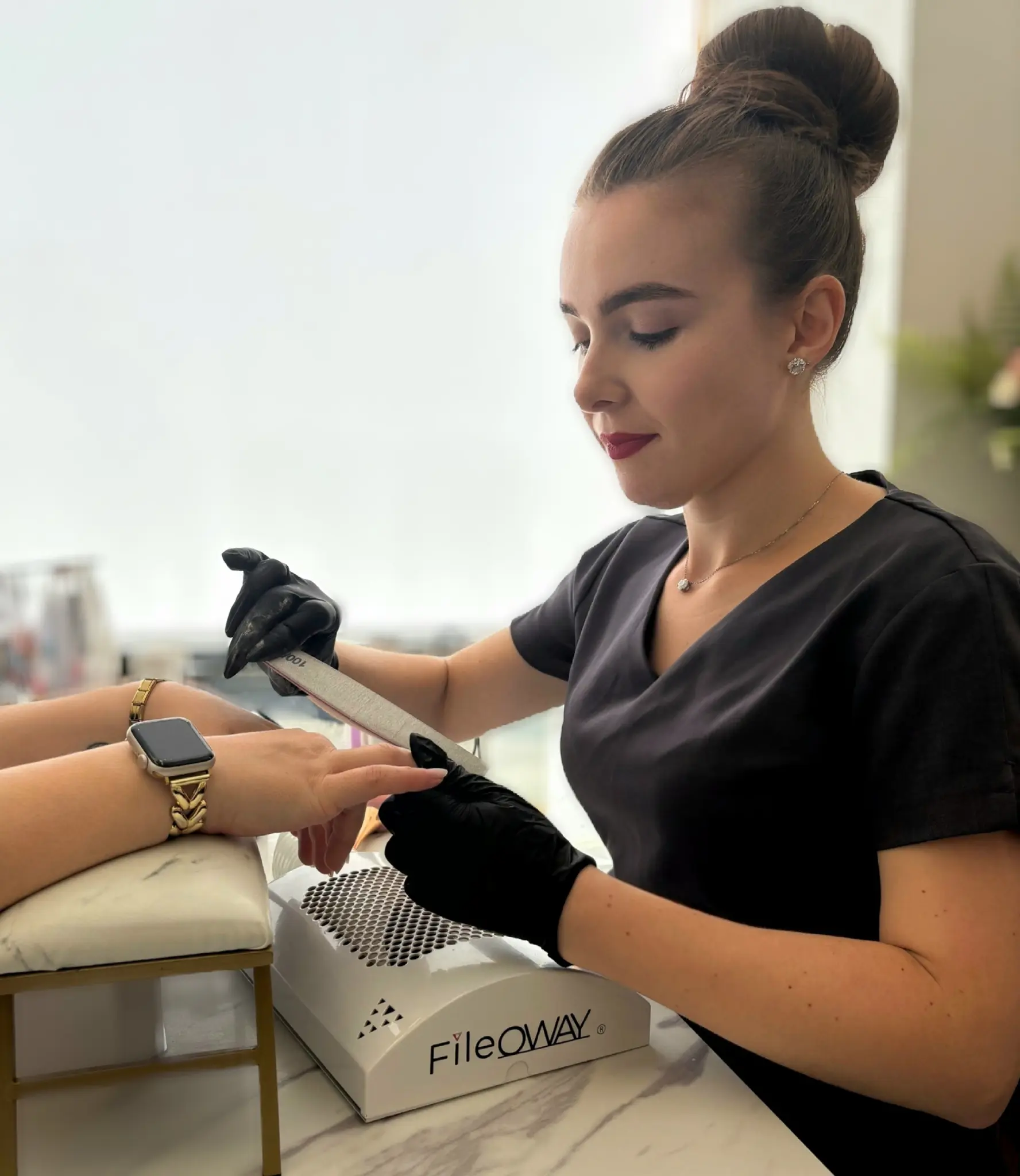
Radina Ignatova is a Professional Nail Expert, Certified Educator, and founder of Artistic Touch – Nail Training Academy, based in Dundee, Scotland, UK.
With over a decade of professional experience operating a busy nail salon whilst simultaneously developing comprehensive training programmes, Radina brings rare dual expertise: active salon practice combined with educational clarity.
Her teaching philosophy focuses on:
- Real-world techniques that work in busy salon environments, not just theory
- Comprehensive troubleshooting rather than perfect application demonstrations only
- Honest transparency about skill development timelines and certification status
- Professional business practices integrated with technical training
Choose Professional Training That Delivers Real Career Value
Online nail education has transformed professional development in the UK beauty industry. Quality training now reaches technicians in remote Scottish islands, busy working parents who cannot attend day workshops, and experienced professionals seeking specific skill upgrades without repeating foundational content.
The key is choosing courses based on skills gained rather than certificates earned. A £297 masterclass taught by an active salon professional delivers infinitely more career value than a £50 certificate from someone who stopped practising years ago.
Your training investment should pay for itself within weeks through superior client results, increased confidence, and the ability to charge premium pricing.
Professional Nail Training from Artistic Touch Academy
All courses taught by Radina Ignatova include lifetime access, structured troubleshooting training, professional business guidance, and honest transparency about certification status.
E-File Manicure & Gel Polish Course – Advanced Techniques
Master Russian-style e-file technique for superior cuticle preparation and consistent 3-4 week gel polish retention. Includes safe removal methods, skin polishing, and comprehensive troubleshooting.
Investment: £297 | Certificate: Non-Accredited Certificate of Completion
BIAB Masterclass – Application & Troubleshooting
Complete Builder in a Bottle training including structure creation, apex mastery, preventing lifting and peeling, safe removal protocols, and client aftercare guidance.
Investment: £297 | Certificate: Non-Accredited Certificate of Completion
Nail Consultation Form – Client Safety & Business Protection
Professional client consultation system including health screening, legal protection, informed consent, liability prevention, and comprehensive safety protocols.
Investment: £297 | Certificate: Non-Accredited Certificate of Completion
Nail Patch Testing – Safe Methods for Nail Techs
Proper patch testing procedure, legal documentation requirements, allergy recognition, emergency protocols, and professional client safety standards.
Investment: £47 | Certificate: Non-Accredited Certificate of Completion
Invest in Professional Skills That Transform Your Career
All courses include lifetime access, troubleshooting training, and Non-Accredited Certificates of Completion
Professional training from active salon expert • Start immediately
About Artistic Touch – Nail Training Academy: Professional online nail education delivered by Radina Ignatova from Dundee, Scotland, UK. Specialising in advanced nail techniques, troubleshooting training, business protection guidance, and honest transparent education for aspiring and professional nail technicians across the UK.