When Should You Stop During Russian Manicure?
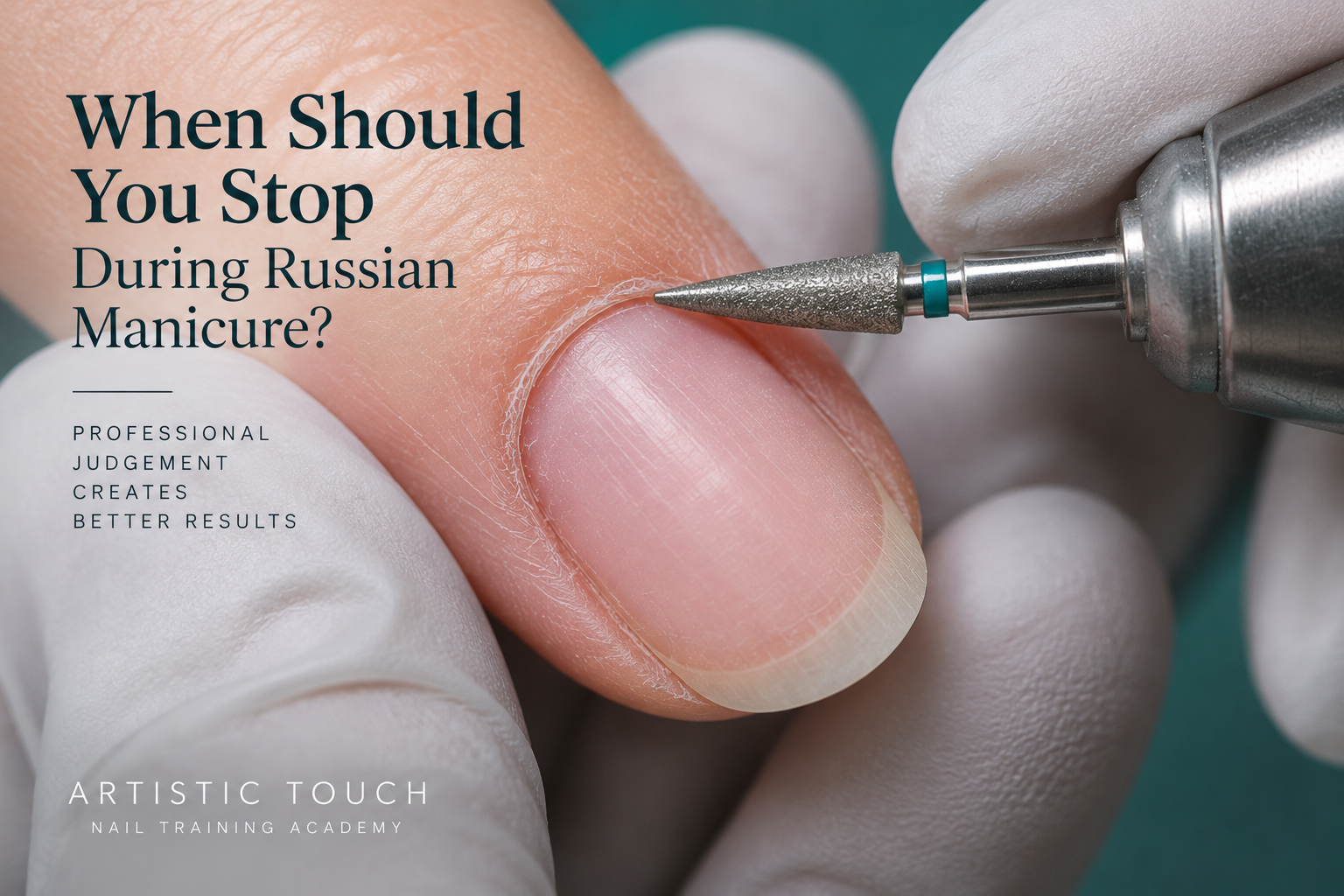
When Should You Stop During Russian Manicure?
You should stop once continuing is no longer a deliberate, necessary decision — once you are working past what your assessment of that client’s tissue actually required, rather than continuing because a small area still looks slightly unfinished. Recognising that point is a professional judgement, not a fixed stage in the sequence, and treating “finished” as identical to “every trace of visible cuticle removed” is the assumption worth reconsidering.
Most Russian Manicure training teaches a sequence, and sequences are reassuring. They give you a clear beginning, a clear middle, and a clear end. The trouble is that “the end” is often taught as a visual state — the cuticle looks clean, the plate looks bare, the line looks tidy — rather than as a decision you actively make.
That difference matters more than it sounds like it should.
The Instinct to Keep Going Until It “Looks Finished”
There is a particular moment in Russian Manicure where the plate looks almost clean, but not quite. A small edge of tissue is still there. It would be easy — quick, even — to go back over it once more.
That instinct is not carelessness. It usually comes from good intentions: wanting the result to be as clean as possible for the client. But “clean” and “continuing” are not the same decision, and treating them as interchangeable is where stop judgement starts to erode.
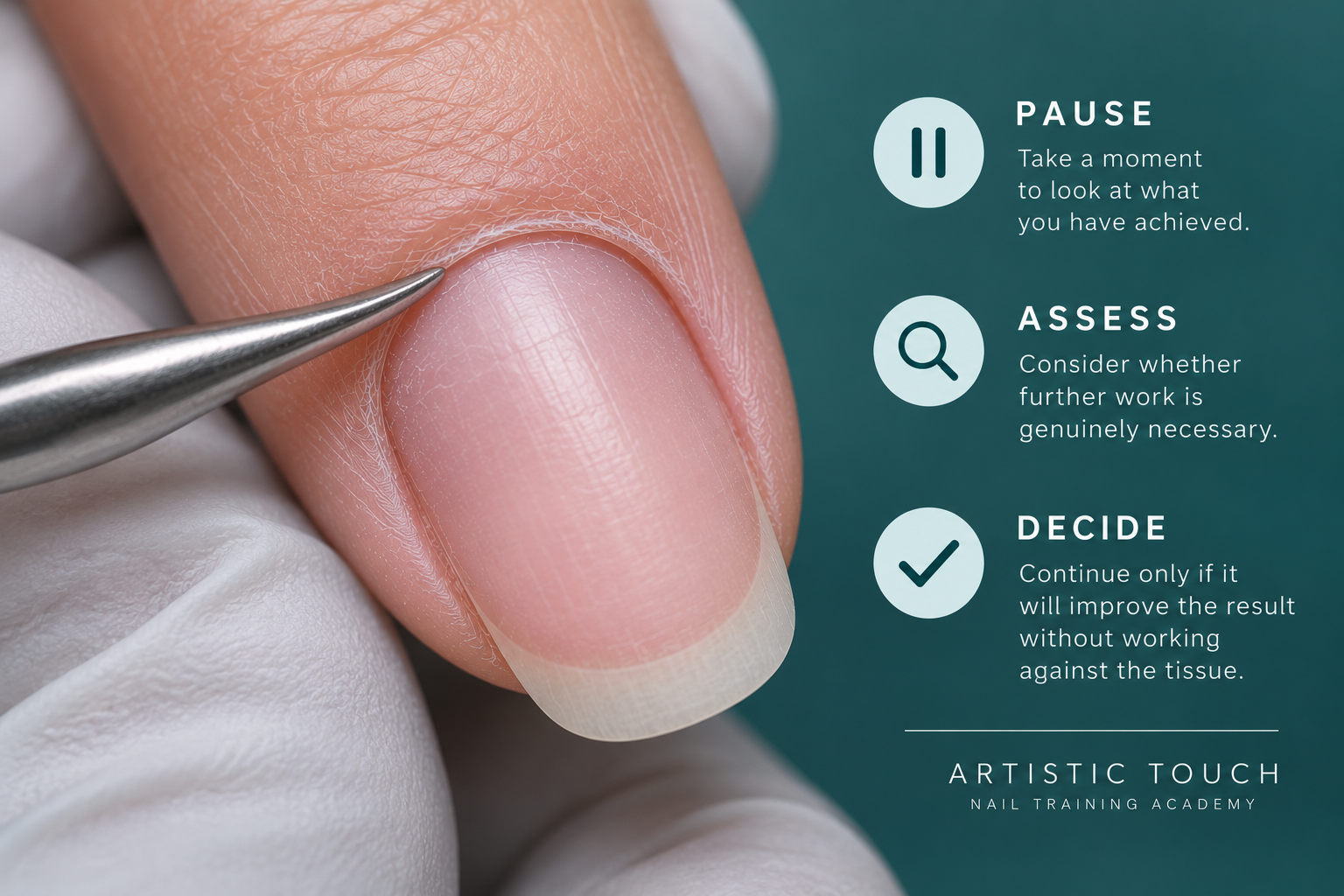
What a Stop Decision Actually Involves
Deciding to stop is not the absence of a decision. It is choosing, consciously, whether the next pass is genuinely necessary for that client’s tissue, or whether it is being driven by something else — the pull of a small area that still looks slightly unfinished, or simply the habit of continuing until a sequence feels complete.
This is why assessment does not end once you begin working. The same attention that informed how you approached the tissue at the start of the service is what tells you, honestly, whether you are still responding to that tissue or have started working toward an idea of “finished” that has little to do with what is actually in front of you.
Continuing Is Not Automatically More Thorough
There is an assumption worth questioning directly: that more time spent on an area is the same thing as more thoroughness. In Russian Manicure, that is not reliably true. Thoroughness is about accuracy — working the right amount, in the right place, at the right moment — not about duration.
A technician who stops at the appropriate point after an efficient, well-controlled pass has not done less than a technician who kept going for longer. A technician who continues for longer has not necessarily done more useful work — she may simply have kept going after the point where continuing was genuinely adding anything.
Recognising the Point Where More Work Adds Risk, Not Quality
There is a point in most services where the work that remains is no longer about the assessment you made at the start — it is about a visual detail that has become distracting in the moment. Recognising that shift is a professional skill, even though it is difficult to describe in general terms, because it depends entirely on what you assessed for that specific client and whether the current pass is still responding to it.
Recognising it does not mean becoming overly cautious or stopping early out of hesitation. It means being honest with yourself about whether the next pass is still necessary, based on what you decided this client’s tissue needed, or whether it is being driven by how a small area happens to look in that instant.
This kind of stop judgement is difficult to teach from a static image, because it depends on what is actually happening under the bit, moment to moment, and how you interpret it. Russian Manicure – Beyond Technique demonstrates this kind of real-time decision-making across genuine client tissue, alongside the anatomy, e-file control and assessment skills that make it possible to apply.
Trusting the Decision, Not Just the Mirror Check
Many technicians validate a finished result by holding the hand up and checking it looks even under the light. That check has a place, but it happens after the decision to stop has already been made, not instead of it.
If the stop decision itself was reactive — chasing one more visible imperfection rather than continuing to apply the same assessment you started with — the mirror check will not catch that. It only confirms appearance. It does not confirm that continuing was the right call in the first place.
What This Judgement Builds Over Time
Recognising your own stop point consistently is not something that arrives all at once. It develops the same way most professional judgement does — through paying attention, comparing what you expected to what actually happened, and adjusting the next time.
Russian Manicure – Beyond Technique works through this decision-making across different real clients and different tissue conditions, so you are building that judgement against genuine variation rather than a single idealised example.
Build the Judgement Behind Every Decision in Russian Manicure
Russian Manicure – Beyond Technique connects anatomy, e-file control and real-client adaptation into one professional system, including the decisions about when to stop.
About the Author
Professional Nail Expert | International Nail Educator
I am Radina Ignatova, a Professional Nail Expert since 2014 and International Nail Educator, based in Scotland, UK. I am the Founder of Artistic Touch Nail Training Academy and TheNailWiki.
At Artistic Touch Nail Training Academy, I provide structured professional online nail education specialising in dual forms, nail preparation and retention, nail structure, E-File work and Russian Manicure, with a strong focus on professional salon safety. I continue to work actively in salon practice, ensuring that all education reflects real client scenarios and current industry standards.
My teaching philosophy is simple: I show real salon challenges, real mistakes and real performance testing, not just perfect demonstrations. This is how you develop genuine technical competence and become a confident, capable nail professional.
Disclaimer: This content is for professional nail technician education purposes only. Russian Manicure and e-file work should be performed only by trained professionals following current hygiene and safety protocols. Always carry out a full client consultation and check for contraindications before performing any nail service.
About Artistic Touch Nail Training Academy: Professional online nail education delivered by Radina Ignatova, Dundee, Scotland, UK, specialising in Russian Manicure, dual forms, nail preparation and retention, and e-file technique.