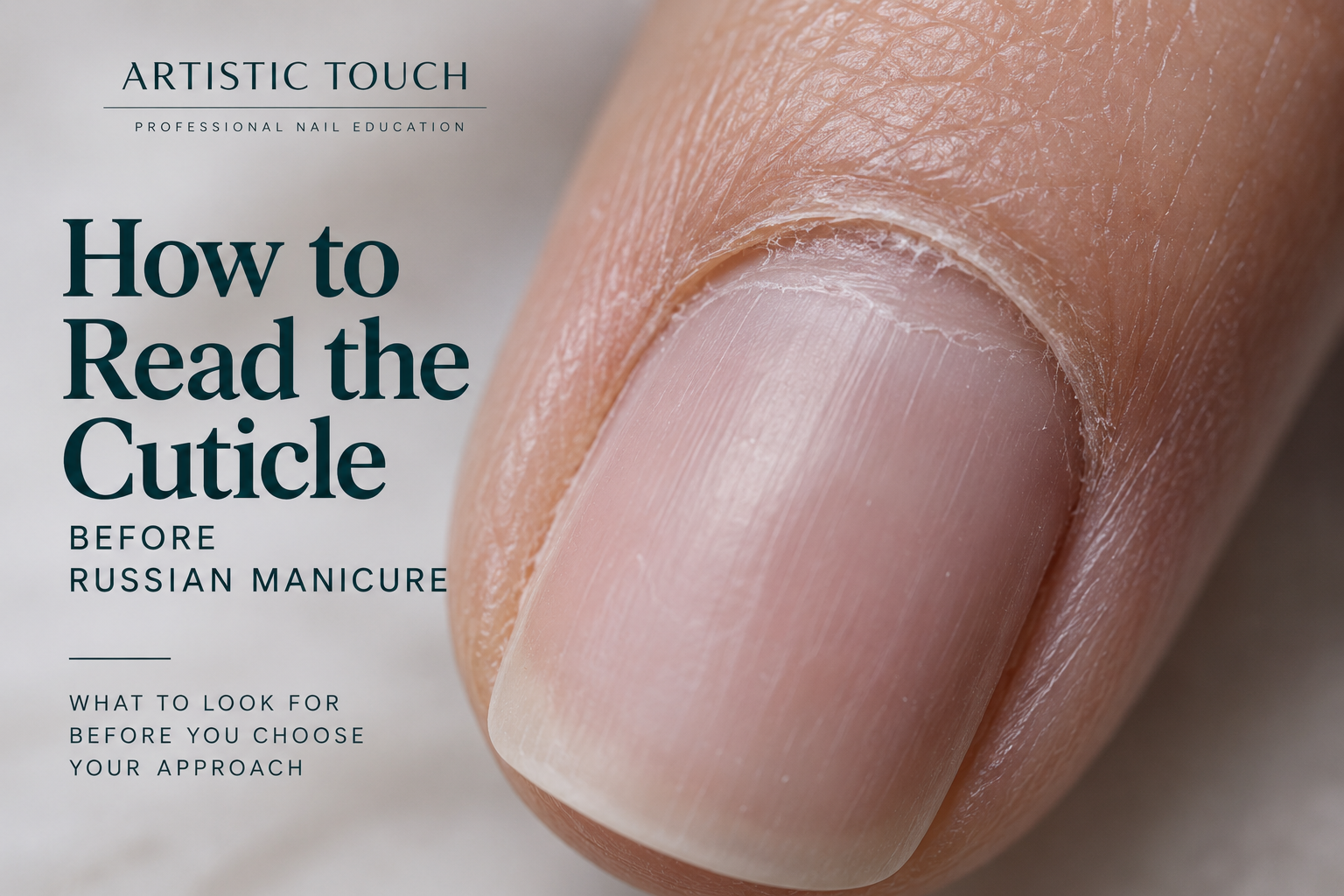
How to Read the Cuticle Before Russian Manicure
How Do You Assess the Cuticle Before Russian Manicure?
Assessing the cuticle before Russian Manicure means looking at, and gently testing, the tissue in front of you before deciding how to approach the service — noting whether it is dry or more hydrated, thin or more resistant, overgrown or closely attached, and how the surrounding skin behaves. This assessment happens before any tool, bit or speed is chosen, because those decisions should respond to what is actually there, not to a routine repeated automatically from the last client.
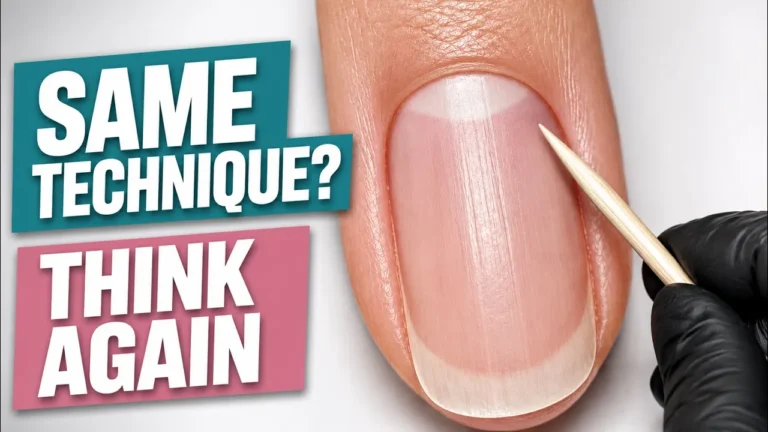
You have performed the same Russian Manicure sequence dozens of times. On some clients, the result is clean and the skin settles comfortably. On another client, using what feels like exactly the same movements, the tissue looks irritated, or the pocket does not open the way it usually does, or you find yourself working longer than you expected to.
The sequence has not changed. The client has.
The Routine Is Not the Problem
Most nail technicians learn Russian Manicure as a sequence: a set order of steps that produces a clean result when followed correctly. That is not incorrect training. A structured sequence is a reasonable and necessary starting point.
What the sequence alone does not account for is that the tissue you are working on is not the same from one client to the next, and is not always the same on the same client from one appointment to another. Two hands can present the same general anatomy and still behave differently under an e-file, because what changes is not the anatomy in the textbook sense — it is the specific condition of the tissue in front of you, on that day.
The question is not only which movement to use. It is what you are looking at before you decide.
What I Am Actually Looking At Before I Begin
Before I pick up an e-file for Russian Manicure, I am looking at a small number of things, and I am doing it deliberately rather than glancing past it on the way to the routine.
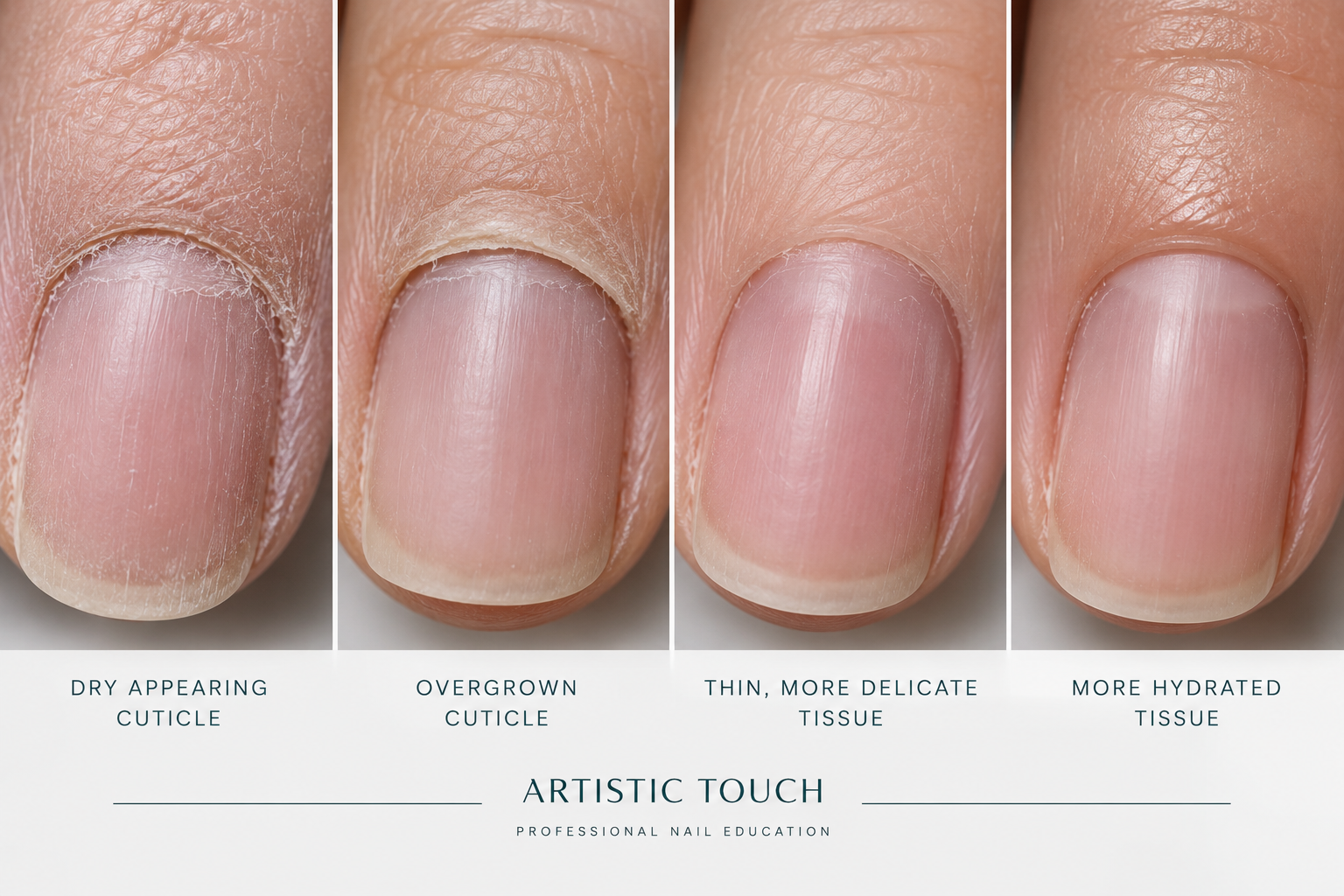
I am looking at whether the tissue appears dry or more hydrated, because this is one of the clearest indicators of what I should expect from it during the service and it can change how I plan to approach that particular client. I am looking at whether it appears thin and delicate, or thicker and more resistant, because that changes how I judge what is a reasonable amount of contact. I am looking at how far the cuticle has grown over the plate, because an overgrown cuticle is not automatically the same situation as a dry one, even though the two can look similar at a glance. And I am looking at the skin surrounding the nail more generally, whether it looks calm, already slightly irritated, or gives me any early reason to think this client’s skin may be more reactive than most.
None of this takes long. It is not a separate consultation stage bolted onto the service. It is a habit of noticing before acting, and it changes what happens next.
Dry or Overgrown Does Not Automatically Mean “Work More”
A common assumption is that dry or overgrown cuticle simply needs more of the same treatment: more passes, more pressure, more time in the same area, until it looks clean. This is where I would slow down and reassess rather than simply do more of what I would normally do.
Dry tissue that is treated exactly the same as any other tissue is not guaranteed to respond the same way, and that uncertainty is precisely why it is worth assessing rather than assuming. Overgrown cuticle is a separate observation again. It tells you that more surface area is covering the plate, not whether that tissue is thick and resistant or thin and delicate. Those are two different questions, and they can lead to different decisions even when the cuticle looks similarly overgrown.
What the tissue looks like on the surface is a starting observation, not a conclusion. The conclusion comes from understanding what you are actually looking at, not from treating appearance as an instruction.
Thin or Sensitive Tissue Changes the Decision, Not Just the Feeling
Thin or sensitive tissue is often noticed only once a client reacts: a flinch, a comment, redness that appears partway through. By that point, the information has arrived later than it needed to.
The more useful moment to notice this is before contact begins, through what the tissue looks like and how it responds to a light initial touch. This does not mean avoiding the area or working so cautiously that the result suffers. It means recognising early that this is a client where the margin between comfortable and uncomfortable is narrower than usual, and adjusting accordingly, rather than discovering that margin by crossing it.
Why the Same Technique Behaves Differently on Different Clients
This is the part that is easy to miss when a routine has been working well for a long time: the technique has not changed, but technique is only one part of the result. The other part is the tissue it is being applied to, and the judgement connecting the two.
Tool, pressure, movement and control matter enormously. But they are being applied to something that varies. A movement that is entirely appropriate for hydrated, more resistant tissue is not automatically appropriate for dry, thin tissue, even though the hand performing it has not changed at all. This is why two technicians can be taught an identical sequence and get identical results on one client, then genuinely different results on the next, not because one of them applied the sequence incorrectly, but because only one of them adjusted it to what was actually there.
The Question Is Not Only “Which Bit Should I Use?”
It is a reasonable question, and tool selection matters. But asking it before assessing the tissue puts the decision in the wrong order. The bit, the speed and the pressure are the response to what you have observed. They cannot meaningfully be chosen first and applied afterwards as though they were universal settings.
A specific bit or speed that suits one client’s tissue is not a rule that transfers automatically to the next client simply because the service being performed has the same name. Recognising that the question needs an assessment behind it, rather than a fixed answer in front of it, is itself a meaningful shift in how the service is approached.
Recognising these differences in the tissue is the first step, and it is one that can genuinely be developed through attention and practice on your own. The deeper professional skill is understanding how each of these observations should actually change your approach: which adjustments matter, how far to adjust, and when the tissue in front of you calls for a different decision altogether rather than a slightly different version of the same one. That connected decision-making is what Russian Manicure – Beyond Technique is built to teach.
Assessment Is a Habit, Not a Checklist
It is worth saying plainly: this is not a formal diagnostic system with named categories that you work through step by step before every client. In real salon work, it happens quickly, almost as part of sitting down and taking the client’s hand. The skill is not remembering a checklist. It is training your attention to notice before you act, until it stops being a separate step at all.
This is also why it can feel invisible from the outside. A technician who assesses well does not necessarily look like she is doing anything different from a technician who does not. The difference is not always visible during the appointment itself. It shows up in how confidently and appropriately you respond when the tissue in front of you is not what you expected.
What Assessment Alone Will Not Do
Recognising that a client’s cuticle is thin and delicate, or dry, or overgrown, is genuinely useful on its own. Understanding what you are seeing is one part of the skill. You still need to develop the control to respond to it correctly, and that comes through practice, observation and correction, not from reading about it.
Russian Manicure – Beyond Technique is where I demonstrate this in depth, across different real tissue, including thin and dry skin and a dry, overgrown cuticle model, so the connection between what you observe and what you do next becomes clearer through guided practice rather than trial and error.
Learn to Assess, Adapt and Make Professional Russian Manicure Decisions
Russian Manicure – Beyond Technique connects anatomy, e-file control and real-client adaptation into one professional system, demonstrated across different tissue types, not a single fixed routine.
About the Author
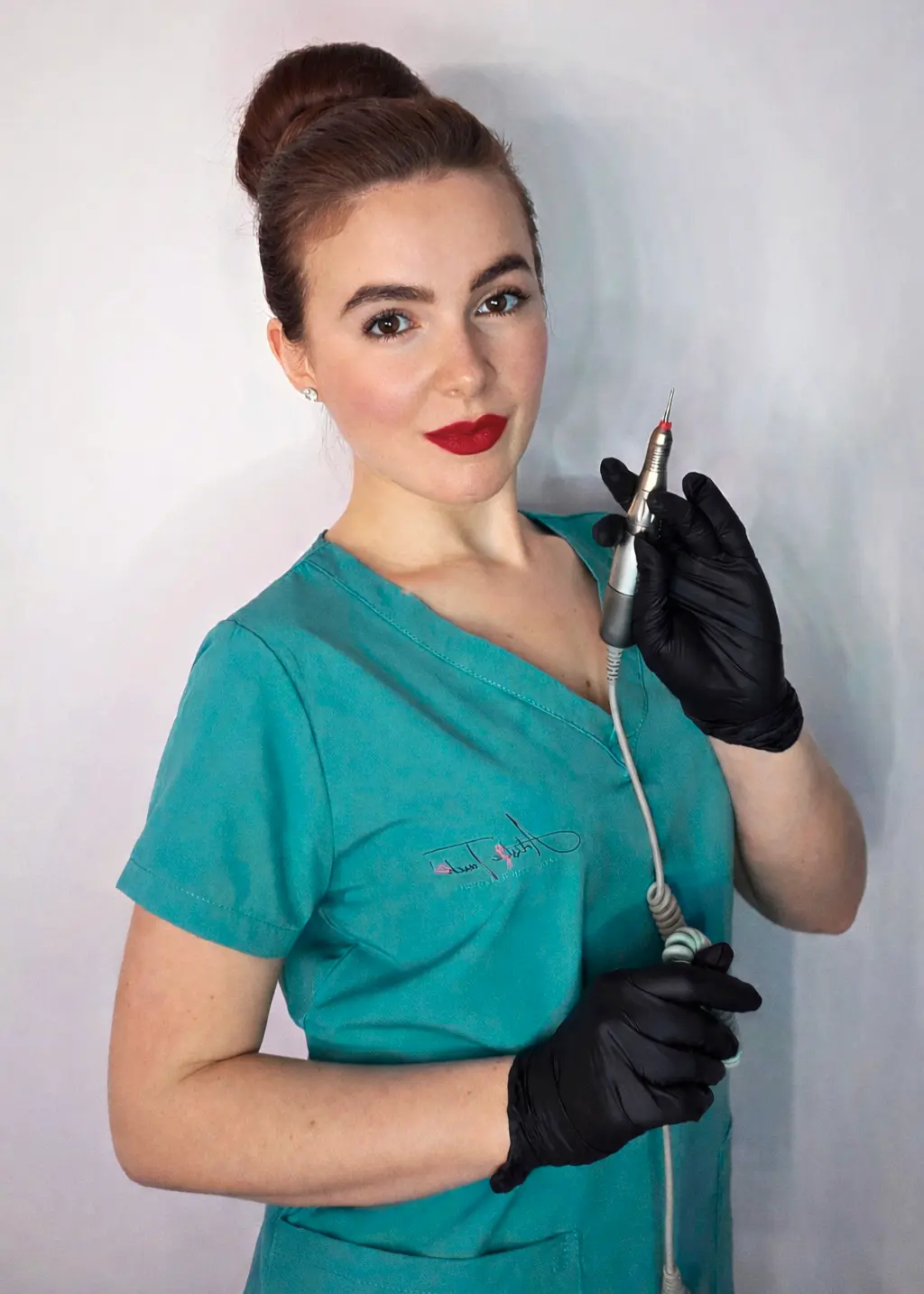
Professional Nail Expert | International Nail Educator
I am Radina Ignatova, a Professional Nail Expert since 2014 and International Nail Educator, based in Scotland, UK. I am the Founder of Artistic Touch Nail Training Academy and TheNailWiki.
At Artistic Touch Nail Training Academy, I provide structured professional online nail education specialising in dual forms, nail preparation and retention, nail structure, E-File work and Russian Manicure, with a strong focus on professional salon safety. I continue to work actively in salon practice, ensuring that all education reflects real client scenarios and current industry standards.
My teaching philosophy is simple: I show real salon challenges, real mistakes and real performance testing, not just perfect demonstrations. This is how you develop genuine technical competence and become a confident, capable nail professional.
Disclaimer: This content is for professional nail technician education purposes only. Russian Manicure and e-file work should be performed only by trained professionals following current hygiene and safety protocols. Always carry out a full client consultation and check for contraindications before performing any nail service.
About Artistic Touch Nail Training Academy: Professional online nail education delivered by Radina Ignatova, Dundee, Scotland, UK, specialising in Russian Manicure, dual forms, nail preparation and retention, and e-file technique.