Why Clean Nails Still Lift: What You Cannot See Beneath Perfect Surface Appearance
Why This Matters
The nails looked perfect. The prep looked complete. Three days later, lifting at the cuticle zone. You review mentally what happened. You cannot identify the mistake. This is the central frustration of nail work: visible cleanliness does not guarantee hidden structural readiness. The problem was never visible to you because it existed where your assessment method cannot reach.
This article explains what you are looking at when you assess nails, and what you are missing.
The Psychological Trap of Visual Assessment
You dehydrated thoroughly. You primed properly. You cleaned with isopropyl alcohol. The nail surface looks flawless—no visible debris, no shine, perfectly matte finish. You feel confident. You apply product. Three days later, the enhancement lifts at the cuticle zone.
Now you experience the emotion that defines inconsistent nail work: confusion that feels like failure. You review what you did. You cannot identify where you went wrong. The routine was correct. The surface looked perfect. So you blame the product. You blame the client. You blame bad luck. You do not question whether perfect appearance and proper preparation are actually the same thing, because you were never taught to distinguish between them.
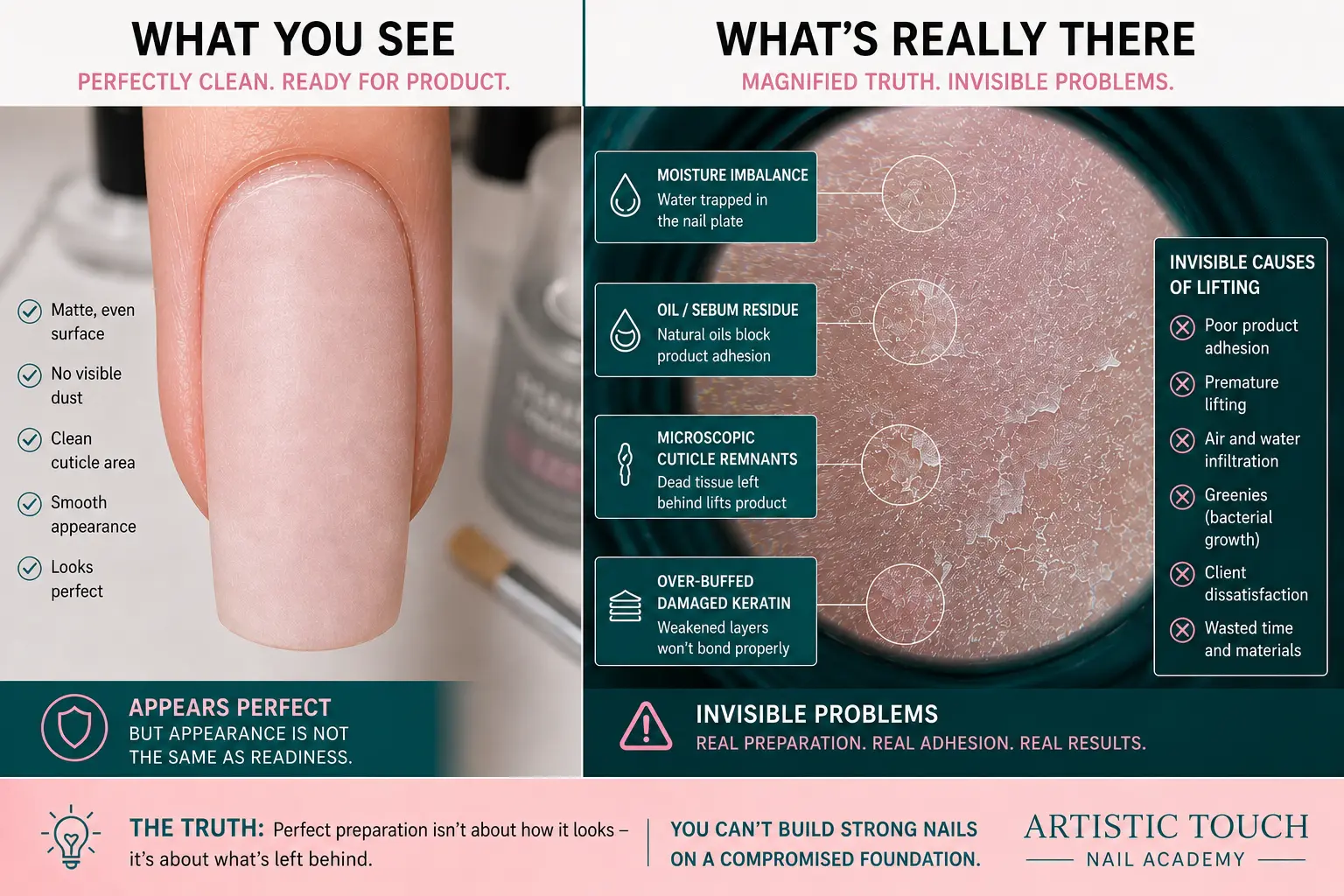
This is the trap. Visual cleanliness feels like completion. A matte finish feels like proper preparation. The absence of visible debris feels like absence of all contamination. But beneath that perfectly clean appearance, invisible failures are already occurring. The nail contains moisture imbalance. Oil has penetrated into keratin layers. Microscopic cuticle remains on the plate. The nail plate was over-prepared in ways your eyes cannot detect. None of this is visible. All of it prevents reliable adhesion.
You are not failing because your technique is poor. You are failing because you were taught to assess preparation through visual confirmation alone. Your eyes can see matte finish. They cannot see moisture chemistry, oil penetration, or microscopic contamination. So you look at what you can see, declare the nail properly prepared and proceed confidently into failure.
When Clean Appearance Becomes False Confidence
The psychological experience of nail prep goes like this: you perform actions. Those actions produce visible results. Visible results feel like progress. A matte finish is visible progress. No shine is visible progress. The absence of debris is visible progress. These visible successes create confidence that you have completed preparation properly.
But preparation is not complete when it looks complete. Preparation is complete when invisible structural conditions support reliable adhesion. These conditions are not visible. They cannot be assessed through looking. Yet your training taught you to assess through looking. So you feel confident about invisible conditions you cannot evaluate.
This is why retention feels random. Some nails hold perfectly despite prep that looked identical to nails that lifted. You assume random luck. Actually, the nails that held had favorable invisible conditions. The nails that lifted had unfavorable invisible conditions. The invisible conditions were not random. They were caused by specific structural and chemical factors. But those factors were invisible during your assessment. So the lifting felt inexplicable.
The Oil That Remains After Cleaning
You wiped the nail with alcohol. The surface appears clean. Oil remains. This seems impossible. How can oil survive alcohol cleaning? The answer reveals what you were never taught about nail structure.
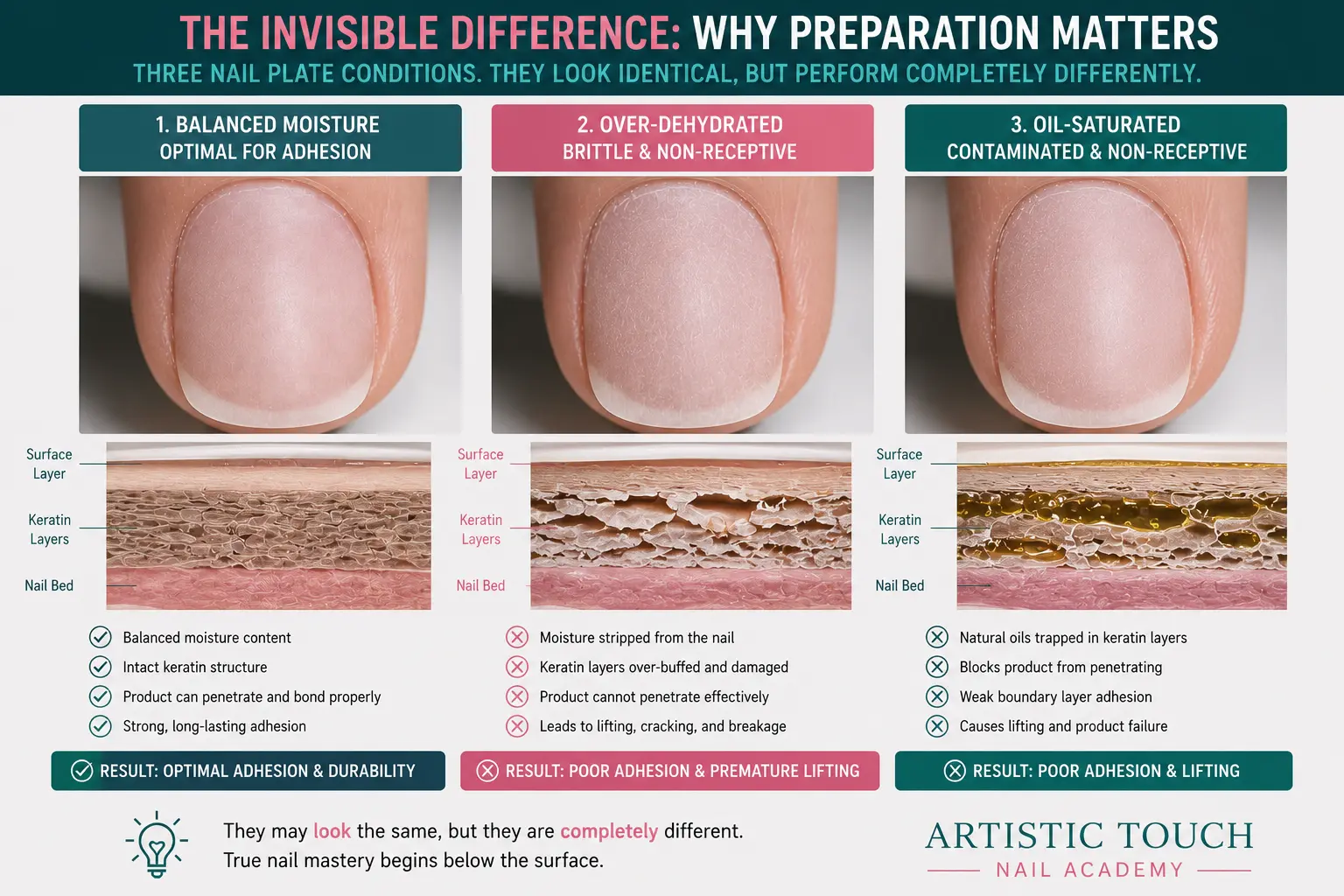
Natural nail oil does not only sit on the surface. It permeates into the upper keratin layers. Your alcohol cleaning removes visible surface contamination. It does not extract oil that has penetrated into the nail structure. When you apply product to this apparently clean surface, the product contacts not just the cleaned exterior but also oil-saturated layers immediately beneath. Adhesion fails not because you missed surface cleaning but because you addressed only the visible problem while the structural contamination remained untouched.
Additionally, some clients produce nail bed oil continuously. You can dehydrate perfectly. By the time you finish preparing all ten nails and return to apply product, fresh oil has migrated to the surface. Your preparation was technically correct. It was biologically defeated by the client’s physiology producing contamination faster than your preparation routine addresses it.
You do not see this happening. The oil is invisible. So you conclude your prep was inadequate and you were not thorough enough. Actually, your prep was appropriate. The client’s biology was simply producing oil faster than surface preparation can address. Two different problems. One feels like technique failure. One is biological reality you were never taught to recognise.
The Cuticle Work That Appears Complete But Is Not
The nail appears free of cuticle. The proximal nail fold looks clean. The eponychium is neatly pushed back. You assess your work as complete. Microscopic cuticle remains on the nail plate at the proximal zone creating a separation pathway invisible to your eye but perfectly functional as a moisture entry point that will cause proximal lifting within days.
Cuticle removal is not binary—present or absent. It exists on a spectrum from obvious visible cuticle requiring removal to microscopic residue that appears gone but structurally remains. Your eye detects the obvious. Your product detects the microscopic. When product encounters even minimal cuticle residue, it cannot achieve flush contact with the nail plate at that location. The gap is too small to see. It is adequate for moisture penetration that will separate the enhancement from the nail bed.
This is why experienced nail techs continue cuticle work longer than beginners expect. They are not being inefficient. They are removing cuticle to the level you cannot assess visually. Beginners stop when visible cuticle disappears. Experienced techs stop when they believe microscopic residue has been adequately addressed. The difference is invisible. The outcome is dramatically different.
This is the frustration: you cannot see the microscopic cuticle remaining. So you cannot know whether you removed enough. You proceed with confidence. Lifting occurs. You assume your technique was inadequate. Actually, you simply cannot assess preparation to the level your prep requires.
The Moisture Chemistry You Cannot Assess Visually
Nail plates need specific moisture content for optimal adhesion. Too dry and the keratin structure becomes brittle and non-receptive. Too moist and product cannot bond properly to the hydrated surface. You cannot determine moisture balance by looking at the nail. It appears the same whether perfectly balanced, excessively dehydrated or over-hydrated. The difference only becomes apparent through product performance—which means by the time you discover the moisture problem, the enhancement is already applied and the lifting pathway is established.
This is the hidden reality: you are making critical chemical decisions based on visual assessment. Dehydrator removes surface moisture. But nails are not uniform in moisture distribution. Some clients naturally have oily nail beds. Others have extremely dry keratin. Your standard dehydrator application creates balanced conditions on average nails. It over-dries already dry plates. It inadequately addresses genuinely oily nails. The nail looks identically matte in all three cases. The adhesion behaviour is completely different.
You interpret the results as product variation. Different gel performs differently on different nails. Actually, the nails are different. The product is performing according to its chemistry. When chemistry fails, the failure cause is contamination at the bonding surface or incorrect moisture balance at that specific nail’s biological condition. But you cannot see either of these. So you blame the product instead of recognising that you applied uniform chemical preparation to non-uniform biological conditions.
The Over-Preparation That Looks Like Thoroughness
You buffed thoroughly. You e-filed carefully. The nail surface has perfect texture—no shine, slightly rough, apparently ideal for adhesion. You removed too many keratin layers. The surface you created is structurally compromised. It looks correct. It behaves incorrectly.
This is the cruelty of over-preparation: it looks and feels like thorough work. The nail has obvious matte texture. The surface feels appropriately prepared. You feel confident you did everything possible to ensure adhesion. You actually weakened adhesion through aggressive preparation. But you do not know this yet. The false confidence prevents you from recognising your error and adjusting your approach.
Keratin layers in the nail plate have different adhesion properties. The outermost layers are densest and provide strongest bonding surface. Deeper layers are more porous and less structurally sound. When you over-prepare, you remove the good bonding surface exposing weaker layers beneath. These deeper layers look identical to proper surface preparation. They feel similar when you touch them. They provide inadequate adhesion despite appearing perfectly prepared.
This is especially common with nail techs who learned that aggressive preparation equals thorough preparation. They buff until all shine disappears. They e-file until the surface has obvious texture. They remove the structural integrity that provides adhesion while creating visual appearance of proper preparation. The lifting that follows seems inexplicable because the surface looked ideal.
Why Some Clients Consistently Experience Lifting Regardless of Your Efforts
You encounter a client. No matter what you do, their nails lift within days. You try different products. Lifting continues. You try different prep techniques. Lifting continues. You become frustrated. You assume your technique is inadequate. You try harder with each application. The lifting persists. You begin to feel that something is wrong with you or the client.
Some nail conditions make reliable adhesion impossible regardless of preparation technique. Continuous oil production by the nail bed. Natural separation between keratin layers. Growth patterns creating mechanical stress. Damage from medical conditions creating permanent structural weakness. These biological factors are invisible during preparation but prevent product bonding. You are trying to bond product to damaged substrate. No amount of adhesion chemistry can compensate for structurally unsound nail plate.
Professional assessment requires recognising when the nail condition rather than the preparation technique is the limiting factor. This is the most important diagnostic skill nobody teaches: recognising when you should decline service. But declining service means losing revenue. So you proceed with service you suspect will fail. The failure follows. You feel like you failed. Actually, the nail biology made success unlikely from the beginning.
When Product Brands Become Scapegoats for Invisible Problems
It is psychologically easier to blame the gel than to question whether your preparation is invisibly inadequate. Product switching feels like taking action and making progress. It rarely solves lifting problems because lifting is almost never product-caused. It is preparation-caused. But preparation failures are invisible. Product choice is visible and controllable. So you focus attention on the thing you can easily change while the actual problem remains unaddressed.
This creates a psychological trap. You switch brands, encounter temporary improvement (sometimes coincidentally, sometimes because the new product better matches the prep conditions you provide), feel like you discovered the solution and recommend the new brand to other techs. The cycle perpetuates. Everyone is switching products constantly. Nobody is developing the diagnostic thinking that would reveal why some nails fail regardless of product selection.
Professional understanding recognises that products perform according to their chemistry. When chemistry fails to create adhesion, contamination or structural inadequacy at the bonding surface is the cause. This understanding shifts attention from what gel to buy to what preparation gaps need addressing. The diagnostic focus changes everything.
The Invisible Failures Already Beginning
Some nails fail structurally long before visible lifting appears. Microscopic separation begins at the proximal zone from cuticle contamination. Stress concentration points form at the apex from positioning errors. Flexibility mismatch creates micro-stress at sidewalls. None of these invisible failures show visible evidence during application. The enhancement appears successful. The failure pathway is already established. It simply takes days or weeks to become visible.
You cannot prevent failures you cannot see developing. This is why nail work feels partially luck-based. You execute preparation. The results feel random. Actually, invisible structural failures are developing deterministically based on specific preparation conditions. But those conditions were invisible during your assessment. So the failures feel random and inexplicable when actually they were predictable consequences of invisible preparation inadequacies.
Assessment Beyond Appearance
Clean appearance does not equal proper preparation. This is the central insight that separates professional nail work from routine technique execution. You can assess what you can see. You cannot assess what you cannot see. Yet adhesion depends on invisible conditions far more than visible ones. Moisture chemistry. Oil penetration. Microscopic cuticle. Over-preparation damage. Structural stress points. Flexibility balance.
None of these are visible. All of them prevent reliable adhesion. Learning to think diagnostically about invisible conditions is the gap between inconsistent results and professional reliability.
Learn What You Cannot See
The E-File Manicure and Gel Polish Online Course teaches you to diagnose invisible preparation failures and understand structural conditions determining adhesion—not just execute visible steps.
Enrol Now →Lifetime access • Start immediately • Learn at your own pace
Frequently Asked Questions
Why do my gel enhancements lift even when nails look perfectly clean?
Visual cleanliness does not guarantee invisible structural readiness. Oil has penetrated into keratin layers beneath the clean surface. Microscopic cuticle remains on the plate creating separation pathways. Moisture balance is incorrect for this nail’s biology. Over-preparation has damaged the bonding surface while looking properly prepared. Professional preparation addresses these invisible conditions, not just visible cleanliness.
How can oil remain on nails after alcohol cleaning?
Natural nail oil penetrates into upper keratin layers, not just sitting on the surface. Alcohol wiping removes surface contamination but cannot extract oil embedded in the nail structure. Additionally, some clients produce nail bed oil continuously. Fresh oil migrates to the surface between preparation and product application, contaminating apparently clean nails before you apply the enhancement.
Can too much preparation cause lifting problems?
Yes. Over-preparation removes dense outer keratin layers that provide strongest adhesion, exposing weaker porous layers beneath. The surface looks perfectly prepared with proper texture and no shine. Structurally, you removed the good bonding surface leaving inadequate substrate. Over-filing, excessive buffing or aggressive e-file use create this invisible damage that appears as proper preparation visually.
Why do some clients consistently have lifting regardless of preparation quality?
Some nail conditions make reliable adhesion impossible regardless of preparation technique: continuous oil production by the nail bed, natural separation between keratin layers, growth patterns creating mechanical stress, damage from medical conditions. These biological factors are invisible during preparation but prevent product bonding. Professional assessment recognises when nail condition rather than technique is the limiting factor.
How do I know if lifting is preparation failure or product failure?
Lifting is almost always preparation-related, not product-caused. Products perform according to chemistry. When chemistry fails, contamination or structural inadequacy at the bonding surface is the cause. Proximal lifting indicates cuticle contamination or oil. Sidewall lifting suggests inadequate adhesion or mechanical stress. Free edge lifting reveals structural weakness. These patterns point to specific preparation gaps, not product inadequacy.
Does switching gel brands solve lifting problems?
Rarely. Product switching creates the illusion of taking action but does not address invisible preparation failures causing the lifting. It is psychologically easier to blame products than question whether your preparation has gaps you cannot see. Professional thinking recognises that gel chemistry works predictably. When it fails, the cause is at the bonding surface—moisture imbalance, contamination, structural damage—not product inadequacy.
About the Author
Radina Ignatova
Professional Nail Expert | International Nail Educator
I am Radina Ignatova, a Professional Nail Expert since 2014 and International Nail Educator, based in Scotland, UK. I am the Founder of Artistic Touch Nail Training Academy and TheNailWiki.
At Artistic Touch Nail Training Academy, I provide structured professional online nail courses specialising in dual forms, gel systems, polygel application, advanced nail structure, E-File work and Russian Manicure, with a strong focus on professional salon safety. I continue to work actively in salon practice, ensuring that all education reflects real client scenarios and current industry standards.
My teaching philosophy is simple: I show real salon challenges, real mistakes and real performance testing, not just perfect demonstrations. This is how you develop genuine technical competence and become a confident, capable nail professional.
Every Artistic Touch course includes lifetime access and access to a dedicated student support group, where I provide ongoing guidance and professional feedback.
Disclaimer: This content is for educational purposes only. Nail services should be performed by trained professionals following current hygiene and safety regulations. Always carry out a full client consultation and check for contraindications before performing any nail service.
About Artistic Touch Nail Training Academy
Artistic Touch Nail Training Academy delivers structured professional online nail education focused on practical skill development, professional standards and safe salon practice. All courses are available online worldwide.