Advanced Online Nail Courses That Actually Improve Your Results
Quick Answer: What Makes an Advanced Nail Course Effective?
Advanced nail courses that improve results teach diagnostic assessment, demonstrate common technical errors and their corrections, include performance testing against measurable standards and provide individualised feedback on your submitted work. Courses that only show perfect demonstrations without diagnostic teaching or accountability produce no measurable improvement.
This article explains how to identify genuinely advanced training and what separates effective courses from surface content.
Why Most “Advanced” Courses Are Just More Demonstrations
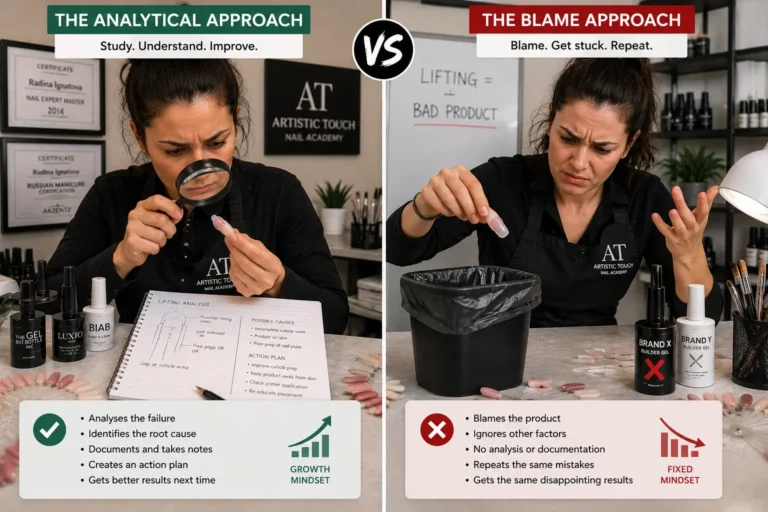
You search for advanced online nail courses expecting structured professional development. You find courses labelled “advanced” that show you fifteen new application methods, demonstrate perfect results on ideal nail models and provide a certificate when you watch all the videos. Six months later, your technique has not improved.
This happens because most content marketed as “advanced” is actually just additional demonstrations of different techniques, not advanced instruction in diagnostic ability or performance correction. The course taught you new procedures. It did not teach you how to diagnose why your results fail or what specific adjustments will bring your execution to professional standard.
Genuinely advanced nail courses teach you assessment skills, error recognition and correction protocols. They make you better at executing techniques you already know before introducing new ones. This is what produces measurable improvement rather than just expanded technique collections.
Demonstration vs Diagnostic Teaching
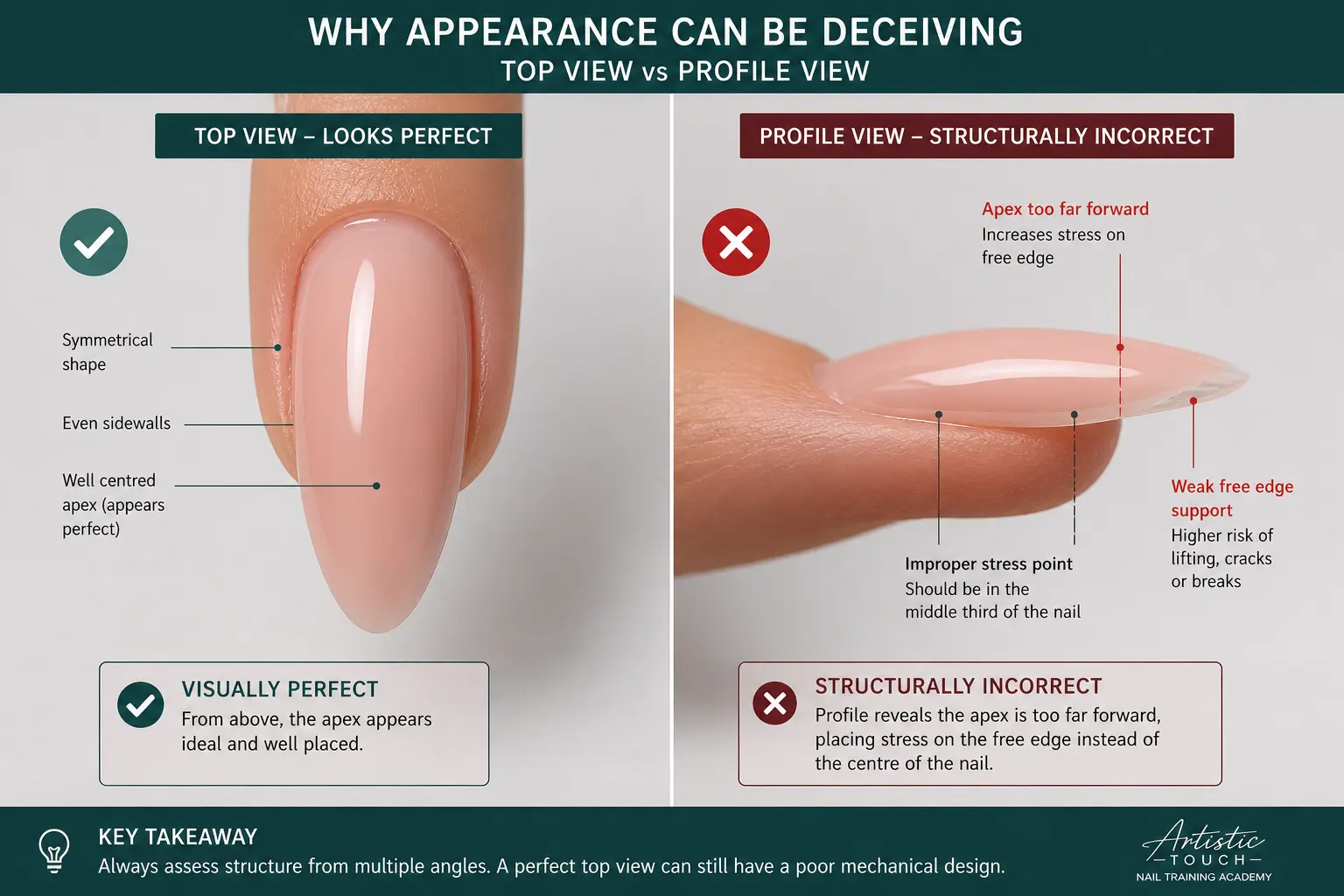
Demonstration shows you what correct execution looks like. Diagnostic teaching shows you what incorrect execution looks like, explains why it produces that specific failure pattern and demonstrates the exact correction sequence that eliminates it.
A demonstration course shows you a perfect gel application with flawless preparation, ideal product viscosity, correct apex placement and complete curing. A diagnostic course shows you what happens when preparation is inadequate, what product looks like when viscosity is wrong, how apex placement affects structural performance and what incomplete curing produces on removal.
Demonstration gives you a target to aim for. Diagnostic teaching gives you the ability to recognise when you miss the target and understand how to correct your aim. Only one of these produces consistent professional results.
Performance Testing vs Content Consumption
Content consumption measures whether you watched the videos. Performance testing measures whether you can execute the technique to professional standards. Most courses marketed as “advanced” test only content consumption.
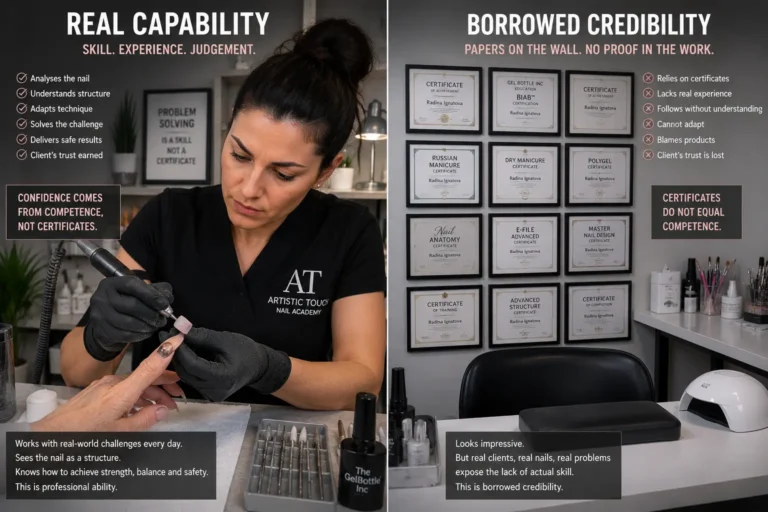
You watch all modules, complete a quiz confirming you remember the steps and receive a completion certificate. Nothing in this process confirms that you can actually perform the technique competently. You might execute it incorrectly every time and still receive the certificate, because no one assessed your actual work.
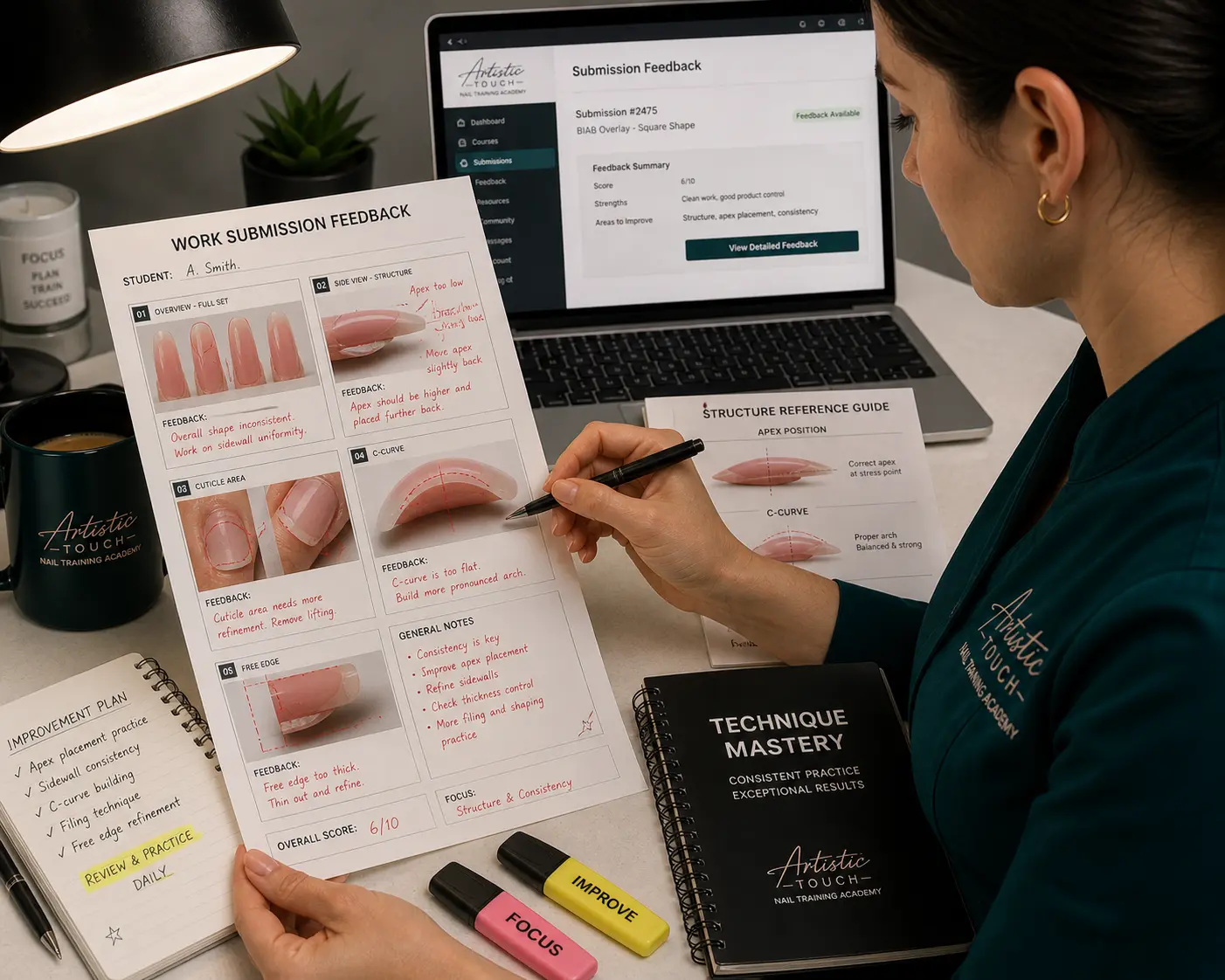
Advanced courses that improve results include work submission and professional assessment. You complete an application. You photograph your result according to specified angles and lighting. An educator evaluates your preparation quality, product placement, structural accuracy and finish standard, then provides specific corrections for the errors present in your execution.
Individualised Feedback vs Generic Instruction
Generic instruction tells all students the same corrections: “apply thinner layers,” “ensure complete preparation,” “cure adequately.” Individualised feedback identifies the specific errors in your work and provides targeted corrections for those exact problems.
Your preparation might be thorough everywhere except the lateral folds where moisture remains. Your layers might be correct thickness everywhere except near the cuticle where product pools. Your curing might be adequate for pigmented colours but insufficient for clear gels. Generic instruction does not address these specific gaps. Individual assessment does.
This is why advanced courses with performance feedback produce faster improvement than courses with only demonstration content. You discover exactly what you are doing incorrectly rather than guessing which generic advice applies to your situation.
Skill Progression vs Technique Collection
Advanced courses structured for skill development follow deliberate progression sequences. Each module builds on principles established in the previous one. You cannot progress to module five without demonstrating competence in module four.
Technique collection courses let you access all content immediately in any order. You can watch advanced structural design before mastering basic apex placement. You can attempt complex artwork before achieving consistent preparation standards. This produces scattered knowledge without systematic competence.
Professional skill development is cumulative. Preparation competence is required before product application competence. Application competence is required before structural refinement competence. Structural competence is required before advanced design work. Courses that respect this progression produce better results than random technique access.
Real Client Scenarios vs Perfect Demonstrations
Perfect demonstrations use ideal nail models: long nail beds, no previous damage, excellent natural structure, unlimited appointment time. These conditions do not represent the majority of salon clients you will work with.
Advanced courses prepare you for real client scenarios: short nail beds that require careful product placement, damaged nail plates that need structural compensation, time constraints that require efficient protocol execution, skin sensitivity that limits product options. They demonstrate how technique adapts when conditions are not ideal.
Surface-level courses show you best-case scenarios and expect you to extrapolate to challenging cases yourself. Advanced courses explicitly demonstrate challenging cases and teach you the diagnostic thinking required to adapt technique appropriately.
Measurable Outcomes vs Completion Certificates
Completion certificates confirm attendance. Measurable outcomes confirm competence. Advanced courses that improve results establish performance benchmarks and verify that you meet them before progression.
Performance benchmarks might include: enhancement longevity of 2-3 weeks minimum without lifting, apex placement within specified tolerance of natural stress curve, preparation that passes contamination assessment, product application that meets thickness standards. You submit work. It is assessed against these benchmarks. You either meet standard or you do not.
This accountability produces genuine skill development. You cannot progress past a module while executing it incorrectly, because the assessment catches your errors and requires correction before you continue. This ensures that foundational skills are solid before you build advanced techniques on top of them.
What Advanced Training Actually Provides
The difference between surface content and genuine advanced training is accountability, diagnostic depth and performance measurement. Surface courses give you more techniques to watch. Advanced courses give you the assessment and correction skills required to execute techniques to professional standard.
When you choose advanced nail training, you are choosing whether to expand your technique collection or develop genuine professional competence. Only one of these changes your client results and business outcomes.
Advanced Training with Performance Accountability
Artistic Touch online nail courses provide diagnostic instruction, demonstrate technical errors and corrections, and include professional assessment of your submitted work. Learn what professional execution requires and how to achieve it measurably.
View All Courses →Lifetime access • Private student community • Start immediately
Frequently Asked Questions
What makes a nail course truly advanced?
Advanced nail courses teach diagnostic assessment, demonstrate common technical errors and their corrections, establish measurable performance standards and include professional feedback on submitted work. Courses that only show perfect demonstrations without error recognition training or performance testing are not genuinely advanced regardless of marketing claims.
Should I take an advanced course before mastering basic techniques?
Advanced courses assume foundational competence in preparation, application and curing protocols. If your basic technique has systematic errors, advanced methods will not compensate. Focus on diagnostic training that corrects fundamental execution gaps before progressing to advanced structural or design work.
How do I know if an advanced nail course will improve my results?
Check whether the course includes work submission and professional feedback, demonstrates technical errors and corrections rather than only perfect results, establishes measurable performance benchmarks and requires competence verification before progression. Courses without these elements are content libraries, not skill development programmes.
Are expensive nail courses better than affordable ones?
Price does not reliably indicate course quality. Expensive courses can be surface demonstrations with completion certificates. Affordable courses can include rigorous performance testing and individualised feedback. Evaluate courses based on their diagnostic teaching depth and accountability mechanisms, not price alone.
Can online courses provide the same quality as in-person training?
Online courses with work submission and professional feedback can match or exceed in-person training quality for nail technicians with foundational skills. The critical factor is whether assessment and correction happen, not whether instruction occurs in person or online. Many in-person courses provide no performance feedback, while structured online courses include rigorous work review.
What should I look for in course reviews before enrolling?
Look for reviews that mention specific skill improvements, measurable result changes or business impact rather than generic praise. Reviews stating “loved the content” or “great instructor” do not confirm that the course improved technical execution. Reviews describing eliminated lifting problems, improved retention rates or increased client satisfaction indicate genuine skill development.
About the Author
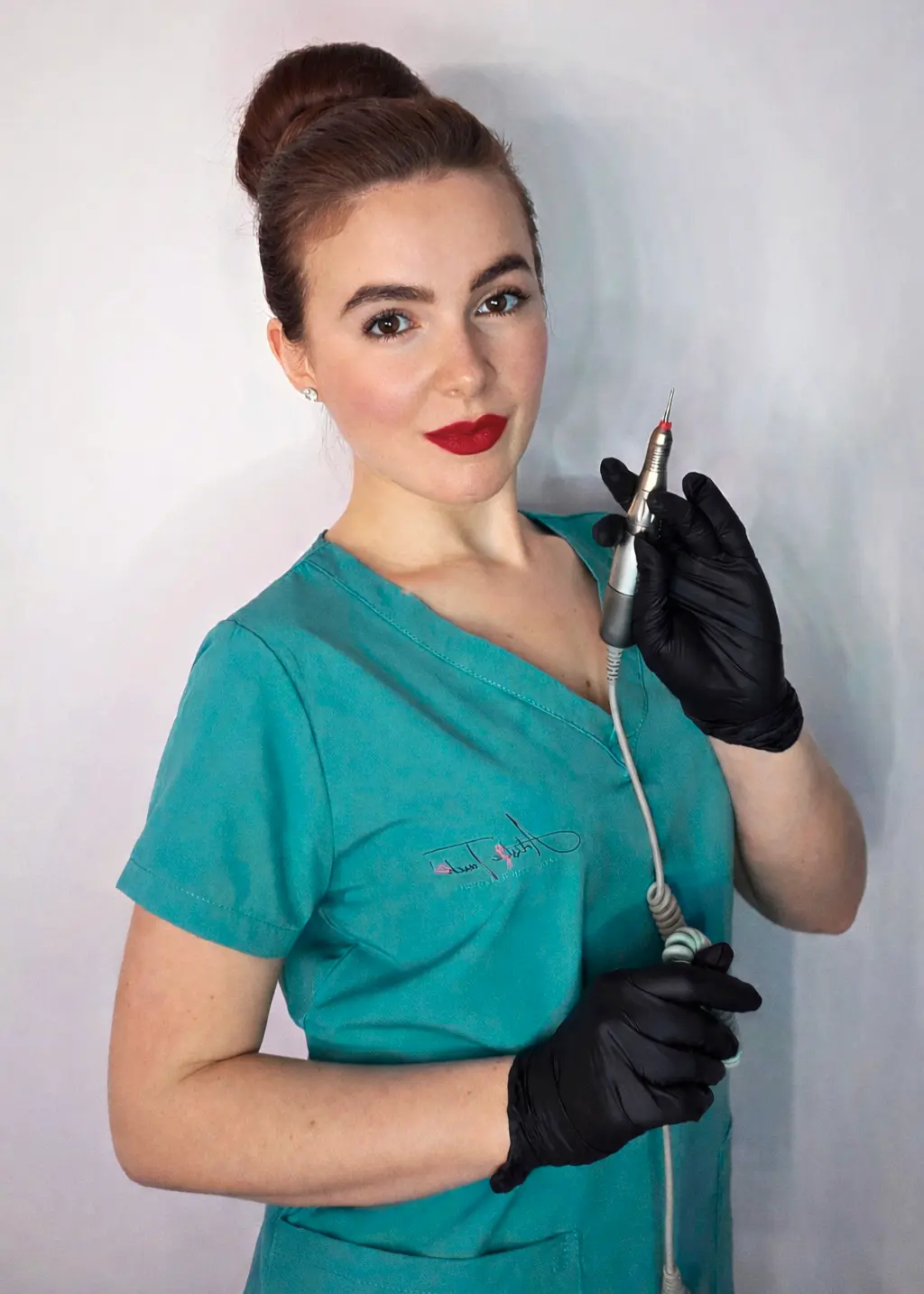
Radina Ignatova
Professional Nail Expert | International Nail Educator
I am Radina Ignatova, a Professional Nail Expert since 2014 and International Nail Educator, based in Scotland, UK. I am the Founder of Artistic Touch Nail Training Academy and TheNailWiki.
At Artistic Touch Nail Training Academy, I provide structured professional online nail courses specialising in dual forms, gel systems, polygel application, advanced nail structure, E-File work and Russian Manicure, with a strong focus on professional salon safety. I continue to work actively in salon practice, ensuring that all education reflects real client scenarios and current industry standards.
My teaching philosophy is simple: I show real salon challenges, real mistakes and real performance testing, not just perfect demonstrations. This is how you develop genuine technical competence and become a confident, capable nail professional.
Every Artistic Touch course includes lifetime access and access to a dedicated student support group, where I provide ongoing guidance and professional feedback.
Disclaimer: This content is for educational purposes only. Nail services should be performed by trained professionals following current hygiene and safety regulations. Always carry out a full client consultation and check for contraindications before performing any nail service.
About Artistic Touch Nail Training Academy
Artistic Touch Nail Training Academy delivers structured professional online nail education focused on practical skill development, professional standards and safe salon practice. All courses are available online worldwide.