Is Gel Polish Banned in the UK? What the TPO Ban Actually Means for Nail Technicians
If you have recently seen headlines saying that gel nails have been banned in the UK, you could reasonably assume that gel manicures themselves are disappearing from salons. That is not what the regulation says.
The Direct Answer
No. Gel nails are not banned in Great Britain. The regulatory change concerns TPO, Trimethylbenzoyl Diphenylphosphine Oxide, a photoinitiator previously used in some UV and LED-curable nail products. One ingredient has been restricted. Gel technology as a whole has not been prohibited.
What Is TPO and Why It Has Been Used in Nail Products
Trimethylbenzoyl Diphenylphosphine Oxide, commonly abbreviated to TPO, is a photoinitiator. Its function is to react when exposed to UV or LED light, triggering the curing process that hardens gel product on the nail. This is what allows a gel manicure to set quickly under a lamp rather than air-drying over time.
TPO has been valued in nail formulations for producing a durable, glossy finish with efficient curing, particularly under LED lamps. It is not the only photoinitiator available to manufacturers, but it has been a commonly used one across a range of gel and builder products.
The Regulation Concerns TPO, Not Gel Technology Itself
This distinction sits at the centre of the entire issue. TPO is one specific ingredient. Gel nail systems, as a category of professional nail technology, are not defined by that single ingredient. A gel or builder product can be reformulated to use a different, permitted photoinitiator and continue to function as a UV or LED-curable system.
Restricting one ingredient is not the same as prohibiting an entire professional service.
Why “Gel Nail Ban” Headlines Are Misleading
A headline written for a general consumer audience often compresses a technical regulatory change into language that implies something far broader than what the regulation actually covers. “Gel nail ban” suggests the service itself has been prohibited. The regulation in question restricts a named chemical ingredient in cosmetic products. These are not the same statement, and the difference matters considerably to a professional trying to understand her legal obligations.
The European Union Regulatory Position
The European Union stopped allowing TPO in cosmetic products from 1 September 2025. This came from Commission Regulation (EU) 2025/877, made under the EU’s Cosmetics Regulation. The reason for the change was that TPO had been reclassified as a Category 1B reproductive toxicant under separate chemicals safety law.
From that date, nail technicians in the EU could no longer use products containing TPO on clients. This applied even to stock bought legally before the rule changed. No exemption was granted for the professional nail sector, so there was no grace period allowing technicians to use up existing stock.
The Great Britain Regulatory Position
Great Britain means England, Scotland and Wales. Great Britain has its own separate rules, not the same as the EU’s. TPO was added to the GB list of restricted chemicals after being reclassified in the same way as in the EU. This then triggered the ban process under GB cosmetics law.
The relevant law is called SI 2026/23, short for the Cosmetic Products Regulation (EC) No 1223/2009 (Restriction of Chemical Substances) (Amendment and Transitional Provisions) Regulations 2026. It was adopted in January 2026. According to this legislation, TPO was added to the list of banned cosmetic ingredients in Great Britain, alongside several other substances.
Great Britain has two important dates, not one:
Confirmed Great Britain Dates
15 August 2026 — cosmetic products containing TPO can no longer be newly placed on the Great Britain market by manufacturers or importers.
14 February 2027 — products already placed on the market before that date can no longer continue to be made available for sale or supply after this date.
These two dates come directly from the Statutory Instrument. There is also a third, practical question: can you keep using stock you already own after these dates? The Cosmetic, Toiletry and Perfumery Association (CTPA), the UK’s cosmetics trade body, has answered this. Working together with Trading Standards, the CTPA says yes: you can keep using stock you already legally own on clients after 14 February 2027, until you run out of it. This is guidance from the trade body, not wording written directly into the law itself, so it is worth checking with your own supplier or trade body too.
Northern Ireland Is Not the Same as Great Britain
This is one of the most commonly overlooked distinctions in current reporting. Northern Ireland continues to follow European Union cosmetics legislation, under the arrangements set out in the Windsor Framework. This means Northern Ireland has been subject to the EU’s TPO prohibition since 1 September 2025, considerably earlier than the Great Britain timetable set out above.
A nail technician working in Northern Ireland is not on the same legal timetable as a technician working in England, Scotland or Wales. Treating the whole of the UK as a single regulatory jurisdiction on this issue is inaccurate.
Why the Prohibition Happened: Understanding the Classification
TPO was reclassified as a Category 1B reproductive toxicant. This classification comes from CMR chemicals law, which stands for carcinogenic, mutagenic or toxic for reproduction. It was based on evidence from animal studies.
Here is how the rule works: once a substance gets this classification, it is automatically added to the list of banned cosmetic ingredients. There is one exception, if a specific request for an exemption is made and approved after a safety review. No such exemption was requested for TPO, so the ban went ahead.
It helps to separate three different things here. First, a substance getting a hazard classification. Second, the legal ban that classification triggers. Third, the actual level of risk to a real client sitting in a salon chair. A hazard classification tells you what a substance can do under laboratory test conditions. It does not, by itself, tell you the precise risk of a specific, real-world exposure.
What the Earlier Safety Opinion Actually Said
Before TPO was reclassified, an EU scientific body called the Scientific Committee on Consumer Safety (SCCS) looked at TPO separately. In an opinion numbered SCCS/1558/15, the SCCS said TPO was safe when used as a professional nail modelling product, at a maximum strength of 5%. The same opinion also said TPO should be treated as a moderate skin sensitiser, meaning it can cause an allergic-type reaction in some people.
This older opinion does not disprove the newer ban, and it is not being hidden or contradicted either. The SCCS wrote that opinion when TPO carried a different, lower classification. Once TPO was reclassified as CMR Category 1B, the law works differently: the classification itself triggers an automatic ban, regardless of what an earlier concentration-based safety opinion said. The two findings sit in two different legal boxes; they are not competing with each other.
According to the CTPA, the amount of TPO actually used in nail products sits far below the level connected to any effect on fertility in the studies behind the classification. This is one reason professional bodies describe the change as a cautious, classification-driven step, rather than proof of harm from typical salon-level exposure.
The Regulation Did Not Ban Gel Nails
A nail system is not defined by one photoinitiator. Manufacturers can, and many already have, reformulate products using permitted alternative photoinitiators while keeping the same UV or LED-curable gel technology intact.
TPO being prohibited does not mean gel technology has been prohibited. Gel manicures, BIAB, builder gel and hard gel systems remain legal professional services in the UK, provided the specific products used comply with current cosmetics regulation.
What Should Nail Technicians Actually Do?

A Practical Checklist
✓ Identify every product you currently use that is UV or LED-cured
✓ Read current manufacturer information rather than relying on social media claims alone
✓ Check the INCI ingredient listing for Trimethylbenzoyl Diphenylphosphine Oxide specifically
✓ Establish which of your products, if any, contain TPO
✓ Follow the legally applicable dates for your specific jurisdiction, Great Britain or Northern Ireland
✓ Contact manufacturers or authorised suppliers directly where ingredient or compliance information is unclear
✓ Keep appropriate product and purchase documentation
✓ Do not assume old stock remains lawful to use simply because it was purchased legally at the time
✓ Do not assume a product marketed as “TPO-free” is automatically suitable for every lamp or every service
This is general professional guidance, not legal advice. Every business is responsible for ensuring the specific products it uses comply with applicable cosmetics regulation in its own jurisdiction.
TPO-Free Does Not Mean Risk-Free
Removing TPO from a formulation does not remove every other consideration that applies to UV or LED-curable professional products. A TPO-free product still requires the same professional attention as any other gel or builder system.
Still Relevant, Regardless of TPO Content
✓ Correct, full curing according to the manufacturer’s specified lamp and time
✓ Using a compatible lamp and product system together
✓ Avoiding uncured product contact with the skin
✓ Awareness of other sensitising ingredients within the formulation
✓ Following manufacturer instructions precisely
✓ Correct product storage
✓ Salon hygiene standards
✓ Safe, controlled application technique
✓ Ongoing professional training
This is not a suggestion that alternative photoinitiators carry hidden dangers. There is no evidence presented here to support that claim, and none is being implied. The point is narrower and more practical: compliance with one ingredient restriction is not a replacement for correct professional practice as a whole.
Why Media Headlines Create Confusion
Phrases circulating in current coverage include “gel nail ban”, “gel polish ban”, “ban in nail salons”, and headlines linking the story directly to fertility concerns. None of these phrases are necessarily dishonest on the part of the publications using them. A headline is written to be read in seconds and to communicate a general sense of a story to a broad consumer audience. That format is simply not well suited to conveying the distinction between a hazard classification, a specific ingredient restriction, and the continued legality of an entire professional service.
The practical result is that many readers, including working nail technicians, come away with an impression considerably broader than what the underlying regulation states. Reading the regulation itself, or a source that explains it accurately, remains the more reliable approach than forming a professional understanding from a headline alone.
Key Takeaway
A particular ingredient has been prohibited. An entire professional service has not. Gel nails, BIAB, builder gel and hard gel remain legal in the UK, provided the specific formulations used comply with current cosmetics regulation for their jurisdiction. Understanding your products, their ingredients, and the regulation itself protects you far more effectively than reacting to a headline.
Build Understanding, Not Just Technique
Professional judgement comes from understanding the products, chemistry and regulation behind your work, not from headlines. Artistic Touch Nail Training Academy’s online courses are built around exactly this kind of depth.
Explore Artistic Touch Courses →About Radina Ignatova and Her Teaching Philosophy
About the Author
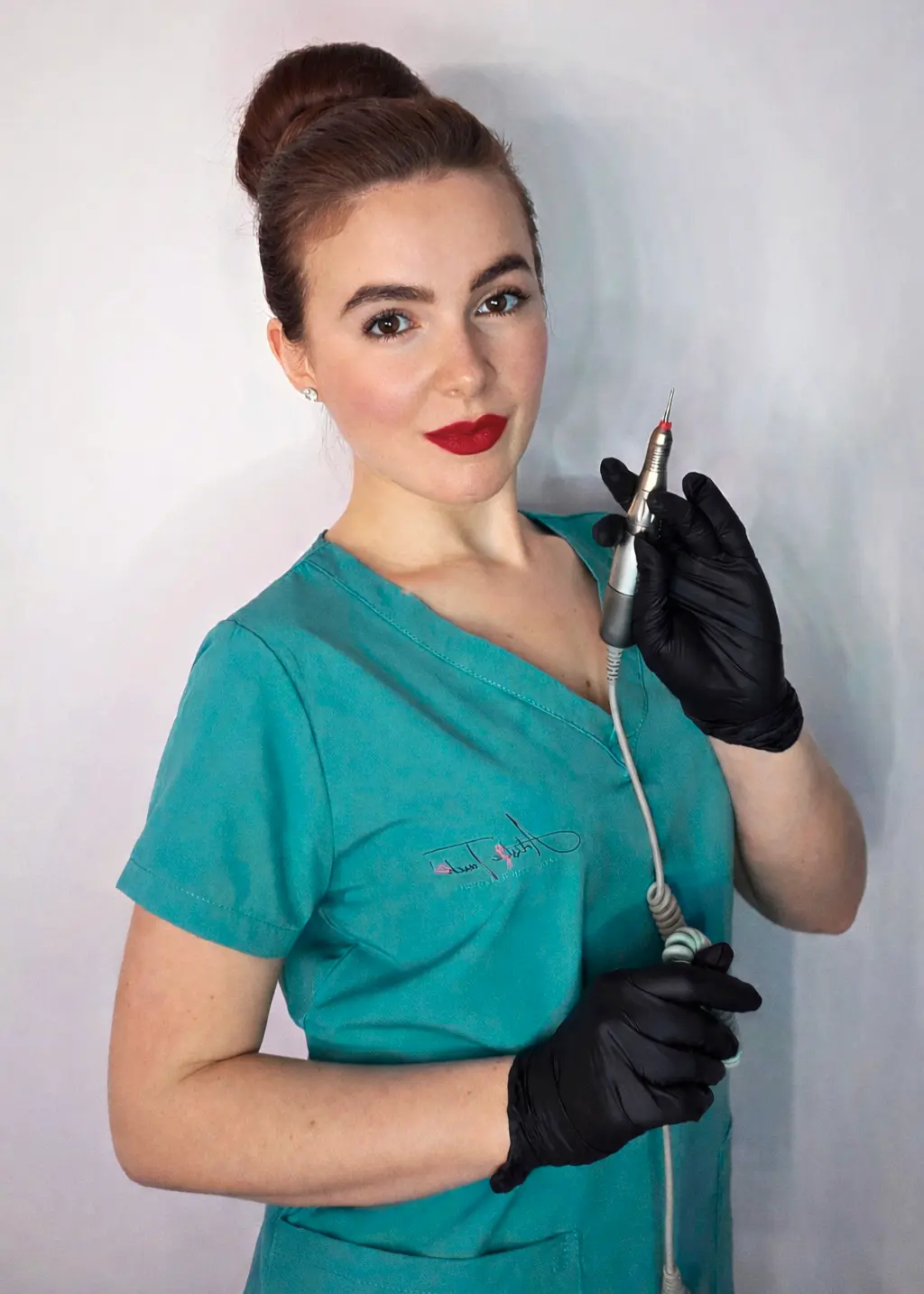
Radina Ignatova
Professional Nail Expert | International Nail Educator
I am Radina Ignatova, a Professional Nail Expert since 2014 and International Nail Educator, based in Scotland, UK. I am the Founder of Artistic Touch Nail Training Academy and TheNailWiki.
At Artistic Touch Nail Training Academy, I provide professional online nail courses specialising in dual forms, gel systems, polygel application, advanced nail structure, E-File work and Russian Manicure, with a strong focus on professional salon safety. I continue to work actively in salon practice, ensuring that all education reflects real client scenarios and current industry standards.
My teaching philosophy is simple: I show real salon challenges, real mistakes and real performance testing, not just perfect demonstrations. This is how you develop genuine technical competence and become a confident, capable nail professional.
Important Information
This article is provided for professional education purposes and reflects publicly available regulatory and scientific information at the time of writing. It is not legal advice. Cosmetics regulation, transition dates and compliance requirements can change, and businesses are responsible for verifying current requirements directly with official sources, including UK Government guidance, the Office for Product Safety and Standards, the Cosmetic, Toiletry and Perfumery Association, and their own product suppliers.
Nothing in this article should be read as a statement about the health outcome of any individual client or technician. Hazard classification, exposure level and individual risk are distinct concepts, and this article does not make claims about the actual level of risk from any specific past or ongoing product use.
Frequently Asked Questions
Are gel nails banned in the UK?
No. Gel nails as a service are not banned. The regulation restricts one specific ingredient, TPO, in cosmetic products. Gel technology using compliant, permitted photoinitiators remains legal.
Is gel polish illegal in the UK?
Gel polish itself is not illegal. Specific formulations containing TPO become subject to placing-on-market and supply restrictions in Great Britain from 15 August 2026 and 14 February 2027 respectively. Gel polish formulated without TPO is not affected by this particular restriction.
What is TPO?
TPO, Trimethylbenzoyl Diphenylphosphine Oxide, is a photoinitiator used in some UV and LED-curable nail products to trigger the curing process under lamp light.
Why has TPO been restricted?
TPO was classified as a Category 1B reproductive toxicant under CMR chemicals legislation, based on animal study data. Under both EU and GB cosmetics law, this classification automatically triggers prohibition in cosmetic products unless a specific exemption is granted, which did not occur for TPO.
Does TPO cause infertility?
TPO carries a hazard classification for reproductive toxicity based on animal studies. This is a hazard classification, not a proven outcome in humans from typical salon-level exposure, and this article does not make claims about individual risk. Industry commentary has noted that the level of exposure in nail products sits considerably below levels associated with effects in the underlying studies.
Can nail technicians still use old TPO stock?
This depends on jurisdiction and date. In the EU, professional use of TPO-containing products ceased from 1 September 2025. In Great Britain, CTPA guidance developed with Trading Standards indicates professionals may continue using legally acquired stock on clients after the 14 February 2027 off-shelf date until it runs out, since the legislation restricts sale and supply rather than setting an explicit use-cutoff date. Confirm current guidance with your supplier or trade body.
Are TPO-free gel products safe?
TPO-free status addresses one specific ingredient restriction. It does not remove the need for correct curing, compatible lamp and product systems, avoiding skin contact with uncured product, awareness of other sensitising ingredients, and proper professional technique.
Is the TPO restriction the same in the EU and UK?
No. The EU prohibited TPO in cosmetic products from 1 September 2025. Great Britain follows its own separate timetable under SI 2026/23, with key dates of 15 August 2026 and 14 February 2027. Northern Ireland continues to follow EU rules under the Windsor Framework, meaning it has been subject to the EU timetable since September 2025, not the Great Britain one.
Does the regulation apply to BIAB, builder gel and hard gel?
The relevant question is whether a specific product’s formulation contains TPO, not the marketing category printed on the bottle. BIAB, builder gel and hard gel products can each be formulated with or without TPO. Check the actual ingredient listing for the product you use, regardless of how it is marketed.
How can I tell whether my nail product contains TPO?
Check the product’s INCI ingredient listing for “Trimethylbenzoyl Diphenylphosphine Oxide”. If it is not clearly stated on the packaging or manufacturer documentation, contact the manufacturer or your authorised supplier directly for confirmation.
About Artistic Touch Nail Training Academy
Artistic Touch Nail Training Academy delivers professional online nail education focused on practical skill development, professional standards and safe salon practice. All courses are available online worldwide with lifetime access.