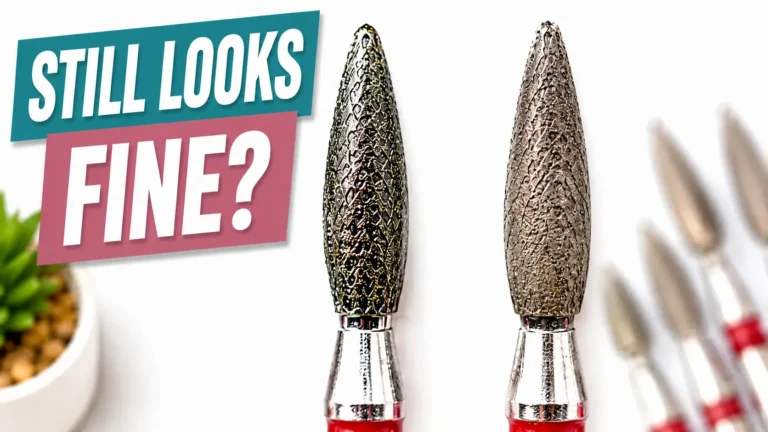
Red vs Blue Diamond Flame Bit: What Is the Actual Difference?
Prefer to watch? The full comparison is on my official YouTube channel, Radina Ignatova | Nail Academy. These are the parts I would watch first:
- Red and blue side by side: the difference in abrasiveness (0:43)
- Which skin and cuticles each bit suits (1:13)
- Compensating with pressure and repeated passes (1:36)
- Red or blue? Look at the skin first (2:24)
- The main thing to remember (3:12)
Do you always reach for the red flame bit because you think it is safer? Or do you avoid the blue one because you think it is too aggressive?
This is one of the most common assumptions in Russian Manicure. Red is treated as the safe option and blue as the risky one. Technicians then choose the red bit for every client, meet tissue it cannot handle efficiently, and compensate with extra pressure, repeated passes or too much time in one area.
What I want you to understand is that the colour band is not telling you which bit is safe and which one is dangerous. It is telling you the abrasiveness. What makes the work safe or unsafe is whether that abrasiveness suits the tissue in front of you, and how you control it.
The Short Answer
A red diamond flame bit is finer. A blue diamond flame bit is medium and more abrasive. Neither colour is automatically safe or dangerous. Red may suit normal, thinner or more sensitive cuticles; blue may suit thicker, overgrown or more resistant tissue. The right choice depends on the skin and cuticle in front of you, not on the colour itself.
Does Red Mean Safer and Blue Mean More Aggressive?
No. This belief is understandable, because finer sounds gentler. But it skips the most important part of the decision: the tissue.
A finer bit is only gentler when it is suited to the skin it is working on. On thick or resistant tissue, a finer bit removes less with each pass. The technician then has to do more to get the same result, and that is where the problems begin.
Red does not mean safe. Blue does not mean dangerous. They are two different abrasive levels for two different situations.
What Do the Red and Blue Bands Actually Mean?
The coloured band on a diamond bit indicates the grit, which is how abrasive the working surface is.
- Red band: finer abrasive.
- Blue band: medium abrasive, so more abrasive than red.
If you put the two bits side by side and look closely, you can see the difference. The red flame has a much finer surface. The blue flame is noticeably coarser.
That is all the colour tells you. It does not tell you which bit to use on a particular client. That decision comes from looking at the skin.
When Might a Red Flame Bit Be More Appropriate?
A red flame bit may be the better choice for:
- normal skin and normal cuticles;
- thinner cuticles;
- more sensitive cuticles.
On this kind of tissue, there is less to remove and less resistance. A finer abrasive gives you more control over a smaller amount of work, which is exactly what delicate tissue needs.
When Might a Blue Flame Bit Be More Appropriate?
A blue flame bit may be more suitable for:
- thicker cuticles;
- overgrown cuticles;
- more resistant tissue.
Here, the more abrasive surface does the work that a finer bit would struggle to do. Used with control, it can mean fewer passes and less time in one area, not more damage.
Why a Finer Bit Is Not Always the Safer Choice
Pay attention to what happens when a red flame bit is used on thick, overgrown skin. The bit removes very little with each pass, so the result does not appear. The natural reaction is to do more.
That “more” is the problem. The gentler bit has not made the work gentler. It has made the technician work harder on the tissue to reach the same result.
Overworking tissue can cause more damage, even when you are using the bit you believe is the safer one.
What Happens When You Compensate With Pressure or Repeated Passes?
When the abrasive level is too fine for the tissue, technicians usually compensate in one of three ways:
- More pressure, pushing the bit harder into the skin to make it remove more.
- More passes, going over the same area again and again.
- More time in one area, staying longer to force the result.
Each of these increases the load on the tissue. They also waste time, which slows the whole service down. The cause is not poor hand skill. It is a mismatch between the abrasive level and the tissue, and the compensation that follows.
Choosing the Bit Is Only the First Decision
Russian Manicure – Beyond Technique teaches how tool selection, pressure, angle and tissue assessment work together, so you are not compensating for the wrong choice during the service.
How to Assess the Skin Before Choosing Your Flame Bit
A lot of technicians ask me whether red or blue is better. My answer is always the same: it depends on what you see in front of you. Look at the skin before you choose the bit.
Thickness
Is the tissue thin, or is it thick and built up? Thicker tissue will usually need more abrasive work to lift and remove efficiently.
Sensitivity
How does the skin react? Sensitive skin needs a lighter approach and more restraint.
Dryness
Is the skin dry and rigid, or supple? Dry skin behaves differently under the bit and can feel more resistant.
Resistance
Does the tissue give way easily, or does it resist? Resistance is often the clearest sign that a finer bit will lead to compensation.
Amount and Condition of Cuticle Tissue
How much cuticle is there, and what condition is it in? An overgrown cuticle and a well-maintained one are not the same job.
These points tell you what the tissue needs. The bit should follow that assessment, not come before it.
Stop Copying Drill Bit Colours — Start Asking Why
Many technicians choose their flame bit because it is the one they saw in a tutorial or the one another technician recommends. That tells you what worked for their client, not what will work for yours.
Do not just copy the colour. Ask why that abrasive level made sense for that particular client. Once you start asking why behind every tool choice, you are working at a completely different level, because your decisions come from the tissue rather than from memory.
Red vs Blue Flame Bit: The Main Principle to Remember
Red does not mean safe. Blue does not mean dangerous.
Red is finer. Blue is more abrasive. They are used on different types of skin and cuticles. Your job is to choose what makes sense for the skin in front of you, and then control it properly.
I would rather you understand why you are choosing a bit than simply memorise the colour.
Key Takeaway
Choosing a flame bit by colour alone is incomplete. Understand the tool, understand the tissue, then adapt. A bit that is too fine for the skin leads to compensation, and compensation is where overworking begins.
Know Which Bit, and Know Why
Russian Manicure – Beyond Technique teaches not only which tool to use, but why, when, and how to adapt your e-file technique when the client in front of you is different. Learn how anatomy, tissue assessment, tool selection and e-file control work together, so every decision is based on what you see rather than what you copied.
Lifetime access · Direct feedback from Radina · Private student support
About Radina Ignatova and Her Teaching Philosophy
About the Author

Radina Ignatova
Professional Nail Expert since 2014 and International Nail Educator
I am Radina Ignatova, a Professional Nail Expert since 2014 and International Nail Educator, based in Scotland, UK. I am the Founder of Artistic Touch – Nail Training Academy and TheNailWiki.
At Artistic Touch – Nail Training Academy, I provide online nail courses specialising in dual forms, gel systems, polygel application, nail structure, E-File work and Russian Manicure, with a strong focus on salon safety. I continue to work actively in salon practice, ensuring that all education reflects real client scenarios and current industry standards.
My teaching philosophy is simple: I show real salon challenges, real mistakes and real performance testing, not just perfect demonstrations. This is how you develop genuine technical competence and become a confident, capable nail technician.
Frequently Asked Questions
What is the difference between red and blue diamond flame bits?
The colour band shows the abrasiveness. A red diamond flame bit is finer; a blue diamond flame bit is medium and more abrasive.
Is a red flame bit safer than a blue one?
Not automatically. Red is finer, but on thick or resistant tissue it can lead to extra pressure, repeated passes and overworking. Safety depends on matching the bit to the tissue and controlling it properly.
Which flame bit is better for sensitive cuticles?
A red, finer flame bit is often more appropriate for normal, thinner or more sensitive cuticles, but the decision should still be based on assessing the skin in front of you.
Which flame bit is better for thick or overgrown cuticles?
A blue, medium flame bit may be more suitable for thicker, overgrown or more resistant tissue, because it can do the work without the technician compensating.
Can using a bit that is too fine cause overworking?
Yes. When the bit is too fine for the tissue, technicians often add pressure, repeat passes or stay longer in one area. That compensation overworks the tissue and can cause more damage.
Want to understand the reasoning behind every tool choice? Explore Russian Manicure – Beyond Technique →
About Artistic Touch – Nail Training Academy
Artistic Touch – Nail Training Academy delivers online nail education focused on practical skill development, high standards and safe salon practice. All courses are available online worldwide with lifetime access.