Why Free Nail Content Alone Usually Stops Working
Quick Answer: Why Does Free Nail Content Stop Producing Improvement?
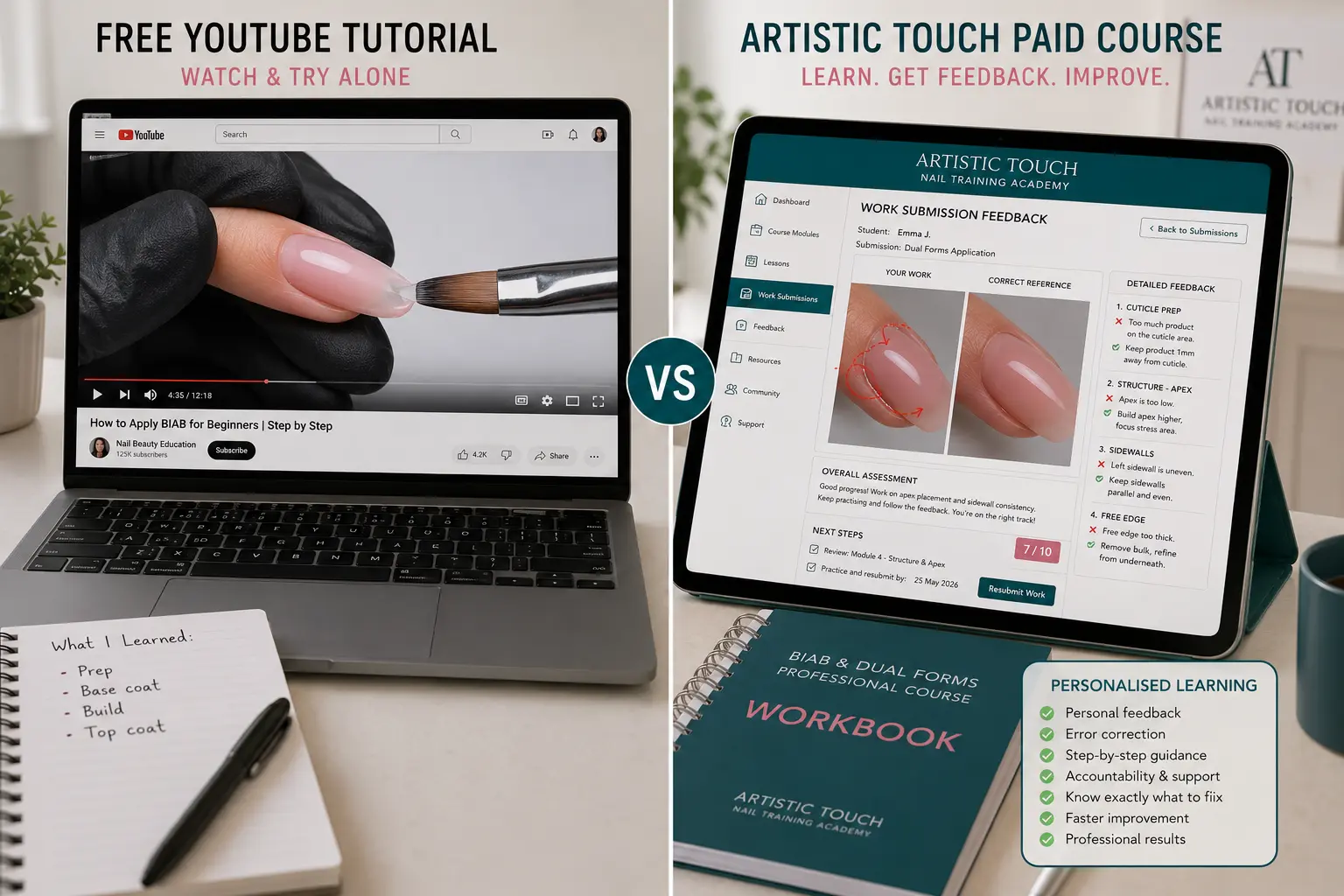
Free content provides exposure to perfect demonstrations but cannot deliver diagnostic instruction teaching you to recognise your own errors, performance feedback identifying specific technical gaps or accountability systems verifying your execution meets professional standards. Initial improvement from exposure plateaus when you lack the diagnostic and correction abilities that structured paid training with assessment provides.
This article explains the structural limitations of free content and what paid training adds.
The Free Content Learning Curve
You began learning nail technique through free content: YouTube tutorials, Instagram demonstrations, free webinars. Your technique improved initially. You learned basic procedures, discovered product options and developed foundational understanding. Then improvement stopped. You continue watching free content but your results remain at the same quality level despite additional exposure to demonstrations.
This plateau is not coincidence. It represents the point where free content has delivered everything it structurally can provide. Free tutorials show you what correct execution looks like. They cannot show you what YOUR execution looks like when assessed objectively, cannot identify the specific errors preventing your improvement or provide the performance accountability that drives continued development.
Free content works brilliantly for initial exposure and inspiration. It stops working when you need diagnostic teaching, error recognition training and external assessment that free delivery models cannot economically provide. Understanding why this limit exists helps you recognise when to invest in structured paid training.
What Free Content Provides Effectively
Free nail content delivers genuine value: exposure to new techniques you have not encountered, demonstration of various application approaches, inspiration for creative work and access to different teaching styles helping you identify whose instruction resonates with your learning preferences.
Free content also provides community connection through comments and discussions, keeps you current with product launches and industry trends and supplements your knowledge with alternative perspectives. These functions serve important purposes in professional development. They are not limitations of free content. They are its strengths.
The mistake is expecting free content to provide diagnostic instruction, individualised feedback and performance accountability when these require significant educator time investment that free delivery models cannot sustain. Free content succeeds at what it is designed to do. It fails at what it cannot economically deliver.
The Economics of Free vs Paid Content
Free content creators monetise through advertising, affiliate relationships, brand partnerships or as marketing for other services. This business model incentivises high view counts and broad appeal. Content optimises for demonstration entertainment value rather than individualised skill development because the economic model rewards viewership numbers, not learning outcomes.
Paid structured courses monetise through student enrollment fees. This model incentivises course completion, student satisfaction and measurable skill improvement because referrals and reputation drive future enrollment. Content optimises for learning outcomes because the economic model rewards successful students, not passive viewers.
These different economic incentives create different content priorities. Free content prioritises broad demonstration reach. Paid training prioritises individual competence development. Neither model is wrong. They serve different purposes with different strengths and different limitations.
Why Individual Assessment Cannot Be Free
Providing individualised performance feedback requires educator time reviewing your submitted work, identifying your specific technical errors, explaining their causes and documenting targeted corrections. This time investment per student cannot be delivered at scale through free content models because the necessary educator hours have no revenue source to support them.
Free content can demonstrate perfect execution to millions of viewers simultaneously. It cannot assess millions of viewers individually. The economic math prohibits it. You can watch a free tutorial alongside ten thousand other people. You cannot receive individualised assessment of your execution from that same educator without payment because individuated attention does not scale to free delivery economics.
This is not content creator greed. It is fundamental economic constraint. The time required to review your work and provide specific feedback has value that must be compensated when provided individually rather than broadcast to masses.
The Diagnostic Gap Free Content Cannot Fill
Free demonstrations show you correct execution. They rarely show you incorrect execution with explanations of recognition markers during your own practice. Showing errors requires additional content production creating videos most viewers will skip because they want to see perfect results, not mistake demonstrations.
Free content optimises for what viewers click on. Viewers click on perfect demonstrations more than error recognition training. Content creators respond to these metrics by producing what gets watched. The result is abundant perfect execution content and minimal diagnostic error content regardless of what viewers actually need for skill development.
Paid structured courses can include error recognition demonstrations because student outcomes matter more than click rates. When your course enrollment depends on developing competence, content includes whatever diagnostic teaching that requires even if it is less entertaining than perfect demonstrations.
Accountability Systems Require Infrastructure
Performance accountability requires infrastructure: work submission systems, documentation standards, assessment rubrics, progress tracking and completion verification. Building and maintaining this infrastructure costs money and time that free content delivery cannot support.
Free content provides inspiration and exposure. It cannot provide systematic progression requiring you to demonstrate competence before advancement. It cannot track your skill development over time. It cannot verify that you met performance standards. These accountability functions require administrative systems that only paid training economics can sustain.
When you wonder why free content does not include work submission and feedback, this is why. The systems enabling accountability cost more than free delivery generates. Paid training covers these costs through enrollment fees. Free content cannot.
When Free Content Works Best
Free content excels as supplement to structured training, not replacement for it. After paid courses teach you diagnostic frameworks, free content provides additional technique exposure interpreted through your developed assessment ability. You watch tutorials differently when you can recognise what the demonstration actually shows beyond surface steps.
Free content also works for experienced professionals maintaining current knowledge. When you have solid diagnostic foundations from previous structured training, free content keeps you updated on product innovations, new technique variations and industry trends without requiring new formal instruction.
The error is using free content as your sole learning source when developing foundational competence. This approach gives you extensive exposure to demonstrations without building the diagnostic and self-correction abilities that competent execution requires.
The Plateau Recognition Point
You recognise free content limitations when improvement stops despite continued learning effort. You watch more tutorials, practice regularly and stay current with free content releases. Your technique quality remains essentially unchanged for months. This plateau signals that demonstration exposure has delivered its value and further improvement requires diagnostic teaching and performance accountability that free content cannot provide.
The plateau frustrates many nail technicians because it appears mysterious. You are investing time and effort. Results are not improving. The missing element is external assessment identifying systematic errors you cannot self-diagnose and providing specific corrections you cannot self-generate from demonstrations alone.
This is the transition point where investing in paid structured training with work submission and professional feedback produces returns that additional free content cannot deliver. Not because free content quality degraded but because your development needs exceeded what free delivery models can economically provide.

What Paid Training Adds to Free Content
Paid structured nail training adds diagnostic instruction teaching error recognition, systematic progression requiring competence verification before advancement, individualised feedback identifying your specific technical gaps, performance accountability systems tracking your development and documentation of demonstrated competence through portfolio or certification.
These additions address the limitations free content has by economic necessity rather than content creator choice. Paid training can invest educator time in individual student assessment because enrollment fees compensate that time. Free content cannot make that same investment while remaining free.
The value proposition is straightforward: pay for individualised assessment and accountability that drives continued improvement or accept the plateau that free demonstration exposure eventually produces. Both choices are valid depending on your development goals and current skill level.
Knowing When to Invest Beyond Free Content
Free content stops working when you need diagnostic teaching, individual feedback and performance accountability rather than additional exposure to demonstrations. This transition point typically arrives after you have acquired basic procedural knowledge from free sources and need external assessment to identify the systematic errors preventing further improvement.
Recognising this plateau and understanding its causes allows you to make informed choices about when free content has delivered its value and when paid structured training provides the next development phase.
Structured Training Beyond Free Content Limits
Artistic Touch online nail courses provide systematic diagnostic instruction, error recognition demonstrations, work submission with professional assessment and performance accountability that free content cannot deliver economically.
View All Courses →Lifetime access • Private student community • Start immediately
Frequently Asked Questions
Can I become a professional nail technician using only free content?
Free content can teach you procedural knowledge and exposure to techniques but cannot provide the diagnostic ability, error recognition and performance accountability that professional competence requires. Most nail technicians who develop reliable professional skills use free content as supplement to structured paid training with individual assessment, not as sole learning source.
Why does my technique not improve despite watching more tutorials?
Tutorials demonstrate correct execution but do not identify YOUR specific errors or provide corrections for them. Without external assessment, you cannot recognise the systematic technical gaps preventing improvement. More demonstrations do not reveal what you are executing incorrectly. Individual performance feedback is needed to identify and correct execution errors.
What do paid nail courses provide that free content does not?
Paid courses provide diagnostic instruction teaching error recognition, systematic skill progression with competence verification, work submission with individualised feedback identifying your technical gaps, performance accountability tracking your development and documented proof of demonstrated competence. Free content cannot provide these because they require educator time investment per student that free economics cannot support.
When should I invest in paid nail training instead of using free content?
Invest in paid training when free content consumption stops producing improvement, when you recognise systematic problems in your work but cannot identify specific causes, when you need external assessment to verify your execution meets professional standards or when you require accountability systems that track and verify skill development over time.
Is free nail content lower quality than paid courses?
Quality differences relate to purpose, not price. Free content often provides excellent demonstrations and inspiration. It cannot provide individualised assessment and accountability because these require educator time per student that free delivery economics cannot support. Both serve valuable purposes with different strengths and limitations.
Can I still use free content after taking paid courses?
Free content works excellently as supplement after structured training provides diagnostic foundations. When you can recognise what demonstrations actually show beyond surface steps, free content provides ongoing technique exposure, product updates and creative inspiration without requiring additional formal instruction. The diagnostic ability from paid training makes free content more useful.
About the Author

Radina Ignatova
Professional Nail Expert | International Nail Educator
I am Radina Ignatova, a Professional Nail Expert since 2014 and International Nail Educator, based in Scotland, UK. I am the Founder of Artistic Touch Nail Training Academy and TheNailWiki.
At Artistic Touch Nail Training Academy, I provide structured professional online nail courses specialising in dual forms, gel systems, polygel application, advanced nail structure, E-File work and Russian Manicure, with a strong focus on professional salon safety. I continue to work actively in salon practice, ensuring that all education reflects real client scenarios and current industry standards.
My teaching philosophy is simple: I show real salon challenges, real mistakes and real performance testing, not just perfect demonstrations. This is how you develop genuine technical competence and become a confident, capable nail professional.
Every Artistic Touch course includes lifetime access and access to a dedicated student support group, where I provide ongoing guidance and professional feedback.
Disclaimer: This content is for educational purposes only. Nail services should be performed by trained professionals following current hygiene and safety regulations. Always carry out a full client consultation and check for contraindications before performing any nail service.
About Artistic Touch Nail Training Academy
Artistic Touch Nail Training Academy delivers structured professional online nail education focused on practical skill development, professional standards and safe salon practice. All courses are available online worldwide.