Short Nail Courses vs Long-Term Mentorship: What Makes the Biggest Difference?
Quick Answer: Do Short Courses or Long-Term Mentorship Build Better Nail Skills?
Neither duration guarantees effectiveness. Short intensive courses with systematic instruction and performance verification can develop specific competencies efficiently. Long-term mentorship with ongoing feedback can build comprehensive professional capability over time. Both fail when they lack diagnostic teaching and accountability. Success depends on instructional quality and structured progression, not programme length.
This article explains what actually determines development outcomes beyond duration.
When Duration Becomes a Proxy for Quality
You believe longer training programmes produce better outcomes than short courses. You enrol in extended mentorship expecting sustained guidance will naturally develop superior skills. The mentorship provides weekly contact over six months but lacks structured progression, systematic skill building or performance verification at each stage. You complete the programme with incremental improvement but no greater diagnostic ability than a focused short course with rigorous assessment would have provided.
Meanwhile, intensive weekend courses with clear learning objectives, systematic instruction, immediate practice with professional feedback and documented performance verification develop specific competencies efficiently. Duration provided no quality advantage when the shorter programme offered better instructional design and accountability.
The assumption that longer equals better ignores what actually drives skill development: systematic progression through foundational to advanced content, error recognition training, regular performance feedback and verification of competence before advancement. Both short courses and long-term mentorship can provide these elements or omit them. Programme length does not determine their presence.
What Short Intensive Courses Can Achieve
Well-designed intensive courses focus on specific skill sets with clear boundaries. A two-day gel application course teaches preparation standards, product behaviour, application technique and structural principles for that specific system. The limited scope allows concentrated instruction without attempting to cover comprehensive nail technician competence.
When intensive courses include significant practice time with immediate professional feedback, they can develop focused competencies efficiently. You learn one skill set thoroughly with external assessment confirming you meet performance standards before leaving. This focused approach often produces better outcomes than extended programmes attempting to cover too much content without adequate practice or feedback on any individual skill.
The limitation of short courses is scope, not effectiveness. They cannot develop comprehensive professional capability in two days. They can develop specific technical competencies when instructional design is sound. The error is expecting short courses to produce outcomes they were not designed to deliver, not the format itself.
What Long-Term Mentorship Can Provide
Extended mentorship programmes enable skill development across multiple techniques with time for consolidation between learning phases. You learn preparation one month, application technique the next, structural work after that, with practice periods allowing each skill to stabilise before adding complexity.
This staged progression can develop comprehensive professional capability when mentorship includes regular performance assessment, identifies specific technical gaps as they emerge and provides ongoing correction guidance. The extended timeline allows you to develop unconscious competence through repeated application with continuous feedback rather than attempting to master everything simultaneously.
However, extended duration provides no advantage when mentorship lacks structure. Weekly contact without systematic skill progression, without regular work assessment or without clear performance benchmarks merely extends exposure time without building competence. Many nail technicians complete year-long mentorship programmes still lacking diagnostic ability because contact duration did not equal instructional quality.
The Critical Role of Structured Progression
Both short courses and long mentorship fail when they lack structured skill progression. Throwing information at students without deliberate sequencing produces confusion regardless of programme length. Professional nail technique has prerequisite relationships: preparation competence before application instruction, application competence before structural refinement, foundational skills before advanced techniques.
Intensive courses achieve structured progression through careful scope definition: this course teaches X specific skill to Y performance standard. Extended mentorship achieves it through phased learning: preparation mastery verified before product application introduction, application competence confirmed before structural complexity added. Duration differs but the principle remains constant: skills build systematically.
Random instruction without progression produces poor outcomes whether delivered over two days or two years. You cannot effectively learn structural apex placement while still struggling with preparation standards. You cannot develop consistent product application while lacking material behaviour understanding. Progression must be systematic regardless of how long it takes to complete.
Performance Verification at Progression Points
The advantage long-term programmes should provide is multiple verification points as skills develop. After preparation instruction, your work is assessed before moving to application training. After application competence, your work is verified before structural complexity is introduced. This staged verification prevents advancing with uncorrected errors.
Short intensive courses verify performance at programme completion rather than at intermediate stages. This single verification point means errors present throughout training may not be identified until the end. However, focused scope means fewer potential errors to develop. A course teaching only preparation technique can verify that specific skill thoroughly even with single-point assessment.
The failure mode is when extended programmes do not actually verify performance at progression points despite having the timeline to do so. Weekly contact without work assessment at skill transition stages wastes the primary advantage duration provides. You progress to advanced content while executing foundational skills incorrectly because no verification occurred.
Ongoing Feedback vs Intensive Feedback
Long-term mentorship enables continuous feedback as your skills evolve over months. Your mentor sees your progression, identifies developing patterns and adjusts guidance as your capability changes. This ongoing observation can address emerging problems before they become ingrained habits.
Intensive courses provide concentrated feedback during compressed timeframes. The instructor observes your practice intensively over hours or days, identifies immediate errors and provides corrections before incorrect patterns reinforce. This concentrated attention often catches problems that weekly observation over months might miss because your work is not observed during the actual practice time between mentor sessions.
The effectiveness of either approach depends on whether feedback actually occurs and whether it is specific enough to drive improvement. Vague weekly encouragement provides less value than concentrated detailed assessment during intensive practice. Extended timelines with sporadic feedback produce worse outcomes than compressed programmes with systematic assessment.

Self-Directed Practice Between Contact Points
Extended programmes require significant self-directed practice between mentor sessions. How you practice during unsupervised time determines whether skills develop or degrade. Without diagnostic ability to self-assess, this independent practice can reinforce errors rather than correct them.
Long-term mentorship should provide frameworks for productive independent practice: specific skills to develop, assessment criteria to verify your own progress, diagnostic questions to ask during practice and documentation requirements showing your work for next session review. When mentorship provides these structures, independent practice time becomes valuable skill consolidation rather than error reinforcement.
Intensive courses compress learning into supervised time, reducing reliance on self-directed practice during skill development. This can produce faster initial competence acquisition because errors are caught immediately rather than practiced incorrectly between weekly sessions. Post-course practice still matters but the foundational skill was established under observation.
Cost-Effectiveness Considerations
Short intensive courses typically cost less than extended mentorship programmes because instructor time is compressed. This creates accessibility for nail technicians who cannot afford comprehensive long-term training. However, lower cost provides no value if the course lacks the diagnostic teaching and accountability required for actual skill development.
Extended mentorship commands premium pricing because of sustained access to professional guidance. This investment is worthwhile when that guidance includes systematic instruction, regular performance assessment and ongoing feedback. It becomes expensive contact time without skill development when mentorship provides only periodic demonstration viewing or encouragement without assessment.
Cost-effectiveness depends on outcomes per pound spent, not absolute cost or duration. An intensive course producing reliable competence in one specific technique provides better value than extended mentorship producing vague improvement across multiple techniques without measurable performance gains.
Choosing Based on Your Development Needs
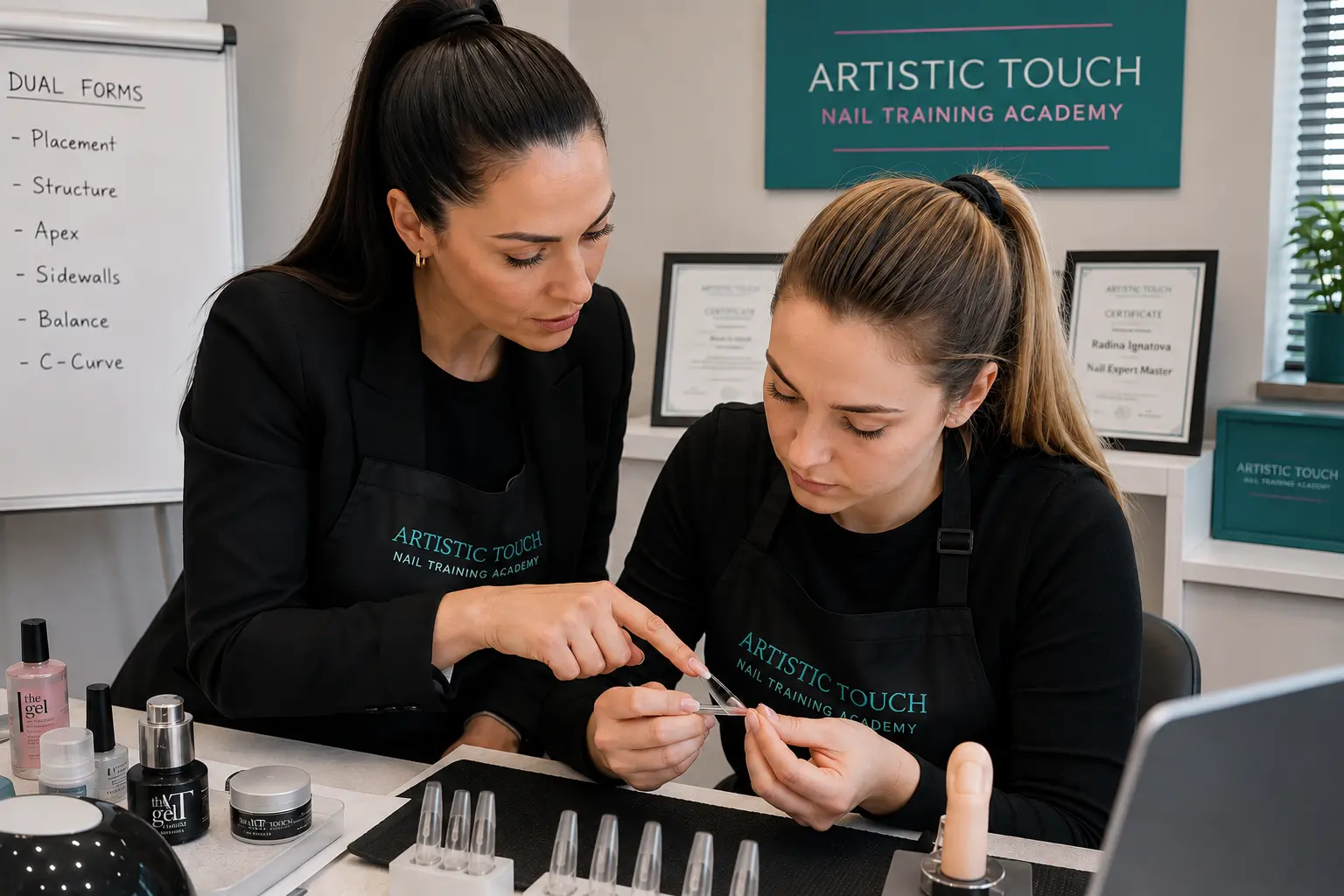
Short intensive courses suit specific skill acquisition when you have identified a focused competency gap. You need to learn dual form application. An intensive dual form course with practice and feedback addresses that need efficiently. Attempting to learn dual forms as one topic within year-long comprehensive mentorship dilutes focus and may provide less actual dual form practice and feedback.
Long-term mentorship suits comprehensive professional development when you need sustained support across multiple technique areas, when you benefit from staged learning with consolidation periods or when your business development requires ongoing strategic guidance alongside technical instruction.
The choice depends on what you need to develop and which programme structure actually provides the systematic instruction, regular assessment and performance accountability that need requires. Duration is a practical consideration but not a quality indicator.
What Determines Development Outcomes
Neither short intensive courses nor long-term mentorship guarantees superior skill development. Effectiveness depends on systematic progression, regular performance assessment, specific diagnostic feedback and verification of competence regardless of how long the programme runs. Poor instruction produces poor outcomes whether delivered over two days or two years. Quality instruction produces measurable improvement whether compressed into intensive courses or distributed across extended mentorship.
Choose based on what specific programme provides in structured teaching and accountability, not programme duration alone.
Structured Courses with Lifetime Access and Ongoing Support
Artistic Touch online nail courses provide systematic skill progression, work submission with professional assessment and lifetime access to a student support community for ongoing guidance. Focused competency development with sustained support.
View All Courses →Lifetime access • Private student community • Start immediately
Frequently Asked Questions
Are short nail courses as effective as long-term mentorship?
Effectiveness depends on instructional quality and accountability, not duration. Intensive courses with systematic teaching and performance verification can develop focused competencies efficiently. Long-term mentorship with structured progression and regular assessment can build comprehensive capability over time. Both fail when they lack diagnostic instruction and feedback regardless of length.
How long should a nail course be to be effective?
Duration should match scope and learning objectives. Focused skill courses can be effective in days when they include sufficient practice and feedback. Comprehensive professional development requires months when building multiple competencies systematically. Length itself does not determine effectiveness—systematic progression and performance accountability do.
What should I look for in a nail mentorship programme?
Look for systematic skill progression through foundational to advanced content, regular work submission with professional assessment, specific performance benchmarks for each skill level, documented feedback identifying your technical gaps and verification of competence before progression to advanced topics. Duration without these elements provides extended contact time but not skill development.
Can weekend nail courses teach enough to start working professionally?
Weekend courses teaching focused skills (specific gel system, dual forms, e-file technique) can develop that particular competency when they include adequate practice and feedback. Comprehensive professional capability across all nail services requires more extensive training. Intensive courses work best for developing specific techniques, not complete professional qualification.
Is ongoing mentorship better than taking multiple short courses?
Neither approach is inherently superior. Multiple focused courses can build comprehensive capability efficiently when each develops specific competence thoroughly. Ongoing mentorship can provide integrated skill development and continuous feedback when structured systematically. Both approaches work when they include proper instruction and accountability. Both fail when they do not.
How much practice time should a nail course include?
Practice time should exceed demonstration time significantly. Courses where you watch more than you practice cannot develop competence regardless of duration. Intensive courses should allocate at least sixty percent of time to supervised practice. Extended programmes should require regular documented practice between sessions with feedback on that practice work.
About the Author

Radina Ignatova
Professional Nail Expert | International Nail Educator
I am Radina Ignatova, a Professional Nail Expert since 2014 and International Nail Educator, based in Scotland, UK. I am the Founder of Artistic Touch Nail Training Academy and TheNailWiki.
At Artistic Touch Nail Training Academy, I provide structured professional online nail courses specialising in dual forms, gel systems, polygel application, advanced nail structure, E-File work and Russian Manicure, with a strong focus on professional salon safety. I continue to work actively in salon practice, ensuring that all education reflects real client scenarios and current industry standards.
My teaching philosophy is simple: I show real salon challenges, real mistakes and real performance testing, not just perfect demonstrations. This is how you develop genuine technical competence and become a confident, capable nail professional.
Every Artistic Touch course includes lifetime access and access to a dedicated student support group, where I provide ongoing guidance and professional feedback.
Disclaimer: This content is for educational purposes only. Nail services should be performed by trained professionals following current hygiene and safety regulations. Always carry out a full client consultation and check for contraindications before performing any nail service.
About Artistic Touch Nail Training Academy
Artistic Touch Nail Training Academy delivers structured professional online nail education focused on practical skill development, professional standards and safe salon practice. All courses are available online worldwide.