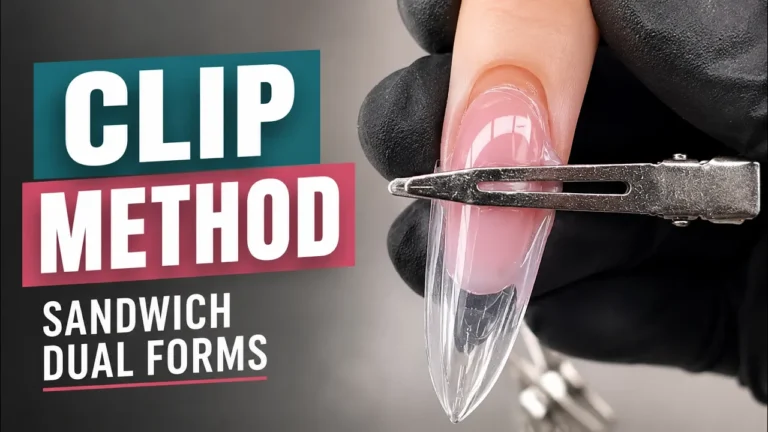
Sandwich Dual Forms: 3 Mistakes That Ruin Your Nails (And How to Fix Them)
Quick Answer: What Are the Most Common Sandwich Dual Form Mistakes?
The three most common sandwich dual form mistakes are excessive slip solution creating adhesion barriers and lifting, stamping the form flat which traps air pockets and squeezes out structural product, and crooked form placement from misaligned central axes. These are technique failures, not product failures, and all are correctable with proper training.
Understanding these mistakes and their corrections is essential for achieving professional, long-lasting sandwich dual form applications.
Watch: The 3 Most Common Sandwich Dual Form Mistakes
In this demonstration, I show the three technical errors that cause sandwich dual forms to fail, along with the correct techniques for professional results. You will see real examples of each mistake and learn exactly how to avoid them.
Why Sandwich Dual Forms Fail: It Is Not the Product
Nail technicians and students frequently report lifting, air bubbles and crooked results with sandwich dual form systems. The immediate assumption is product failure — the gel is not curing correctly, the forms are defective, or the slip solution is incompatible.
This is rarely the case. Sandwich dual form failure is almost always a technique error. If you have been taught incorrectly or have developed habits from trial and error without proper guidance, you will repeat the same mistakes and blame the materials.
The three mistakes outlined in this article account for the majority of sandwich dual form failures. Once you understand what is happening and why, the corrections are straightforward.
⚠️ Technique Matters More Than Product Selection
Sandwich dual form systems require precise application technique. Using a premium product will not compensate for incorrect slip solution control, stamping placement or axis alignment. Professional training is essential for consistent results.
Mistake 3: Over-Saturation with Slip Solution
Slip solution is not an ingredient. It is a tool for controlling polygel viscosity during application. When used correctly, it allows smooth product manipulation without excessive stickiness. When overused, it creates serious structural problems.
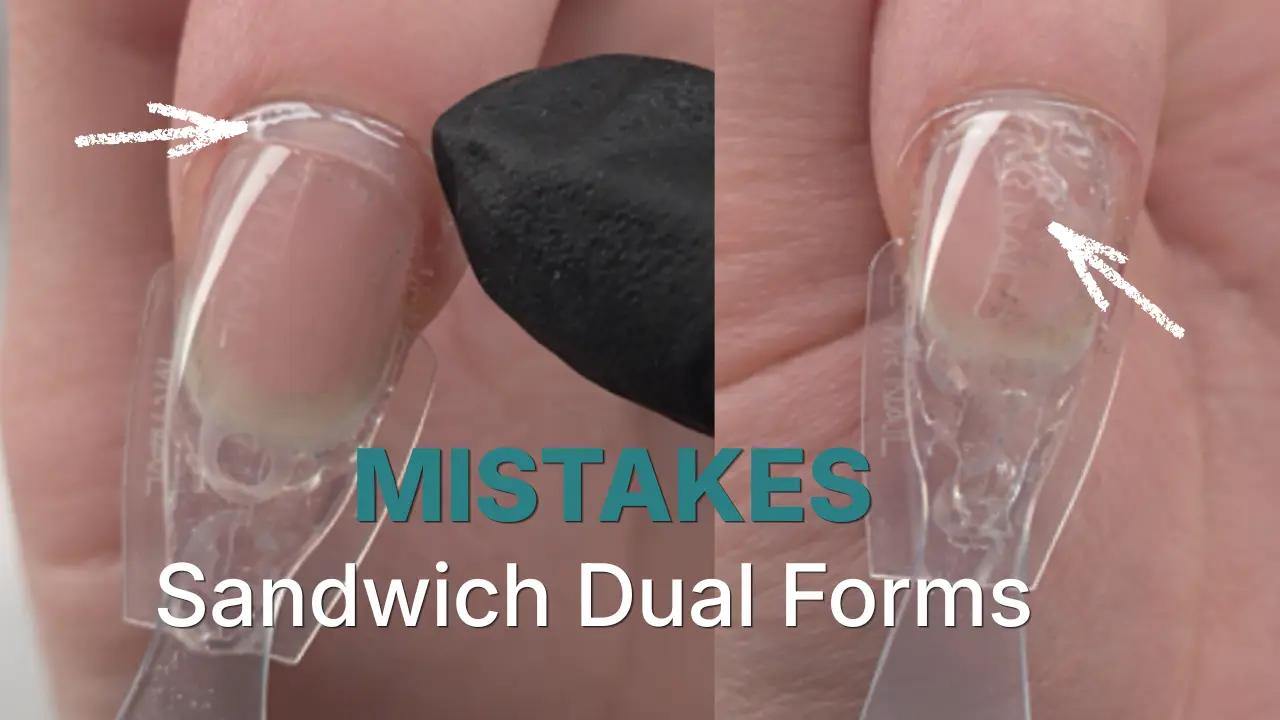
If your brush is dripping wet with slip solution, and your sandwich form is visibly shiny with excess liquid, the product will begin losing viscosity before you even place it on the nail. The slip solution creates a barrier between the natural nail and the polygel, preventing proper adhesion. This trapped liquid layer is a direct path to lifting and potential nail infections.
The Correction: Damp Brush, Not Wet Brush
Your brush should be damp, not saturated. The correct technique is to wipe your brush onto a lint-free pad that has been soaked with slip solution, rather than dipping the brush directly into the dish. This gives you precise control over how much liquid contacts the product.
The polygel inside the sandwich form should have a smooth, workable texture without visible shininess or liquid pooling. If you can see wetness, you have too much slip solution.
Mistake 2: Stamping the Form Flat (Product Overflow and Air Pockets)
Pressing the sandwich form down like a stamp is one of the most common errors in dual form application. This flat, direct placement pinches the edges of the form and forces product to overflow at the cuticle area whilst simultaneously trapping air bubbles underneath.
The result is cuticle flooding, wasted structural product squeezed out from the sides, and hollow pockets under the enhancement that weaken the entire structure. These air pockets are visible after filing and create weak points that lead to cracks and breaks.
The Correction: 45-Degree Roll and Squeeze Method
Instead of stamping the form onto the nail, place it at a 45-degree angle. Begin at one side and roll the form down across the nail plate whilst applying gentle, even pressure. This rolling motion allows air to escape naturally whilst keeping the product evenly distributed.
The roll and squeeze method eliminates air pockets and prevents product overflow. You achieve a clean imprint with full adhesion and the correct amount of structural product in place.
Mistake 1: Crooked and Shifted Forms (Misaligned Central Axes)
Even with perfect slip solution control and correct placement technique, your nails will look unprofessional if the forms are crooked. This is the result of misaligned central axes — the form’s centre line does not match the finger’s natural centre line.
Crooked nails are immediately visible to clients and other professionals. They signal poor technique and lack of attention to structural accuracy. The problem is compounded if the form shifts during the curing process.
The Correction: Match Finger and Form Central Axes
Before placing the form, identify the finger’s central axis. This is the natural vertical line running through the centre of the nail bed and finger. The sandwich form has its own central axis marked by the midpoint of the form.
Align these two axes precisely before applying pressure. Once aligned, do not shift the form during curing. Hold it steady until the initial cure is complete. This simple alignment step ensures straight, professional results every time.
What These Mistakes Have in Common
All three of these errors stem from the same root cause: incorrect or incomplete training. Sandwich dual forms are not intuitive. You cannot learn proper technique from watching occasional videos or experimenting without guidance. Each mistake creates compounding problems that undermine the entire enhancement.
The corrections are simple once you understand the mechanics, but they must be practised under proper instruction. Professional training teaches you not only what to do, but why each step matters and how to troubleshoot when results are not as expected.
Master Sandwich Dual Forms with Professional Training
The Sandwich Dual Forms Online Course covers complete application technique including sizing, my signature bottom placement method to reduce skin contact and irritation, troubleshooting, clean imprint application and professional finishing. Designed for nail technicians who want consistent, professional results.
Sandwich Dual Forms Course — £97 →Lifetime access • Start immediately
Frequently Asked Questions
Why do my sandwich dual forms keep lifting?
Lifting is typically caused by excessive slip solution creating a barrier between the natural nail and the polygel, preventing proper adhesion. Over-saturation with slip solution traps liquid under the enhancement, which leads to lifting and potential infection. Use a damp brush technique and control the amount of slip solution in contact with the product.
How do I prevent air bubbles in sandwich dual forms?
Air bubbles are created when the form is stamped flat onto the nail, pinching the edges and trapping air underneath. The correct technique is the 45-degree roll and squeeze method: place the form at an angle and roll it down across the nail plate whilst applying even pressure. This allows air to escape naturally whilst maintaining even product distribution.
Why are my sandwich dual form nails always crooked?
Crooked nails result from misaligned central axes. The finger has a natural centre line, and the sandwich form has its own central axis. These two lines must be aligned precisely before placement. If the form shifts during curing or is placed off-centre initially, the nail will appear crooked regardless of product quality or curing time.
Is sandwich dual form failure a product problem or technique problem?
Sandwich dual form failure is almost always a technique problem, not a product failure. The three most common errors are over-saturation with slip solution, incorrect stamping placement creating air pockets and overflow, and misaligned central axes causing crooked results. These are all correctable with proper training and do not indicate defective materials.
How much slip solution should I use with sandwich dual forms?
Your brush should be damp, not dripping wet. The best technique is to wipe your brush onto a lint-free pad that has been soaked with slip solution, rather than dipping the brush directly into the dish. The polygel inside the form should be smooth and workable without visible shininess or liquid pooling. If you can see wetness, you have used too much.
What is the roll and squeeze method for sandwich dual forms?
The roll and squeeze method is the correct placement technique for sandwich dual forms. Instead of stamping the form flat onto the nail, you place it at a 45-degree angle, starting at one side. You then roll the form down across the nail plate whilst applying gentle, even pressure. This technique eliminates air pockets, prevents cuticle overflow and ensures clean product distribution.
About the Author
Radina Ignatova
Professional Nail Expert | International Nail Educator
I am Radina Ignatova, a Professional Nail Expert since 2014 and International Nail Educator, based in Scotland, UK. I am the Founder of Artistic Touch Nail Training Academy and TheNailWiki.
At Artistic Touch Nail Training Academy, I provide structured professional online nail courses specialising in dual forms, gel systems, polygel application, advanced nail structure, E-File work and Russian Manicure, with a strong focus on professional salon safety. I continue to work actively in salon practice, ensuring that all education reflects real client scenarios and current industry standards.
My teaching philosophy is simple: I show real salon challenges, real mistakes and real performance testing, not just perfect demonstrations. This is how you develop genuine technical competence and become a confident, capable nail professional.
Every Artistic Touch course includes lifetime access and access to a dedicated student support group, where I provide ongoing guidance and professional feedback.
Disclaimer: This content is for educational purposes only. Nail services should be performed by trained professionals following current hygiene and safety regulations. Always carry out a full client consultation and check for contraindications before performing any nail service.
About Artistic Touch Nail Training Academy
Artistic Touch Nail Training Academy delivers structured professional online nail education focused on practical skill development, professional standards and safe salon practice. All courses are available online worldwide.