Should You Take a Standard Nail Course or a Masterclass?
Quick Answer: Which Should You Choose?
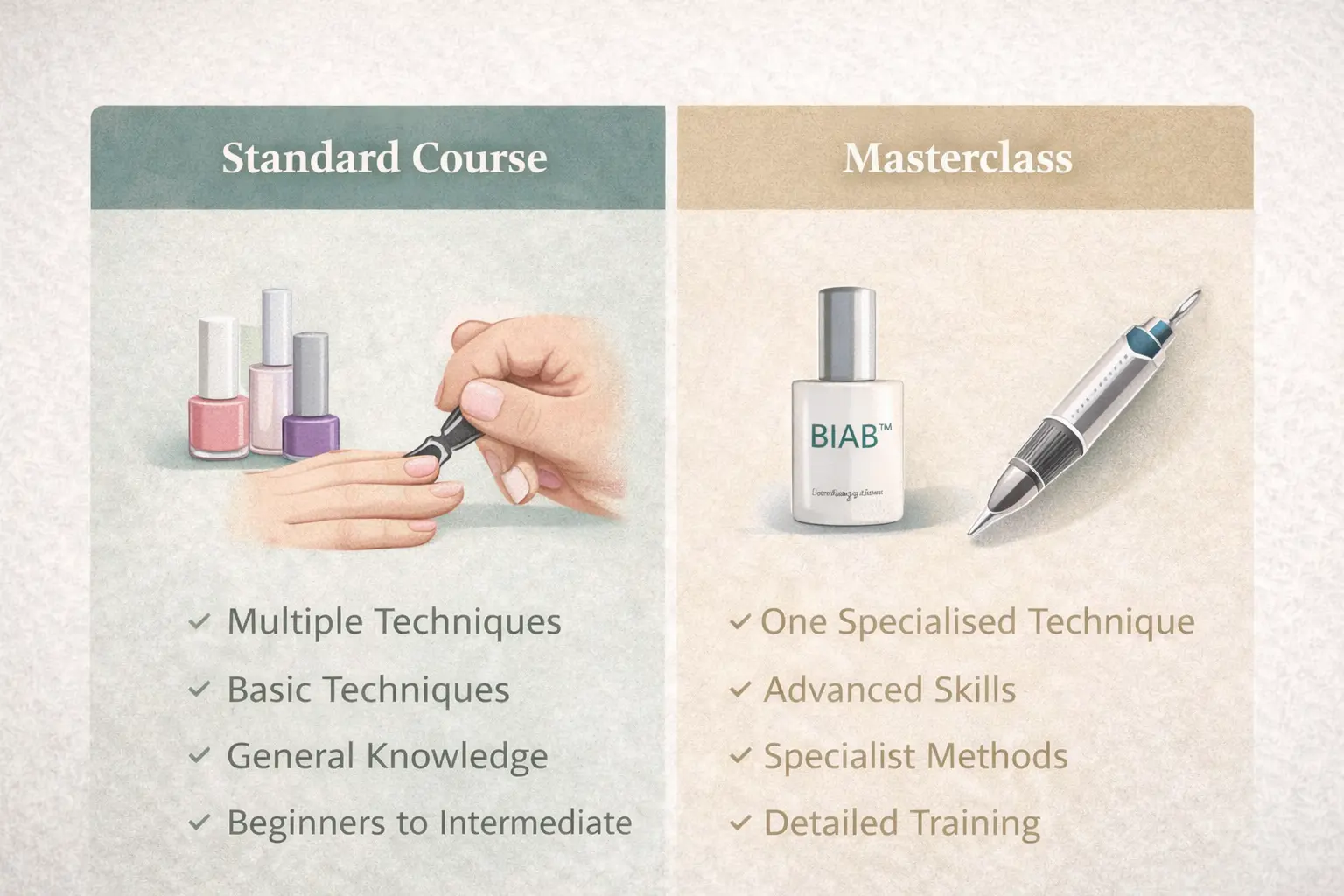
If you are completely new to professional nail services, start with a standard course covering fundamentals, safety protocols, and basic techniques. If you want to solve specific problems, master a particular technique, or elevate your skills in one focused area, a masterclass is designed for you—regardless of whether you are a beginner working on fundamentals or an experienced technician refining expertise.
The key distinction: Standard courses build broad foundation knowledge across multiple techniques, whilst masterclasses provide deep, focused training in one specific area with problem-solving emphasis. Each masterclass has its own difficulty level—some are beginner-friendly, others require more experience.
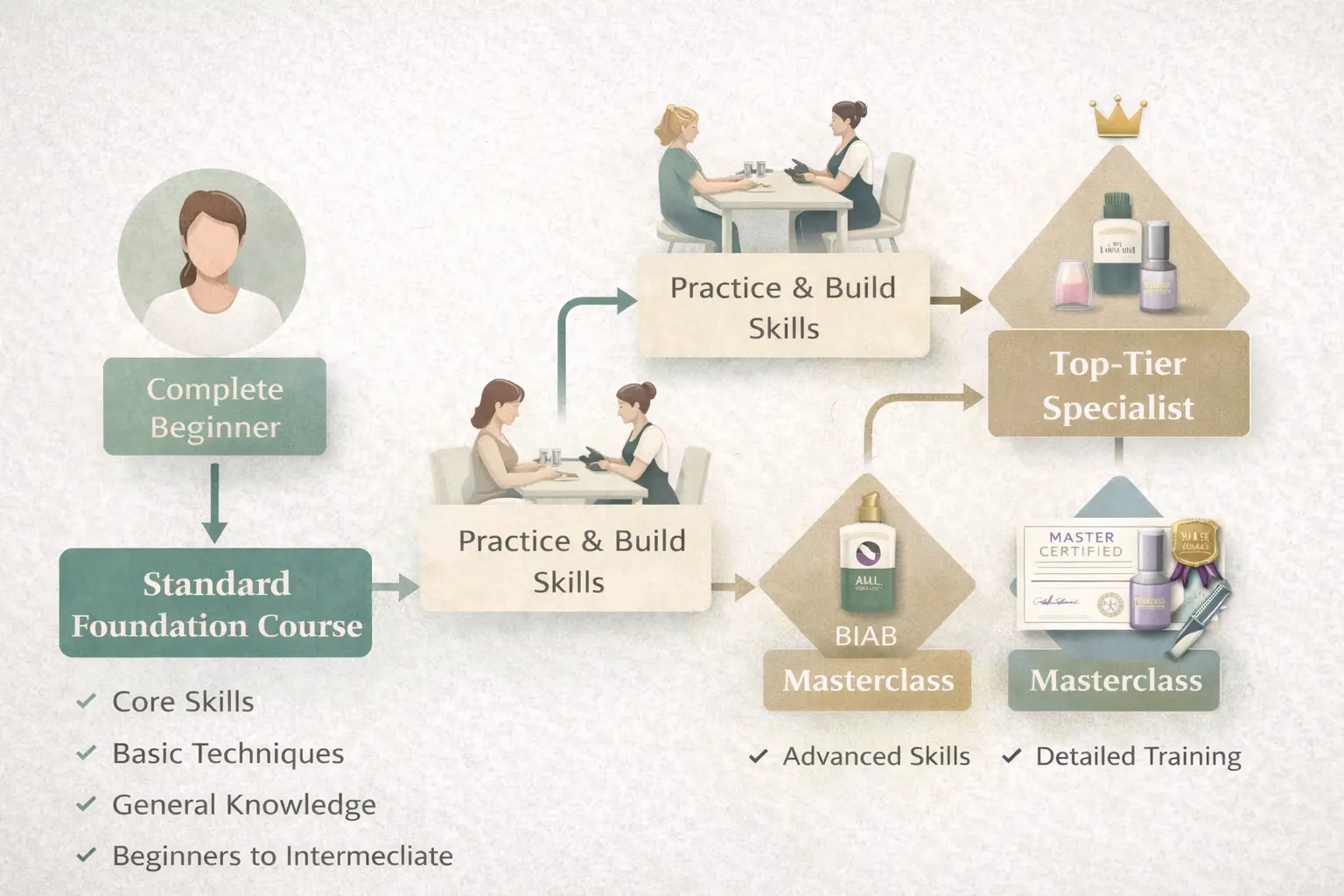
Important note: Whilst a standard course teaches you how to be a nail technician, a masterclass teaches you how to be a top-tier nail technician in that specific skill.
Why This Question Matters More Than You Think
Every month, dozens of nail technicians contact me asking whether they should enrol in a standard nail course or jump straight into a masterclass. Many believe masterclasses are simply “better” or more comprehensive versions of standard courses. This misconception costs them time, money, and confidence.
The truth is more nuanced. Standard courses and masterclasses serve fundamentally different purposes and are designed for distinct career stages. Choosing the wrong one does not just slow your progress—it can actively damage your development as a professional nail technician.
After 12 years of hands-on salon experience and training hundreds of nail technicians across the UK, I have seen both paths succeed brilliantly and fail spectacularly—usually because the student started at the wrong entry point.
This guide will help you assess your current skill level, understand what each type of training offers, and make the decision that accelerates your career rather than stalling it.
What Actually Defines a “Standard Nail Course”?
Before comparing the two, we need clear definitions. The nail education industry uses these terms loosely, creating confusion about what students will actually learn.
Core Characteristics of Standard Nail Courses
Standard nail courses provide comprehensive foundation training designed to take someone from zero experience to working professional competence. These courses typically include:
- Nail anatomy and physiology: Understanding nail structure, growth patterns, and common disorders
- Health and safety fundamentals: Sterilization protocols, infection control, and client safety
- Basic manicure and pedicure: Traditional techniques for natural nail care
- Gel polish application: Standard gel application on natural nails
- Basic nail extensions: Introduction to tips, forms, or basic builder gel methods
- Client consultation: Assessment, patch testing, and consent procedures
- Business basics: Pricing, insurance requirements, and professional standards
Who Standard Courses Are Designed For
Complete beginners with no professional nail experience, individuals transitioning from other industries, self-taught technicians who never received formal training, and anyone who needs comprehensive foundation knowledge before advancing to specialized techniques.
What Standard Courses Do Not Cover
Understanding what standard courses exclude is equally important:
- Advanced e-file techniques beyond basic surface prep
- Russian Manicure or dry manicure methods
- Complex nail art and design systems
- Advanced troubleshooting for retention issues
- Extreme nail shapes or sculptural techniques
- Product chemistry at advanced level
- Specialized problem-solving for difficult nail types
Standard courses provide breadth of knowledge across many techniques, preparing you to offer a range of basic services safely and competently. They do not provide the depth needed to become a specialist in any particular advanced technique.
What Actually Defines a “Masterclass”?
The term “masterclass” describes focused, problem-solving training in one specific technique or skill area. Unlike standard courses that cover multiple topics broadly, masterclasses dive deep into solving particular challenges—whether you are learning that technique for the first time or refining existing skills.
Core Characteristics of Masterclasses
Genuine masterclasses share these characteristics:
- Narrow focus: Deep specialization in one specific technique or system
- Problem-solving emphasis: Addresses specific challenges, common failures, and troubleshooting methods
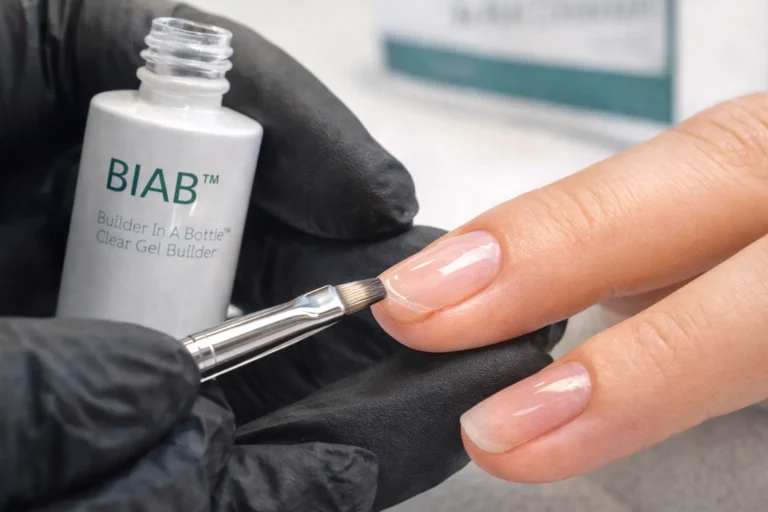
- Varying difficulty levels: Some masterclasses suit beginners (like fundamental BIAB application), others require more experience (like advanced Russian Manicure)
- Expert-level instruction: Taught by professionals with years of hands-on experience solving the exact problems covered
- Real-world application: Focuses on salon scenarios and practical solutions, not just theory
- Efficiency techniques: Methods for achieving better results in less time
- Clear learning outcomes: By the end, you can solve specific problems or perform specific techniques confidently
Who Masterclasses Are Designed For
Anyone wanting focused training in a specific technique—from complete beginners learning fundamental BIAB application to experienced technicians mastering complex nail art. The key is choosing a masterclass that matches your current skill level in that particular technique. Each masterclass clearly indicates its difficulty level and recommended prerequisites.
Examples of Masterclass Topics by Level
Masterclass subjects span all skill levels:
✓ All Levels Masterclasses
- BIAB Systems: Application fundamentals and troubleshooting
- Patch Testing: Safety protocols for all technicians
- Client Consultation: Professional communication skills
- Nail Preparation: Foundation techniques for retention
✓ Intermediate+ Masterclasses
- E-File Techniques: Safe cuticle work and surface prep
- Russian Manicure: Advanced dry manicure methods
- Extreme Nail Shapes: Structural integrity in stiletto and edge shapes
- Complex Nail Art: Advanced design systems
The important distinction is not whether masterclasses are “advanced”—it is whether the specific masterclass matches your skill level in that technique. A BIAB Masterclass can be perfect for beginners focusing on fundamentals, whilst an E-File Masterclass requires intermediate nail preparation knowledge to get the most from the training.
Direct Comparison: Standard Course vs Masterclass
This comprehensive comparison table clarifies the key differences:
How to Assess Which Path You Need
Choosing between a standard course and a masterclass depends entirely on your current skill level and professional goals. Use this assessment framework to determine your best starting point.
Self-Assessment Questions
Answer these questions honestly:
- Have you completed formal nail technician training? If no, you need a standard course regardless of self-taught experience.
- Can you confidently perform basic gel polish application with consistent retention? If no, focus on fundamentals first.
- Do you currently have paying clients receiving your nail services? Professional experience helps you get the most from advanced training.
- Can you identify and fix common problems like lifting, chipping, or poor adhesion? If no, you need more foundation knowledge.
- Do you understand nail anatomy, disorders, and contraindications? This knowledge helps maximize masterclass learning.
- Are you looking to specialize in one specific technique or service? If yes and you have experience, a masterclass makes sense.
- Do you already offer the service you want to improve? Masterclasses refine existing skills rather than teaching from scratch.
Decision Framework
If you answered “no” to questions 1-5: You need a standard foundation course before attempting any masterclass.
If you answered “yes” to questions 1-5 and “yes” to 6-7: You are ready for masterclass training in your chosen specialty.
If you answered “yes” to 1-5 but “no” to 6-7: Consider whether you truly need advanced training or if practice with fundamentals would serve you better.
The 5 Most Common Mistakes When Choosing Nail Training
After 12 years of training nail technicians, I have observed these patterns repeatedly. Avoiding these mistakes saves time, money, and frustration.
Mistake 1: Choosing the Wrong Level Masterclass
Not all masterclasses require advanced experience—but choosing one that does not match your current skill level in that specific technique creates frustration and wasted investment.
What actually happens: If you enrol in an intermediate or advanced masterclass without the foundational knowledge it assumes, you will struggle with terminology, cannot follow instructions effectively, miss important context, and ultimately cannot apply what is taught because you lack the prerequisite skills.
⚠️ Real Example
A student enrolled in an intermediate e-file masterclass without ever using an e-file before. She could not understand bit terminology, did not know proper angles or pressure, and had never worked with professional tools. The masterclass assumed these basics and focused on problem-solving. After completing beginner-level e-file training and practising for three months, she retook the masterclass and succeeded—but she paid twice and delayed her progress.
The solution: Always check the stated difficulty level and prerequisites for each masterclass. Some masterclasses (like fundamental BIAB application) welcome complete beginners, whilst others (like advanced Russian Manicure refinement) require existing experience in that technique.
Mistake 2: Not Checking Masterclass Prerequisites
Each masterclass has different prerequisites—some welcome absolute beginners, others assume you already practice that technique. Not checking before enrolling leads to frustration.
Why this matters: Masterclasses solve specific problems. If a masterclass addresses intermediate troubleshooting but you have not yet learned the basic technique, you cannot apply the solutions. Conversely, if you already have experience and enrol in a beginner-focused masterclass, you may find the content too basic.
The solution: Always read the “Who This Is For” section before enrolling. Match the stated level to your current abilities in that specific technique. If you are unsure, contact the instructor before purchasing.
Mistake 3: Choosing Based on Price Rather Than Appropriateness
Masterclasses often cost less than comprehensive standard courses because they are shorter and more focused. Some students choose masterclasses simply because they appear more affordable.
This is backwards logic. A £50 masterclass you are not ready for wastes £50. A £300 standard course that provides foundation competence is a worthwhile investment.
Mistake 4: Collecting Masterclasses Without Mastering Basics
Some technicians enrol in multiple masterclasses across different techniques before achieving competence in fundamentals. This “course collecting” behaviour stems from insecurity about basic skills.
Master one service completely before adding advanced variations. Quality beats quantity in professional development.
Mistake 5: Ignoring Instructor Experience and Teaching Style
Whether choosing a standard course or masterclass, instructor quality matters more than course content. A mediocre curriculum taught brilliantly by an experienced professional produces better outcomes than excellent content delivered by someone with limited real-world experience.
What to evaluate: How many years of hands-on salon experience does the instructor have? Do they currently work with clients or only teach? Can they demonstrate problem-solving in real scenarios? Do they show mistakes and failures as well as perfect results?
✓ Current Artistic Touch Courses
- ✓ E-File Manicure & Gel Polish Course – Intermediate level
- ✓ BIAB Masterclass – All levels, focus on fundamentals
- ✓ Nail Consultation Form Course – All levels
- ✓ Nail Patch Testing Course – All levels
The Hybrid Approach: Strategic Course Sequencing
Rather than choosing between standard courses and masterclasses, the most successful nail technicians use both strategically at different career stages.
The Recommended Development Path
- Start with comprehensive foundation training covering nail anatomy, health and safety, basic manicure, gel polish, and either gel extensions or BIAB basics.
- Complete insurance requirements and business setup to work legally and professionally from the beginning.
- Practise foundation techniques on clients to develop muscle memory, speed, and problem-recognition skills.
- Identify your first specialization based on client demand, personal interest, and observed skill gaps.
- Enrol in a focused masterclass addressing that specific technique or problem area.
- Implement and practise masterclass techniques until you achieve consistent, professional results.
- Add additional masterclasses strategically as your client base and skills develop.
✓ Example Career Timeline
- Month 1-2: Complete foundation nail technician course
- Month 3-5: Build client base offering basic gel polish and BIAB
- Month 6: Enrol in BIAB Masterclass to solve retention issues
- Month 7-10: Perfect BIAB technique, increase prices
- Month 11: Add further e-file training to improve cuticle work
- Month 12+: Position as BIAB specialist with premium pricing
This progression allows you to earn money whilst learning, identify real problems before seeking solutions, and invest in education strategically rather than impulsively.
Frequently Asked Questions About Nail Courses vs Masterclasses
Can I skip a standard course if I have been doing my own nails for years?
No. Working on yourself is fundamentally different from working on clients professionally. Standard courses cover essential health and safety protocols, client consultation, contraindications, infection control, insurance requirements, and professional standards that self-taught experience does not provide. Additionally, techniques that work adequately on your own nails may not be safe or effective when applied to diverse nail types and conditions.
How long should I wait between finishing a standard course and taking a masterclass?
This depends on your practice volume, but generally 3-6 months of regular client work helps you get the most from masterclass content. You benefit most when you have developed muscle memory, encountered common problems, and understand what specific issues you need to solve. If you are working with clients weekly, 3 months may be sufficient. The key indicator is whether you have experienced the problems the masterclass addresses.
Are masterclasses worth it if I already do the technique fairly well?
Yes, if you want to refine technique, solve specific persistent problems, work faster without compromising quality, or command premium pricing as a specialist. Masterclasses take you from “fairly well” to “exceptional”—the difference between an average nail technician and a sought-after specialist. Evaluate whether the investment will generate returns through increased efficiency, higher prices, or expanded service offerings.
Can I take multiple masterclasses at once?
Technically yes, but each masterclass requires dedicated practice time to implement new techniques and develop proficiency. Taking multiple simultaneously divides your focus and prevents you from mastering any single technique. The better approach is sequential learning: complete one masterclass, implement and practise those techniques until consistent, then move to the next specialization.
What if I took a standard course years ago—do I need to retake it before doing a masterclass?
Not necessarily, but honestly assess whether your foundation skills remain current and competent. If you have been working consistently since your original training, you likely have the experience needed for masterclass content. However, if you completed training years ago but never worked professionally, or if you stopped working and are now returning, refresher training may be beneficial. The key question is whether you can perform basic techniques confidently and competently right now.
Do masterclasses include certification?
This varies by provider. Some masterclasses offer certificates of completion, whilst others focus purely on skill development without formal certification. For most advanced techniques, certification is less important than demonstrable competence—clients care about results, not certificates. However, if you need documentation for insurance purposes or professional registration, verify whether the masterclass includes certification before enrolling.
What is the difference between an “advanced course” and a “masterclass”?
Terminology varies across providers, but generally an “advanced course” covers multiple advanced techniques with moderate depth, whilst a “masterclass” focuses intensively on one specific technique with exceptional depth. Advanced courses might cover several extension methods, various nail art styles, or multiple product systems. Masterclasses typically address one specific skill area with deep specialization.
Should I choose in-person or online training for standard courses and masterclasses?
Both formats work effectively when delivered well. In-person training offers immediate hands-on correction and tactile learning, which benefits beginners learning foundation techniques. Online training provides flexibility, lifetime access for review, and often more detailed troubleshooting content. For masterclasses, online training often works exceptionally well because experienced technicians can implement techniques independently and benefit from being able to pause, rewatch, and review specific sections multiple times. The instructor’s quality matters more than the delivery format.
About Your Instructor: Radina Ignatova

Radina Ignatova is a Professional Nail Expert, Certified Educator, and founder of Artistic Touch – Nail Training Academy, based in Dundee, Scotland, UK.
With over 12 years of continuous hands-on experience in professional nail services and advanced techniques including BIAB systems, Russian Manicure, e-file methods, and extreme nail shapes, Radina specializes in transforming beginner nail technicians into confident professionals through structured, progressive education.
Unlike educators who transitioned away from client work to teach full-time, Radina maintains an active client base whilst training students. This ongoing salon experience ensures her teaching addresses current industry challenges, real retention problems, and practical efficiency techniques rather than theoretical perfection.
Her teaching philosophy focuses on:
- Progressive skill development matched to career stage and readiness
- Honest assessment of prerequisites to prevent wasted investment
- Problem-solving and troubleshooting rather than just perfect demonstrations
- Safety-first protocols in every aspect of nail services
- Building confidence through proper foundations before advancing to specialization
Choose Your Next Step With Confidence
The decision between a standard course and masterclass is not about which is “better”—it is about which matches your current skills, experience, and professional goals. Making the right choice accelerates your development, whilst making the wrong one wastes time and creates frustration.
Remember the fundamental principle: Whilst a standard course teaches you how to be a nail technician, a masterclass teaches you how to be a top-tier nail technician. Both are valuable, but only when taken at the appropriate career stage.
Your Next Steps:
- ✓ Honestly assess your current skill level using the self-assessment questions
- ✓ Determine whether you need foundation knowledge or specialized refinement
- ✓ Review available courses that match your determined level
- ✓ Plan your long-term development path with strategic course sequencing
Invest in education that matches where you are now, not where you aspire to be eventually. Build foundations first, specialize strategically second, and your career development will progress smoothly and sustainably.
Explore Our Complete Course Catalogue
Find the perfect training for your current career stage, from complete beginner courses to advanced specialist masterclasses.
Lifetime access • Direct instructor support • Flexible learning
About Artistic Touch – Nail Training Academy: Professional online nail education delivered by Radina Ignatova from Dundee, Scotland, UK. Specializing in BIAB systems, Russian Manicure technique, e-file methods, and comprehensive nail education for aspiring and professional nail technicians at all career stages.