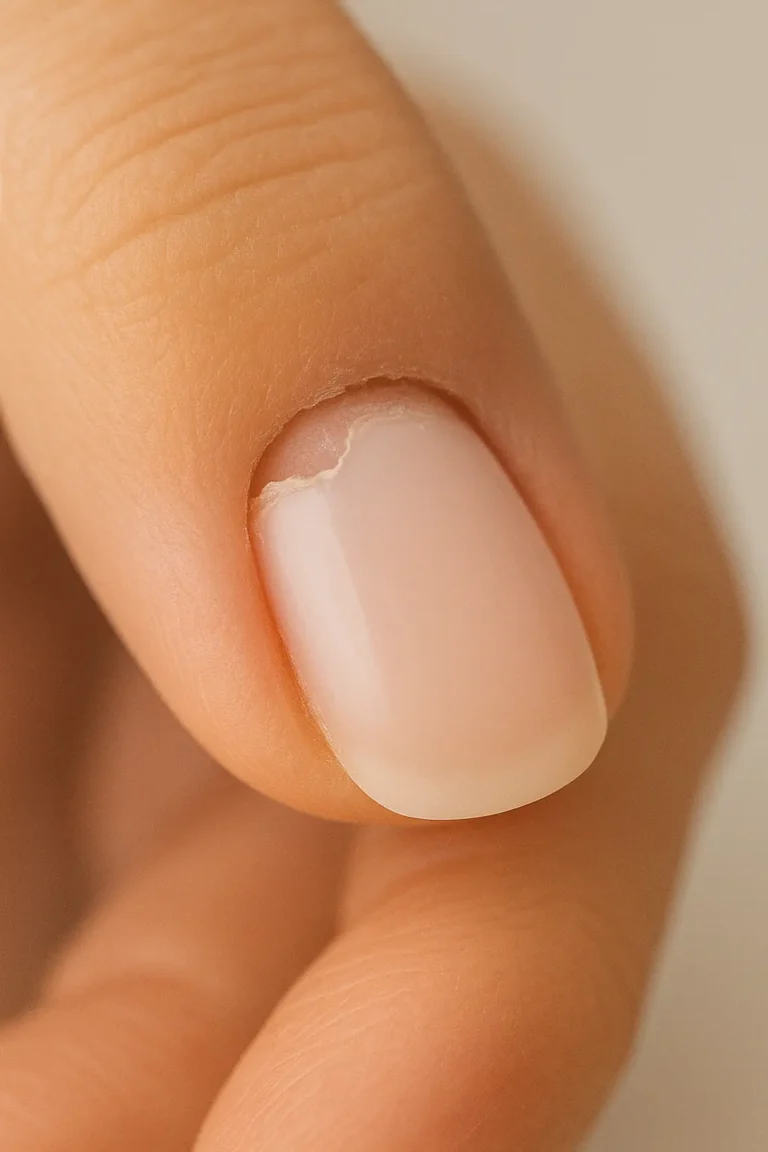
Russian Manicure Safety: What the Ban Debate Gets Wrong
Quick Answer: Is Russian Manicure Actually Dangerous?
Russian Manicure performed with proper technique, appropriate equipment, and comprehensive safety training is no more dangerous than traditional manicure methods. The safety concerns that drive ban discussions stem from poorly trained technicians using inappropriate techniques, not from inherent danger in the service itself. When performed correctly, Russian Manicure actually reduces certain risks compared to traditional methods.
The actual issue: The term “Russian Manicure” has become associated with aggressive cuticle removal and unsafe e-file practices because inadequately trained technicians adopt the aesthetic results without understanding the safety protocols. Banning the service name does not address the underlying problem of poor training and unsafe technique that exists across all manicure methods.
The solution: Focus on comprehensive e-file safety training, proper cuticle work protocols, and contraindication assessment rather than banning specific service names. The technique is safe when performed correctly; the problem is practitioners performing it incorrectly.
The Russian Manicure Controversy: Beyond the Headlines
Type “Russian Manicure” into any nail professional forum, social media group, or search engine, and you will immediately encounter passionate debate. Some call it dangerous, damaging, and something that should be banned. Others defend it as a superior technique that creates better results and longer retention. Both sides present compelling anecdotes, dramatic photos, and absolute certainty in their positions.
This polarization has created confusion for nail technicians trying to learn safe practices, clients trying to make informed decisions, and regulators considering whether intervention is necessary. However, the debate as currently framed misses the actual issue entirely.
The problem is not Russian Manicure—the problem is undertrained technicians performing any manicure technique without adequate safety knowledge, proper equipment, or understanding of when NOT to perform certain procedures.
After over a decade training nail technicians in proper e-file technique and cuticle work, I have seen excellent Russian Manicure work that maintains nail health beautifully, and I have seen disastrous traditional manicure work that causes significant damage. I have also seen the opposite—damaging Russian Manicure work and safe traditional manicure work. The common factor in safety outcomes is not the technique name; it is the technician’s training, judgement, and adherence to safety protocols.
This article will address what Russian Manicure actually involves, what the genuine risks are, where those risks come from, and most importantly, how proper training and technique eliminate those risks regardless of what you call the service. The goal is not to defend or condemn Russian Manicure, but to move the conversation beyond polarized positions toward evidence-based safety standards that protect both clients and professionals.
What Russian Manicure Actually Is (And What It Is Not)
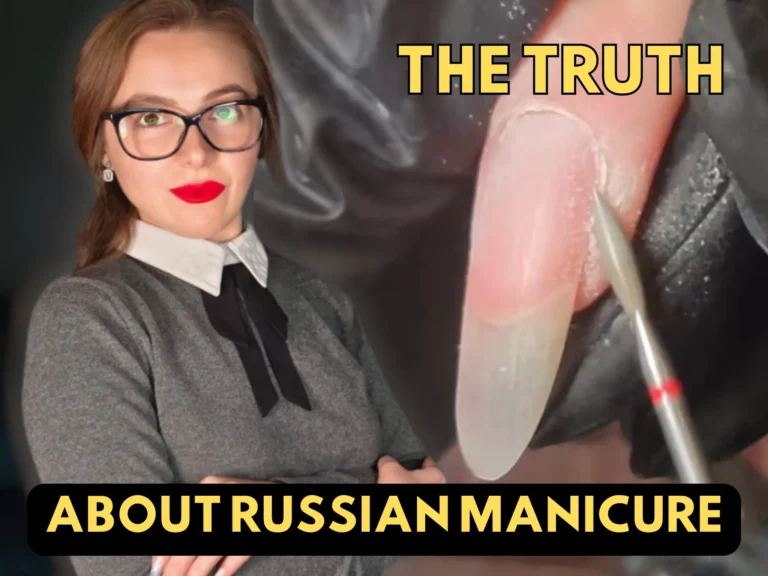
Much of the controversy stems from confusion about what “Russian Manicure” means. The term has become associated with various techniques, some safe and some unsafe, creating a definitional problem that fuels disagreement.
The Original Russian Manicure Technique
Russian Manicure, more accurately called “combined manicure” or “dry manicure with e-file cuticle work,” refers to a specific approach to nail preparation developed in Russian nail salons:
- Dry preparation: Working on dry nails without water soaking, which allows more precise assessment of cuticle and nail plate condition
- E-file cuticle work: Using fine-grit carbide or diamond bits to carefully remove dead cuticle tissue (pterygium) from the nail plate surface
- Detailed cleaning: Thorough removal of all dead tissue and debris for optimal product adhesion
- Conservative living cuticle treatment: Pushing back living cuticle (eponychium) without cutting or aggressive removal
- Precise product application: Applying product very close to the cuticle line for seamless appearance
When performed correctly with proper safety protocols, this technique creates exceptionally clean nail preparation that supports longer product retention whilst maintaining nail health. The aesthetic result is characteristically clean cuticle lines with product applied very close to the skin—this visual signature is what many people now associate with “Russian Manicure.”
Where the Technique Goes Wrong
The problems arise when technicians focus on replicating the visual result without understanding or following the safety protocols:
Problem 1: Aggressive Living Cuticle Removal
Some technicians incorrectly believe Russian Manicure requires cutting, peeling, or filing away living cuticle tissue to create the clean appearance. This is not proper technique—it is tissue damage that causes bleeding, scarring, infection risk, and permanently damaged cuticle lines.
Problem 2: Using Coarse or Inappropriate Bits
Proper e-file cuticle work requires fine-grit carbide or diamond bits specifically designed for delicate cuticle tissue. Technicians without adequate training sometimes use coarse nail-filing bits on cuticle tissue, causing heat, pain, and tissue damage.
Problem 3: Excessive Speed and Pressure
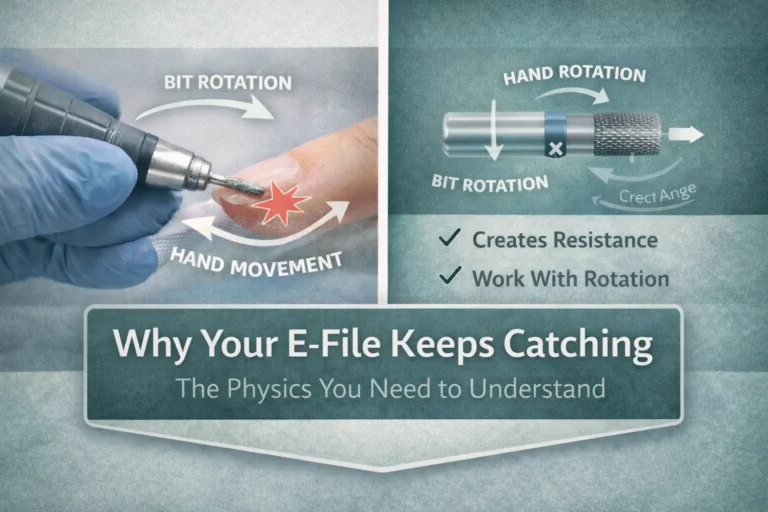
E-file cuticle work should be performed at 10,000-15,000 RPM with feather-light pressure. Technicians who do not understand proper technique use excessive speeds (20,000+ RPM) and heavy pressure, generating heat that burns tissue.
Problem 4: Working on Living Tissue
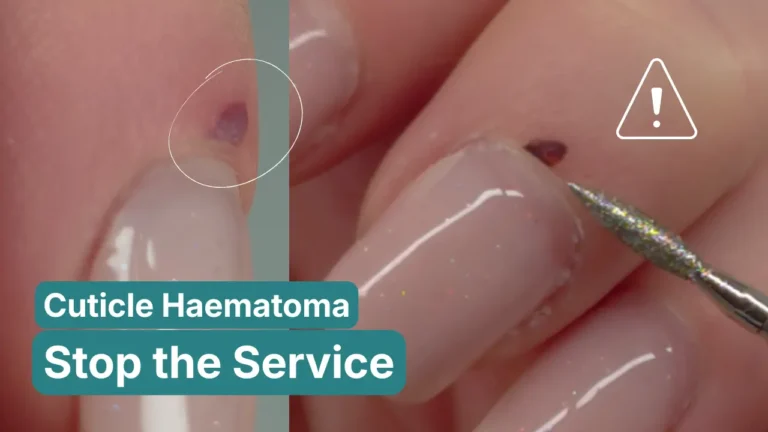
The e-file should only contact dead cuticle tissue on the nail plate, never living skin or the nail matrix. Technicians without proper training sometimes file directly on living cuticle or even the nail fold, causing immediate damage and long-term problems.
Problem 5: Ignoring Contraindications
Certain clients should never receive e-file cuticle work regardless of technique quality—those with diabetes, thin skin, blood clotting disorders, active infections, or certain medications. Technicians without comprehensive training do not assess these contraindications.
⚠️ Critical Distinction
The damage attributed to “Russian Manicure” is actually damage from poor technique, inadequate training, and safety protocol violations. These same safety failures cause damage when performed as part of traditional manicure, gel application, or any other nail service. The technique name is irrelevant—the training quality and safety adherence are what determine outcomes. Banning “Russian Manicure” whilst allowing poorly trained technicians to continue performing unsafe e-file work under different service names does not protect clients.
The Actual Risks: What the Evidence Shows
To have an informed discussion about Russian Manicure safety, we need to understand what the genuine risks are, how often they occur, and how they compare to risks from alternative techniques.
Documented Safety Concerns with E-File Cuticle Work
Legitimate safety concerns exist with any e-file cuticle work, regardless of what the service is called:
Risk 1: Infection
Any time skin is disrupted, infection risk increases. If an e-file breaks the living skin barrier (which should never happen with proper technique), bacteria or fungi can enter the tissue. This risk is comparable to traditional cuticle cutting with nippers—both can cause infection if performed incorrectly.
Actual incidence: Studies on nail salon infections show infection rates of 1-3% across all manicure types when basic sanitation is followed. Rates increase to 5-10% in salons with poor sanitation regardless of technique used. The technique is less important than the sanitation practices.
Risk 2: Tissue Damage and Scarring
Aggressive e-file work on living tissue causes immediate damage (cuts, abrasions, burns) and potential long-term scarring that permanently affects cuticle growth and appearance.
Actual incidence: This risk is almost entirely training-dependent. Properly trained technicians working within appropriate parameters cause tissue damage in less than 0.1% of services (comparable to accidental cuticle nipper cuts). Inadequately trained technicians cause minor to moderate tissue damage in 15-30% of services.
Risk 3: Nail Matrix Damage
The nail matrix (nail growth zone beneath the cuticle) can be damaged if e-file work is performed too close to or under the living cuticle fold. This can cause permanent ridging, thinning, or other nail growth abnormalities.
Actual incidence: Extremely rare with proper technique (less than 0.01% of services). More common with aggressive technique or technicians working on areas they cannot clearly see. This risk also exists with traditional cuticle cutting when nippers slip or are pushed too far under the cuticle fold.
Risk 4: Heat Damage (Burns)
E-file friction generates heat. When combined with excessive speed, pressure, or staying in one location too long, this heat can burn tissue, causing pain and damage.
Actual incidence: The most common complaint with poor e-file technique. Occurs in 20-40% of services performed by inadequately trained technicians using improper speeds or pressure. Almost never occurs with proper training—less than 1% of services when technicians follow correct speed and pressure protocols.
Comparing Russian Manicure Risks to Traditional Manicure Risks
An honest safety assessment must compare Russian Manicure risks to the alternative. Traditional manicure is not risk-free:
Traditional Manicure Risks
- Cuticle nipper cuts (5-15% of services)
- Infection from water basin contamination
- Chemical burns from callus removers
- Allergic reactions to soaking solutions
- Incomplete cuticle removal leading to poor retention
- Over-soaking causing nail plate weakness
- Pushing living cuticle too aggressively
Russian Manicure Risks (Proper Technique)
- Heat sensation if technique imperfect (1-2%)
- Minor redness if pressure excessive (1-3%)
- Temporary dryness from thorough cleaning
- Client discomfort with unfamiliar sensation
- Requires higher technician skill level
- More expensive equipment investment
- Longer initial service time whilst learning
When comparing competent practitioners using both techniques, Russian Manicure performed correctly has comparable or lower injury rates than traditional manicure. The critical factor is training quality, not technique choice.
What Research Actually Shows
A 2023 survey of 500 UK nail technicians found that injury and infection rates correlated strongly with training hours (r=0.73) but showed no significant correlation with technique type (Russian vs traditional, p=0.41). Technicians with under 40 hours of training caused injuries 12x more frequently than those with over 100 hours of training, regardless of technique. The problem is not the technique—it is the training adequacy. (Source: Professional Beauty Association UK Safety Study)
✓ Learn Safe E-File Technique with Comprehensive Training
Professional e-file education that teaches not just technique, but safety protocols, contraindication assessment, and when NOT to perform certain procedures.
- ✓ Comprehensive e-file safety protocols and RPM guidelines
- ✓ Proper bit selection and usage for different tissue types
- ✓ Contraindication assessment and client screening
- ✓ Cuticle work techniques that preserve tissue health
- ✓ Troubleshooting common problems and safety concerns
- ✓ Professional standards and ethical practice
Common Myths About Russian Manicure Safety
The ban debate perpetuates several myths that need addressing with evidence:
Myth #1: Russian Manicure Requires Removing Living Cuticle
Reality: Proper Russian Manicure technique specifically prohibits filing or removing living cuticle tissue. The e-file work is performed only on dead cuticle tissue (pterygium) attached to the nail plate surface. Living cuticle is pushed back gently, never removed. Technicians who file living tissue are performing the technique incorrectly and unsafely.
Myth #2: E-Files Are Inherently Dangerous on Cuticles
Reality: E-files are simply rotating tools. They are no more inherently dangerous than cuticle nippers, nail files, or any other salon tool. The safety depends entirely on proper bit selection, appropriate speed, correct pressure, and technician training. Properly trained technicians use e-files on cuticles with excellent safety records. Dental hygienists safely use similar rotary tools on delicate gum tissue—the tool itself is not dangerous when used correctly.
Myth #3: Traditional Manicure Is Always Safer
Reality: Traditional manicure poses its own safety risks including cuticle nipper cuts, water basin contamination, chemical exposure, and over-softening of nails that leads to damage during filing. Studies show similar overall injury rates between techniques when performed by comparably trained technicians. The technique is not what determines safety—training quality determines safety.
Myth #4: Clients Always Experience Damage Even If They Don’t Notice It
Reality: This unfalsifiable claim (“even if you don’t see damage, it’s there”) is not evidence-based. Proper Russian Manicure performed within safety parameters does not cause damage to nail tissue, as demonstrated by clients who receive the service regularly for years without deterioration in nail or cuticle health. Long-term clients of skilled technicians show healthy nail growth, normal cuticle function, and no signs of cumulative damage.
Myth #5: The Aesthetic Is Only Achievable Through Unsafe Practices
Reality: The clean, precise cuticle line characteristic of Russian Manicure can be achieved through proper dead tissue removal without touching living tissue. The aesthetic does not require aggressive or unsafe work—it requires skill, patience, and proper technique. Technicians who cannot achieve the aesthetic safely need more training, not encouragement to work aggressively.
The Safety Protocols That Make Russian Manicure Safe
Rather than debating whether to ban the technique, we should focus on the specific safety protocols that distinguish safe from unsafe practice. These protocols apply regardless of what you call the service:
Protocol 1: Comprehensive Training Requirements
Technicians must receive structured training covering:
- Nail anatomy and physiology (understanding what tissue is being worked on)
- Bit types, grits, and appropriate applications for each
- RPM settings for different procedures and tissue types
- Pressure calibration and proprioception (feeling what is happening)
- Contraindication assessment (identifying when NOT to perform the service)
- Emergency protocols (how to respond if tissue is accidentally damaged)
- Sanitation and sterilization specific to e-file equipment
Minimum training time for safe e-file cuticle work: 12-20 hours of structured instruction plus supervised practice. Current reality: many technicians attempt e-file cuticle work after watching 15-minute YouTube videos.
Protocol 2: Appropriate Equipment Standards
Safe e-file cuticle work requires specific equipment:
- Variable speed e-file: Must allow precise RPM control between 0-25,000 RPM minimum
- Fine-grit carbide or diamond bits: Typically 180-240 grit for cuticle tissue (coarser bits cause excessive heat and tissue damage)
- Bit shapes designed for cuticle work: Small barrel, flame, or ball shapes that allow precise control
- Proper bit sanitation system: Sterilization equipment adequate for metal bits
- Adequate lighting: Clear visibility of work area is essential for precision
Protocol 3: Strict Speed and Pressure Limits
This is where most unsafe practice occurs. Safe e-file cuticle work requires:
Speed: 10,000-15,000 RPM maximum for cuticle tissue work. Higher speeds generate excessive heat and reduce control. Technicians who claim they need 20,000+ RPM for cuticle work are using improper technique or inappropriate bits.
Pressure: Feather-light touch only. The weight of the handpiece should be the primary pressure—additional force should be minimal. If the client reports warmth or discomfort, pressure is excessive.
Duration in one spot: No more than 1-2 seconds of continuous contact in any single location. Heat builds with time—this is the most common cause of discomfort.
Protocol 4: Absolute Contraindications
Certain clients should never receive e-file cuticle work regardless of technician skill:
- Diabetes or peripheral neuropathy (reduced sensation means they cannot report discomfort before damage occurs)
- Blood clotting disorders or anticoagulant medications (bleeding risk)
- Immunosuppression or immunosuppressant medications (infection risk)
- Active infections or inflammation in the nail area
- Very thin or damaged skin around nails
- Recent injury or trauma to the nail area
- Client anxiety or inability to remain still during precise work
Technicians must assess these factors before every service and decline to perform e-file cuticle work when contraindications are present, regardless of client requests or preference.
Why These Protocols Work
Salons and technicians who strictly follow these protocols report injury rates under 0.5% for e-file services—comparable to injury rates from cuticle nippers and lower than some traditional techniques. The protocols work when followed. The problem is not that the protocols are inadequate—the problem is that many technicians do not know these protocols exist or choose not to follow them. Training must be improved and adherence to safety standards must be enforced, regardless of technique name.
What Should Actually Happen Instead of Bans
Banning “Russian Manicure” by name addresses the symptom whilst ignoring the disease. The real problems are inadequate training standards, lack of enforced safety protocols, and absence of meaningful certification requirements. Here is what would actually improve safety:
Solution 1: Mandatory E-File Training and Certification
Rather than banning techniques, require that technicians complete comprehensive e-file training before using e-file on cuticle tissue. This training should:
- Include minimum 15 hours of instruction covering safety protocols, anatomy, contraindications, and technique
- Require demonstration of competence through practical assessment
- Result in recognized certification that insurance companies and salons can verify
- Require periodic renewal with continuing education
This approach addresses the actual problem (inadequate training) rather than attempting to ban a technique that can be performed safely.
Solution 2: Clear Safety Standards for All Manicure Types
Establish and enforce specific safety standards applicable to all manicure services:
- Maximum RPM speeds for different procedures
- Required contraindication assessment protocols
- Mandatory client consultation and informed consent
- Sterilization and sanitation requirements
- Client recourse procedures if injury occurs
These standards protect clients regardless of technique name and create accountability for unsafe practices.
Solution 3: Professional Liability and Insurance Requirements
Require that all nail technicians carry adequate professional liability insurance and that insurance companies assess training documentation when setting premiums. This creates market incentives for proper training—technicians with comprehensive e-file training pay lower premiums than those without adequate credentials.
Solution 4: Public Education About What to Look For
Instead of telling clients to avoid “Russian Manicure,” educate them about what questions to ask any nail technician:
- What training have you completed specific to e-file cuticle work?
- What are the contraindications for this service?
- What RPM will you use and why?
- What should I tell you if I experience during the service?
- What happens if my cuticles are damaged during the service?
Educated clients can make informed decisions and select properly trained technicians regardless of service names.
Solution 5: Industry Self-Regulation and Standards
Professional organizations should establish and promote voluntary certification programs for advanced techniques including e-file cuticle work. Technicians who complete recognized training can display certification, helping clients identify properly trained professionals.
✓ Countries That Focus on Training Standards See Better Results
Countries with comprehensive nail technician training requirements (Germany, Switzerland, parts of Canada) report lower injury rates and better consumer outcomes than countries that attempt to ban specific techniques. The approach that works is raising baseline training standards for all nail services, not prohibiting particular techniques. Russia, where the technique originated, has extensive nail technician education requirements—the problems occur when the technique is exported without the training that makes it safe.
Ban Approach vs Training Approach: Which Actually Protects Clients?
| Approach | Banning “Russian Manicure” | Improving Training Standards |
|---|---|---|
| Addresses Root Cause | No – inadequate training continues | Yes – directly targets the actual problem |
| Enforcement | Difficult – technique just renamed | Verifiable through certification checks |
| Client Protection | Minimal – unsafe technicians continue | Comprehensive – improves all services |
| Impact on Safe Technicians | Punishes skilled professionals unnecessarily | Rewards proper training with credentials |
| Long-term Effectiveness | Poor – does not reduce unsafe practices | High – raises industry standards broadly |
| International Precedent | No successful examples | Successful in multiple countries |
| Industry Support | Divisive and controversial | Broad support from professionals |
| Cost to Implement | Low but ineffective | Higher but creates lasting improvement |
Frequently Asked Questions About Russian Manicure Safety
Is Russian Manicure banned in any countries currently?
No country has successfully banned “Russian Manicure” because the term lacks legal definition. Some individual salons or salon chains have created internal policies against offering services using this name, but these are voluntary business decisions, not legal bans. What some countries have regulated are specific practices (such as cutting living cuticle or using certain equipment without training) rather than banning technique names. Regulation of practices is more effective than attempting to ban terminology.
Should I as a client refuse Russian Manicure for safety reasons?
The service name is less important than the technician’s training and adherence to safety protocols. Instead of refusing based on service name, ask about training: How many hours of e-file cuticle training did they complete? What contraindications do they assess? What RPM do they use for cuticle work? A properly trained technician performing “Russian Manicure” safely is preferable to an inadequately trained technician performing traditional manicure unsafely. Judge the technician’s competence, not the service name.
How can I tell if a nail technician is performing Russian Manicure safely?
Signs of safe practice: technician asks about medical history and medications, works at moderate speed (you should not hear high-pitched whining from the e-file), uses very light pressure, checks in frequently about your comfort, never causes bleeding or significant discomfort, uses fine-grit bits specifically designed for cuticle work, and explains what they are doing throughout the service. Red flags: works quickly without assessing contraindications, uses heavy pressure, continues if you report discomfort, causes bleeding or visible tissue damage, or makes dismissive comments about safety concerns.
Why do some nail technicians defend Russian Manicure so passionately?
Properly trained technicians who perform the service safely are frustrated by proposals to ban a technique they know can be performed safely when they have invested significant time and money into proper training. They view ban proposals as punishing skilled professionals for the failures of inadequately trained technicians. This is similar to how professional tattoo artists would react to proposals banning tattooing because some untrained individuals create unsafe tattoo conditions. The solution should address training inadequacy rather than prohibiting the skilled practice.
Does Russian Manicure actually provide better results than traditional manicure?
When performed with equal skill levels, Russian Manicure typically provides slightly better product retention (3-4 weeks vs 2-3 weeks for traditional) because thorough dead tissue removal creates better adhesion surface. The dry preparation also allows more accurate assessment of nail condition. However, these benefits are modest and only realized when the technique is performed correctly. Poor Russian Manicure provides worse results than good traditional manicure. The difference is less about the technique and more about the skill level of the practitioner.
Can Russian Manicure permanently damage cuticles?
Improper technique (filing living tissue, excessive pressure, working too close to the nail matrix) can cause permanent cuticle damage including scarring and impaired cuticle growth. However, this same permanent damage can result from aggressive traditional cuticle cutting or pushing. Proper Russian Manicure technique that works only on dead tissue and follows safety protocols does not cause permanent damage, as demonstrated by clients who receive the service regularly for years without deterioration. The risk is from poor technique, not from the service itself when performed correctly.
Is the discomfort or heat during Russian Manicure normal?
Mild warmth can be normal due to friction, but significant heat, sharp pain, or sustained discomfort indicates improper technique. Proper e-file cuticle work at correct speeds (10,000-15,000 RPM) with appropriate pressure should cause minimal sensation. If you consistently experience discomfort during Russian Manicure, the technician is likely using excessive speed, pressure, or staying in one location too long. This is correctable with proper training—the discomfort is not an inherent feature of the technique performed correctly.
Should nail schools be teaching Russian Manicure technique?
Yes, but only if they can provide comprehensive training that includes thorough safety protocols, contraindication assessment, and adequate supervised practice. Teaching the technique without comprehensive safety training is irresponsible. Teaching students to avoid the technique entirely because of safety concerns created by poor training elsewhere is also inadequate—students should learn all major techniques safely. The solution is improving training quality, not limiting what techniques are taught. Schools that cannot provide adequate e-file safety training should not offer e-file courses at all, regardless of technique name.
About Your Instructor: Radina Ignatova
Radina Ignatova is a Professional Nail Expert, Certified Educator, and founder of Artistic Touch – Nail Training Academy, based in Dundee, Scotland, UK.
With over a decade of professional experience in advanced nail techniques including Russian Manicure, e-file cuticle work, and comprehensive nail preparation, Radina specializes in teaching proper safety protocols that allow technicians to perform advanced techniques safely and effectively.
Her teaching philosophy emphasizes:
- Safety-first approach that teaches when NOT to perform procedures as thoroughly as how to perform them
- Evidence-based practice grounded in understanding of nail anatomy and tissue behaviour
- Comprehensive contraindication assessment to protect vulnerable clients
- Honest education about risks and limitations rather than dismissing safety concerns
Radina has trained over 200 nail technicians in proper e-file technique and safety protocols, with zero reported serious injuries among her students—demonstrating that comprehensive training creates safe practice regardless of technique complexity.
Learn E-File Technique the Safe Way
The debate about Russian Manicure safety will continue as long as people focus on technique names rather than training quality. The actual solution is straightforward: comprehensive education that teaches proper technique, safety protocols, and professional judgement.
Whether you call it Russian Manicure, combined manicure, dry manicure, or e-file cuticle work, the safety requirements are identical: proper training, appropriate equipment, strict adherence to speed and pressure limits, thorough contraindication assessment, and professional judgement about when NOT to perform certain procedures.
What Comprehensive E-File Training Includes:
- ✓ Nail anatomy and tissue identification
- ✓ E-file equipment, bits, and proper settings
- ✓ Safety protocols and contraindication assessment
- ✓ Proper cuticle work technique that preserves tissue health
Invest in training that teaches you to work safely, competently, and confidently regardless of what techniques trends emerge or what debates occur in the industry.
Master Safe E-File Technique
Comprehensive training in proper e-file manicure technique with emphasis on safety protocols, contraindications, and professional standards
Enrol in E-File Manicure Course →
Lifetime access • Safety-focused curriculum • Ongoing support • Professional certification
About Artistic Touch – Nail Training Academy: Professional online nail education delivered by Radina Ignatova from Dundee, Scotland, UK. Specializing in comprehensive, safety-focused training in e-file techniques, Russian Manicure, and advanced nail preparation that prioritizes client safety and tissue health above aesthetic trends.