Is a Lower RPM Safer? Why Turning Your E-File Down Does Not Fix the Problem
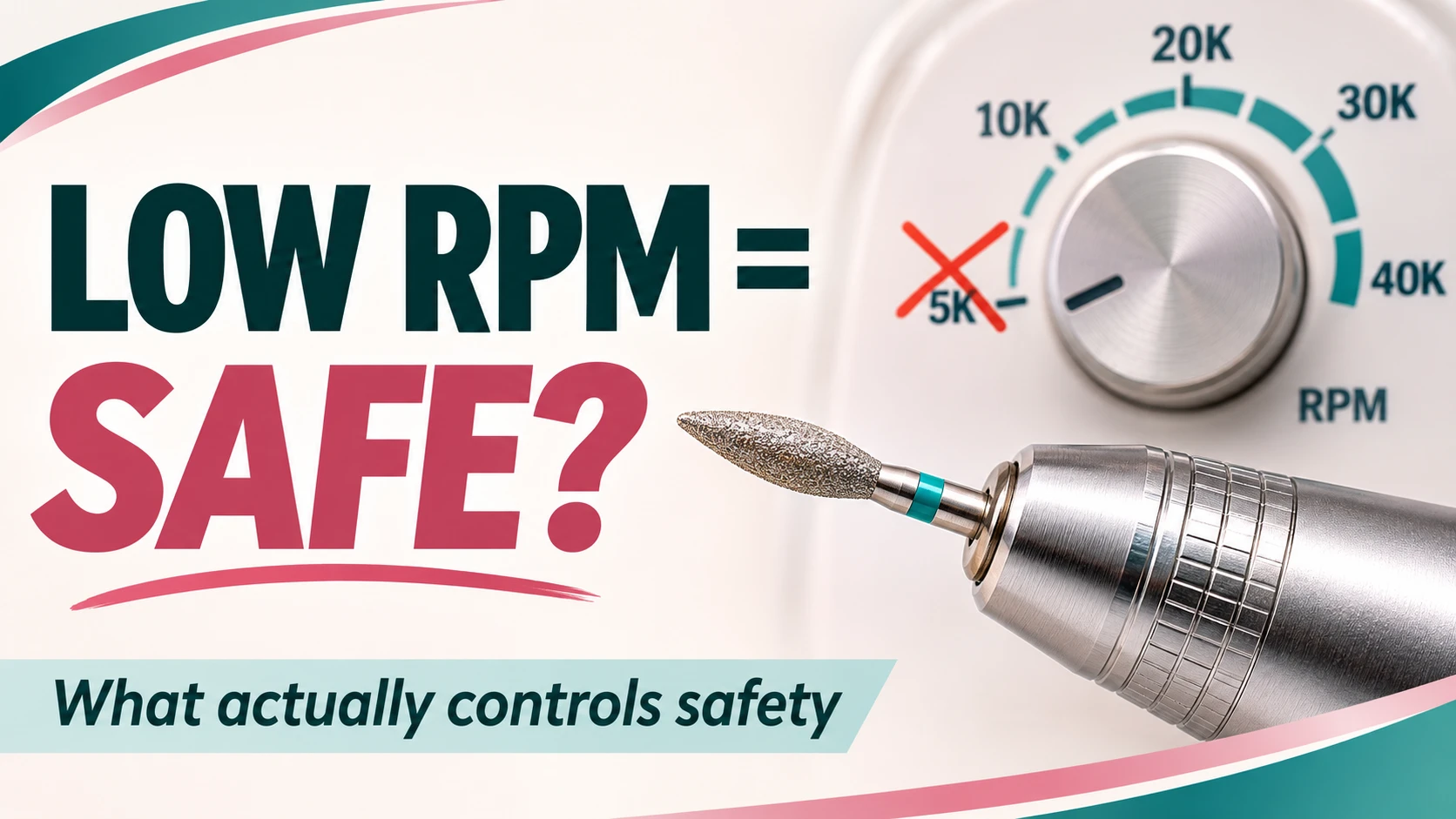
You turned the e-file down to be safe, and the client still flinches. Or you turned it up to finish faster and the cuticle area looks overworked. Either way, the question is usually the same: what is the right RPM?
I am Radina Ignatova, a Professional Nail Expert since 2014, and I work in a salon every day. In my teaching, RPM is never the first question. Here is why, and what I look at instead.
Quick Answer: Is a Lower RPM Safer?
Not necessarily. Lowering the RPM does not make up for too much pressure, the wrong bit angle or repeatedly working over the same area. Speed, pressure, movement and contact all affect the result. The right setting depends on the tool, the nail and skin in front of you and your control. If a client feels discomfort, stop and assess what is happening instead of only changing the speed.
If you want the full explanation rather than a tip, see Russian Manicure – Beyond Technique, taught from the foundations for technicians with basic e-file experience.
Why One RPM Number Does Not Exist
Speed, pressure and movement always work together. If one changes, the others usually need to change too. A slower e-file with heavier pressure, or with more passes over the same area, can still overwork the nail or the skin. A higher speed is not automatically dangerous either, but it does not guarantee safety: control, contact and the tissue you are working on decide that.
That is why a number copied from another educator does not travel. It was chosen for their bit, their hand, their client and their technique. Your results depend on yours.
What Changes When You Only Change the Speed
| What you change | What often happens next |
|---|---|
| Turn it down because the client flinches | It feels slower, so pressure, passes or time go up to compensate. The result can be worse, not safer. |
| Use a finer bit to be gentle | A bit that is too fine often leads to compensating with pressure, extra passes or extra time. |
| Turn it up to work faster | Control drops if you are not yet steady, and visibility suffers. |
| Copy someone else’s setting | It was set for their technique, not for the nail in front of you. |
Many technicians try to solve every problem by changing the RPM. Improving technique solves it first.
What I Look At Instead
- Visibility: I need enough light and a clear view of the area I am working on. I do not work where I cannot see.
- Patience: a clean Russian manicure is never achieved by force or speed. The machine and the bit do the work while I provide the control.
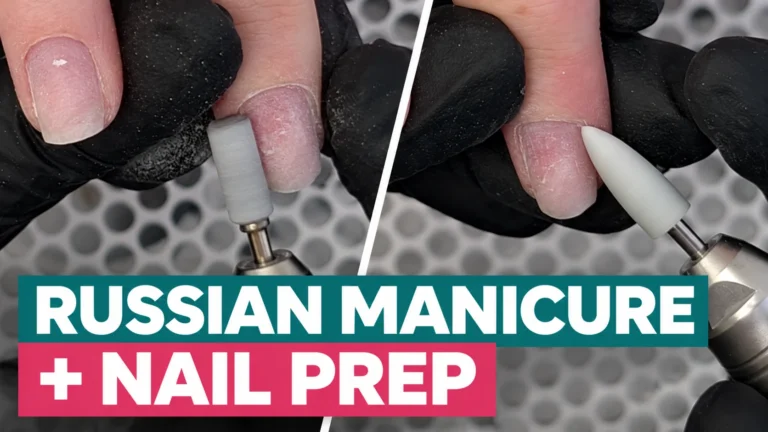
- Angle and contact: bleeding at the nail sinuses often points to the bit angle, and it can also come from depth, pressure, poor stabilisation or contact with living tissue. It is a technique signal, not only a speed problem.
- The nail and skin in front of me: every client’s cuticle area is different, so the work is different. Anatomy comes first.
- Pressure: none of it should need force. If I feel the need to press, I stop and ask why.
It should not hurt. If a client feels pain, stop and reassess what you are doing and why, because the RPM is rarely the only cause. Pain can also mean the service is not suitable for that client on the day.
More Dust Is Not More Progress
More dust does not always mean more progress. Dust on its own does not prove damage, so look at what is being removed and how the nail plate is responding, not only at how fast the bit spins. This connects to a rule I teach: never make the natural nail thinner. Prepare the surface and the true cuticle, then stop.
Where to Read Next
Choosing the bit is part of the same decision: Red vs Blue Diamond Flame Bit explains why colour shows abrasiveness, not safety. Before the flame bit starts, read Why You Must Open the Cuticle Pocket First and Why You Keep Catching the Nail Sinus. For the wider safety picture, read The Safety Protocols That Make Russian Manicure Safe. Power also differs between machines, as shown in JD700 vs Saeyang K35, which is why the number on the dial is not the whole story. To understand the service, see What Is an E-File Manicure?
Stop Relying on the RPM Number
Learn how speed, pressure, angle, stabilisation and anatomy work together, and how to adapt your Russian Manicure technique to different clients. Basic e-file experience is recommended.
Explore Russian Manicure – Beyond Technique →Frequently Asked Questions
Is a lower RPM safer for cuticle work?
Not necessarily. Speed, pressure, movement and contact work together, and turning the speed down while pressure, angle and technique stay the same does not make the work safe.
What RPM should I use for Russian manicure?
There is no single RPM that is safe for every client and every application. It depends on your tool, your control, the client’s nails and skin and your technique.
Why does the client still flinch at a low RPM?
Often because of angle, pressure, contact point, depth or visibility, not only speed. Stop, find the cause and adjust.
Does a finer bit make it safer?
Not automatically. A bit that is too fine often leads to extra pressure, passes or time.
Should I copy another educator’s setting?
No. Their setting suited their technique. Understand why, then adapt to the nail in front of you.
Key Takeaway
There is no single RPM that is safe for every client. Speed, pressure, movement and contact work together, so control, visibility and anatomy decide whether e-file work is safe.
About the Author

Professional Nail Expert | International Nail Educator
I am Radina Ignatova, a Professional Nail Expert since 2014 and International Nail Educator, based in Scotland, UK. I am the Founder of Artistic Touch – Nail Training Academy and TheNailWiki.
At Artistic Touch – Nail Training Academy, I provide structured professional online nail education specialising in dual forms, nail preparation and retention, nail structure, E-File work and Russian Manicure, with a strong focus on professional salon safety. I continue to work actively in salon practice, ensuring that all education reflects real client scenarios and current industry standards.
My teaching philosophy is simple: I show real salon challenges, real mistakes and real performance testing, not just perfect demonstrations. This is how you develop genuine technical competence and become a confident, capable nail professional.