Why Some Nail Techs Never Progress Beyond Average
Quick Answer: Why Do Some Nail Techs Stay Permanently Average?
Permanent plateau happens from: avoiding external feedback that reveals blind spots, blaming products or clients instead of assessing technique honestly, staying comfortable with current capability rather than seeking challenges, hoping time or more courses will create improvement without deliberate practice, collecting surface familiarity with many techniques without mastering fundamentals and mistaking client acceptance for professional quality.
This article explains the specific protective patterns preventing development.
The Feedback Avoidance Trap
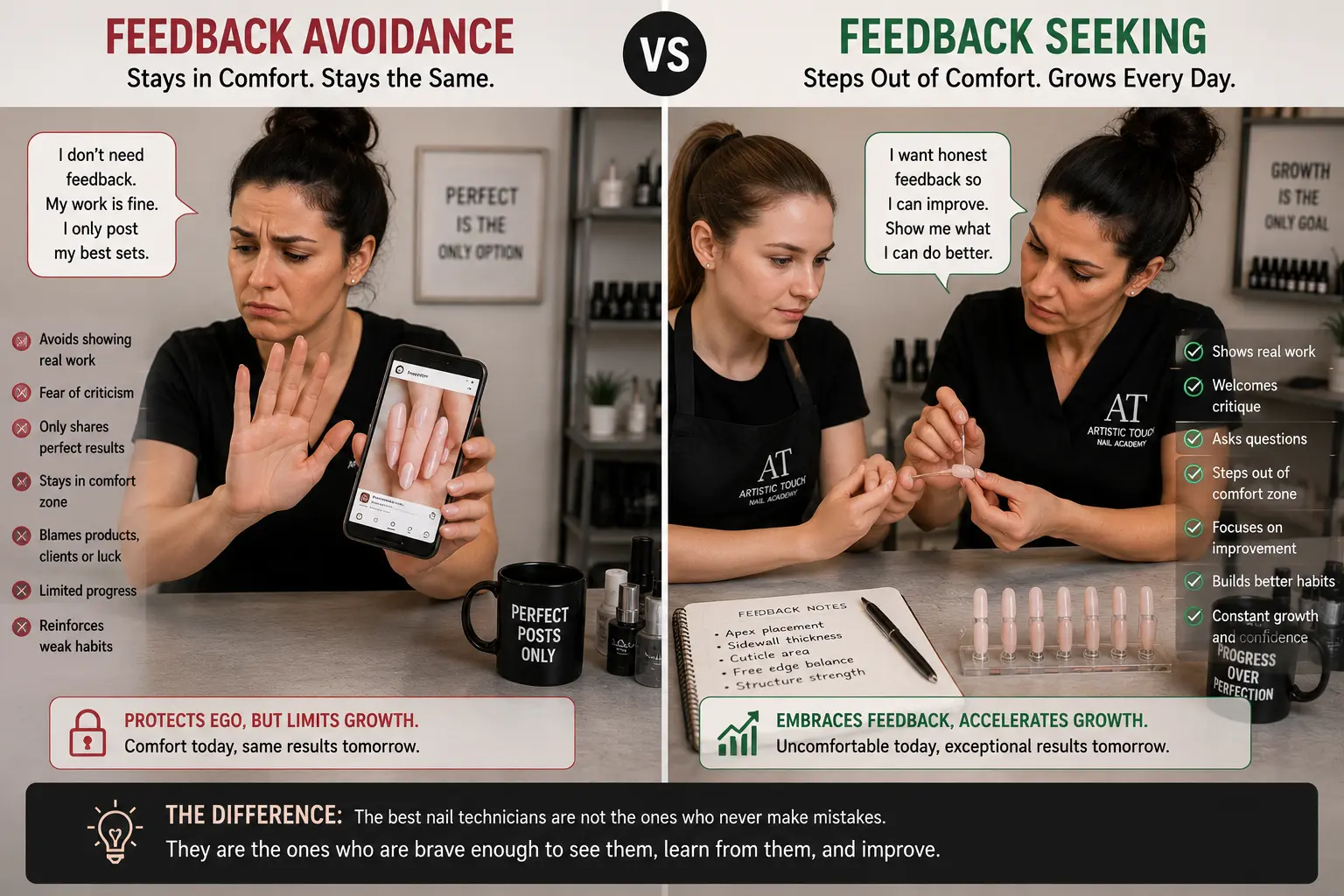
You share only successful work on social media. When problems occur, you hide them. You never ask experienced professionals to assess your technique honestly because criticism feels threatening. You surround yourself with peers at similar skill level who will not challenge your current execution. This protection feels emotionally safe. It guarantees permanent plateau.
Advanced professionals actively seek uncomfortable feedback. They show work to educators who will identify systematic errors. They ask for brutal honesty about technical gaps. They specifically request criticism of their weakest areas. This exposure is psychologically difficult. It is also the only path to identifying blind spots you cannot self-diagnose.
Your preparation looks adequate to you. An experienced eye immediately recognises microscopic inadequacies causing retention failures. You will never see these problems through self-assessment because you do not know what inadequate actually looks like beyond your current understanding. External feedback reveals this gap. Avoiding feedback protects ego while preventing improvement.
Externalising Blame Prevents Learning
When sets fail, you blame: product quality was poor, client behaviour caused problems, environmental factors were wrong, bad luck happened. You rarely consider: my preparation had gaps I did not recognise, my structural decisions created stress concentration, my application technique introduced problems or my assessment of adequacy was incorrect.
External blame feels better because it protects self-image. Internal honest assessment creates discomfort by revealing capability gaps. But you cannot fix problems you refuse to acknowledge as yours. Every failure blamed externally is a lost learning opportunity where you could have identified specific technical inadequacies requiring correction.
Nail techs who improve rapidly treat failures as diagnostic information revealing their execution gaps. Nail techs who plateau permanently treat failures as evidence of external factors beyond their control. The difference is whether you protect comfort or pursue capability.
Staying Comfortable With Current Level
You work on nail types you handle reliably. When challenging presentations appear—severe damage, unusual geometry, complex requirements—you refer them elsewhere or avoid booking them. This keeps your work comfortable and predictable. It also prevents the stretch experiences that build new capabilities.
Professional growth requires deliberately seeking situations slightly beyond current comfortable capability. You need challenges that force adaptation, problem-solving and capability expansion. Staying within comfortable range means repeating what you already do adequately. Repetition without challenge reinforces existing patterns, including systematic errors.
This comfort preference is understandable. Difficult situations create anxiety and risk visible failure. But permanent capability growth requires accepting temporary discomfort. The nail techs who progress continuously are those willing to attempt work that scares them because it stretches current limits.
Hoping Time Creates Improvement
You believe experience years automatically create skill development. You think: “I have been doing nails for five years, so I must be competent.” But time only creates improvement when spent deliberately building capability. Years of comfortable repetition avoiding challenges and external feedback produce minimal development regardless of calendar duration.
Real improvement requires: targeted practice addressing identified weaknesses, systematic study of structural principles, active feedback seeking exposing blind spots, challenging work stretching current limits or honest failure analysis revealing technical gaps.
These activities do not happen automatically through time passage. They require intentional effort. You can work for ten years without real development if you avoid the uncomfortable activities that actually build competence. Time is necessary but not sufficient for growth.
Collecting Courses Not Building Mastery
When results disappoint, you buy another course hoping new education will solve your problems. You accumulate certificates from dozens of trainings. You have surface familiarity with many techniques. You lack depth mastery of any because you never invested sustained focus needed to move beyond beginner competence before chasing the next training.
Permanent plateau often correlates with course collection behaviour. New education feels productive. It creates temporary hope that this training will finally unlock improvement. But courses provide information and demonstration. They do not build competence. Competence requires deliberate practice applying that information with systematic feedback and correction.
You need less course accumulation and more deliberate development of fundamentals you already learned. The problem is not information absence. The problem is execution gaps in applying information you already possess.
Mistaking Client Acceptance for Quality
Clients accept your work. They return for maintenance. They pay without complaint. You interpret this as evidence your work meets professional standards. But client acceptance often reflects limited technical knowledge rather than actual quality assessment. They cannot evaluate preparation thoroughness, structural integrity or whether work will perform beyond initial appearance.
Relying on client acceptance as your quality measure creates comfortable plateau because standards never exceed client expectations. Advanced professionals maintain internal standards significantly higher than client requirements. They assess work against objective professional benchmarks regardless of whether clients would accept lower quality.
This internal standard creates continuous pressure toward improvement because you refuse to accept from yourself work that merely satisfies clients when you know it falls short of professional excellence. Client acceptance becomes minimum threshold, not achievement marker.
Product-Switching Instead of Skill-Building
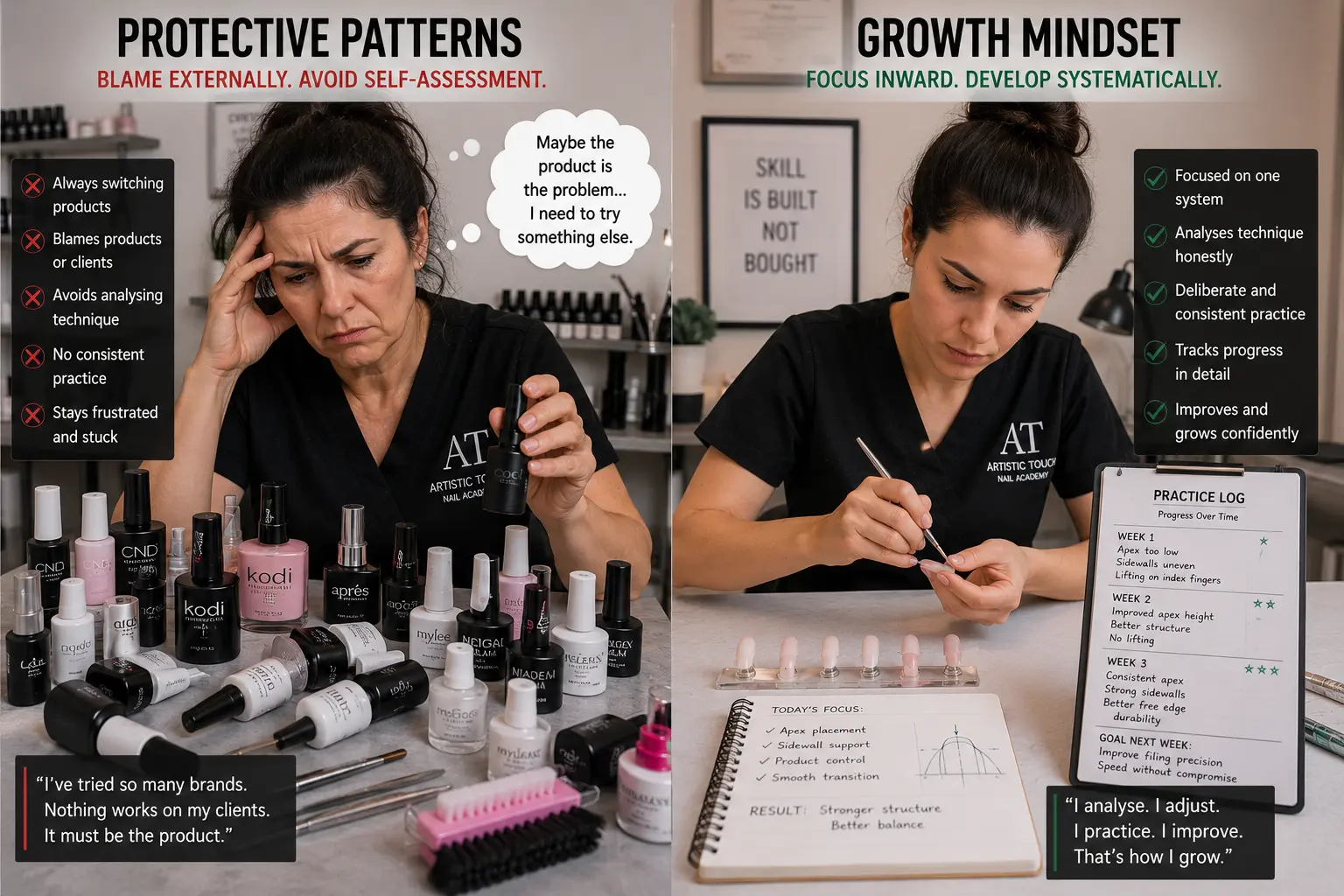
Your retention results are inconsistent. You immediately buy different products hoping formulation changes will solve problems. You spend hundreds trying various brands, systems and tools. Nothing produces sustained improvement because product was not the limiting variable. Your technique inadequacies remain unchanged regardless of brand switching.
Product experimentation feels productive because you are taking action and spending money usually correlates with serious commitment. But this activity prevents actual development when technique gaps cause problems that no product can fix. You need skill improvement, not product variety.
Nail techs who break through plateaus investigate failures systematically before changing variables. They determine: is this retention problem product-related or technique-related? What evidence distinguishes between them? They change products only when diagnosis identifies formulation as actual cause rather than as hopeful solution to undiagnosed technique problems.
Trend-Chasing Before Fundamentals Mastery
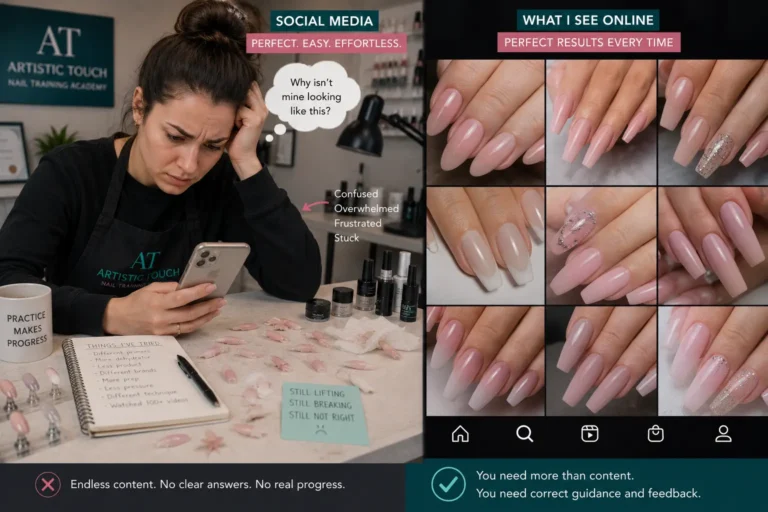
Instagram shows new technique trending. You immediately attempt replication without mastering prerequisites. You jump to advanced methods while basic skills remain inconsistent. You chase aesthetic trends rather than building fundamental competence. This creates perpetual beginner status where you have surface familiarity with everything but reliable mastery of nothing.
Real professional development requires uncomfortable commitment to fundamentals until they become automatic. You practise basic preparation beyond the point where it feels productive. You refine apex placement on simple geometries before attempting complex adaptations. You ensure retention consistency on standard nails before pursuing dramatic designs.
This depth-first approach feels boring compared to trend-chasing. It produces sustainable capability growth that breadth-first variety cannot match. Permanent plateau often indicates preference for exciting variety over fundamental mastery.
Avoiding Difficult Self-Assessment
You complete work and evaluate: Does this look okay to me? Do I feel satisfied? Would a client probably accept it? These subjective vague assessments allow systematic errors to persist because there is no external reference revealing gaps between your comfort level and professional standard.
Advanced professionals conduct brutal self-assessment using objective measures: Is apex placement within 2mm of optimal stress distribution point? Does C-curve meet structural adequacy for this nail width? Is surface finish consistent to 240-grit standard? Are sidewalls symmetric within 0.5mm?
This objective evaluation reveals discrepancies between what you think you executed and what actually occurred. Your subjective impression says work is adequate. Objective measurement finds systematic deviations from professional benchmarks. Without these measurements, you cannot accurately identify what needs improvement.
Protective Comparison Habits
You compare your work only against peers at similar or lower skill levels. This comparison feels validating because you appear competent relative to your reference group. It prevents growth because you never see the gap between your current capability and actual professional standards.
Real development requires comparing yourself against work significantly better than yours. This comparison is uncomfortable because it reveals how far you are from excellence. But discomfort is the point. You need to see the capability gap clearly to understand what targeted development would address.
Nail techs who plateau permanently protect themselves from this uncomfortable comparison. They select reference groups making their current work appear adequate. This protection prevents the honest assessment needed for continued growth.
Believing Natural Talent Determines Ceiling
When you see nail techs with superior capability, you assume they possess natural talent you lack. This belief provides comfortable explanation for why you remain average while excusing you from the difficult development work that actually creates advanced capability. If success requires innate gifts, effort becomes pointless for those not naturally talented.
This is false comfort preventing growth. Advanced capability comes from: deliberate practice with systematic feedback, deep study of structural principles, active uncomfortable assessment seeking, challenging work acceptance and honest failure analysis accumulating over years.
These are choices about learning approach, not genetic advantages. The nail techs you admire likely invested thousands of hours in difficult development activities you have avoided. Attributing their results to talent protects you from acknowledging that your plateau results from protective habits, not from biological limitations.
Protective Patterns Not Capability Limits
Permanent plateau happens from: avoiding external feedback, blaming failures externally, staying comfortable, hoping time will create improvement, collecting courses without mastery, accepting client satisfaction as quality measure, switching products randomly, chasing trends before mastering basics, avoiding objective self-assessment, protecting ego through selective comparison and believing talent determines outcomes.
These are protective psychological patterns preventing the uncomfortable activities that build competence. Breaking plateau requires abandoning protection and accepting discomfort. The capability is available. The question is whether you will do the difficult work.
Break Through Your Plateau
Artistic Touch courses confront protective patterns by teaching objective self-assessment, systematic failure analysis, structural principle understanding and deliberate practice methods that create real development—not comfortable validation.
View All Courses →Lifetime access • Private student community • Start immediately
Frequently Asked Questions
Why does my technique not improve despite years of experience?
Years of comfortable repetition avoiding challenges, external feedback and honest self-assessment produce minimal development regardless of time duration. Real improvement requires deliberate practice addressing identified weaknesses, systematic principle study, active feedback seeking and challenging work stretching current limits. Time is necessary but not sufficient for growth.
Should I seek feedback even when it feels uncomfortable?
Yes. Avoiding feedback protects ego while preventing improvement by hiding blind spots you cannot self-diagnose. External assessment from experienced professionals reveals systematic problems your self-evaluation misses. The discomfort is the point. You need uncomfortable truths about technical gaps to identify what requires development.
Why does buying more courses not improve my results?
Courses provide information and demonstration. They do not build competence. Competence requires deliberate practice applying information with systematic feedback and correction. You likely need less course accumulation and more targeted development of fundamentals you already learned. The problem is execution gaps, not information absence.
Is staying average due to lack of natural talent?
No. Permanent plateau results from protective patterns: avoiding feedback, blaming failures externally, staying comfortable, hoping time creates improvement and collecting courses without mastery. Advanced capability comes from deliberate practice, principle study, uncomfortable assessment seeking and honest failure analysis. These are choices about learning approach, not genetic limitations.
Should I be satisfied if clients accept my work?
Client acceptance reflects minimum adequacy, not professional excellence. Many clients lack technical knowledge to assess preparation thoroughness or structural integrity. Advanced professionals maintain internal standards significantly exceeding client expectations. They assess work against objective benchmarks regardless of whether clients would accept lower quality. Client satisfaction becomes threshold, not achievement.
How do I break through a long-term plateau?
Abandon protective patterns preventing uncomfortable assessment. Actively seek external feedback revealing blind spots. Conduct brutal honest self-evaluation using objective measures. Accept challenging work stretching current limits. Stop blaming external factors and analyse your execution gaps. Master fundamentals before chasing trends. Build depth in core skills rather than collecting surface familiarity with many techniques.
About the Author
Radina Ignatova
Professional Nail Expert | International Nail Educator
I am Radina Ignatova, a Professional Nail Expert since 2014 and International Nail Educator, based in Scotland, UK. I am the Founder of Artistic Touch Nail Training Academy and TheNailWiki.
At Artistic Touch Nail Training Academy, I provide structured professional online nail courses specialising in dual forms, gel systems, polygel application, advanced nail structure, E-File work and Russian Manicure, with a strong focus on professional salon safety. I continue to work actively in salon practice, ensuring that all education reflects real client scenarios and current industry standards.
My teaching philosophy is simple: I show real salon challenges, real mistakes and real performance testing, not just perfect demonstrations. This is how you develop genuine technical competence and become a confident, capable nail professional.
Every Artistic Touch course includes lifetime access and access to a dedicated student support group, where I provide ongoing guidance and professional feedback.
Disclaimer: This content is for educational purposes only. Nail services should be performed by trained professionals following current hygiene and safety regulations. Always carry out a full client consultation and check for contraindications before performing any nail service.
About Artistic Touch Nail Training Academy
Artistic Touch Nail Training Academy delivers structured professional online nail education focused on practical skill development, professional standards and safe salon practice. All courses are available online worldwide.